New WoodChat!
Home Articles Forums Gallery Marketplace Videos

WoodCentral Forums

Knowledge You Can Build On — Est. 1998

REAL MILK PAINT

Back on Track (Lingerie Chest)

Posts

Back on Track (Lingerie Chest)

#1

Back on Track (Lingerie Chest)

Derek Cohen (in Perth, Australia)

First of all I am very pleased - and relieved - to mention that the panels are back in one piece and together.

Then just a couple of comments about the failure and the hide glue ...

The reason for the failure was that the join was glue-starved. As simple as that. Well, almost.

The reason for the join being glue starved was not because I used too little glue, and not because of the type of glue, but because I over-tightened the clamps.

The over-tightening was due to the spring joint being too wide. What is a good- and what is a bad spring joint? Well, a good joint is one that may be closed with hand pressure, and a bad one is one that requires help to do so. In the case of the one panel, I got it right. In the case of the failed panel, clearly I did not. I could see light through the centre when I inspected the join, and immediately I knew this was the cause. Pulling the join together with a clamp just disguised the issue since all the tension was at the centre (where the join failed), and the force squeezed the glue out ...... no glue + tension = open up.

A second question is "why spring at all". Some like to do this and others argue that it is not necessary, that glue is tougher than wood. In my book, it is important to ensure that the ends of a panel contact each other. If there is any curvature to mating sides (and often this is difficult to see - which is the point), extra clamping at the ends creates two tension sections .. where as the spring joint only creates one tension point. But the spring must be almost imperceptible, as in the photo I posted.

A third issue is the choice of Titebond hide glue. Well hide glue rocks ... but Titebond? I have had a number of emails warning me about its use, that it is unreliable, etc. My experience with it is not long - about two years. In that time I cannot recall a failure. It needs to be pointed out that the mortice-and-tenon joints were solid. There was no failure there.

I must admit that I have avoided going to the trouble of preparing the stuff myself since I am lazy. The issue is that I get into the workshop on weekends only, and making up a fresh batch of glue each time, keeping it warm, etc .. well, it does not thrill me. Anyone have a way of circumventing this?

So back to the repair.

It the face needed a minimal amount of scraping to level the joint ...
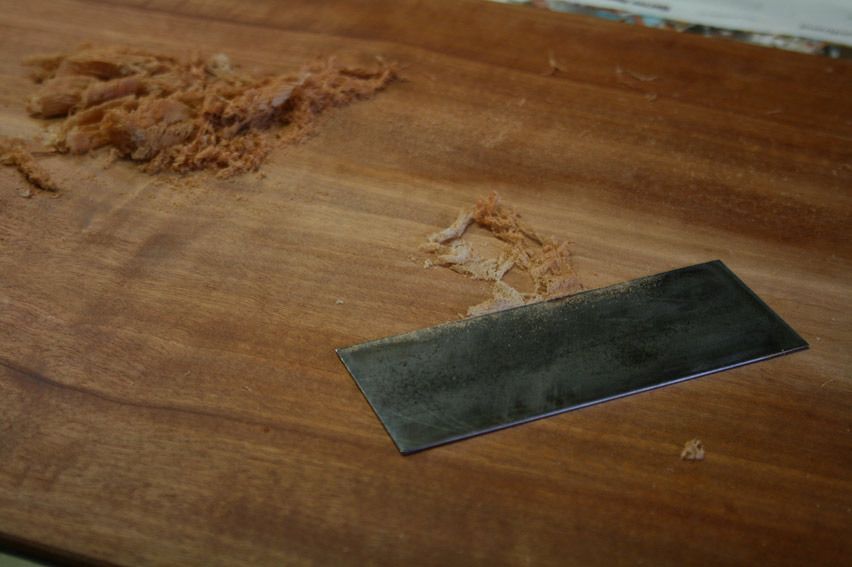

... before I called it good and re-glued and pinned the panel inside the frame.

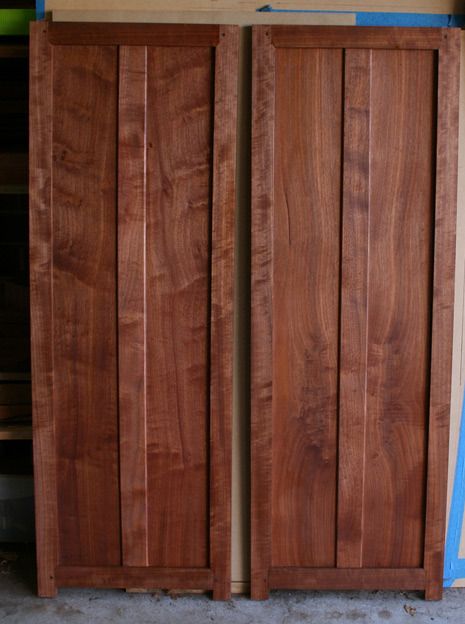
The repaired panel is on the left ...
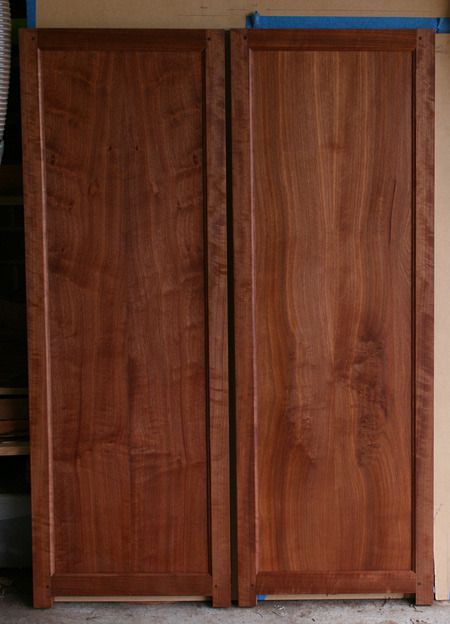


Reinforcing strips were added to the rear - I had planned to do this anyway to beef up the thin panels. They will not be seen (on the inside) but will offer a little more reliability ..

Some may be interested in the supports I built to aid accuracy in dimension and to keep everything square. The first was the base, which also will enable the chest to be moved around later ..
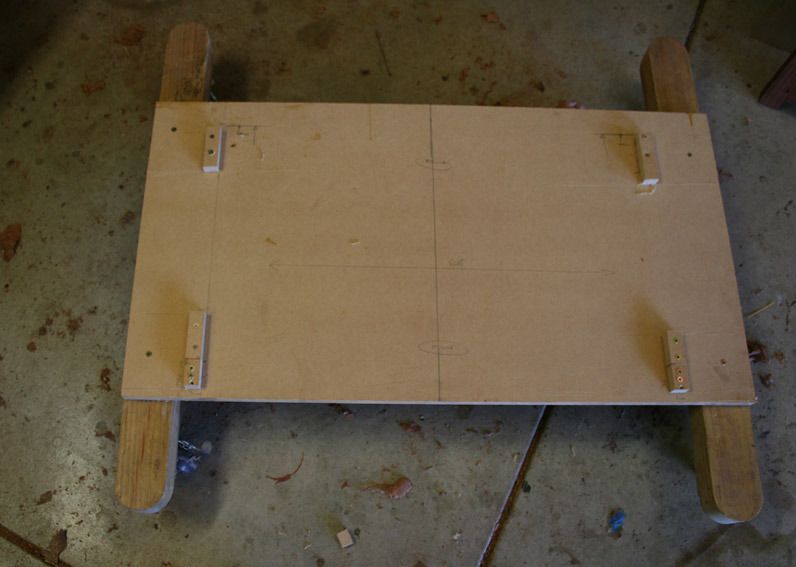
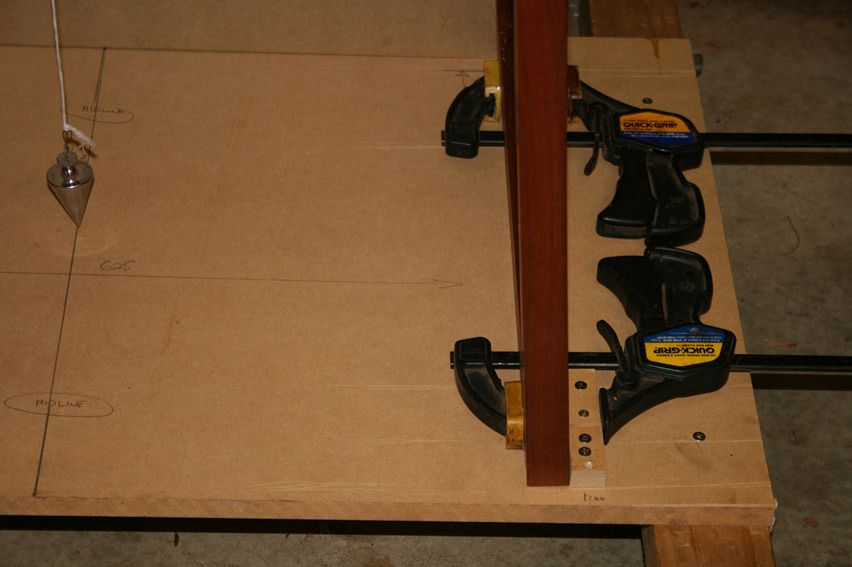

The other clamps across the top ..


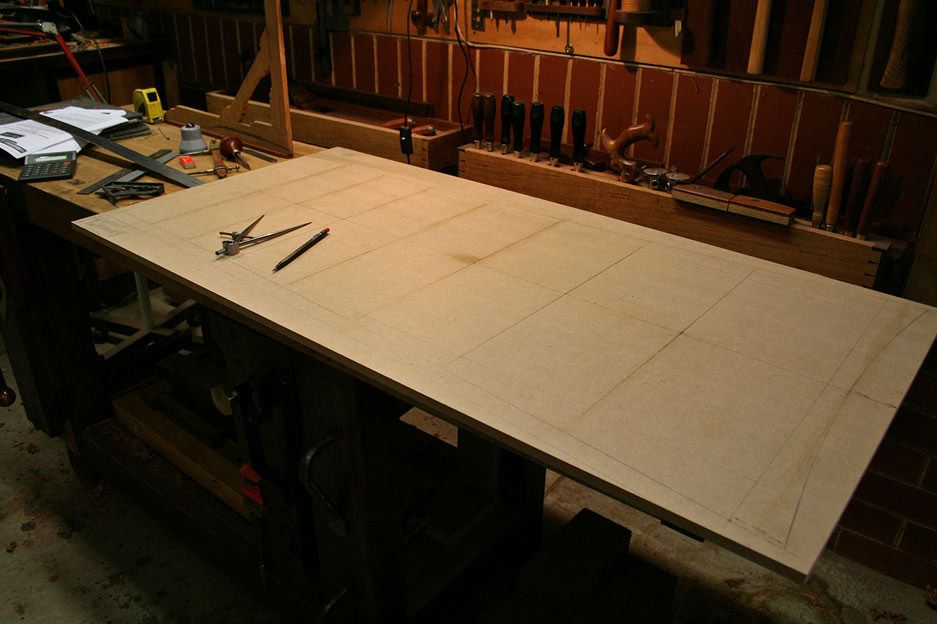
So now we are back to clamping all on the jigs, with an added section of MDF clamped to the rear. The plumb bob ensures that vertical and centre is created, and may be returned to at any time ...


Once this is done, the inside perimeter can be traced onto the MDF. The MBF is moved to the bench, where the drawer dividers are drawn in. This is to act as a template.

A line is drawn down the centre of the cabinet template, and the dimensions first marked on this centre line ...
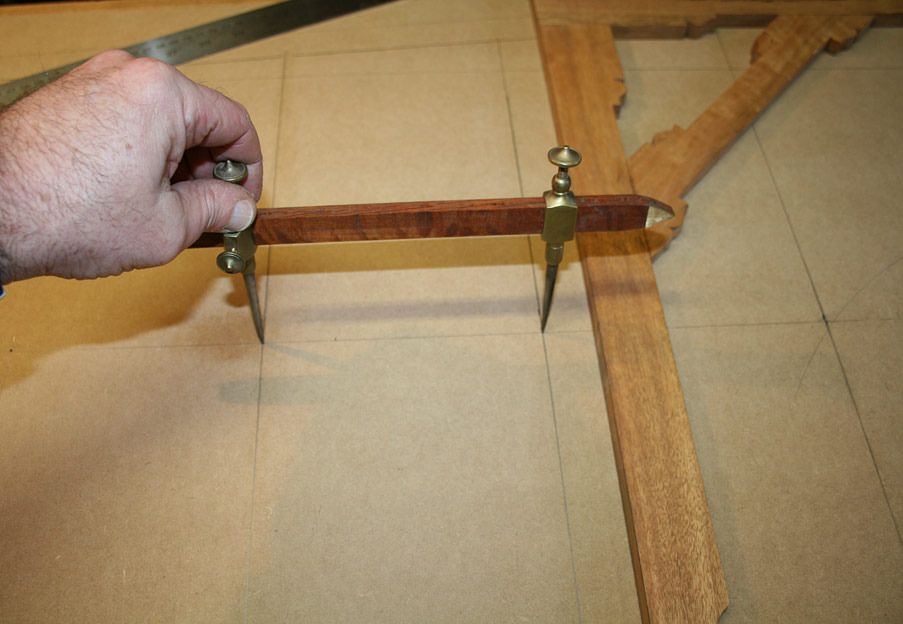

They are then transferred to each side ..


Here is the template back supporting the chest sides ...


I moved it to the other side and it was reassuring that there was about 1mm difference in the marked outline.

Now the intention was not to use these marks as the template, but rather to create a template from them. To do this the MDF outline was sawn down the centre, and then the curved side band sawn out, with a little cleaning up done with a small block plane.
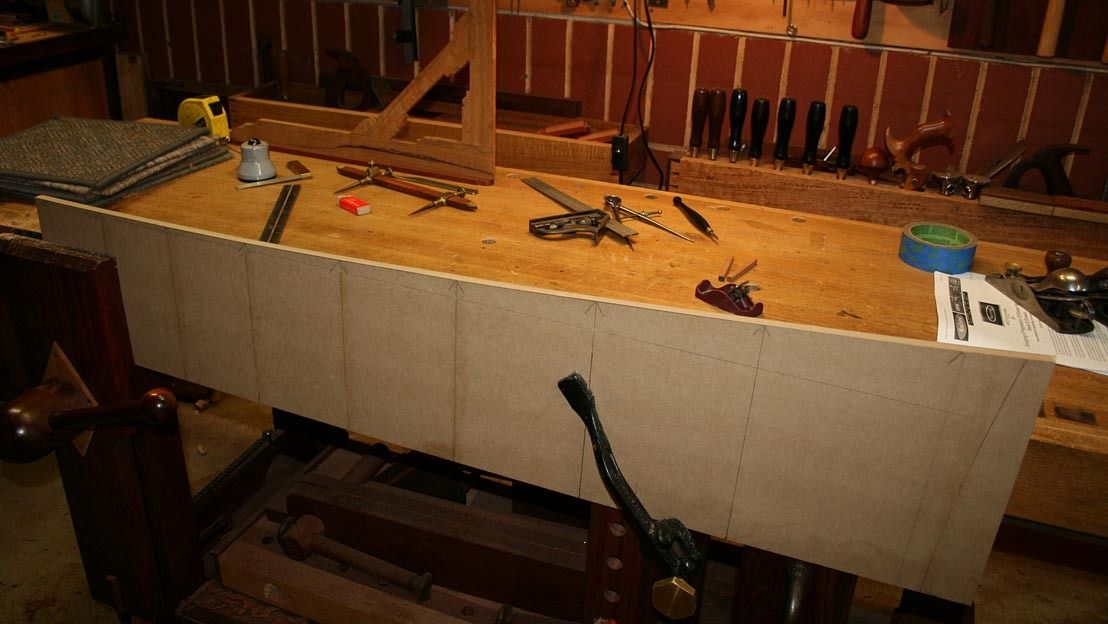

Measurements are marked both sides ..
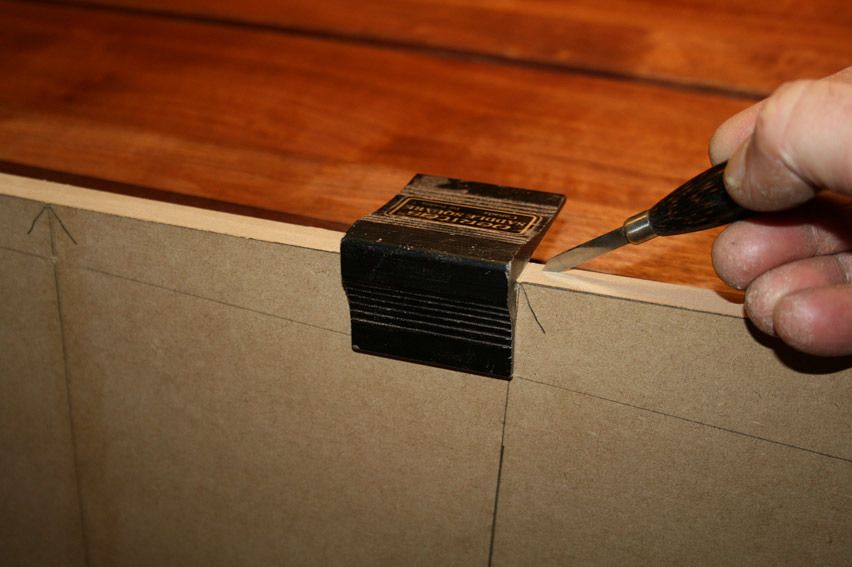

... and then transferred to each side of one board (only) ..


The panels are clamped together and the markings transferred from one board to the other ..
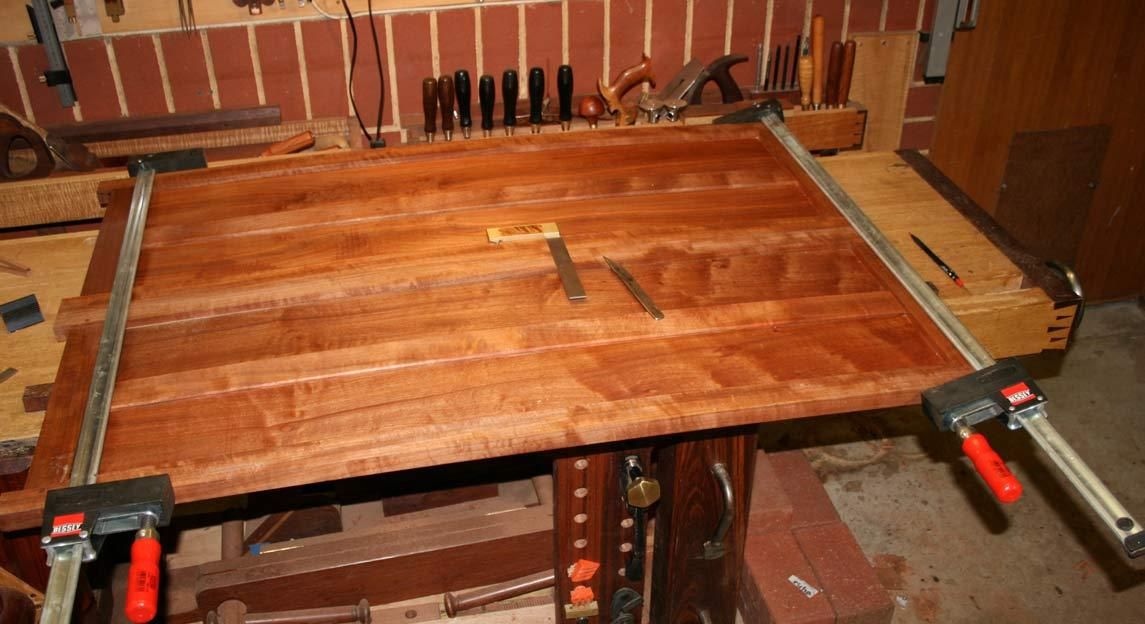

Once one side is match, the boards are rotated to complete the other matching edges ...
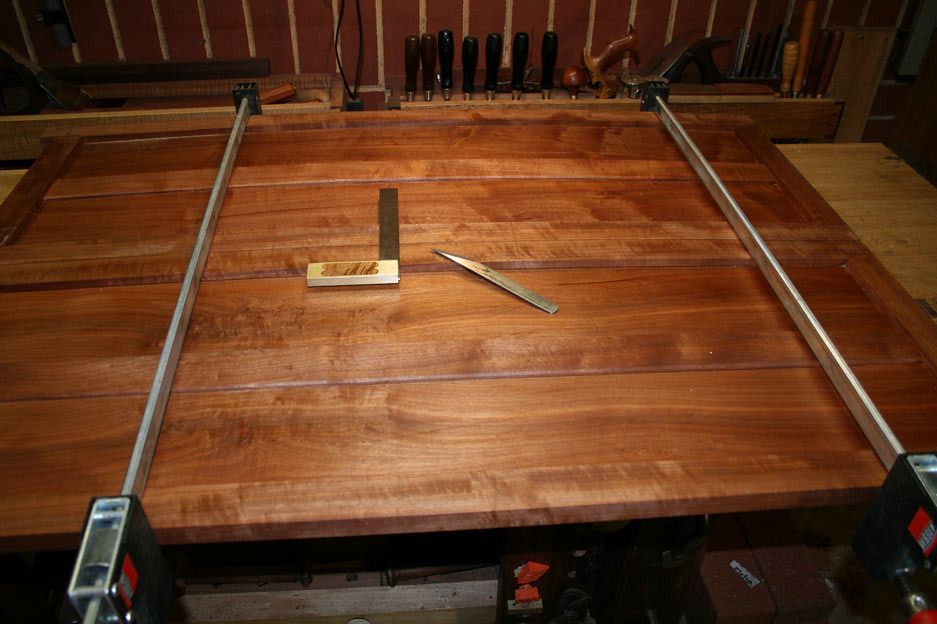

Now we can move on to marking out angled sliding dovetails and build the draw dividers.

Regards from Perth

Derek

Re: Back on Track (Lingerie Chest)

#2

Re: Back on Track (Lingerie Chest)

Sgian Dubh

"I must admit that I have avoided going to the trouble of preparing the stuff myself since I am lazy. The issue is that I get into the workshop on weekends only, and making up a fresh batch of glue each time, keeping it warm, etc .. well, it does not thrill me. Anyone have a way of circumventing this?"

Dissolve a smallish batch, heat, use, and pour what's not needed that weekend into a clean jam jar (or similar), put the lid on, stick it in the fridge, and reuse as needed. You might even have a water bath heating system that includes a sealable pot. For example, I've heard of people using baby food warmer type devices, and something like this with a sealable pot might work. Even if the pot doesn't have a lid, you could probably rig up something like a bit of stout plastic sheet and an elastic band to keep the glue for a reasonable period.

However, I've made up batches of hide glue, used it for a few days, and then not needed the stuff for three or four weeks and I've simply left it in the pot with a cover of plywood or something over the top. Then when I'm ready to glue up things again, I simply warmed the glue up, added water as needed and used. Slainte.

Re: Back on Track (Lingerie Chest)

#3

Re: Back on Track (Lingerie Chest)

don stephan

Like Richard, I store unused hide glue in a small fridge in the workshop. To simplify, I thoroughly clean and rinse a vegetable or fruit can when empty. I use a Hold Heet glue pot, and the cleaned can is slightly taller and 1" narrower than the inner pot of the Hold Heet. I mix water and hide glue granules in the can, put the can in the inner Hold Heet pot, pour water around the can and plug in the glue pot. At the end of the gluing session I remove the can and pour out the hot water in the inner Hold Heet pot. When the unused glue and can are cool I cover with a plastic bag and rubber band and put in the fridge until needed again. There's no cleanup of the Hold Heet. If the unused hide glue has been in the fridge for a while I usually have to add some clean water when it is hot to get a viscosity similar to freshly mixed hot glue.

Re: Back on Track (Lingerie Chest)

#4

Too much clamp pressure ......Impossible

Bill Tindall, E.Tn.

First, a disclaimer. I will leave it to someone else to do the testing on the liquid hide glue for I don't use it for edge gluing for several reasons.

I don't believe one can squeeze sufficient glue from a joint to "starve" it. It takes two molecular layers of glue to make a joint on two perfectly flat surfaces. The viscosity of glue climbs rapidly as water diffuses away from the joint. No amount of force is going to squeeze all this viscous glue from between the joint faces.

To test this hypothesis for yellow glue I glued a test piece in a full sized machine vise capable of exerting pressure far beyond what a clamp can muster. When the joint was broken there was the normal amount of wood failure. In consultation with the tech staff of Franklin glue company they agreed that they had never been able to document a starved joint from excessive clamp pressure. Perhaps liquid hide is different but I doubt it. It too is viscous.

The data does not agree with the excessive pressure hypothesis. With this sprung joint the highest pressure was at the ends, not the middle. If pressure led to starving the joint the ends would suffer more than the middle. I expect the problem was too little pressure on the middle, leaving a gap filled with glue that didn't squeeze out. Glue is only 50% (approx.) solids so when a glue filled gap dries glue foam is left behind and glue foam has little strength. As was pointed out it is very difficult to get any pressure on a gap when clamping a thin wide board.

The business of "excessive" clamp force leading to starved joinery is not an academic matter. Clamp force insufficient to eliminate all but a thin layer of glue from a joint definitely leads to a weak joint, for the reason discussed above. If woodworkers are needlessly fretting over using too much force then they can make a fatal error of using to little.

My personal target is ramp up the clamps just shy of wood crushing or panels bowing. In the case of wide thin panels this force is small and not capable of correcting a gapy joint.

Re: Back on Track (Lingerie Chest)

#5

99.99...% aren't wrong

Bill Tindall, E.Tn.

The market for conventional hide glue is infinitesimal and for edge gluing a few orders of magnitude even smaller (hide has its recognized advantages for some veneering). The population using modern glue has not failed to see the advantages of hot hide glue. Rather, they have recognized its disadvantages and moved on to a modern product superior for almost all woodworking applications.

A market can fail to recognize a superior new product, at least for a while. But when a market wholesale abandons an old product for a new product and stays with this decison it is not ignorance driving the decisions.

Re: Back on Track (Lingerie Chest)

#6

Re: Back on Track (Lingerie Chest)

Bruce McCrory

Two things...

There were some quips about hide glue and longevity. I acquired a "strip" in the mid-60s, and doubt it was new any later than the 1930s. I thought it was rawhide having never heard of hide glue at the time. I am going to melt it and test some joints.

Second, the sprung joint. Starved or fat is meaningless. A few inches of sensible tension at either end will keep the slabs together. Flatter contact will fix the snapped connection, as done.

Whatever, this is the best selling point for hide glue I've heard in a while.

Re: Back on Track (Lingerie Chest)

#7

Fish glue

GolfSteve in Calgary

I've never had a starved joint, so my money would be on too much spring.

Anyway, I like fish glue better than liquid hide glue. The only downside is that fish glue requires very long clamping time (24 hours). I had one joint fail when I unclamped after 8 hour or so. This was East Indian Rosewood veneered onto cedar, and I suspect the EIR is so non-permeable that it didn't allow enough moisture to escape from the joint in the time I kept it clamped.

The Franklin liquid hide glue is good stuff, but it always remains sensitive to moisture - even touching it with your fingers makes it go sticky. I've had no problems with it, but prefer fish glue.

The Old Brown liquid high glue is nice stuff - but it needed to be heated to be liquid; in my shop around 15 deg C the stuff was like Jello. It also needed to be mail ordered (before Lee Valley started carrying it), so it wasn't an attractive option.

I like hot hide glue for hammer veneering, but it's too much hassle otherwise, especially when I only get into the shop every second weekend or less.

I like Titebond original for most work. Quick, easy, cheap, and reliable - but slightly harder to clean-up than hide or fish glue.

Re: Back on Track (Lingerie Chest)

#8

Re: Too much clamp pressure ......Impossible

Derek Cohen (in Perth, Australia)

Hi Bill

If the joint failed for reasons other than being glue starved, what do you suppose it could have been?

I do not have a photo of the "bad" panel, but here is the "good" panel, which will give you an indication of the amount of (liquid hide) glue used. At the point take, there was pressure only at the centre (where the spring takes effect), and some excess glue had been wiped away - even more was beading as the boards sat there ..


This same glue line was apparent along the join as more clamps were added. I wiped away the excess glue with a damp cloth, which is what I tend to do. Again note that this was done with the "good" panel, and to no ill effect (either to strength of join or finish) ...


Now, when I opened up the other panel (with the too-large spring), there was little to no signs of glue on the mating edges.

Regards from Perth

Derek

Re: Back on Track (Lingerie Chest)

#9

Re: Fish glue

Derek Cohen (in Perth, Australia)

I've never had a starved joint, so my money would be on too much spring.

Hi Steve

Definitely too much spring on this joint. However, this is only really meaningful if the glue does not have sufficient strength/hold. If the glue is stronger than the wood, it should not have pulled apart.

Regards from Perth

Derek

Re: Back on Track (Lingerie Chest)

#10

answers, well actually discussion

Bill Tindall, E.Tn.

If the joint failed for reasons other than being glue starved, what do you suppose it could have been?

It takes an imperceptible amount of glue thickness to establish a bond between the two pieces of wood. I maintain that it is impossible to squeeze so much viscous glue from the joint that insufficient glue remains. The glue that is seen to squeeze out is unaltered glue. The glue next to the wood has rapidly lost moisture (presuming the wood is dry) and its viscosity is huge. I know this to be a fact with Yellow glue. It remains to be tested whether one can "starve" a joint with liquid hide glue.

Now, when I opened up the other panel (with the too-large spring), there was little to no signs of glue on the mating edges.

A demonstration I have seen: Two 2" cylinders ground optically flat. Add a drop of cyanoacrylate adhesive and make a rub joint. In this case the adhesive has little viscosity and all but a glue layer a few molecules thick is squeezed out. Hook one cylinder to a crane and the other to a car. Successfully lift car. If squeeze out led to starved joinery this would be the ideal case to show it.

One can not see the tiny thickness of an ideal glue bond. Wood is porous so the situation is a bit more involved than bonding metal, but we can begin the discussion with metal. The first molecular layer of glue bonds to the metal atoms by various molecular forces. Additionally, these two layers of glue molecules must join with themselves. Likely the main process that bonds these layers together is the entanglement of these long molecules with one another (Think plate of spaghetti noodles or tangled hair.) this entangled layer does not need to be thicker than the glue molecules are long which is a few nanometers.

In the case of porous wood, additional glue is needed to fill the surface pores. Once filled glue can not squeeze from these holes.

I don't know why the joint failed but I remain skeptical it was too much pressure until someone shows that too much pressure leads to failure of a liquid hide joint. I suspect that even the recommended pressure for this adhesive would have bowed the thin panel.

Re: Back on Track (Lingerie Chest)

#11

Re: Back on Track (Lingerie Chest)

TomD

"The reason for the failure was that the join was glue-starved. As simple as that. Well, almost.

The reason for the join being glue starved was not because I used too little glue, and not because of the type of glue, but because I over-tightened the clamps."

There is a theory that you can't glue starve a joint, not my experience really, but maybe we will hear some peer reviewed science down the thread...

"The over-tightening was due to the spring joint being too wide. What is a good- and what is a bad spring joint? Well, a good joint is one that may be closed with hand pressure, and a bad one is one that requires help to do so."

I have crunched a ton of them down, and never had a problem, but the ratio of length to width still has to be something reasonable or bad things will happen. Normally they fail at the ends, and if it is a sitaution where the ends might fail then trimming the ends can be another save. If it failed in the middle where you couldn't bring the panel together, I am not sure I would call that glue starvation, unless you only iced one side of the joint.

"In the case of the one panel, I got it right. In the case of the failed panel, clearly I did not. I could see light through the centre when I inspected the join, and immediately I knew this was the cause. Pulling the join together with a clamp just disguised the issue since all the tension was at the centre (where the join failed), and the force squeezed the glue out ...... no glue + tension = open up."

I don't see how you spring a joint in tropical hardwoods where there is any perceptible gap and you have a high width, low length aspect ratio. Get yourself a dial indicator and see how much it deforms with hand pressure. For instance I got a 5 thou deformation in a 22 inch wooden plane. It was about 4 times thicker than your panel I would guess and had very similar deformation to a cast iron jointer, essentially the same. And most of that block was missing where the blade goes through. Head math wise the plane would be about 1/2 the stiffness of an 7 x 22 panel (hout taking into account the cut out in the plane).

"A second question is "why spring at all". Some like to do this and others argue that it is not necessary, that glue is tougher than wood. In my book, it is important to ensure that the ends of a panel contact each other. If there is any curvature to mating sides (and often this is difficult to see - which is the point), extra clamping at the ends creates two tension sections .. where as the spring joint only creates one tension point. But the spring must be almost imperceptible, as in the photo I posted."

Springing is great if you don't have an immovable object. If you have an immovable object, then you need to make a straight joint. When properly executed you don't need any clamps, so I can't see clamping as a problem. Straight joints are a no brainer, but they take a little more time, so there isn't any reason to do then if they aren't necessary.

"A third issue is the choice of Titebond hide glue. Well hide glue rocks ... but Titebond? I have had a number of emails warning me about its use, that it is unreliable, etc. My experience with it is not long - about two years. In that time I cannot recall a failure. It needs to be pointed out that the mortice-and-tenon joints were solid. There was no failure there."

It is used extensively in industry, I think the perception that it fails comes from the comparison of hide glue properties to hide glue modified for more open time. But that isn't the same the as Colonels 17 secret spices.

One observation I made from Youtube is that after a while it hit me that a lot of the industry guys I had seen using it were using heated parts during the assembly, for what that is worth.

"I must admit that I have avoided going to the trouble of preparing the stuff myself since I am lazy. The issue is that I get into the workshop on weekends only, and making up a fresh batch of glue each time, keeping it warm, etc .. well, it does not thrill me. Anyone have a way of circumventing this?"

Yeah, you need to look at how they make it for lutherie. You can use old batches, keep it in the fridge, package squeeze bottles in advance and freeze them etc. Freeze ice cube trays, etc... If you know how to preserve a batch of soup, you have the info you need, but they have come up with some cool tricks.

But I don't think you have to go there. There are reasons for using hot hide, and there are reasons for using the Franklin. If you have a hot hide good/Franklin bad, hot hide hard to use matrix, you are at the ignorance end of the spectrum in the grip of bad technical ideas.

Hide glue is great is largely based on myth. It is great, but... They used to have these arguments on the bowhunting boards about 2 blade heads vs more than 2, and guys would invariably pound home their point with " I wouldn't use that on a deer, but if I won the lottery and got to hunt elephant..." Well... Clearly at 10 000 pounds elephants are harder to put down than deer... But that is the way the mind works. Apparently. The analogy being; I wouldn't use any of those synthetic glues on my sock drawer, but if I was building a yacht to sail around the world; or a plane; or gluing a bridge on a steel string guitar where it is under constant string pressure of 200 pounds pass the synthetics.

Re: Back on Track (Lingerie Chest)

#12

Re: answers, well actually discussion

Bob Lang

I don't think "glue starvation" in the sense of squeezing all of the glue out of a joint with excess clamp pressure is possible. As Bill notes above an effective glue line is very, very thin. The technical guys from Franklin have also weighed in that they haven't been able to starve a joint. I've had this discussion with them in person, and in a similar thread on another forum there is a letter from one of them that includes their detailed reasoning.

From the other side of the planet I agree that Derek's joint failed due to "too much spring", but beyond that his explanation doesn't hold up. When you force wood together with clamps (as you do in any spring joint) the wood would like to return to the shape it was in originally. Tension remains in the joint, and that is quite a different condition than two straight edges resting next to each other. The glue is stronger than the wood, but when something gives it is usually right next to the glue line. If the wood in Derek's panel failed next to the glue line you might only see wood at the break. This isn't failure of the glue, it's trying to overcome an imperfect joint with glue.

Like Bill, I don't want to pick on Derek personally, but when we write about what happens and why, we need to be careful about how we explain things for the good of the craft. Repeating myths or something that we heard somewhere that sounds good on the surface only furthers confusion.

Bob Lang

Re: Back on Track (Lingerie Chest)

#13

Re: Back on Track (Lingerie Chest)

Bruce McCrory

"The analogy being; I wouldn't use any of those synthetic glues on my sock drawer, but if I was building a yacht to sail around the world; or a plane; or gluing a bridge on a steel string guitar where it is under constant string pressure of 200 pounds pass the synthetics."

Use synthetics of non-reversible order, and you have a disposable musical instrument. And, furniture as well. The traditional instrument builders and repairers I met used glue they could pop the joints free on with table knives (spatulas). They even used solvent based finish. And, had 200-hundred year-old doors and trim, with holes. "Repair" being the operative word. Maybe, they could use that hide stick...

But, then, I'd use plastic, bolts and hot melt glue on steel guitars, too.... Call the garbage truck, Madge. Ps. I like my 'Dead.....

Re: Back on Track (Lingerie Chest)

#14

Hide glue in small batches

Paul M

"I must admit that I have avoided going to the trouble of preparing the stuff myself since I am lazy. The issue is that I get into the workshop on weekends only, and making up a fresh batch of glue each time, keeping it warm, etc .. well, it does not thrill me. Anyone have a way of circumventing this?"

I went to the Guild of American Luthiers (GAL) convention last year. There were a couple of guys who are experts in instrument repair that were giving a talk. They said that they make batches of hide glue every couple of months or so, and put about an ounce into small dixie cup type of containers and store them in the freezer. When they need hide glue, they take out one little container, microwave it for a few seconds, and then use it for their repairs.

I think the key is to store it using flexible containers such as these little paper cups. Shrinkage during drying would break glass or other rigid containers if you try storing long term in them.

I haven't tried this myself, as I usually just mix up a few ounces as needed. It takes an extra hour or two to mix and get this flowing until the sticky threads form showing the glue is usable. I usually have that much time beforehand when I know I will want hide glue so it isn't an issue.

Re: Back on Track (Lingerie Chest)

#15

Re: Back on Track, maybe...

Bruce McCrory

Literally.... In defence, I think the issue was a joint that opened and "starved joints" was merely an off-the-cuff explanation. Mr. Cohen freely shares his projects which inspire both positive and less discussion. Thankfully, his wood is not all that is hard. I love all aspects of the discussions. Even when some of his procedures make no sense, at all, I chalk them up to personal challenges, and move on.

One thing that intrigues me as a spinoff to the discussion is the obsessive indulgence we have for bridge-holding glue joints. I think the old Crazy Glue Guy standing under a dump truck affixed itself into our collective beings. [If only he knew...] Ibid, the "Forever" finish.

Structural and geo-tech engineers go to great lengths to design bomb-proof edifices when all that is needed is something to stay up a thousand years. I am sure there were plastic and aluminum helmeted Egyptians waving arms and tablets at pyramids during construction.

What needs to guide our methods and materials is practical application. I build a piece of furniture. If needed, I want to be able to repair it, too. Call any furniture restorer and ask them what they hate most about their job.

Re: Back on Track (Lingerie Chest)

#16

I did

Bill Tindall, E.Tn.

Nails and epoxy was the answer.

Re: Back on Track (Lingerie Chest)

#17

You are the exception...

Bruce McCrory

Elmer's is good binder for sawdust board, too. ;>

Re: Back on Track (Lingerie Chest)

#18

Re: Impossible in the imaginary world

TomD

"I don't believe one can squeeze sufficient glue from a joint to "starve" it. It takes two molecular layers of glue to make a joint on two perfectly flat surfaces. The viscosity of glue climbs rapidly as water diffuses away from the joint. No amount of force is going to squeeze all this viscous glue from between the joint faces."

1) The perfectly flat surfaces exist only for stuff like optical glass. Not even my woodworking is that good... :)

2) Titebond doesn't glue well when both sides are dried glue, and you two molecules of glue with flash off dry before you move down the joint. So while I truly see your point I think the model is over-simplified.

"To test this hypothesis for yellow glue I glued a test piece in a full sized machine vise capable of exerting pressure far beyond what a clamp can muster. When the joint was broken there was the normal amount of wood failure. In consultation with the tech staff of Franklin glue company they agreed that they had never been able to document a starved joint from excessive clamp pressure. Perhaps liquid hide is different but I doubt it. It too is viscous."

"The data does not agree with the excessive pressure hypothesis. With this sprung joint the highest pressure was at the ends, not the middle. If pressure led to starving the joint the ends would suffer more than the middle. I expect the problem was too little pressure on the middle, leaving a gap filled with glue that didn't squeeze out. Glue is only 50% (approx.) solids so when a glue filled gap dries glue foam is left behind and glue foam has little strength. As was pointed out it is very difficult to get any pressure on a gap when clamping a thin wide board."

I basically agree with that, but I have seen the phenomenon where the end fail, am not sure what is happening. But trimmed ends can fall apart. It is also the case that you can't under clamp a joint that is brought together.

Re: Back on Track (Lingerie Chest)

#19

Re: I did

TomD

Probably because furniture made with that stuff never needs them. My dad used to run a university college, and their maintenance guy made a lot of the furniture for the residence rooms. I don't think epoxy was involved, but dadoes, nails and sliding dovetails kept the hordes at bay.

Re: Back on Track (Lingerie Chest)

#20

Re: 99.99...% aren't wrong

don stephan

But when a market wholesale abandons an old product for a new product and stays with this decison it is not ignorance driving the decisions.

Does this apply to all the particleboard KD cabinets being sold?

Re: Back on Track (Lingerie Chest)

#21

yes

Bill Tindall, E.Tn.

It meets a price point.

Many people can't or won't afford sold wood custom made cabinets. Veneered particle board with printed vinyl lasts as long as many expect to keep their mobile home or camper.

Re: Back on Track (Lingerie Chest)

#22

The trouble is...

John in NM

I've had houses where some poor misguided soul put those in instead of a product that cost 40% more but would last 5 times longer.

Though I'm generally in line with accepting market trends as the inescapable reality we live in, the broader market's choices do not always suit my needs. One has to be very careful when attributing market success to material properties which may or may not exist - in some cases the superiority is one of convenience rather than material, such as we see with hide glue vs. pva.

In other cases the market choice is a decidedly inferior product that is vastly easier to to use, as is the case with portland cement stucco - lime plasters are superior in use but are very, very inconvenient to use and have a steep learning curve.

Depending on market trends is fine, as long as one understands that the broader market may measure success with a different yardstick than you do yourself. I find this to be true more often than I like - such as when shopping for cars, just to toss out yet another example.

Personally I like hide glue, but I've never found it superior to pva. I use both, each in what I consider their appropriate roles.

Re: Back on Track (Lingerie Chest)

#23

Re: yes

R. Payne

When I was working as a trim carpenter we did a million dollar house with MDF base board/casing and particleboard cabinets.

The only place I find PVA to be superior to hot hide is convenience (and that may be debatable once one is past the learning curve) and since I have a skin reaction to PVA I generally use hot hide.

Re: Back on Track (Lingerie Chest)

#24

Here are some advantages others find

Bill Tindall, E.Tn.

For the sake of the observers to this conversation so they don't conclude that "yellow glue" has no advantages, yellow Titebond has these advantages:

1. Substantially stronger under ambient high temperature and humidity conditions (data reported from University of Maryland Furniture Conservation department)

2. Stronger in M&T joinery (data from Franklin technical manual on furniture gluing)

3. Shelf life of years in ready to use condition (my experience)

4. Easier to use in a cold shop, but not too cold (Franklin technical manual)

5. Essentially no learning curve to successful usage

6. Preprepared and ready to use.

I expect that 5&6 are the reasons most people use it.

Re: Back on Track (Lingerie Chest)

#25

And #7...

John in NM

Goes along with 5&6 for why so many use it - readily available from more or less any hardware store in any podunk town in the country :D