New WoodChat!
Home Articles Forums Gallery Marketplace Videos

WoodCentral Forums

Knowledge You Can Build On — Est. 1998

Fast and affordable laser cutting – so you can make the parts you can’t find anywhere else

Wish me luck - first dovetails!

Posts

Wish me luck - first dovetails!

#1

Wish me luck - first dovetails!

Tony Wilkins

I've been working on building a Dutch tool chest. If I'm able tomorrow, I'm at the point to cut the dovetails for the bottom. This will be my first attempt at dovetails. Feel pretty good about having all the book learning. I'll either succeed or my large chest will become a small chest.

Re: Wish me luck - first dovetails!

#2

Re: Wish me luck - first dovetails!

BrianMonumentCO

Sharpen your chisels.

Use a good marking knife and saw on the right side of the line.

Chisel well.

And if these are your first dovetails don't be too critical.

Save the saw dust and mix it with glue and fill in any gaps.

The first dovetails are always the toughest....

It is a learning experience. Go with it.

Good luck.

Re: Wish me luck - first dovetails!

#3

Darrell in Oakville

Re: Wish me luck - first dovetails!

Darrell in Oakville

Gotta say it:

"Mark Your Waste!"

I always mark my waste. The few times I didn't, I cut on the wrong side of the line.

Darrell

Wood Hoarder, Blade Sharpener, and Occasional Tool User

Re: Wish me luck - first dovetails!

#4

Re: Wish me luck - first dovetails!

Bob Entwisle in NJ

Go for it, Tony,

And remember, dovetails are meant to be structural, not decorative:)

Bob in NJ, (who can fill a gappy dovetail and sand it clean with the best of em!)

Re: Wish me luck - first dovetails!

#5

Re: Wish me luck - first dovetails!

Wiley Horne--So. Calif.

Hi Tony and all,

You might consider doing a small practice joint. Doesn't need to be full size. Just use square scrap--coupla pins and one tail, even. It will tell you where the problems will be, without wasting your project wood.

Good sawing!!

Wiley

Re: Wish me luck - first dovetails!

#6

Re: Wish me luck - first dovetails!

William Duffield

Emphasizing what Darrell says:

The pros all mark their waste, every time. You never get good enough at it that you don't need to mark your waste. You're not a CNC machine. It's all too easy to get distracted.

With practice, you will get good enough too saw to the line, at the right angle, stopping exactly at the base line, but it takes practice, a lot of it. Practice sawing straight on scrap, lots of repetitious cuts, on multiple occasions, before touching a saw to your project wood. Think Carnegie Hall.

Re: Wish me luck - first dovetails!

#7

Re: Wish me luck - first dovetails!

Sgian Dubh

"The pros all mark their waste, every time."

I have to disagree with you a wee bit on that one William. I never mark the waste. And fairly commonly I don't even mark the position of the dovetails, nor the required rake, and just eyeball the job and go for it. Basically, I cut the dovetail slope on the tail board for the two outer half pins, guess the halfway point for the middle full socket, then guess roughly half of each subdivision just created and cut two more full sockets, and keep going until I decide there's enough tails and sockets.

However, many moons ago when I was new to the task I soon learnt to mark the waste side of the line so that I didn't (again) create gappy joints, nor create what I euphemistically named as anti-dovetails, ha, ha. But as time passed I found the need for such meticulous checking and double checking lessened to the point where I didn't need to bother with it all.

For a beginner though I absolutely agree with you: make sure you mark the waste side. It really helps. Slainte.

Re: Wish me luck - first dovetails!

#8

Re: Wish me luck - first dovetails!

William Duffield

I call them "tail-doves."

I was thinking that I had watched Frank Klaus mark his, but considering the occasion a bit deeper, he did this while teaching a class on how to actually lay them out and cut them, and so was setting an example for those with less experience, who were going to go out and use his techniques. OTOH, I've seen him cut them (like you, without marking anything except the base lines and the transfers) at woodworking shows, where he was cutting them somewhat as a "parlor trick" where no wasted motions was important to the effect. He was also using the softest pine he could find.

Re: Wish me luck - first dovetails!

#9

Luck has nothing to do with it......

roger lance

but practice does....so good practice !

Re: Wish me luck - first dovetails!

#10

Practice makes better

Tony Wilkins

Decided to take advice and do some practice. Got some poplar scrap.

First go did a 'quick' go at it. Not so successful. Just did pencil lines - no knife. Didn't carry the lines around. Sawed out as if I was in a coma. Only thing I did right was mark the waste.

Won't talk about second go where I didn't mark the waste.

Third times the charm. Not a pretty joint but functional. At little tweaking and it might not be ugly!

Re: Wish me luck - first dovetails!

#11

Re: Practice makes better

Ron in Sterling, CT

Hi Tony,

It is amazing how many people don't practice cutting dovetails, but go straight from "reading how" to "cutting dovetails on their project". I have been cutting dovetails for longer than I can remember, but every time I have some to cut on a project (usually several months, or a year apart) I still do a practice run. It is amazing what mistakes I make, but how quickly things fall back into place.

Good for ya Tony. You will not be sorry you did the practice. Good luck on the real ones, and keep us up to date with your progress.

Ron

Re: Wish me luck - first dovetails!

#12

Gang cut or no?

Tony Wilkins

When CS cut the dovetails for this same project on The Woodwright's Shop, he gang cut the tails. I've got my first board marked out. Should I gang cut both board or do one at a time?

I'm leaning towards doing them one at a time.

Re: Wish me luck - first dovetails!

#13

Re: Gang cut or no?

William Duffield, on the Cohansey

How good are you at keeping your saw kerfs straight and parallel? Gang cutting them two at a time doubles the total error.

How many TPI is your dovetail saw? If it is too fine, you won't save much if any time gang cutting, because your gullets will clog up before your teeth get all the way through two boards.

These parameters get worse as the number of boards in the bundle increase, e.g., if you are gang cutting several boards at a time for drawer sides or backs.

Re: Wish me luck - first dovetails!

#14

Re: Gang cut -- no

Tony Wilkins

Not taking much to convince me. My dovetail saw isn't super fine (14 point IIRC) but don't want to mess with the gang cut really.

Should be able to reproduce the same layout on the other side anyway -- have the two sets of dividers still set to walk out the joint.

Re: Wish me luck - first dovetails!

#15

Re: Wish me luck - first dovetails!

Derek Cohen (in Perth, Australia)

Hi Tony

Thanks for keeping us updated with your adventure in woodworking. Please keep in mind at all times that we are all beginners in anything we do that is new, and agonise over its possible failure, as you are doing now. I look back at some of my early stuff, and it is not particularly well made, but it still brings back fond memories. In any event, we are our worst critics, and no one else seems to see the "huge" gaps.

Keep in mind that it is only wood. If you screw it up really badly, just start again.

Focus on marking out accurately. Clean lines and lots of light (the blue tape method is a huge help here - see my website: http://www.inthewoodshop.com/Furniture/HalfblindDovetailsinJarrah.html ).

Practice saw cuts before hand (think of it as a warm up for a game of tennis).

Regards from Perth

Derek

Re: Wish me luck - first dovetails!

#16

Re: Gang cut -- no

Tony - Memphis

One of the reasons I read for gang cutting was that it makes it easier to keep the saw straight. I tried it and it worked for me. I was very skeptical, but I do think it helped me. Try it, it may or may not suit you. One of the things that helped me (I'm still quite the dovetail rookie) was concentrating on keeping the saw at 90° to the face. Hard when you are focusing on twenty different things at once, but that makes a big difference in the final fit. Also, I experimented with different ways of starting the kerf. I like to start it on the far edge and bring the saw down. Good luck with your tails! I need lots more practice. I just finished three drawers for a desk I'm working on. They turned out "fair," but were good practice.

Tony

Re: Wish me luck - first dovetails!

#17

Alternate view

Wiley Horne--So. Calif.

Hi Tony and all,

For right now, I think you should follow your intuition and just go one board at a time. Over time, you will gain proficiency, and if you stick with 'tails first' I suggest you at least try ganging drawer sides or smallish case parts (i.e., which can be easily aligned for clamping).

Here's why. Sir Wm. said that a problem with ganging is that a sawing mistake takes multiple parts with it, not just one. That's true. However, what kind of a sawing mistake are you going to make on tails boards? The only one that is going to hurt you is 'cuts not parallel'. Cause then the mating parts can't fit right, no matter how accurately the pins are sawn. If the slant of the tails is a little off, or if the spacing between tails is a little off compared to what you marked out, it won't matter structurally so long as the pins are marked and sawn to match.

So the money cuts are mostly on the pins board; the saw cuts on the tails board can be free-handed without even marking (see Sgian's piece), provided you achieve parallelism of those initial slanting cuts. Which means those tails board cuts have to be square to the face--every one. Now. The main thing gained by ganging the tail pieces is that it improves the squareness of those cuts; because you are sawing to a longer registration mark.

There are some other efficiencies as well. For example, you only need to mark one of the ganged boards (other than scribe line), and if you saw the waste, that sawing can be done with the boards still ganged in the vise--no additional setup. The easiest of all is if you do 'London pins', because then you only make one entry cut on the tails board--it only has to be parallel to itself! But this is all gravy--the main thing is that ganging the tails pieces should improve the squareness of the cut and ensure parallelism. See Tony's remarks.

Wiley

Re: Wish me luck - first dovetails!

#18

Single cut

Tony Wilkins

Was just about to set up the gang cut but went with the single board at the last minute. Glad I did. Just felt more comfortable. Have the tail angles cut and the edges cut off. Was surprised how close I was to the base lines and to the angles I marked out.

Re: Wish me luck - first dovetails!

#19

Surprises from Ian Kirby's Dovetail book

Tony Wilkins

On suggestion of C. Stanford on another forum, I downloaded Ian Kirby's book on dovetails from the Kindle store. I read the first 4 chapters last night (which takes me through the explanation of the through dovetail).

There were a couple of surprises that I wanted to ask about:

1. He talks about splitting the knife line on the end grain of the pin board. Everything else I read talks about leaving the line. What am I missing?

2. He suggests using a hammer without padding block to close the joint. Need reassurance before I start waking on bare wood with a hammer.

Re: Wish me luck - first dovetails!

#20

Agree entirely

Bill Tindall, E.Tn.

Agree with ganging is easier, and I too start the cut on the far side then come down. The longer line of the double thickness makes keeping the saw at 90 degrees easier.

Re: Wish me luck - first dovetails!

#21

bad idea for beginners

Bill Tindall, E.Tn.

"1. He talks about splitting the knife line on the end grain of the pin board. Everything else I read talks about leaving the line. What am I missing?"

There is a world of difference between what someone does that is proficient at making dovetails and one learning. Saw away you scribe line and you have lost your guide for paring. Especially on a half blind I am lost with out this scribe line to guide paring the remaining waste. Leave the line and you can fix a tight dovetail. Saw it away and the joint will be perfect(if you are that experienced) or more likely loose. Tight is easier to fix than loose.

Nothing beats making dovetails for learning how. Figure out what works best for you. Reading how some pro does it is of marginal use.

Re: Wish me luck - first dovetails!

#22

Basic principle

Wiley Horne--So. Calif.

Re Item 1: Splitting the line....

This is one case where the reality is so visible, that you don't need a formula. And I say that as a big fan of Ian Kirby. You've got a flat-sided knife inside a socket and you are marking the perimeter of that socket on the pin endgrain below. Every bit of the mark you made belongs on the inside of that socket--because it was marked from the inside.

That's the basic principle. You will develop your own specific approach, by doing dovetails (as Bill points out so well!). But this is the first set, and you need a starting point. As a starting point, I agree with Bill--saw as close as your skill permits, while leaving a witness. Don't saw away the witness. If you pencil your knife cut, leave part of the pencil.

Wiley

Re: Wish me luck - first dovetails!

#23

Re: Surprises from Ian Kirby's Dovetail book

Derek Cohen (in Perth, Australia)

On suggestion of C. Stanford on another forum, I downloaded Ian Kirby's book on dovetails from the Kindle store. I read the first 4 chapters last night (which takes me through the explanation of the through dovetail).

There were a couple of surprises that I wanted to ask about:

1. He talks about splitting the knife line on the end grain of the pin board. Everything else I read talks about leaving the line. What am I missing?

2. He suggests using a hammer without padding block to close the joint. Need reassurance before I start waking on bare wood with a hammer.

Hi Tony

Mmm ... Charlie likes that book. I have a copy and have never been enamoured with it. I have no doubt that many on this forum could do better.

To repeat what I said before, marking out clearly is the key to accurate sawing and the best fit. If you cannot see the lines, then you cannot cut to the line.

Assuming you are sawing tails fits (I do), then you can mark out with a pen or pencil. I would recommend that you make the top lines with a knife as well, and use these to guide the saw. The most important saw cut is this one and it MUST BE PERFECTLY SQUARE to the board.

Once you have removed the tail waste, all subsequent marking MUST BE WITH A KNIFE. Throw away the pencil at this stage. The pencil line is too wide. A knifed line is really thin.

Now here is the thing: You plan to saw INSIDE the waste side of the line. The more you saw inside that line, the more the pin will be too small for the tail (tight). And the more you saw outside the line, the more the pin will be too large for the tail (loose). If you can saw right up against a line scribed with a knife, then you should have a perfect, first-time fit. (OK, this is to aim for. In reality you just want to get as close as possible, and then, as Bill suggested, pare to the line with a chisel).

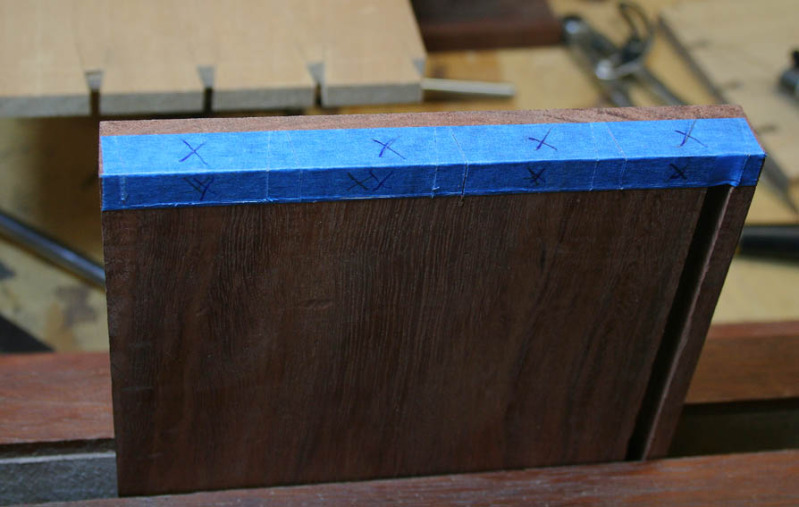
Here are some pictures (and now you will see why using blue tape can be so helpful). Note that these are half blind dovetails, not through dovetails ..

Mark on top of the blue tape ..

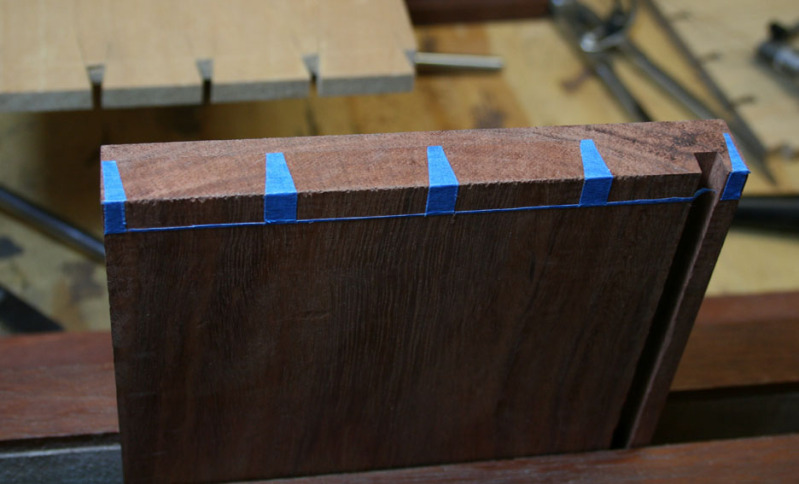
Then peel the waste sections away ...

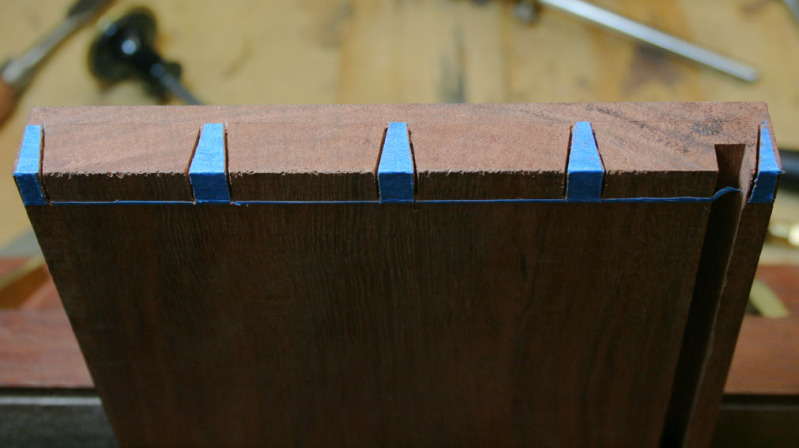
Saw as close to the line as you can ...


This is what I mean ...

Here are the cleaned out sockets ...
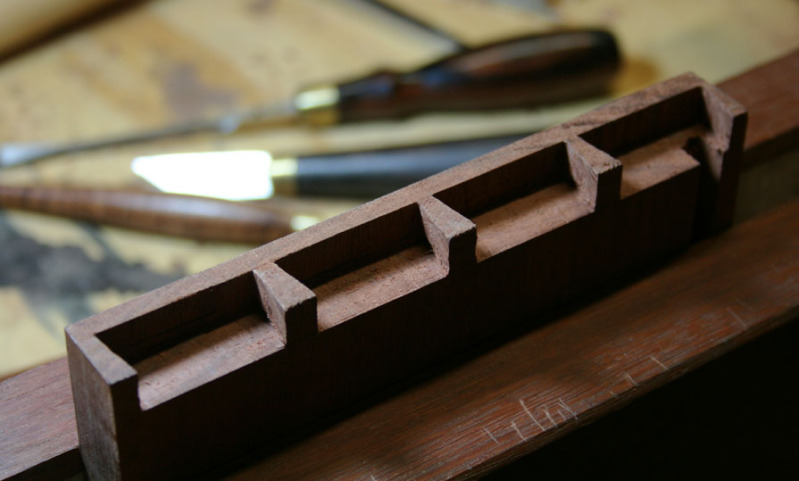

If lucky, you get a perfect fit ...
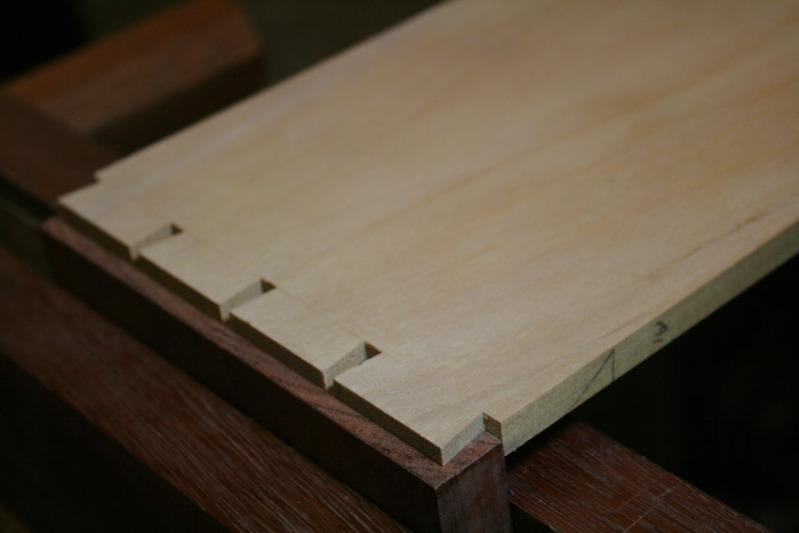

I emphasise that this is to aim for, and that it takes time to achieve. The tape makes it easier on the eyes only - you still need to learn to use your saw. I've been at this a few decades.

Regards from Perth

Derek
Re: Wish me luck - first dovetails!

#24

Re: Surprises from Ian Kirby's Dovetail book

Bob Lang

Seems to me that suggestion #1 begets the need for suggestion #2.

The best thing you can do is put down the books, get away from the computer and go practice. Get an inexpensive piece of wood that isn't part of a project and see how you do. Filling your brain with other peoples opinions won't do a thing to develop your hand/saw/eye coordination.

Bob Lang

Re: Wish me luck - first dovetails!

#25

Amen! and a story.....

Bill Tindall, E.Tn.

Told by Jeff Headley, master cabinet maker in the Mack Headley and Sons Shop. (In case you don't know, this shop makes reproduction furniture as good as it gets)

Jeff was at a show where LN was selling their wares. He was thinking about buying a new dovetail saw and asked if he could try the LN saw. The LN demonstrator at that time assisted in producing a saw and board. As Jeff stated sawing the demonstrator pointed out that Jeff was sawing the dovetail wrong.

The point to make is that successful dovetails can be done with a wide variety of techniques, customized to suite the maker.

Suggestion: Strive to make dovetails that will hold something together. Get over wanting to show them off. Fret over perfect dovetails is you decide to sell studio furniture. I delight in spotting "fixed" dovetails in studio furniture.