WoodCentral Forums

Est. 1998 — 27 years of woodworking knowledge

On Grinding - Dry Vs. Wet

Posts

On Grinding - Dry Vs. Wet

#1

On Grinding - Dry Vs. Wet

david weaver

Figured I would bring this over here since there are some members fighting about it elsewhere and I'd rather talk nuts and bolts and have no fighting in it, instead.

In the debate of the dry grinder vs. the tormek, still I don't think there is any assertion with any competent woodworker where the dry grinder is being used properly and it is faster to get from a dull chisel needing a grind to a very sharp honed chisel.

And until last week, I'd make that comparison with a hard wheel, and the dry grinder wins hands down every time. Three strokes on a medium stone off the dry grinder and there is a fat wire edge, and a little bit of work in a fine stone and done.

And then last week I got a camel pink wheel out of a clearance bin and it cuts steel so fast that on the tsunesaburo irons literally one stroke across the dry wheel for each time the iron has been honed and the iron will be ground all the way to the edge and I can place it directly in my palm after all of that metal has been removed (I would imagine this is a sensation that a 46 3x wheel would provide, but I am too cheap for that...the camel wheel was $10.69, admittedly that is not a regular price).

I have used a tormek with a freshly graded wheel with microadjust and a good square chisel, and I will have my plane iron done off the dry grinder before I have a chance to mount the tormek wheel.

If there is any situation where the tormek is faster than a dry grinder, there is a serious technique issue somewhere. I was grinding all the way to the edge less a stone stroke or two with the hard wheel, and now with the pink wheel, there is no limit to doing the same thing with speed.

So, my challenge is this. A single 1" wide chisel or a single 2" wide plane iron - one that has been honed at least three times or four times and in need of a hollow refresh. Video from the time that it is picked up dull and needing ground to the time that it is fully honed. I won't even request any time factor added in for the tormek to grade the wheel or play with water.

I had everything for my tormek that would help speed (too setter, micro adjust, diamond grader, etc) and I will have a fully honed iron after a dry grinder grind before I'd have been done with the tormek, even if I didn't have to fiddle with angle on it.

What the tormek does have is scorched earth level of safety. It is my opinion that it should not be recommended for beginners, though, because the various other tricks (soft wheels, rests, etc) are plenty effective for a beginner and they will grow with them. Instead, someone should only buy a tormek if they are so ham handed and ham brained that they absolutely can't use a dry grinder. For the vast vast majority, the difference in cost that will never need to be spent could be spent on wood or tools.

Re: On Grinding - Dry Vs. Wet

#2

So, what is a camel pink?


Re: On Grinding - Dry Vs. Wet

#3

Re: On Grinding - Dry Vs. Wet

Tom

Your header is dry vs wet, the text is an anti tormek rant and a pro no-name recommendation. I don't have a problem with that, but I do think it probably needs to be refined a lot to really get anywhere.

Tormeks seem to have a variety of characteristics,

- one is they create a flat bevel. One can leave that argument for another day, but I haven't really see a tool in general use that does that dry on a stone, of course belts and discs can do that though they tend to be expensive.

- it is wet which while I agree it can be seen as a belt and suspenders kind of deal, and there would be a lot of issues around that like water in the shop, mess, cold... Still, it is reasonable to have some kind of grinder option that protects steel absolutely.

- It is possibly a pretty minimal deal, but they do transition from grits on the grinder to waterstones seamlessly

- Tormek is actually designed for the grinding of hand tools, which is neat, because few other things are.

I also use dry wheel grinders, but they are designed for sharpening tool bits of hss and carbide, for machine tools, they are not designed for "us". So while they can work really well in the right hands, there isn't any real point in carrying on as though it is a mystery that people didn't get the non memo.

I think it could be like any other skill that people don't get, at some point someone will get through to the punters, like a CS, and there will be a BC/AD situation on this skill also. But that may take a while because most of the wind in the sails these days is not behind the shop situation where people have power and hand tools at their most efficient level. Or at least they pretend that isn't the situation.

- Dry grinders are really, really dangerous. Haven't seen it myself yet, but I have seen similar bad things really grab my attention, like exploding bowls. I believe the people who say one can get seriously hurt, and I accept that isn't what some people may want to flirt with. Of course this applies to the standard units with vitreous wheels. There are safer dry options.

Re: On Grinding - Dry Vs. Wet

#4

Re: similar to Tup's Indispensable?


Re: On Grinding - Dry Vs. Wet

#5

Re: Safety II

Tom

Airborn vitreous dust...

Re: On Grinding - Dry Vs. Wet

#6

Re: On Grinding - Dry Vs. Wet

david weaver

Yeah, not necessarily dry vs. wet, I guess. More dry and fast vs. wet and slow.

"designed for hand tools" doesn't really mean much. If it's designed to be foolproof for a beginner, that's usually a sign of a tool that will be cumbersome and slow.

There is plenty of range in a dry grinder for it to be superior in both hand tools and turning tools (though I do my turning tools freehand on a trizact belt).

I eventually got tired of the speed of the tormek and gave it away, I don't know if I said that or not. It's one of those things that's talked up so well on the web that I wanted to get it. I have to admit while I thought it was a quality piece of gear, I never thought it to be very useful compared to a decent full speed 6" grinder. Not even better and faster than a $39 ryobi grinder that I used for a while with a $20 white wheel from the local rockler.

Not saying you can't do woodworking with a tormek. Not even saying that you can't get a sharp tool by going through the steps they'd like you to (coarse grade, fine grade and then honing leather), but a pink wheel on a dry grinder is literally a pass on the pink wheel for each time you hone the iron. I never keep water at my dry grinder, but the risk is even less now than it was before - I can touch a ground tool to my palm after its last stroke on the grinder and hold it there, and I by no means have tough hands that wouldn't feel it.

So wet and slow speed vs. dry and high speed, I guess. None of us for the most part will have access to a wet and high speed wheel like a cutler would use, nor would we want one.

I have seen the argument about the dust before, but pretty much all I've ever done is back my grinder against a wall and the dust is for the most part right behind it (I have a grinder that has a hose hookup on the back, except I've never hooked anything to it). I've never had a piece of grit on my bench, despite the fact that my bench is 6 feet away in the peripheral view of the grinder and I use only the very coarse wheels.

I did have water all over the place when I used the tormek, though, and I did crack a blackstone in half attempting to take the tormek apart to sell, because I had a supergrind with the mistake-waiting-to-happen plated arbor. Lucky three times removing stones, but not the fourth.

Everything on the tormek was slow, from standing and filling a jug of water to bring to it, to grading the wheel or if it just didn't respond, taking the diamond truing tool to it. And the leather is too slow and too soft to be of use.

Re: On Grinding - Dry Vs. Wet

#7

Re: Safety III

david weaver

I can't imagine being too concerned about safety in the shop with a grinder that has shields, especially when one is doing other things like using chisels and especially if someone allows themselves to turn large objects.

I have been in the hospital to get metal removed from my eye, superficial as it was, but it was doing an operation that a tormek couldn't do and getting very unlucky.

Can't forget the thickness planer, Jointer and TS, though I don't use the jointer very much.

Oh, and a contraption to power strop, that threw an iron and as I could hear darwin's feet, I quickly ended that edge rounding experiment.

Suppose my lament here is that a lot of the stuff that I've spent good coin on couldn't hang with a lot of stuff that I didn't.

Re: On Grinding - Dry Vs. Wet

#8

Re: a pink wheel...

david weaver

..it's a friable pink dry grinding wheel.

It's pink alumina, a cool running thing, though since I know little about camel's stuff vs. anyone else's, I don't know if that's always the case with pink wheels.

I was too cheap to buy a 3x wheel and pay shipping. I suspect they're similar.

(after comparing prices, one might run into camel at woodcraft. I wouldn't buy it there without a coupon).

Re: On Grinding - Dry Vs. Wet

#9

Re: On Grinding - Dry Vs. Wet

Derek Cohen (in Perth, Australia)

Hi David

You know I am just going to repeat what I said to you on SMC! However I imagine that others here will want to know what I said, so I will say it again! :)

I have a luxurious set up insofar as having a Tormek 2000 (with the 10" wheel) and an 8" dry grinder with a 46 grit Norton 3X and a 36 grit Norton white wheels. I would like to venture that I am reasonably adept at freehand grinding. Still, 90% of the time I use the Tormek and only 10% the dry grinder.

I would also like to firmly point out that sharpening is a religion to many. I am absolutely not one of those but, like many when asked, do have a definite position. I do what I do because it works for me. What works for you ... whatever floats your boat. I actually dislike having to stop working to sharpen - I am far too impatient - and therefore have gravitated to a method that gets me going fast and keeps me going longer.

The question "which grinds faster" is the wrong question. A better question is "which system leads to faster edge preparation". There are some systems that are really fast - such as going directly from a ground edge to a motorised strop - but they do not suit everyone. I will also strop - that extends an edge as well.

Back to the issue of "which system is best": In the one corner we have a dry grinder and (say) waterstones. In the other corner we have the Tormek and waterstones. Using the dry grinder - assuming that you are using O1 or A2, or another high carbon steel - the first step is to grind as close to the edge of the blade as you dare. Closer is better as there is less steel to hone and less steel when it comes to re-hone. I have not experienced any frailty in such edges.

So how close can you get with a 46 grit white Norton on a dry grinder? 2mm, 3mm? Any closer and the heat will affect the temper of the steel. (And burning the steel can happen in the blink of an eye - but that is not the issue here). Time taken is approximately 1 minute for a 1" chisel. Reasonable?

OK, what about the Tormek? It would take you about 3 minutes. I only use the Tormek as a grinder and so am referring to a 220 grading. I have the standard wheel that comes with the Tormek. The time is longer but the grinding goes all the way to the edge. No danger of burning the edge.

Now comes the honing. I prefer to freehand directly on the hollow, which acts as a jig (and the Tormek makes it easy to set up a specific angle, which is also part of setting up speed, if you want to factor this in as well). Let's say we are using a decent set up of Shaptons 1000/5000/12000. On the dry grinder hollow it will take you about 3 minutes to go through these stones. On the Tormek hollow it will take you 30 seconds to reach a razor edge just using the 5000 and 12000. At this stage there is no need for a 1000.

Total so far: Dry grinder is 1+3 = 4 minutes. Tormek is 3+1/2 = 3 1/2 minutes.

Not so different now. But wait, there is more! Subsequent honing on the Tormek takes between 30 - 60 seconds, while subsequent honing on the dry ground hollow takes 3 minutes and upwards.

Win for the Tormek on speed.

I will leave it to Tom to discuss the issue of flying grit. What I will mention is that the 3X Norton is fast and cool grinding. However it is the messiest stone I have ever used - incredibly friable. I rarely use it any longer and stick with the less friable white.

Lastly, I would like to emphasise again that I am not trying to convince everyone to buy a Tormek. They are expensive, and I bought a green run out model at a large discount. It was still expensive. If I did not have it I would be happy with the dry grinder. I am simply answering the question which is faster, not which one should own.


Regards from Perth

Derek

Re: On Grinding - Dry Vs. Wet

#10

Safety... c'mon, lets keep it in perspective here.

John in NM

There are plenty of actual dangerous things in the shop, even the hand tool shop, without the flights of fancy required to turn a bench grinder into one of them. There are a few simple rules, follow those and they simply never do anything unexpected - and unexpected is what causes 95% of accidents.

Re: On Grinding - Dry Vs. Wet

#11

Re: On Grinding - Dry Vs. Wet

david weaver

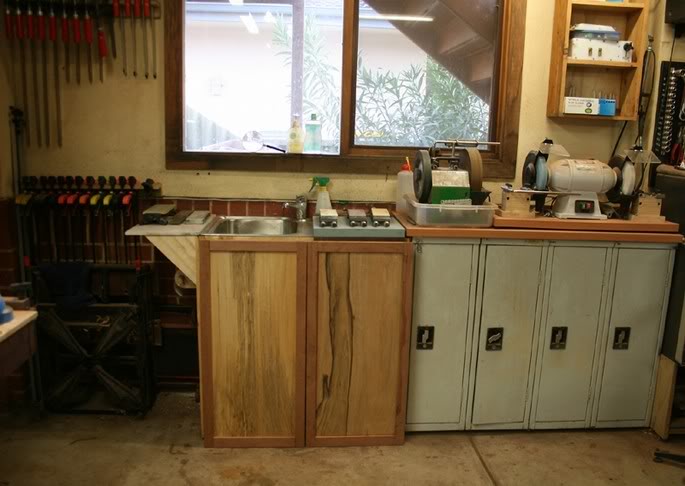
That area looks too clean!

I'll see if I can take a video of what's going on with my iron and stones. I should be ashamed of how dirty my shop is, but I use it as an excuse to not care...how dirty it gets.

For a 1" stanley chisel ground around 25 degrees, it probably takes me a total of a minute and a half at the most to go from walking over to the grinder to honed. I work very close to the edge with the grinder, no effect on temper, not even on a tsunesaburo blue steel stanley style iron, and I can take any iron or chisel - especially with this pink wheel - and place it in my palm after grinding and at the worst get slight discomfort.

And I agree, I hate stopping to sharpen unless I've already been in the shop for an hour or two. Though I mind it less now than I did before, there are no time hurdles to jump now. I like the whole regimen the absolute least when I have 1/3rd of a panel yet to go and I'm already past my bedtime...that kind of thing.

At any rate, you can definitely grind right to the edge without affecting temper, it's just a matter of doing it once successfully and then repeating after that, but I grind about half a mm short or a little less maybe. it's easier to keep geometric control and minimize the total time to get back to work.

Not sure about the 3x wheel because I haven't used one, the camel wheel might be a touch harder. It definitely does yield to a T shaped diamond grader pretty fast, though.

Re: On Grinding - Dry Vs. Wet

#12

Re: On Grinding - Dry Vs. Wet

Charles Stanford

Interesting, I suppose, theoretically at least. Most won't have a facility for both types for grinding, it's usually a one or the other proposition (or is it? maybe not these days!). I doubt that those who own Tormeks are worried about leaving a few minutes on the table assuming dry grinding is faster, which it probably is. What I don't like about Tormeks is the diameter of the wheel, they produce too shallow a hollow for regular Stanley/Record plane irons. A gradual hollow is nice for turning tools, I suppose, but HSS is difficult to blue so there's no real need for slower, wet grinding. One can just dry grind on a large wheel all the way to the edge a la Richard Raffan.

Otherwise, being able to grind to the edge with virtually no risk is moot the vast majority of time since there is only a need to refresh the built-in jig, the hollow and you don't need to go all the way to the edge to do this (that wouldn't be a refreshment but a reshaping). And grinding to the edge is not terrible risky with a freshly dressed dry wheel, a dash pot, and a light touch. The risk of burning steel is vastly overblown.

It's always a good idea to wear eye protection when running any kind of grinder and I wouldn't walk into a woodshop without leather steel-toe boots or leather steel-toe shoes.

Re: On Grinding - Dry Vs. Wet

#13

Re: On Grinding - Dry Vs. Wet

david weaver

Yeah, also not a fan of the wheel diameter. There's an extra hone or two for each grind on a dry grinder.

Out of personal habit, I always stand outside the arc of anything that spins, grinders included. Never had any issue with one, it's just what I do - grinders, wire wheels, whatever.

I don't know if that's critical or not, but once you're in the habit of it...

As far as grinding goes, 3 minutes of grinding on something that wasn't thick HSS is outside my realm of patience. I'm always curious how to do that kind of stuff (saw sharpening, grinding, etc) faster because it's not something I enjoy doing, but it's something you can't get around.

It would be interesting to see what people would say is a soup to nuts time from a hollow that needs to be refreshed to a fresh edge. I've never timed myself, I'm curious also as to whether it's the minute and a half that I think it is.

Re: On Grinding - Dry Vs. Wet

#14

Re: On Grinding - Dry Vs. Wet

Charles Stanford

You seem to be asserting that it is necessary to grind all the way to the edge to refresh a hollow. It's not. Stopping a millimeter or two away from the edge is perfectly fine, accomplishes the task perfectly well, and is a shop standard best practice. Yours is a false premise - there's no need to get closer. If your argument centers around a constant need to get closer than this to the edge then it bears on quicksand. You are either nicking your edges inexplicably too often or have a fundamental misunderstanding the of the process, generally.

Re: On Grinding - Dry Vs. Wet

#15

Re: On Grinding - Dry Vs. Wet

Charles Stanford

It's even less than that for me on a regular Stanley plane iron - three or four passes on the grinder and I'm done. I just need to feel the 'click' on the oilstone again. It's no more complicated than that.

Re: On Grinding - Dry Vs. Wet

#16

Re: On Grinding - Dry Vs. Wet

Derek Cohen (in Perth, Australia)

Hi Charles

As I mentioned earlier, I do not find any issue with the durability of my edges. What determines durability is the angle at which they are honed.

Grinding to the edge safely is only possible with a Tormek. Don't knock this unless you have tried it. It speeds up honing and re-honing significantly. Getting "close" to the edge is not the same thing.

Regards from Perth

Derek

Re: On Grinding - Dry Vs. Wet

#17

Not the only way

david weaver

There's really no risk to griding to the edge with a friable wheel. I ground pretty much to the edge with an N hardness wheel, which is a lot less forgiving than the pink camel wheel (which doesn't specify hardness).

It's not a safety issue, more a geometry issue since there is no jig limiting the iron or chisel travel into the wheel.

I'm not really into measuring such things, but I'll see how much edge is left on a typical grind of mine. If anything, I leave a touch in the corners so as not to round them off, but not really anything to speak of anywhere else.

Re: On Grinding - Dry Vs. Wet

#18

Re: Safety... c'mon, lets keep it in perspective h

wilbur

There is one safety issue that will be hard to get around with a dry wheel grinder, and that's the danger of inhaling grinder wheel and metal dust on your lungs.

Re: On Grinding - Dry Vs. Wet

#19

Re: Safety... c'mon, lets keep it in perspective h

Tom

And not just at the point that you grind it but for years after as it settles in the shop.

Re: On Grinding - Dry Vs. Wet

#20

Re: Safety... c'mon, lets keep it in perspective h

david weaver

In all seriousness, what do you guys think the risk is - statistically - of grinding a couple of plane irons and chisels per week. Honestly. Aluminum oxide contains very little to no free silica.

Especially when you're already working with something that creates wood dust (even working by hand will create some dust, I don't know if you guys work by hand entirely on any reasonably large products and eschew sanding).

I'm sure there are some fines in the air from grinders, but I haven't cleaned around my grinder in a year, and all of the fines have pretty much settled straight down under the grinder (most of them end up in the guard, anyway). We are not talking about sprayed lacquer that stays in the air for a long time as a fog.

Re: On Grinding - Dry Vs. Wet

#21

Re: Not the only way

Derek Cohen (in Perth, Australia)

It's not a safety issue, more a geometry issue since there is no jig limiting the iron or chisel travel into the wheel.

Hi David

That reminds me of another reason that with the Tormek the sum is greater than the parts.

Although one could add a grinding guide to a dry grinder, this only comes standard on the Tormek. In other words, the Tormek is not a freehand operation (although it could be used that way).

Using the guide on the Tormek, the result is a hollow grind hat is very even in depth and square. Unlike the hollow on a dry grinder, which will vary even if you are very adept at grinding, there is no straightening to do with a 1000 waterstone. One can go directly to a 5000 stone, especially if you grind to the edge of the bevel.

The Tormek has a shallower grind, as Charles pointed out. This enables one also to hollow grind laminated blades, such as Japanese chisels, without weakening the reinforcement layer. David Charlesworth is another to do so.

David, I am not trying to have the Tormek compete for speed with a dry grinder. All I am attempting to demonstrate is that is is not a slow machine when you look at the big picture.

Regards from Perth

Derek

Re: On Grinding - Dry Vs. Wet

#22

Re: On Grinding - Dry Vs. Wet

Charles Stanford

I understand fully well that wet grinders grind to a thin edge more safely. My only question is why this isn't just a once in a blue moon kind of thing for you. How often do you find yourself needing to grind until a burr is formed and why?

Re: On Grinding - Dry Vs. Wet

#23

Re: Safety III

Tom

"I can't imagine being too concerned about safety in the shop with a grinder that has shields, especially when one is doing other things like using chisels and especially if someone allows themselves to turn large objects."

Yeah, I agree, but presumably those aren't the people with the Tormeks. Reality is there are a lot of people who are scared of just about everything, but sure, they aren't turning large bowls made of heavy fragile mush. Turning pretty much demands a dry grinder, and I never looked back, so presumably we are talking about different segments of the craft.

"I have been in the hospital to get metal removed from my eye, superficial as it was, but it was doing an operation that a tormek couldn't do and getting very unlucky."

That is the other thing I don't like, you get an MRI and they insist on xraying the eyeball which is not a place you want radiation. If I didn't do the stuff I do, I would consider that adequate reason along to avoid using such tools, but I am way past that point.

"Can't forget the thickness planer, Jointer and TS, though I don't use the jointer very much."

At least they don't normally explode when they are switched on.

"Oh, and a contraption to power strop, that threw an iron and as I could hear darwin's feet, I quickly ended that edge rounding experiment."

Yeah, polishing in general can get exciting, or so I have heard. I once took a shot for the team, in the team, when an 8" grinder polisher got jammed up in an ama I was working on, and the results was like midget pole vaulting.

"Suppose my lament here is that a lot of the stuff that I've spent good coin on couldn't hang with a lot of stuff that I didn't."

Yeah, so true, I built my trimaran essentially with the 8" polisher, Bosch jigsaw, and a screw gun. Great ratio of tools to result.

Re: On Grinding - Dry Vs. Wet

#24

Re: Not the only way

david weaver

To me, a 3 or 4 minute total take from chisel in need of attention to chisel ready to use, even without dealing with water or truing the stone, etc, is pretty slow.

I guess that's my point.

It seems that what's hinged on is what's tolerable to grind in terms of time and neatness.

The fact that a jig has to be used in general is at the top of the list why I don't use it. It took me about as long to get the iron in and out of the jig as it takes me to grind, notwithstanding the rest of the tormek parts, such as actually grinding.

The three minute process (maybe four on something like a thick shepherd A2 iron, just because there's a lot to it) is what sent me in the other direction.

I think of all of the monster size rests are done away with for a simple two piece rest that is small enough to maneuver on, if one is willing to commit themselves to using the dry grinder, it becomes a process that takes a third the time and is much more satisfying (or maybe less dissatisfying is accurate) mid process when in the heavy throws with boards.

I use the stock cast rests that came on the baldor (which itself has gotten quite bloated in price in the last three years, to the point that it makes little money sense to buy it), but must admit that the ryobi grinder that came out a bunch of years ago that had two piece cast aluminum rests on was actually just fine.

Re: On Grinding - Dry Vs. Wet

#25

Re: Safety... c'mon, lets keep it in perspective h

Tom

John, keep in mind pretty much all accidents are avoidable, and most safety rules consist of a few simple rules or steps. That doesn't mean accidents don't happen. If everyone was equally smart and safe and informed, we wouldn't have forums.

Here is a list of fatal accidents resulting from grinding wheel explosions, not limited to unguarded wheels. It is over 7 years, regional, and a partial listing only:

https://www.osha.gov/SLTC/machineguarding/grinder_accidents.html

My advise is not to look up photos on google. In part because they include crazy pictures of limbs ripped off on metal lathes, but not just for that reason.

I use all kinds of dry grinders, I didn't say don't use them. I just think there are some people who will choose not to, and safety is one of the reasons. Most people will be picking something up from asia, probably not balancing the wheels, etc...

👍 This page answered my questions

Your vote helps other woodworkers quickly find the answers and techniques that actually work in the shop.