No endvise *LINK*
Kees
This is smart.
http://www.theenglishwoodworker.com/?p=1434
Knowledge You Can Build On — Est. 1998
No endvise *LINK*
Kees
This is smart.
http://www.theenglishwoodworker.com/?p=1434
It illustrates a point....
Bill Tindall, E.Tn.
The choice of "best" bench and fixtures can not be decoupled from what is done on it. Before being seduced by this or that latest bench reproduction, bench fixture or author it is well to know what one intends to do on the bench.
I don't have a tail vice. I don't surface plane lumber with hand planes. However, there are times when I would use a tail vice if I had one. I get by with a large bench top overhang and a multitude of various clamps. I can't see that the device demonstrated would fulfill the function of a tail vice for anything that I would use a tail vice for.
Re: It illustrates a point....
Kees
It's not a device. It's a piece of wood and a clamp. 
What kind of purposes are you thinking about?
No end vise....or the search for ww nirvana....
roger lance
I suppose for some there is allure in seeking some mythological sweet spot where some of the more modern contrivances can be ignored for some basic method of work that is actually the equal of what is now thought of as needed. If "old English woodworkers looked upon an end vise as a pesky import that deprived them of their skill", then end vises probably would not have caught on. This method works....many other methods work as well....clamps and wedges come to mind....but I like an end vise and will be keeping mine and my electron killing devices as well.
electrons don't die
Bill Tindall, E.Tn.
They only get tired and await rejuvenation at a power plant. It could make one misty eyed knowing that the electrons powering your mortising machine might be the same ones Krenov used in spite of CA's efforts to retire them.
Thankyou
Re: electrons don't die
roger lance
Thats true....electrons don't die, they just fade away....but I couldn't recall the wording: electron killing machines....or electron eating....or just electron using. Oh, I know that they don't just fade away either....
endvise + birdsmouth
Wiley Horne--So. Calif.
Hi Kees,
Thanks for showing! All ingenuity is eventually put to use.
Even those with end vises may have them set up for some other operation, at the very moment they need to flatten a different stick. The method shown provides another workstation, if there is enough bench space.
I like end vises, specifically the LV twin screw. But sometimes it is used to hold a stop, rather than do the stopping itself. For example, in edge jointing a narrow stick or a thin stick, sometimes I like to do this whilst running the stick into a birds mouth, the birds mouth held by the end vise.
Here's the birds mouth--the section you're not using is gripped by the vise. The advantage of the birds mouth for narrow or thin sticks is that the stick is held dead vertical for edge jointing, but without compression from the vise.

Of course, thins can also be put on their side and shot, but sometimes it suits better to use the birds mouth, just by the happenstance of what's on the bench at the moment.
Wiley
Re: No endvise
Tom
I think that both sides of the argument are right. Most of us who have tail vises worked without them before we got the vise, and are well aware of the pros and cons at this point. One of the facts often left out of the presentation is that we all have pieces that don't fit our benches, or that don't fit given the work in progress, and one has to use something other than the tails vise to hold them. In the video, the angled board, and the front vise take up a huge slug of real estate, that method will not make best use of the real estate. And the angled board looks more complex to micro adjust if the pieces being planed vary a little one from the other. I do like the presentation though, he seems aware of all the issues, and mainly speaks of the cost of fitting a vise, which can vary from zero to a lot, depending on how you want to do it. If cost doesn't play a part in the issue, it is hard to argue that you can do everything on a bench with a vise that you can on one without, and in addition you have the vise. I will say that I use my face vise hundreds of times more than the tail vise.
Re: No endvise
Paul M.
I went to all the hassle of building a tail vise into my bench, and I almost never use it. I use the holdfast and batten method for most things, or just plane against a stop if I can get away with it. The area around my tail vise has been cluttered with the detrius of life because I never seem to use that end of the bench. The detrius is not the reason I don't use the tail vise, but is simply a convenient and mostly unused space to store stuff.
Re: No endvise
Bill Houghton, Sebastopol, CA
I'm going to save that link. The notched batten is a new one to me, and looks very effective.
I've run into the problem now and again with an endvise of clamping thin boards and having the pressure from the vise turn them into long bananas. This approach should reduce that problem.
All I need to do now is figure out how to mount holdfasts on a bench that is full of stuff stored underneath, of necessity because of shop size.
Re: No endvise
wilbur
How about the Lee Valley holdfast? It comes with an optional short post.

Re: No endvise
Derek Cohen (in Perth, Australia)
This reminds me of the many work-arounds I did before I had a tail vise. My previous bench went 18 years without one.
Occasionally I still need a work-around as there is no one-stop-tail-vise-for-all-situation. However, since I began using the new bench 18 months ago I have discovered the convenience of a wagon vice (.... wagon tail vise because of space issues). For example, face planing short and, especially, thin boards for drawer sides. A snap. Holding boards at the side edge of the bench for grooving. So much easier now.
I'd estimate that the tail vise gets nearly as much use as the face (leg) vise.
Further, as Tom pointed out, there is just more real estate to use ...
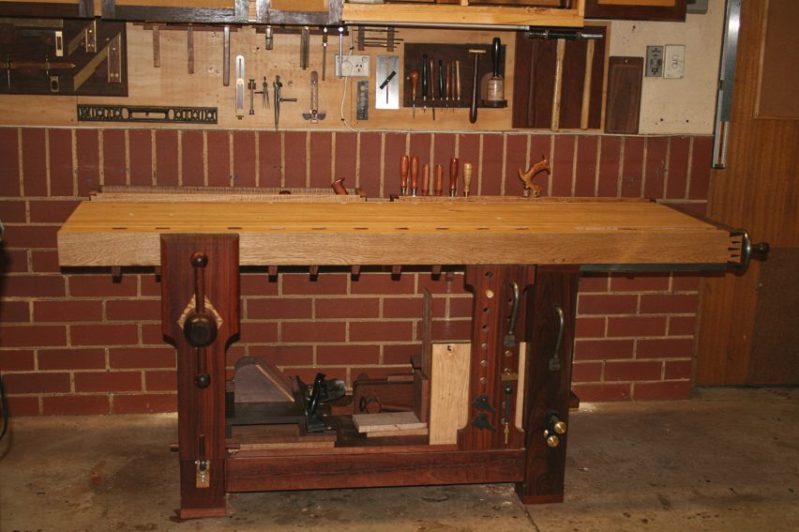
Even tool trays are kept away from the work area ...

Regards from Perth
Derek
what is/defines a "wagon vise"?
Re: No endvise, a question
Patrick Gibbons
I like this device. I have an end vise that's not working. I may substitute. It annoys me that he refers to this devise as primitive, a term used to excess on the likes of eBay to describe anything without a plug or complication. My question is for those who have an English-style bench with skirts. How do you use bench dogs when it's so hard to get to them underneath the bench to push them up? Maybe that's why English benches don't have tail vises and dogs.
Re: what is/defines a "wagon vise"?
Patrick Gibbons
A wagon vise is a tail vise that does not have a moving chop. The screw has a dog attached to it that moves in a channel cut into the bench. In a regular vise there would be a dog in the back jaw. As the screw is turned, the jaw moves away from the bench or toward it. The wagon vise has no such jaw.
now I understand...thanks
a question
Bill Tindall, E.Tn.
My bench is simply a 3.5 x 7' x 3" top that sits on a 4-legged frame (like a table) with a large overhang around the edges, as shown not very well in the picture. Would it be possible to install a wagon vise into this top as it stands?
Re: a question
Derek Cohen (in Perth, Australia)
Hi Bill
It is possible to add a wagon vise to your existing bench top. However the Benchcrafted version I use really needs to be built into the bench at the outset. Retrofitting it is difficult.
Here is mine, shortly after the bench was completed. Without dogs ...

With dogs and in use ...

There are two other versions that can be dropped into a routed mortice. The first is the one made and sold by Lee Valley ...


http://www.leevalley.com/US/wood/page.aspx?p=66819&cat=1,41659
The other is one made and sold by HNT Gordon (here in Australia) ...


The HNT Gordon link is not working at present.
Regards from Perth
Derek
The problem I see with the Lee Valley
Bill Tindall, E.Tn.
Advancing/retracting the screw with that handle would become tedious. I can't imagine a less convenient handle. I wonder if the rod could be threaded and a wheel added or at least some "T" style handle like the aluminum bar clamps have so that the screw could be moved faster and more conveniently?
Re: The problem I see with the Lee Valley
Derek Cohen (in Perth, Australia)
Hi Bill
I think that the problem with a wheel replacement for the LV (and others) is the need to keep the top of the handle below the bench top.
I have used the HNT Gordon, and the wheel, while small, spins fast. This would be a more expensive option for the USA, unless you can access it locally. The LV I have not used.
Regards from Perth
Derek
Re: wagon vise recommendations
Lars Parrington
Bill, here's a couple other wagon vises you should check out.
First, the Maguire wagon vise. Manufactured by the same guy who made the video we're commenting on. Looks like it could be retrofitted to a bench fairly easily.
Second, the Dogsled Vise. Very similar to the benchcrafted wagon vise, except you build it yourself mostly out of wood.
easy solution then....
Bill Tindall, E.Tn.
LV should have used a "T" style handle. It can be spun with one finger and come to rest parallel to the bench top which I presume would be below the bench surface.
Re: wagon vise recommendations
Lars Parrington
also, it might not actually be that difficult to retrofit a benchcrafted style wagon vise. your benchtop is thin relative to what these vises were designed for, and that should acutally make it easier. i think you would end up cutting a rectangular hole through the top, bolting on an end cap, and screwing on some spacer blocks underneath the bench.
Re: a question
Tom
Sure. There are also ways of using standard fittings to make one. You can use veneer screws or pipe clamps. This might not be the solution you want for ever, but if you are up in the air over it, you could do a trial and then get the "real thing" later. One method is you cut a slot, then probably trim it fair with a router. The you groove it with a router slotting bit. Then you insert a block that rides in the slots, and it moves back and for with a veneer clamp through an endcap. This basic design was published in a Seth Janofsky article, though it is not new. I probably have it somewhere, but I couldn't find it online. It makes a pretty good vise the main limitation being that it stick out the end of the bench by the amount the screw is withdrawn.
Another option is to just place a record type vise on the end of the bench and use the dogs that come with those. In installations I have seen for that, the tail vise has been relatively small. I don't know if the users cheaped out. It seems more likely a really small vise is all one needs since jaw size is not a factor. These vises are quick adjust which is a factor for you, and this method eliminates the problems of bench top reduction most other vise options inflict.


