Comparing chisel steels
Derek Cohen (in Perth, Australia)
Call it multitasking  While building the current project, a blanket chest, I took the time to do a few reviews, one of which was to compare 4 different chisels .. 5 if you add in the chisel that tidied up after some of the others.
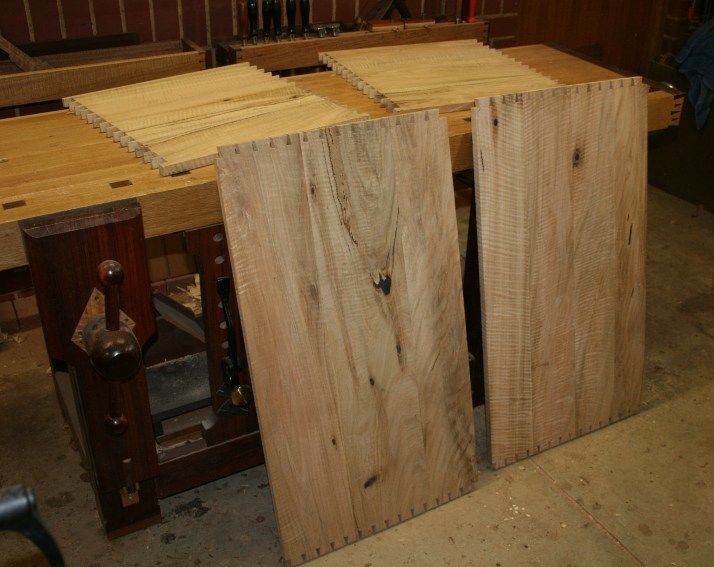
The wood used is 3/4" thick Curly Marri. This is hard - not quite as hard as Jarrah overall (although sections were very hard indeed), but i can only describe it as "chewy". That is, it is extremely interlocked and it resisted attempts to drive a chisel through it. Where Jarrah is very hard, it is also brittle and breaks away. This Curly Marri just did not let go. Firewood. Beautiful firewood.
I did not set out to compare chisels when I began dovetailing the sides. This thought occurred to me when I was into the first side. I decided to continue as I had begun: using two chisels, one for the tails, and one for the pins. The tails would be comfortably cut only by pushing the 1/4" chisel (frankly, anything wider would not penetrate the wood). The 3/4" chisel would be used with a mallet (I did persevere with pushing where possible, and now have a painful rotator cuff for my pains).
The boards are 20" across. There are 13 tails 3/4" at the baseline (the ratio is 1:6 for those curious), and 14 pins with 1" at the back and 1 1/4" at the front.
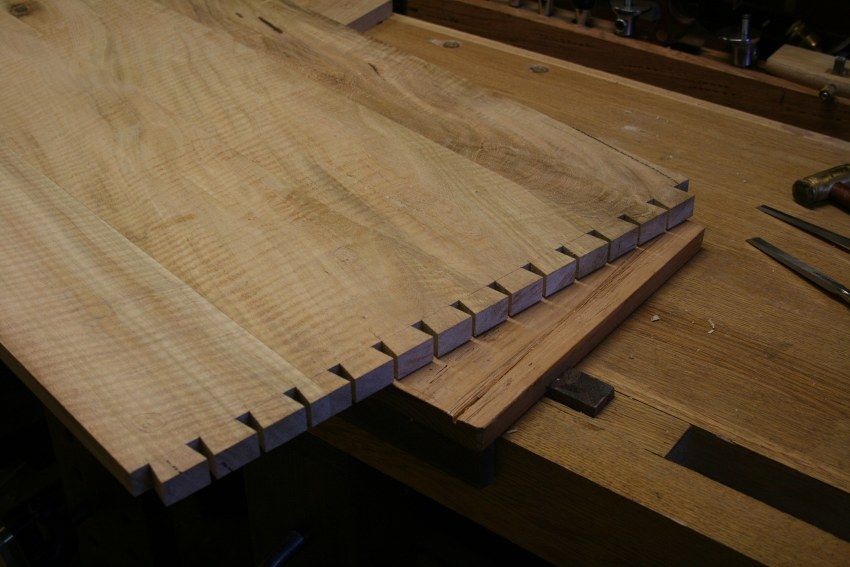
Most of the dovetail waste was removed with a fretsaw, and it was the remainder that constituted the test material ...
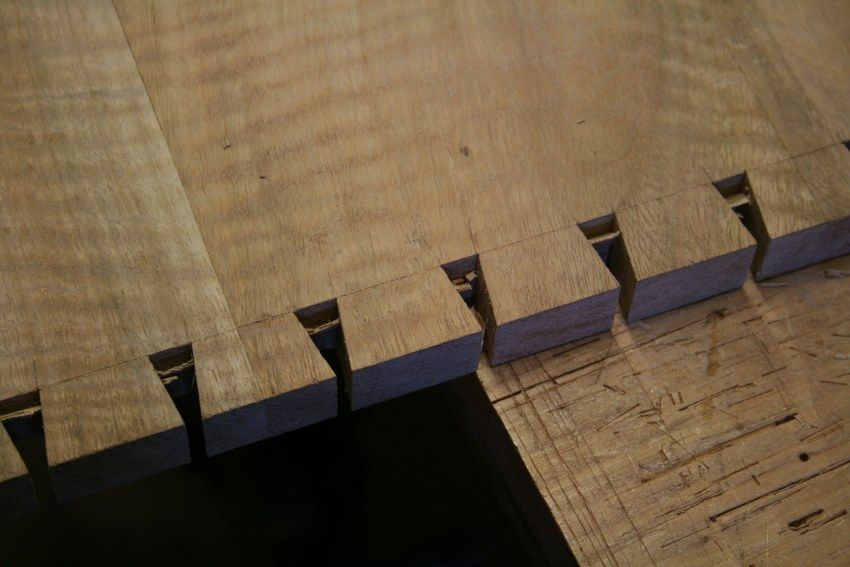
The chisels used (in order) were the Veritas PM-V11, Stanley #750 (which is a HCS similar to O1, but I am unsure of the specific type), Koyamaichi white steel, and Blue Spruce A2. All the bevels of the 1/4" chisels were ground and honed at 30 degrees, while all the 3/4" chisels bar the Veritas were also at 30 degrees. The Veritas was at 25 degrees (why? Because I use it that way and did not think to change the bevel angle).
Paring ended when the chisel could not easily cut and then failed a pine end grain attempt ...
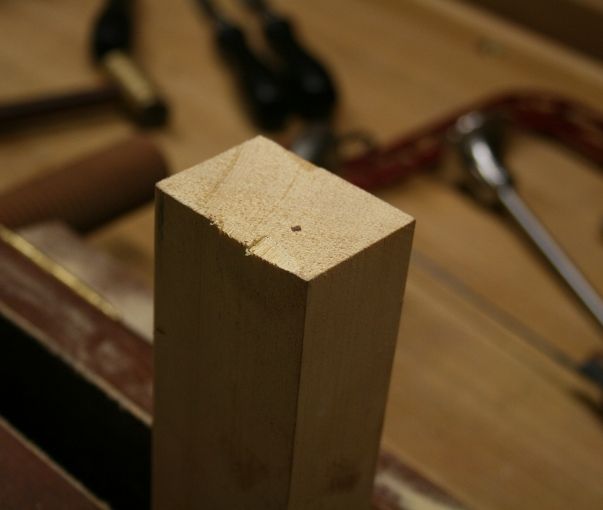
All dovetails were pared half-way through one side, then the board was flipped over and the other side done. In this way a board may be said to have 26 tail and 28 pin cuts.
The tails were cut first.
Both the PM-V11 and the White Steel had no difficulty paring 26 cuts (both sides of the tails, an example is above).
The Stanley could only manage 3 cuts ...
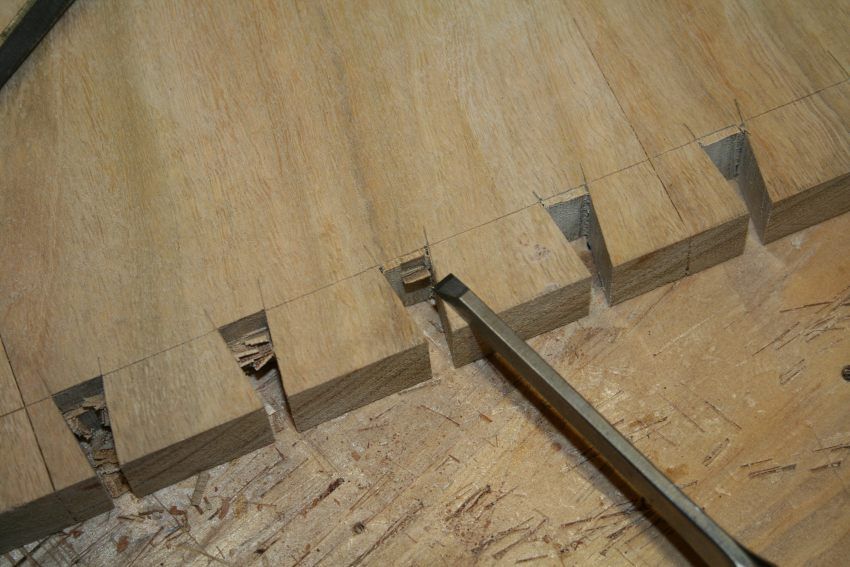
The A2 did a little better with 7 cuts ..
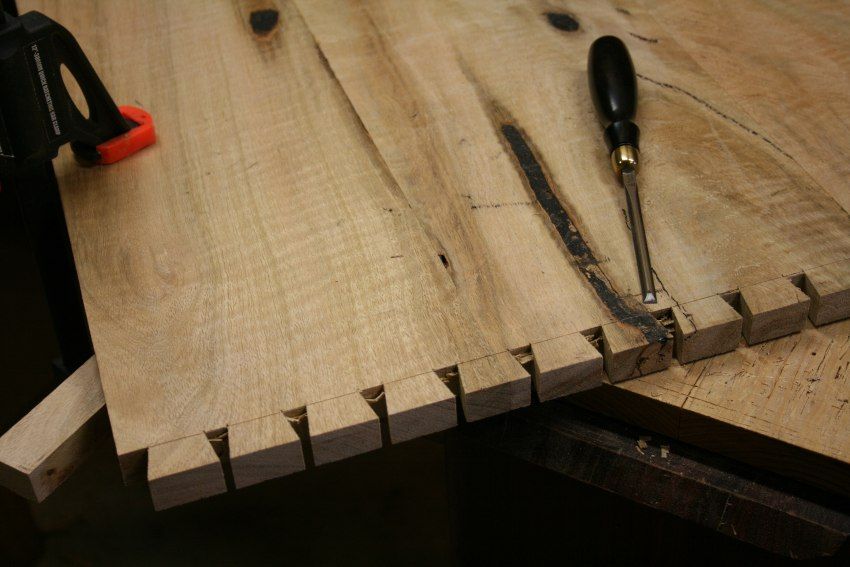
With the 3/4" chisel on the pin board, both the PM-V11 and the White Steel were able to do most of both sides. 22 1/2" (out of 31 1/2") of pin length for the PM-V11 and 27 1/2" of pin length for the White Steel.
PM-V11 cleaning up ...
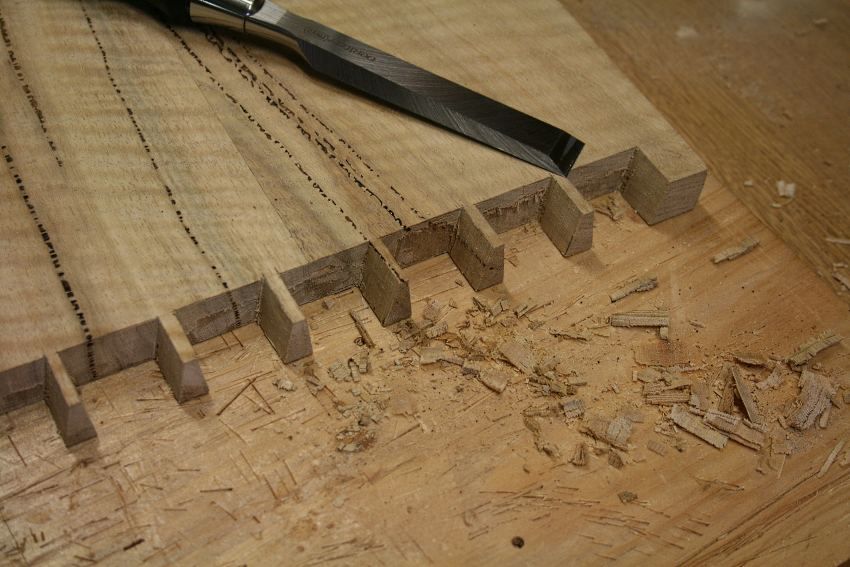
White Steel at work (I managed to push these, then required a hammer to continue) ...
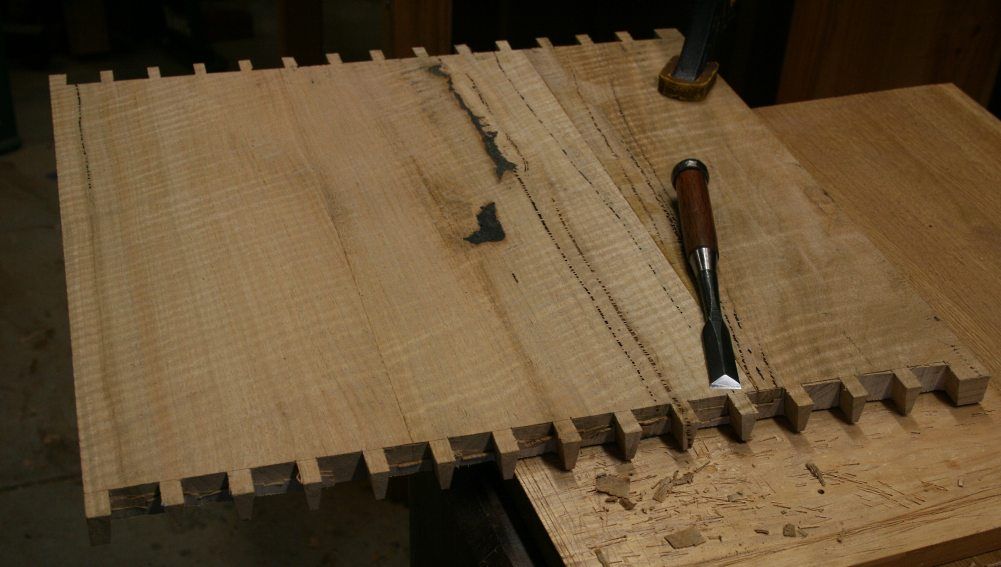
The Stanley managed 4" in all, failing on the 5th ..

The A2 completed 7" ..

What of the fifth chisel I mentioned early on? To clean up when a chisel stopped working, I used a Funmatsu-Nezumi-Haisu (from Tools from Japan). This is a PM-HSS chisel. A right royal pain in the bottom to sharpen, but it holds an edge like nothing else ...
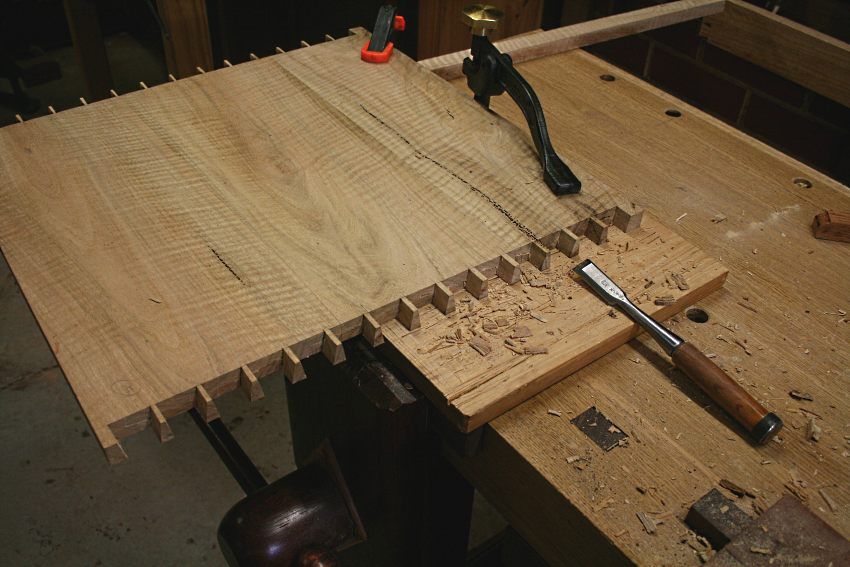
Summing up: The PM-V11 and the White Steel really do deliver. The gap between them and the A2 and O1/HCS is very large. There is no appreciable extra effort to hone the steels when used with modern waterstones, such as Shaptons (used here) or Sigmas.
It must be emphasised that this was about the steel, not the chisels. What do I mean by that? A chisel is not simply a lump of steel with a handle. Edge-holding is sometimes less important than balance and control and comfort when in use. The Stanley here is one of my favourite users as I customed the handles for myself. The Blue Spruce are one of the nicest chisels around, which arguably the best handles made on this planet. The Veritas handles are really excellent as well, and the balance in use is surprisingly good, and they are lighter than they look, but not as light as the BS. All good chisels. It is only when one works mongrel wood that good steel becomes a dominating factor.
Regards from Perth
Derek

 ) ...


