New WoodChat!
Home Articles Forums Gallery Marketplace Videos

WoodCentral Forums

Knowledge You Can Build On — Est. 1998

Reach the woodworkers who ACTUALLY BUY

Installing drawer slips

Posts

Installing drawer slips

#1

Installing drawer slips

Bill Tindall, E.TN.


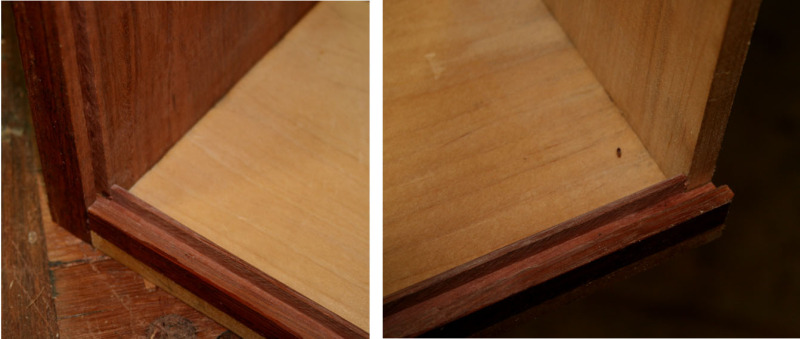
Two alignment pieces are prepared the thickness of the groove in the slip and drawer front. These are the dark cherry pieces in the picture. These are inserted in the front and back of the slip groove and mated with the groove in the drawer front, and bottom of the drawer back. They ensure perfect alignment of the slip groove with the rest of the drawer while the glue dries.

I use yellow glue to stick the slip to the drawer side. A rub joint might work but I add 3 clamps for a few minutes while the glue tacks. Rub joints and hide glue have been used commercially (Alan Batty reference).

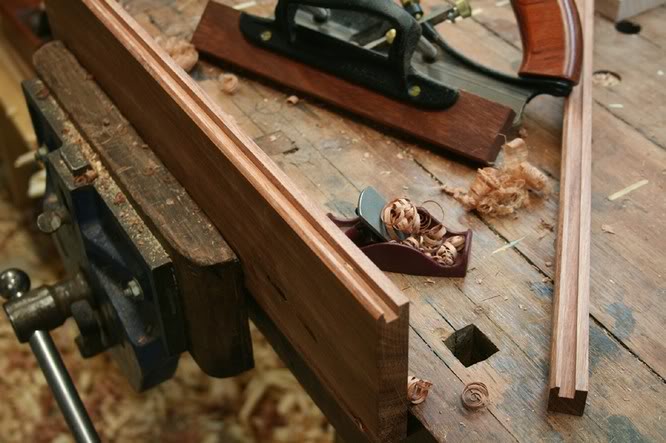
This style slip is also easy to fabricate. I mill the groove and round over on 4 edges of 6/4 lumber and then saw 4- sticks of slip stock from this piece. Then just cut to length and notch for the drawer back.

I like this English style drawer. For me it is not a fashion statement or homage to English Period Correct. It enables a light weight drawer and hence a light weight chest of drawers. It is not necessary to build a sock drawer that can be stood in.
Re: Installing drawer slips

#2

Re: Installing drawer slips

roger lance

Bill.....my favorite set of discussions on this site was the ones we had on drawer construction, drawer slips, drawer fitting, etc, etc....thanks again....your drawers are looking great....nice dovetailing.....looking forward to the finished product.

Re: Installing drawer slips

#3

Re: Installing drawer slips

William Duffield

Your arguments and examples are winning me over to this style of drawer construction, because it works.

Thanks for the new tip with the alignment tabs.

I've seen one of those pros from New Hampshire use similar tabs for aligning the front and sides while marking the half blind sockets from the tails. That method requires cutting the drawer bottom grooves before marking out and making the dovetails, but it saves you from getting the pieces upside down or inside out since the grooves stand out a lot more than chalk marks. It doesn't help with the drawer back, of course, and it's not compatible with slips.

Re: Installing drawer slips

#4

Could we see one finished?


Re: Installing drawer slips

#5

Headley inspired

Bill Tindall, E.TN.

Jeff and Steve use a similar alignment piece for marking dovetails as you describe. That is where I got the idea.

Re: Installing drawer slips

#6

Unsure of question

Bill Tindall, E.TN.

the slips in the picture are done except for mowing off the bottom to be even with the drawer bottom.

Re: Installing drawer slips

#7

Re: Unsure of question

Ron Harper

I was not looking carefully. i was looking for something " rounded over"

Re: Installing drawer slips

#8

Re: Unsure of question

William Duffield

I'm not clear on Bill's technique and sequence of operations to get the strips from 6/4 stock in particular. It's propably a sequence of roundovers on the router table, ploughs on the table saw, and rips on the table saw, while rotating the stock and flipping end for end. The important point is that when he's done, the inside top edge of the slip, that is going to be in contact with the contents of the drawer, should be rounded over. If you are using a routah, it is really difficult to do the round over after cutting the slip to almost final dimensions.

If you were using aplough plane, a wooden hollow plane and a sticking board, you would eliminate the fear factor, but if you were doing more than a couple drawers, it would probably take you a lot longer.

Re: Installing drawer slips

#9

Re: Installing drawer slips

TomD

I have never had a problem with aligning the grooves if they were correct in the first place, but that isn't to say it won't happen some day. I like them reasonably tight so if they did cause problems it would be awkward. Is it a problem with poplar drawers, that is a nasty colour match to boot, though it is a readily available wood in good dimensions. I always used to use maple, but it has gone so far up market, if I didn't cut it I would have second thoughts. Your drawers are looking very tight.

I don't agree on the sock drawer thing. If I lived in the US, I would have a couple of 1911s in there, and enough ammo for the zombie apocalypse. As it is, I still manage to get stuff like binos in there. I prefer solid bottoms in my drawers, or even framed bottoms, I hate to waste something as valuable as plywood in a drawer.

Re: Installing drawer slips

#10

Gotcha


Re: Installing drawer slips

#11

Slightly different slips

David Charlesworth

Bill,

My second book of articles shows a slightly different slip arangement, which I think, loses a little less of the interior drawer depth. It is however a bit more complicated.

It was taught to me in the early seventies by a man who was trained in the best arts and crafts tradition.

best wishes,

David Charlesworth

Re: Installing drawer slips

#12

Mind, my slip is showing  ...

Derek Cohen (in Perth, Australia)

Bill, while you use a loose "alignment" piece, my slips have tenons that fit into the front groove. The tenon aligns the slip.


The slip is made by ploughing a wide board, sawing it free, then adding the tenon.


This is a method following discussion here with Richard Jones a couple of years ago (when I presented the progressive build of an armoire) ...


Link for discussion (near end of article): http://www.inthewoodshop.com/Furniture/DrawerDesignandDrawerBottoms.html

Regards from Perth

Derek

Re: Installing drawer slips

#13

Hand Tools

Warren in Lancaster, PA

If you were using a plough plane, a wooden hollow plane and a sticking board, you would eliminate the fear factor, but if you were doing more than a couple drawers, it would probably take you a lot longer.

I am having trouble imagining somebody doing all this work with Hand Tools.

Re: Installing drawer slips

#14

I agree

Bill Tindall, E.TN.

Which is likely why the Colonies abandoned this practice in favor of using thicker wood which was plentiful. These parts, almost trivial to make with a table saw, would have added substantially to the cost of a drawer in 1720.

It leaves one wondering how many of our current practices and "fashions" date to a previous technology situation.

Re: Installing drawer slips

#15

American colonies

Warren in Lancaster, PA

Which is likely why the Colonies abandoned this practice in favor of using thicker wood which was plentiful. These parts, almost trivial to make with a table saw, would have added substantially to the cost of a drawer in 1720.

The American colonies abandoned drawer slips in 1720? Where and when did they make drawer slips in the American colonies?

Re: Installing drawer slips

#17

Re: Mind, my slip is showing  ...

David Charlesworth

Bill,

Sorry I am not able to send drawing.

Derek,

Your slip is appropriate for clothing etc. The slip I describe is flush with the drawer bottom and therefore suitable for things like photographs, (and showing off).

The drawer bottom has its tongue on top at the front and at the bottom along the sides. Often a small scratch bead where the slip and bottom join. (If the drawer bottom wer 6mm thick each groove and tongue would be 3mm.

It is also in the Robert Wearing book "The Essential Woodworker". A most excellent tome recently republished by Lost Arts Press.

Best wishes,

David

Re: Installing drawer slips

#18

can someone draw this arrangement....

Bill Tindall, E.TN.

I'm not getting it. Sounds like it would be useful to know about.

Re: Installing drawer slips

#19

Re: Mind, my slip is showing  ...

TomD

I like that one, very neat. I prefer them when they are under the sides, but the tenons would allay some concerns.

Re: Installing drawer slips

#20

not too hard, I think

Chris Friesen

Think of rabbeting the bottom rather than bevelling it. Then install the bottom such that the top surface of the bottom is flush with the top surface of the slip.

There's an example of this on page 33 of "http://www.finewoodworking.com/pdf/drawerbuildingbasics.pdf", look for the "square-edge slip" with "rabbetted solid-wood bottom".

Re: Installing drawer slips

#21

Re: can someone draw this arrangement....

GolfSteve in Calgary

Something like this, where the top of the drawer bottom and the top of the slip are flush with each other:


Re: Installing drawer slips

#22

But....

Bill Tindall, E.TN.

David said the arrangement he used took up less drawer space. The arrangement pictured takes up more, about 1/4" of depth. I can't think of any advantage it has.

Re: Installing drawer slips

#23

Re: But....

Wiley Horne--So. Calif.

Hi Bill,

David C's first post spoke of increasing drawer 'depth' through flush slips. However, in David's second comment to Derek, he clarified a bit. He said that the built-up slips were fine for 'clothes', i.e., soft objects. He said that the flush slips were better for 'cards', i.e., shaped objects that need stacking.

For example, in a shallow desk drawer, if one were placing stationery boxes, boxes of notecards, boxes of checks/checkbooks, boxes of pencils, pens, paperclips, rubber bands, stapler, boxes of staples, what have you--all stuff that gets stacked and placed--then the built-up slips might actually eliminate usable drawer width or placement flexibility, even though the slips are occupying almost negligible volume. Then again, if the drawer is a jumble, maybe all the space gets used anyway--theory vs. practice :) .

Wiley

Re: Installing drawer slips

#24

good point

Bill Tindall, E.TN.

I was thinking in the wrong dimension.

Re: Installing drawer slips

#25

Re: can someone draw this arrangement....

Derek Cohen (in Perth, Australia)

I know exactly the arrangement to which David is referring. It requires that the tops of the slip and base fit together flush using matching rebates.

This is indeed a better design as it allows one to lay objects such as boxes flat across the drawer. It creates an effectively wider drawer this way. Itis more work to build which is why one needs to decide beforehand whether it it necessary.

There is an article in the Australian Wood Review magazine, part I, 22:16; part II, 25:66; part III, 72:28, Making Drawers, written by my good friend Neil Erasmus (a very fine highend furniture maker) on building the highest quality drawers. This article, or the magazine, is no doubt available if you contact the AWR. It is worth doing - well written and excellent photos. http://woodreview.com.au

Regards from Perth

Derek