O. T. Sharpening kitchen knives
Patrick Gibbons
Nothing like a good sharpening controversy so here goes. For pocket knives I prefer a Scandinavian grind for ease of sharpening and use. What do cooks recommend for kitchen knives? Anybody know?
Est. 1998 — 27 years of woodworking knowledge
O. T. Sharpening kitchen knives
Patrick Gibbons
Nothing like a good sharpening controversy so here goes. For pocket knives I prefer a Scandinavian grind for ease of sharpening and use. What do cooks recommend for kitchen knives? Anybody know?
A steel
Neal in San Jose
Use it regularly. One comment I get often from guests in my kitchen is that my knives are really sharp. A stone will wear out a knife much more quickly and since I'm fond of my knives, I'd like to keep 'em around as long as possible.
Concur
Bill Houghton, Sebastopol, CA
I've got a steel, picked up somewhere (used, or from family, can't remember; in other words, it's old). I use it on the knives I use; just a few seconds perks up the edge for several days.
Re: Concur
Ron Hock
I use a smooth steel to keep my kitchen knives sharp. I rarely abrade them at all (years go by without them seeing a stone) and I refuse to use one of the "steels" that is really just a longitudinal file that removes steel while leaving a ragged edge. A smooth steel works like a burnisher does on a scraper blade -- it reshapes the edge by forming a "burr" that does the cutting. Works like crazy and your knives will last for generations.
Depends on the chef *LINK*
Bruce, a MN Galoot
My brother, a chef for 36 years, uses one of these. It's also the only thing I've used for the last 20 years.
Wusthof diamond steel
Re: O. T. Sharpening kitchen knives
Darren Brewster
Here are some videos by Bob Kramer about knife sharpening: http://www.youtube.com/playlist?list=PL6B306529B840B64E
He knows a heck of a lot more about knives than I ever will.
Re: O. T. Sharpening kitchen knives
Bill Tindall
No clue what a Scandinavian grind is. I grind any knife with a water stone, about 1000 grit. I put a cookie sheet over the sink, put the stone on it, drizzle water onto the stone and grind away.
However, for the knife I made from CPM 3V I use a diamond plate.
Because I don't pay much heed to the angle I wind up with a trendy "convex edge".
My main complaint about kitchen knives is that people use steels and hence kitchen knives are much softer than what I would consider ideal. If they were Rc 58 many could not sharpen them but they would respond better on a water stone. I don't own a kitchen knife that comes close to the edge I can get on the 3V knife or another knife made of 440 and hardened to Rc 58.
It depends...
Schtoo
If it's a good Western type knife, then the edge created with #1000 stone (or equivalent) and steeled with a smooth, good quality steel. When the edge becomes brittle, re-grind and steel again.
If it's a Japanese type knife, then sharpened with stones ranging from #1000-#20000 depending on the knife type and intended use.
I'm not fanatical about it, but I do like my knives to be sharpened properly.
Stu.
less expensive places to buy them
Bill Tindall
EzLap makes and sells them and they can be bought at any restaurant supply shop that sells commercial knives (which by the way are as good as many kitchen supply store knives for a fraction the price).
Re: kitchen knives......
George Allchin in Lowell, Mich.
We have a set of stainless steel knives that I am constantly sharpening with a file to shape the edge and remove the edge that has severely rolled, then a stone to make it sharp. A rod/file is used to briefly maintain it.
We also have a butcher knife that is used for just about everything,peeling chopping, cutting that is made of steel and is about 50 years old at least. It was my mother in laws. I rarely need to sharpen this and then it has to be a set of stones. It is built to last not like the knives today that are built to wear out!
Ah the good old days!
Work safe,
George
Re: It depends...
archie
My daughter brought over the grandson and her dull (exceptionally so) kitchen knife set (good German blades). Typically, I use a Bester 1200 because its coarseness really does a great job setting the edge. This time I used my Tormek and then followed on 1200 and 3000 waterstones. The results are stellar!! BTW, thanks Stu for great reocommendations.
I was asking a different question
Patrick Gibbons
I know how to sharpen though I do appreciate people weighing in on using a steel. My question is about how the knife should be ground for optimum use in the kitchen. Most knives are concave with a secondary bevel. A Scandanavian grind is a flat all the way to the edge, though it doesn't have to go all the way up to the back. It produces an edge that is very sharp. Edge life may be a different story. It is optimal for woodworking. Think Mora knives. Do professional chefs have a preference or are they as segmented as we woodworkers seem to be about things?
For my brother in law and nephew for Xmas presents I made some Colonial-style knife boxes and bought some carbon steel Murphy and Old Hickory knives. The Murphys are sharp but need honing and the Old Hickorys are dull. I'm sharpening the blades and just keeping the original geometry but was wondering if I should change their grind. The Old Hickorys are 1095 and boy did they sharpen up nicely. Intended use is barbecue. While these are inexpensive knives (the 8" slicing knife was only $6.05), they are not cheap.
The Bob Kramer videos are good, thanks
answering the clarified question
Bill Tindall
"Most knives are concave".... I have a dozen knives in the knife block (Russels, Henckles, Forschner, and white handled "food service") and none are hollow ground (I presume by concave you mean hollow ground). The fact that the flat grind is so common either means it is preferred by customers or it is easiest to make.
The least expensive "white handled" food service knives actually take as good an edge as any I have but none of them sharpen as well as my woodworking tools.
Re: I was asking a different question
Warren in Lancaster, PA
I have some Old Hickory knives and give them away as gifts. I like to slim down the profile (paring knives especially) on a 22" wet sandstone wheel. I make more of a straight taper from spine to edge so that they are lighter, thinner, and easier to sharpen. I also taper the paring knives at the spine a little so the spine is full thickness at the handle but thins a little toward the tip.
For sharpening I use a flat bevel, roughly 15 degrees on a side. Some have mentioned above that a knife won't last if you sharpen it on a stone, but I have a knife that my great grandmother bought 80 years ago; I have had it since 1977 and I sharpen it about every other week. My son now uses a knife that my mother bought in 1965 when I begged her to buy a knife with good steel.

Steel use
Robert Tutsky
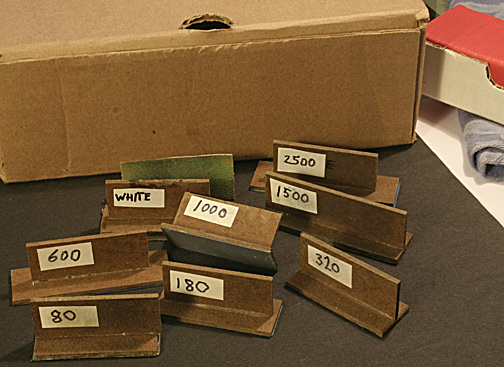
As I understand it a steel doesn't actually sharpen a knife, it's use is to "straighten" the burr that develops during use. I will use the steel a few times after a sharpening but after that I use small blocks of wet/dry grit sandpaper mounted with Tightbond III glue. Usually a few swipes with higher grits (1000, 1500, 2500) then green compound on leather. Once the sanpaper gets loaded O just wash them off. I love a sharp knife. My main kitchen knife (Henkel) will cut a tomato completely through by just the weight of the blade.
Re: O. T. Sharpening kitchen knives
TomD
"My main complaint about kitchen knives is that people use steels and hence kitchen knives are much softer than what I would consider ideal. If they were Rc 58 many could not sharpen them but they would respond better on a water stone. I don't own a kitchen knife that comes close to the edge I can get on the 3V knife or another knife made of 440 and hardened to Rc 58."
Well you know the solution to that one... Get a Japanese knife. Use them, and love them, but I have to say I prefer a chef's knife overall, and I have an excellent one that cost about 30 dollars. The commercial ones are a lot cheaper than that, and I agree with you on those.
Re: Lansky
TomD
I use a bunch of everything. My favourite all around system is the Lansky. There are cheaper versions of this, and most of the white sticks are pretty good. This one seems to have the perfect black stick. Does not clog, sharpens fast, and for some steels the edge is pretty usable. I use a trueangle hone for serrated.
http://www.knife-depot.com/knife-83086.html
One of the problems all us sharpening geniuses will face is dealing with dull knives. While a sharpener can keep knives going with a hone, a lot of people will leave sharpening far too long. Then they give the knives to us. There is nothing for those kind of situations to match a belt grinder and a buff, which you can also do on the belt grinder. I use the LV for this:
http://www.leevalley.com/en/wood/page.aspx?p=44884&cat=1,43072
I dream of making a more solid version of this with a proper contact wheel and a variable speed, powerful, motor. But I have to say, that over the years, I have been satisfied with this one, and have not felt the need urgently enough to actually do it. It is more than capable for kitchen knife duty.
Re: Lansky *LINK*
Bruce, a MN Galoot
Tom, did I give you this link before? Can't remember.
belt grinders
Re: Those cheap "x" steel things....
Bruce McCrory
.... because most kitchen steel is crumbly stainless and a couple swipes (metal scraping) will remove edge reflection, leaving a nice, fine saw-like edge that feels like hot steel sliding through butter; or, lard. $200 or a $2 special, they all do the same thing. Twenty minutes on the sharpening-system for every use is silly.
The only thing I got rid of over the years were serrated bread knives. And, the pokey steel.
I did knock off 3" from a forged 12" butcher knife that was massive compared to a longer Whustoff(sp). Was cutting corn-on-th'-cobb using a hammer. My wife's favorite knife. It looks like one of those hatchet jobs, now. Use it for slicing frozen tenderloin. And tomatoes.
You can sharpen scissors with the steel, too. 
Re: Those cheap "x" steel things....
Tom Colligan
Is there a way of telling if a knife is HC or SS? Thanks in advance,
Easy
Bill Tindall
Is it black after a little use? If not it is stainless. Or put a drop of water on it to evaporate. If rust remains it is not stainless steel.
there are some fine stainless knife steels, and some crappy carbon steels and some different philosophies in heat treatment, all which affect how happy you may be with a knife.
Re: Lansky
TomD
Thanks for that Bruce. I have come across it. That KMG grinder down the page is the one I have, and I made a small wheel attachment for it.
Re: Those cheap "x" steel things....
TomD
I can often tell by the look, shiny and cheap, or by the feel when sharpening like it doesn't want to be cut. Really stainless SS is non-magnetic, or at least not nearly as magnetic as regular steel, but most stuff that holds an edge is magnetic. Chrome in stainless will look a little chromy.