New WoodChat!
Home Articles Forums Gallery Marketplace Videos

WoodCentral Forums

Knowledge You Can Build On — Est. 1998

If you sell to woodworkers, your customers are already here

Alternative "Moxon" Vise

Posts

Alternative "Moxon" Vise

#1

Alternative "Moxon" Vise

Bill Tindall

First, to make clear my objectives. If someone gave me a Moxon vise and I had a handy place to store it and it mounted on and off my bench easily I would use it for sawing dovetails. There is no questioning its utility, and need, when it comes time to saw dovetails in something wide. But, consider that most of us are not sawing dovetails in something wide very often.

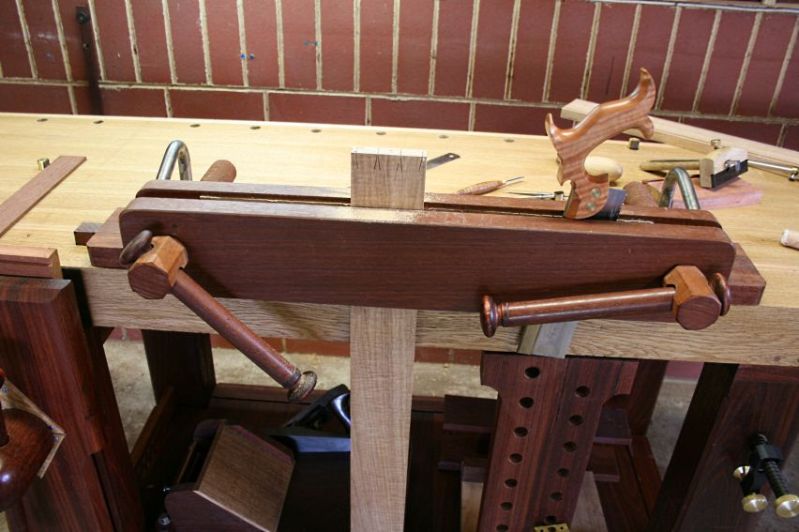
I built my multitasking bench long before I ever used hand tools to any extent. So, it is a large flat surface with a quick release vise on each corner and later I added some dog holes. So given the limitations of my bench and my unwillingness to spend time on making enhancements that are seldom used, how to solve the problem that the Moxon vise solves so handily? I post this solution in case a few others wish an effortless, but inelegant, solution to the problem.

For typical drawers I just clamp the stock in the vise. However, for the dovetailed tops of cabinetry and the occasional wide drawer the vise does not engage enough of the board to keep it from flexing while sawing. The arrangement shown below holds wide stock sufficiently and it is not inconvenient to use for the few times a year I need it.

Re: Alternative "Moxon" Vise

#2

PS handy for chain saws too

Bill Tindall

This arrangement holds the bar of a chain saw while sharpening just dandy. Two blocks are added to the jaws of the clamp to clamp on the bar but let the chain move freely.

Re: Alternative "Moxon" Vise

#3

Re: Alternative "Moxon" Vise

William Duffield

I've done it that way, too, but I use a second handscrew in place of the F-clamp.

The Nicholson bench, with all the dog holes in the wide front plank is intended for sawing dovetails using two holdfasts in the front.

I do like to get the stock up higher, and clamped higher for sawing dovetails, and for that the Moxon or my adaptation of the Moxon has some advantage. (Ref. my conversation with Warren in a previous thread.)

Mine does have some disadvantages. It is a lot heavier, especially with the end vise, and takes up a lot more room, than a traditional Moxon with wooden threads, or even that a modern Moxon design with the Benchcrafted hardware.

Also, either my hardware or Benchcrafted's hardware hangs out in front of the bench where you are liable to snag a pocket on it. I usually bury most of the all-thread behind the rear jaw, leaving just enough gap between the jaws for 4/4 stock. If I have to saw monster dovetails in thicker stock, I go get a crescent wrench, loosen the back nut, run the all-thread out and retighten the nut. The first time I snag myself, I go get the crescent wrench again.

As for storage, when I'm not using the Loxiliary bench, it makes great ballast under my lathe.

But for sure, you don't want the Moxon, in any form, hanging around on your bench when you are not using it, unless you can walk around and use the back side of the bench.

Re: Alternative "Moxon" Vise

#4

Re: Alternative "Moxon" Vise

John Pappas

I've mounted my vise so that the back jaw is flush with the edge of the bench. That allows a single Bessy clamp to hold the right edge. That is how I edge plane long boards.

Re: Alternative "Moxon" Vise

#5

Re: Misses the point

TomD

I do it that way also. One of my benches has the L face vise, and it will hold most stuff you want to do without any additional clamping.

That said, I thought a lot of the impetus for this kind of stuff was to have a secondary jaw set that is higher so that one does not need to bend over. It depends obviously on what height the whole thing is at, as to what the person has in mind. But if all you want is a wide jaw, then you could do as you have or follow those who prefer the widely set jaw, in LV chain gang form or otherwise. But none of that gets the piece up high. Of course you could raise raise the piece with basically the same kit and some jigging that you have shown. One way is to have a box at whatever height, hold the piece in the vise, then just clamp the upper edge to the box, etc... But at some point there will be an advantage to a higher set actual vise, and then it earns it's way. Pro shops have this kind of stuff in them, because they do cut dovetails a lot, and they need a comfortable place to do it. Assuming the person is doing real work...

Re: Alternative "Moxon" Vise

#6

when height is an issue...

Bill Tindall

I back the piece to be dovetailed with a backing piece that stiffens and raise it up. However, it just occurred to me that I don't do that any more so I must have learned to accommodate sawing lower. I saw different anyway, starting at the back of the piece to establish the kerf across the top and progressing forward and down to establish the kerf in the vertical. Maybe I do that to compensate for the height thing.

Re: Alternative "Moxon" Vise

#7

Re: when height is an issue...

Derek Cohen (in Perth, Australia)

The whole idea of the Moxon vise for dovetailing is to raise the work to a comfortable height. This is not only to save the muscles in one's back (which is important), but to alter the way you angle the saw, which changes the way the teeth enter the wood.

When the saw is angled downward, the rake of the teeth is effectively increased. This will make a dovetail saw - especially one with zero rake (such as a LN) - feel even notchier and difficult to start. Zero rake increases the aggressiveness of the saw, which makes it cut faster.


When the saw is angled upward, that is, starting the saw cut at the front of the board, the effective rake of the saw is reduced, thus making the saw cut more easily. Saws such as the LV dovetail saws have 14 degrees of rake, and this is the reason they are so easy to use (but slower). However most other makes range from zero to 5 degrees of rake.


Raising the height of the work makes it easier to angle the saw upward. This action is uncomfortable when the work is held low down.

Regards from Perth

Derek

Re: Alternative "Moxon" Vise

#8

Re: when height is an issue...

CStan

Don't doubt a word of it, but starting a cut on the near corner? Blasphemous! (your good results notwithstanding)

Re: Alternative "Moxon" Vise

#9

Re: Alternative "Moxon" Vise

CStan

FWIW, every bit of this is unnecessary with a Scandinavian style workbench. There are at least four ways to hold a part being dovetailed with this style bench.

Re: Alternative "Moxon" Vise

#10

Re: when height is an issue...

William Duffield

Have you changed your dovetail saw? A difference in hang angle can make a proportional difference in the height at which the saw is comfortable.

Another consideration, at least in my case, is that I didn't want to build both a Moxon vise and my Loxiliary bench and have to swap them back and forth. For carving and inlay work, I found the Loxiliary bench to be most useful at just about elbow height. This also means, with a 50w halogen work light and 3 diopter reading glasses, I can see my marks. It follows that I need a saw with a lower hang angle, if I don't want to risk carpel tunnel syndrome by canting my wrist at the wrong angle.

Re: Alternative "Moxon" Vise

#11

tell us more....

Bill Tindall

Here is the wilds of E. TN I have never encountered such a bench.

Re: Alternative "Moxon" Vise

#12

Technically true, no doubt....

Bill Tindall

but dealing with making and storing this vise is a high price to pay for not learning to start a saw. As you point out, the first time I used a LN saw I found it grabby stating with a downward cut. But in spite of my at best ordinary skills it was no time before I was able to slightly lift the saw while starting a cut and start it smoothly. And, no doubt someone sawing dovetails daily in a factory setting would be concerned with ergonomics. But if the furniture posting frequency demonstrated is any indication none of us are suffering from dovetail sawing.

What was done in 1720, or whenever, at a factory bench is not necessarily a useful guide to what makes sense in a shop focused on making a few pieces of furniture a year. In spite of the two claims that this vise is all about height, for an amateur shop its practical advantage is that it will be a secure way to hold wide stuff and at the same time flatten it if it is bowed, which invariably it will be to some amount.

Re: Alternative "Moxon" Vise

#13

Re: Technically true, no doubt....

david weaver

Do you have anything else that could double as the back side?

I didn't want to make an entire vise, either, but I had a hardwood rigid router fence that I had made when I used a router, one that I used for tall items and edge detail, etc (about 8 inches high). I didn't want to get rid of it in case I redo my kitchen, and had a place for it already.

All I had to do with it is drill holes in it, cut a piece of 8/4 lumber to size, and thread some large dowels. It takes up no more space now, and certainly gets more use, and could still be used as a router fence.

Re: Alternative "Moxon" Vise

#14

Re: Alternative "Moxon" Vise

William Duffield

Only four ways? That may be sufficient if all you are making is Shaker, or packing crates.

When you say "Scandinavian", if you mean the current crop of Sjöbergs benches, you'll be lucky if you can get them to hold anything securely, in either vise or against their misshapen excuses for dogs.

Re: Alternative "Moxon" Vise

#15

Re: tell us more....

CStan

Tage Frid's bench.... never seen it? Hoffman and Hammer is a commercial model one used to see in shops here and there.

Re: Alternative "Moxon" Vise

#16

Re: Alternative "Moxon" Vise

CStan

Absolutely not.

I'm speaking of a Tage Frid/ Frank Klausz style bench not benches with an iron vise.

More specifically, these benches do not have guide arms on the vises that restrict what can be clamped in them. I will say this for the Moxon - there is a nice wide space between the screws.

Re: Alternative "Moxon" Vise

#17

Re: Technically true, no doubt....

Derek Cohen (in Perth, Australia)

Technically true, no doubt.... but dealing with making and storing this vise is a high price to pay for not learning to start a saw. As you point out, the first time I used a LN saw I found it grabby stating with a downward cut. But in spite of my at best ordinary skills it was no time before I was able to slightly lift the saw while starting a cut and start it smoothly.

Hi Bill

My Moxon vise is stored under my bench. It is not in the way.


The vise is not a way of avoiding how to saw correctly. It is just an aid in sawing, full stop. It lifts the work piece to a comfortable height.


The LN is a terrific dovetail saw. It is one of my go-to saws (the other is an Independence Tools, on which the LN is based). I have not changed the rake angle on the LN. It did take some time to learn to use, and I would argue that it is definitely not the dovetail saw I would recommend for a beginner (the LV is my choice there).

Regardless of which saw - zero rake or high rake - sawing "up" is my preferred orientation because (1) it is easier to start the saw (the saw is less likely to jump off the line), and (2) you can saw to the two lines facing you (for accuracy).

Regards from Perth

Derek

Re: Alternative "Moxon" Vise

#18

Re: German vs Scandinavian Benches?

William Duffield

Sorry for my misunderstanding, Charles. I thought Frank Klaus's benches were in the German (or at least somewhere in the Central European, not Northern European) tradition. Maybe Ellis could help out here? IIRC, he helped Frank with the construction of his latest bench (the one with the purpleheart accents).

Refreshing my memory from The Workbench Book and other photos on the web, now, I see that the Klaus bench design and the Frid bench design are very similar, but in many ways different from the 1830's period German bench I restored a while ago. My understanding is that it was probably built in America by a German immigrant (but he could have originated in Alsace-Lorraine (Reichsland Elsass-Lothringen), which might explain the Roubo influences. In particular, it has a leg vise instead of of a shoulder vise, and the front posts are flush with the front of the top. (I don't think I need to explain how these two features facilitate dovetailing and other work on edges and ends of boards.)

Warning: It ain't pretty, but it does work, now.


Obviously, the builder was quite a bit shorter than we are, and probably used wooden planes instead of Bailey metal planes, and there was a lot of rot and wormholes in the bottoms of the leg posts, so I added the trestle feet. They're black locust, and end grain no longer touches the ground, so they should hold the bench together for another century or two.

Re: Alternative "Moxon" Vise

#19

Re: Technically true, no doubt....

William Duffield

MY informal multi-year survey supports your opinions regarding the L-N DT saw. I've see an incredible number of photos, videos and live demonstrations of hand tool woodworking techniques and classes by highly respected professional woodworkers and effective teachers, from Roy Underhill to Frank Klausz. The vast majority of them who work in the Occidental tradition use the L-N DT saw in their work. And I don't think this is just astute product placement by Thomas's marketing department. Note that I am not saying it is universal. For example, I've never seen one in Sam Maloof's or James Krenov's hand or even hanging on the wall in their shops. It's also my dovetail saw of choice, even though it has the disadvantage Derek and others describe. My advise to the beginner is to learn the other necessary sawing skills first on a slower saw, and then graduate to the L-N to learn how to start a fast saw.

Re: Alternative "Moxon" Vise

#20

Wandering a little OT...

John in NM

Hey Derek, just have to say I really like the handles on that vise :D

Re: Alternative "Moxon" Vise

#22

Re: German vs Scandinavian Benches?

CStan

Same thing Bill as far as I'm concerned. I use the terms synonymously which perhaps may be sloppy.

Here's a link for you. Enjoy:

http://www.workbenches.se/

Re: Alternative "Moxon" Vise

#23

Re: German vs Scandinavian Benches?

CStan

The bench I speak of DOES NOT have a leg vise, the screw of which impedes clamping certain workpieces.

Re: Alternative "Moxon" Vise

#24

Re: German vs Scandinavian Benches?

William Duffield

I agree, it's an impediment, but there is a work-around: Throw a pipe clamp across the bench and use it to clamp the right hand side of the board to the bench top. Ugly, but effective, and still necessary for blanket chests.

Not having used a tradtional shoulder vise, my first thought was that the chop and jaw would get in the way of sawing dovetails, but after due consideration, I decided the distance between the front of the screw and the jaw is still less than the length of my arm from the elbow to the back teeth of my dovetail saw, so it wouldn't be in the way at all. Also, I've seen Fran Klausz saw dovetails held in the tail vise, sawing parallel to the front of the bench.

Beautiful benches! Not at all like the Sjöbergs I'm used to. And in all the shop pics in the video, I didn't see one L-N ITDT saw. I'm suspecting a conspiracy. :D

Re: Alternative "Moxon" Vise

#25

Re: My "Scandinavian" Bench

William Duffield

Base assembly: (Disregard the mortises in the tops of the leg posts…Just a flesh wound.) That's not the groove for the board jack, it's a rabbet for a shelf.


Tail vise, with lower grove for board jack:


Attaching Face Vise. No, it's not Australian. The top is upside down, on a pair of saw horses (ref. first photo above), with one trestle leg assembly on top. Note upper groove for board jack.


Drilling dog holes to work with face vise:


Yes, it is Scandinavian. I built it completely from these Norway Spruce (Picea abies) glue-lam beams, imported from Norway. :D :D :D