Re: Round Dog Sizes -- John Ross
Texchappy
If (ok when) I want to add John Ross hold fasts to the arsenal they are 3/4" too.
Knowledge You Can Build On — Est. 1998
Re: Round Dog Sizes -- John Ross
Texchappy
If (ok when) I want to add John Ross hold fasts to the arsenal they are 3/4" too.
Update:
Texchappy
Figuring out new ways to clamp really helped so a big thank you to everybody.
I got my new bad axe 12inch today. It felt heavy until I got it into the wood and then it went ok. There was a definite difference in DPI and the bad axe cut much more slowly than the ryoba. Ergonomics felt a little better so I'm going to keep at it a while.
Got to planing too. Used the kanna set a little heavier (not quite moon toilet paper) and used it like a block plane to even up the long rip I screwed up. I suspect I will like BOTH kanna and western wooden planes. I sure could have used a trying plane today because I don't think the long edge I 'block' planed is quite level and square. But it was close enough that I felt some level of accomplishment.
I need to get back into Wiley's hole figurin' out strategy because I think a vise, dog, or something would have been very useful. I also need to find a way to buy, borrow, or steal a way to hold boards upright to saw down (i.e. the moxon). That would have made my life much easier.
Back to ryoba question and wiley's comment --- What is a good 270mm ryoba for me?
Kataba?
Texchappy
better yet, what is a good 270mm Rip katana for me?
Re: Learning curve - two solutions
Texchappy
Figured out going back to reading what Wiley put and what I did today that two things probably would have been the greatest help.
1. the inline vise from Lee Valley that Wiley linked would let me vertically hold a work piece.
2. a shooting board would have helped I was trying to square the edge of the board I was working on.
Re: Kataba?
Wiley Horne--So. Calif.
Tony,
There are numerous Japanese crosscut kataba (sometimes 'kataha') saws around. I searched rip kataba (kataha, also) and found only one. It is a 240mm (many vendors sell it):
http://www.craftsmanstudio.com/html_p/J15.114.250.htm
If you don't want machine made, or want a true 270-300mm, the next step up--that I know of--is either Mitsukawa or Kaneharu (Harrelson Stanley's house brand), at a few hundred dollars. Mitsukawa makes a range of different qualities, so each vendor seems to carry a little different line, at a little different (or sometimes lot different) cost. You have to call Harrelson, if interested in the kaneharu, which I believe to be good saws. The next step beyond those is Heiji, at several hundred dollars, and he makes really fine saws. Since you have a relationship with Stu, ask him about saws--he would know what's out there better than me.
From what I know, I wouldn't recommend anything beyond the Z saw for you, until you have made something to find out the limits--not of the tool--but of yourself. Found out what kind of recovery schedule and process is going to be sustainable for you. The most expensive and finest rip kataba in the world won't change the work equation much for you--ripping every stick can be extreme work, depending on project size.
The first question is: Are you going to be able to hand rip the stock for what you want to make? You can find out the answer to that with the Z saw. If the answer is 'yes', then Wow, that's great, you can do what you want to do. But if the answer is no, that's not a tragedy--I'd be amazed if anyone on this board hand rips all their stock. It's the grunt work job of all times, that and resaw.
'No' is not bad. If the answer is no, that's progress--you know what your direction must be. You know that if you want to continue the woodworking, you need a bandsaw. (You were emphatically against table saw.) And you didn't blow the budget on a handmade saw to find out.
Wiley
Re: Kataba?
Texchappy
Yep, probably not a good idea for me to get a Heiji until I limit the number of times per saw cut that I play accordion with it. It looks like the main options are 270mm just like my 210mm or a kataba with a combination tooth set.
Planing stops (lots of pics)
wilbur
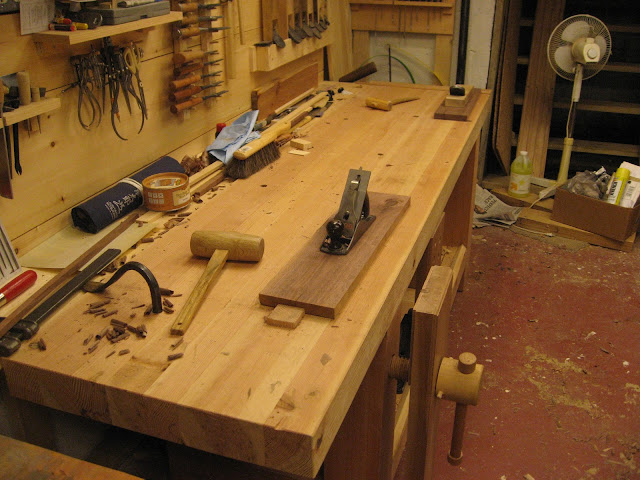
Planing stops are a quick and easy to install method of holding boards for planing. An end vise and dog holes will give you more secure holding in some cases, but you can't beat planing stops for ease of installation.
Here's the planing stop that I use with Japanese planes. It's a pair of 1/4-20 brass machine screws, threaded into insert nuts that sit below the surface of the bench top. The holes are countersunk so that I can screw down the brass machine screws so that they are completely out of the way. A piece of scrap wood goes across the heads of the brass machine screws.

Here's an action shot. The plane engages the board, which butts up against the scrap wood, which butts up against the brass machine screws, and everything is held in place by the force of the planing stroke.

The same principle can be applied to western planes, of course. Just turn everything around.
On the other end of my workbench, I have a different planing stop set up for use with western planes. It's a square piece of wood that fits into a square opening with a friction fit. The wood can slide up and down to accommodate different thicknesses of boards being planed.

I also have a holdfast hole placed so that I can place a piece of scrap wood across the planing stop that's held by the holdfast for planing wider boards.

And just for grins, here's both planing stops being used simultaneously.
Re: Planing stops (lots of pics)
Texchappy
Question on planing stops: would a couple of 3/4" dowels through that strip lined up with the dog holes work just as well?
Re: Planing stops (lots of pics)
wilbur
It sure would.
The thing I like about this method is that if for some reason the scrap wood I place against the screws isn't working for me, it's pretty quick to get another piece of scrap wood that's more appropriately sized. The usual situation is when I'm planing a thin board and the scrap wood is thicker than the board I'm planing, which then gets in the way. At this point I have a variety of 24" long strips of wood of varying thicknesses. But I didn't start out to make an arsenal of plane stops. My first one was a little under 1/2" thick, and I used it until I wanted to plane a board that was too thin for that piece of wood, so I got another piece of wood that was thin enough.
Re: Planing stops (lots of pics)
Texchappy
Ok, see what you're saying Wilbur. Thanks.
Re: Kataba?
Wiley Horne--So. Calif.
Tony,
Yes, I agree with you. I have the 300mm Gyokucho ryoba, and it's very handy to have around. The teeth are 9ppi crosscut and 6-1/2ppi rip. It's a softwood setup, meaning an aggressive rake on the rip side. But like all Gyokucho, it's way sharp and holds it's sharpness. Good saw to have around.
From what you related about the 210 Gyokucho, the main problem was that any deviation from a perfect cut would get the saw timber bound, so you'd have to make stop cuts in order to get a new heading. The antidote to that is a saw with a heavier plate and more set, so that it is cutting a wide enough kerf as it goes along to keep itself cutting freely. I've included some data below to provide some context on plate thickness and set. There is still the problem of the lack of relief in any ryoba, because the set will provide clearance only until the opposing set of teeth enter the cut, and then you have zero clearance.
Here are some thickness data (all in inches) I just mic'ed off of three 240mm ryoba--Gyokucho, Chuyemon, and Yataiki--plus comparable data on the 300mm Gyokucho. The data illustrate some points better than my words do:
___________________________________________________________
Weld Shank Plate Total Set
240 GYO N/A 0.020 0.020 6 thou
240 CHU 0.074 0.043 0.018 8 thou
240 YAT 0.090 0.064 0.020 8 thou
300 GYO N/A 0.028 0.028 10 thou
__________________________________________________________
Point 1: Taper and stiffness. The handmade saws gradually taper from their weld through the shank and into the saw plate. Note that the Yataiki is about 3/32" at the weld, 1/16" in the shank, yet tapers into a plate which is about the same thickness (20 thou) as the 240 Gyokucho. The Gyokucho has no weld nor taper, so its resistance to bending is established by the 20 thou plate thickness. The Yataiki feels like a far heavier and stiffer saw--and it is. The 240 Gyokucho has minimal set compared to the others also. [The Chuyemon is intermediate between the Gyo and the Yataiki--it's a nice saw too, for the money. There is a 295 Chuyemon I have often thought of buying.]
Point 2: Set. The figures above for total set refer to the difference in thickness between the teeth and the plate just above. So, for example, a total set of 8 thou refers to 4 thou each side. Note the two welded saws are at 4 thou per side; the 240 Gyo at 3 thou per side; the 300 Gyo at 5 thou per side.
Point 3: The two Gyokuchos. A huge frustration is that the US vendors provide the most meagre data on what they sell (only Dieter Schmidt in Germany makes an effort). Look at what is happening between the 240 and the 300 Gyokuchos. The bigger saw has 40 percent more plate thickness and 67 percent more set. It will hold its line better and is more resistant to being drawn off course.
Wiley
P. S. Sorry my ad hoc 'table' of data didn't render, but the info is all there. For each saw, there are 4 figures, measured in inches, of
weld thickness, shank thickness, mid-plate thickness, and total set (as defined above).
Hardwood Set? *link*
Texchappy
Wiley et al:
Since most of the wood I’m finding readily available is oak and walnut, would it make sense for me to look for a ryoba or kataba with a hardwood set like this one?
http://www.toolsfromjapan.com/store/index.php?main_page=product_info&cPath=316_318_502_482&products_id=1279
Does someone have one?
Wiley Horne--So. Calif.
Tony,
I looked at this saw at Hida Tool's website, and there they spell out that it is indeed 'hard wood set', not just hard point. They have it for $90, which is what you'd pay at this site, allowing for conversion rate (78 Yen to the USD plus currency conversion at 3%). Replacement blades $71.
I'd like to hear from someone who has one: Does anyone own one of these?
Wiley
P. S--Oh, that's Stu's site
Wiley Horne--So. Calif.
I wasn't trying to steer you to Hida. There's benefit to you in developing the relationship you already have. (My reason for mentioning Hida was to clarify hardwood set vs. hard point for the benefit of other forumites.)
What does Stu say about the 300mm Z-saw combination tooth kataba, w/11tpi? Is it tapered from tooth line to back?
Wiley
Re: P. S--Oh, that's Stu's site
Texchappy
No problem, I’ve ordered from both Hida and Stu. Linked Stu’s because he’s on here and also because Hida didn’t have the larger sizes listed (max was 225).
I’d also be interested in in the flesh (now there’s a gruesome picture) experience with it.
On a side note, Tomohito at Iida said it would take a week to handle the 3mm Ouchi. I haven’t heard from him. I’ve about decided that the 3mm is not that useful for me. If he’s already got it, I’d get it whether useful or not. Would it be bad form to not email and see if I get an invoice or let it go if he’s forgotten?
Re: P. S--Oh, that's Stu's site
Schtoo
Wiley wrote;
I wasn't trying to steer you to Hida. There's benefit to you in developing the relationship you already have. (My reason for mentioning Hida was to clarify hardwood set vs. hard point for the benefit of other forumites.) What does Stu say about the 300mm Z-saw combination tooth kataba, w/11tpi? Is it tapered from tooth line to back? Wiley
Hard point and hardwood set are the same saw. I know that because I asked the man who's name is on the saws...
Pretty much every decent Japanese saw is capable of sawing most NA hardwoods without trouble. Every saw I list is good for NA type hardwoods (as well as Europe and here in Japan), otherwise I won't touch them. The idea of modern mass/semi-mass production, good quality Japanese saws being unable to handle hardwoods is bovine excrement. Yes, some genuine 'hardwood' saws do exist, but the designation of 'hardwood' is stuff like ipe, bloodwood, ebony and the like.
No production Z Saw or Gyokucho saw has a tapered/hollowed saw plate. Every Tatsumi, Mitsukawa and Nokogiri-kobo saw (that I'm aware of) does have a hollowed/tapered saw plate and hammer set teeth. These better saws have most of the elements of a hand made saw, without being hand made and without the price tag.
However, I'd not ever consider willingly sending a hollowed/tapered plate saw to anyone who hasn't built up enough experience with a lesser saw like Z Saw or Gyokucho, simply because these higher grade machine made saws are brittle and will snap if abused. Abuse a Gyokucho will shrug off without protest will snap a hollowed plate saw.
I don't use 300mm Z Saws, and never a combination type saw except for their 250mm 'Hardwood' variant. The only Z Saws I actually have are the 250mm rip, the 250mm hardwood and a small dozuki type saw (I think). I've used nearly everything they make, but don't like them enough and don't have enough use for their saws to actually own many of them. I prefer Gyokucho where a Tatsumi, Mitsukawa or Nokogiri-kobo saw won't meet the need.
(Or when I need to rip down some chunks of something very hard. I'd rather chew up a cheap blade than an expensive one.)
Stu.
Thanks Stu,
Wiley Horne--So. Calif.
that's very helpful, especially your comment on Z saw versus Gyokucho and others.
I very much agree with you (from experience) that all the Japanese saws, whatever their filing, will readily handle No. American hardwoods.
Thanks,
Wiley


