We value your privacy.
We use cookies to enhance your browsing experience, analyse site traffic, and personalise content.
By clicking “Accept all”, you consent to our use of cookies. You can also choose
“Essential only” or learn more.
On another blog site, the question was posed as to the necessity of a vice. Personally, I could not do without them. The crochet(sp?) is ok, but I find my time better spent using my dogs and end vise. Because of my back, I dovetail with a Moxon vise. (it raises it to the correct height). One respondent spoke of hammering in a nail as a stop. This makes me shudder. A planing stop would work, but I do not want any more holes in my bench. What do the wizards here think?
There are perfectly acceptable alternatives to a vise. For edge work, many use a crochet, and holdfasts or clamps to hold the work against the front apron of the bench. For face planing, a plane stop or holdfasts and dogs. For end grain work, holdfasts and or clamps on the front apron.
Reminds me of David Ellsworth advocating purposefully rusting the bed of a lathe ( better grip of tail stock.) I told him I just couldn't bring myself to do it. He just smiled a bit.
Vises rule, as soon as they became possible they took over. Interesting that some of the cultures that don't use vises use wedges which is just a linear screw.
That said this is one of those internet subjects.
There are activities for which a screw or nail are best. I made tapered wooden battens for my trimaran sail. Great use for a japanese plane, because the action of planing tensions the battens. You want full access to the strip. I did one batch with a wedge and rope. Another option is to drill the hole for the tie off. Then put that hole over a screw head adjusted to be too low to be hit by the plane. Great system, and I really don't see a simpler alternative.
Another batch of strips I worked one were being cut to a constant thickness. They were beautiful cedar. I could have put them through a planer, but I felt it was a sad thing to loose the opportunity to hand plane such wonderful wood. That time I used an inclined finishing nail, clipped off, just press the strip down and plane.
The only metal that I want to penetrate the 3" maple top is the Gramercy hold fasts and the smoother when I re-flatten the top. I would suppose that if you had a soft top that the insertion of a nail would be ok. However, I would doubt that a nail would ever come back out of the maple.
For years and years I put up with a face vise that racked and many work-arounds to hold parts. It got the job done.
However, now that I have a decent bench with decent vises, that include working dogs, all I can say to those that continue using work-arounds is ... you don't know what you are missing! The vises, et al, have transformed my work at the bench, which is the most important handtool of them all.
McKay....for what its worth, I'm a traditional vise guy....but what I'm a little curious about is the relationship between the amount of personal investment a woodworker has in his bench and the type of use(abuse)/attitude that woodworker has toward his bench....I would suppose that if one were to make their own bench and invest a lot of time, effort, money, sweat and tears in the build that they would be very unwilling to drive nails into it or "mis-use it" in some other way.....and if one had little personal investment in the bench (they bought it, made it in an afternoon with material from the big box, found it abandoned on the side of the road, etc) then they are probably more inclined to smack in a 16p here and there when it would solve the issue of the moment after all "its just a bench".....but then again, I'm frequently told I'm mistaken.
One guy here is planing, the other is rabbetting. These fellows certainly knew what a vise was; there are leg vises and bench dogs illustrated in the same volume. However it is much faster not to have to clamp the board in place. Using your set up, to switch from one board to the next you have to loosen the hold fast, loosen the end vise, switch boards, tighten the vise, and then reposition the holdfast. You can call this "time better spent" if you want, but when I groove drawer parts I just pick up one board and replace it with the next.
The assumptions some of you make never cease to amaze me. My assumption, therefore, is that you subscribe to the "guy who has the best toys when he dies wins" theory of life. It's simply not true that we all think you have the best toys or that we'd have them if it weren't for lack of something, whether money or space or general superiority.
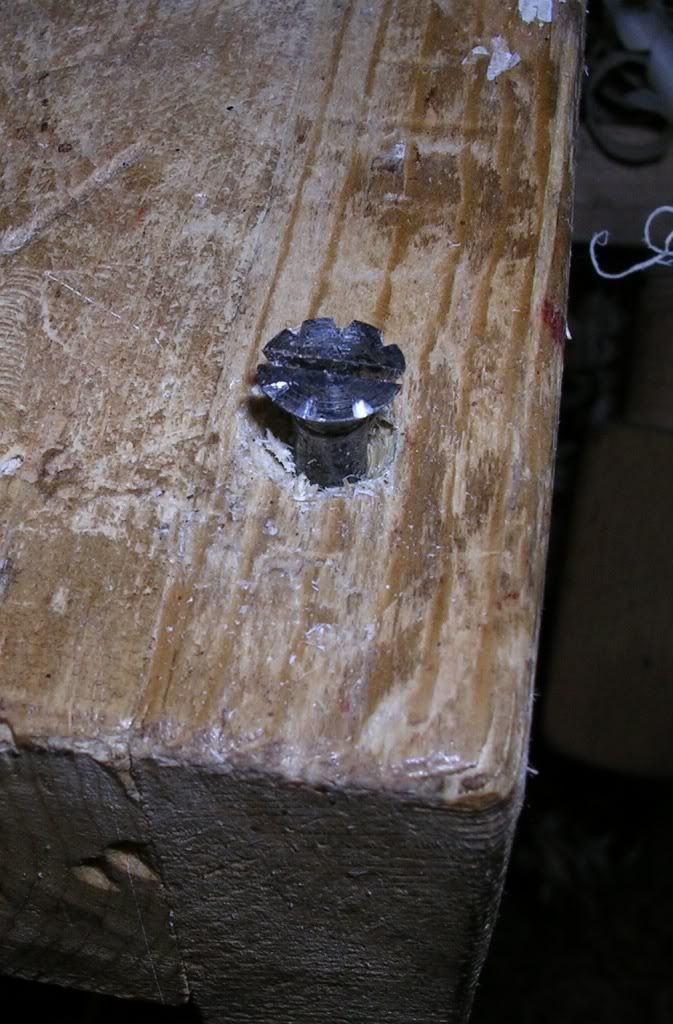
Using a screw in the bench is not some sort of make-do solution, it's superior in certain situations. For example, I leave two screws at the base of the planing beam attached to the back of my bench so I can place a board quickly and securely for gravity feed planing. They never get in the way, hold the board perfectly, and are easily adjustable for different thicknesses. Get it?
Pam, I have used a screw in the bench. I have used strategically placed supports, and wedges and whatever else I could think of. I find that the tail vise and dogs has made my life at the bench so much easier. That is what I wrote.
McKay, the opening post, asked whether others feel the same.
I do not see Warren's reply to be a contradiction. Just another response. His work situation is different. He does this for a living and time is money.
That's pretty much exactly what I was asking you. You said you'd used many work arounds, which description says second rate; whereas as now you think you have a superior solution. What I said was, often a "work around" IS the superior solution. I know you read and understand English and you're very intelligent, so let's see some evidence of that. No one is allowed to play dumb here.
I do not have a permanent vise attached to my bench. I do have a crochet, bench hook [not a side rest], two adjustable planing stops and one screw. When not in use it easily goes down below the surface, and it can be adjusted to any height.
You said you'd used many work arounds, which description says second rate; whereas as now you think you have a superior solution.
Pam, I think that you read too much into my post. All I wrote was that my previous need for "work arounds" - using work supports of many shapes and forms - has been surpassed by the use of a vise and associated dog system that works well. I put off building a decent bench and vise for years, and my comment was to those who were guilty of doing the same. If you are happy with what you have, then you do not fit in this category.
Roger, I don't have screws in my bench. I guess I would if I wanted them. I have screws in my bench to hold the vises in place. I use the screws in planing beams, beams are superior in a lot of situations since they can be any length, are cheap, can be kept flat, or built out of composites that do not shift, moved to where they are needed, and so forth. I have several benches, and beams around the shop, and I store the beams on the wall when not in use.
I might also use screws in fixtures. They could also be mounted in dogs as a mini dog, or on blocks held in vises. So there really isn't any need to worry about the condition of your bench.
I agree with you on benches. I keep mine pristine for a variety of reasons. Pride and love. I made it and like it. I also think a bench like any part of your shop (gulp) is an advertisement for the contents of your mind, and you abilities. But most of all it needs to be functional. A rough bench damages certain kinds of work, guitars being the extreme case in my shop. Really a proper guitar bench needs a surface of shag carpet, but I just don't like that. Pristine surfaces are as close as I can get. And right at the moment they are down there somewhere.
There was nothing indecent about your previous bench. I always read your posts carefully because you always have something to say; although I don't always like it. It's not that I take your posts personally; but I do take them seriously, and I don't like it when a superior attitude is allowed to prevail. So when I and/or others say that we use screws purposefully, I expect you and everyone else to respect that.
Pam, I find your attitude to be unprovoked and overly defensive. I don't think I'm projecting a superior 'attitude' if I say that I find that while a simple screw can be used and perhaps used adequately for some, that I believe it inferior to the versatility of benches fitted with vises.
Rather than a superior attitude, I'm projecting what I believe is a superior 'opinion', as I've experienced a screws or other primitive stops to be inferior to my own bench. In fact, the reason I built the bench I have is because I believe it to be overwhelmingly superior to such primitive improvised holding devices. I don't, however, begrudge you your choices but neither do I demand you respect mine. That's not realistic.
"So when I and/or others say that we use screws purposefully, I expect you and everyone else to respect that."
Don't. Don't expect me (everyone else) to respect that. I don't.
While I think it's fine if you choose to use a screw instead of a vise, and while I respect your right to do so and have your opinion, that doesn't mean I don't think your system is inferior. Why and how can you demand I respect your choices? I clearly do not in this case. And why is that a problem to you?
Perhaps differentiating what it is that we should respect makes it clearer. Really, it's enough to respect each other as people on this forum, to politely and respectfully agree or disagree, but that hardly means I have to respect your opinions, which often I don't. I do, however, value you as a person and enjoy most of what you have to say, but I do get rather rankled and prickly when someone tells me what to think or do.
I use a brass plate with a slight undercut that fits into the dog holes (I have three equidistant rows). This projects just under an 1/8" above the table surface. In addition to this I have several other stops that fit into dog holes, some which swivel. Also, I have a threaded stop which can clamp very thin stock for planing when needed. (I even have a shorter stop that allowed me to plane and scrape timber for plank-on-frame admiralty-style hull models.
The first benches I ever worked on with hand tools had projecting screws to stop wood for planing and I can only begin to tell you how much I hated that. When something slipped, it would damage it. It damaged the endgrain. It was usually in the way and otherwise annoying. Again, I don't expect your experience to necessarily accord with mine, but I do think a screw in a bench to be inferior for many tasks.
And I don't demand you respect that one damned bit.
[appended on edit]
The last thing I made with those stops was a set of mahogany fan blades for a vintage ceiling fan restoration. Balanced them within a gram of one another with a smooth plane. Sweet.
BTW, I've seen Ian Kirby work without a vise. Fast, too. To each his own.


 It's not that I take your posts personally; but I do take them seriously, and I don't like it when a superior attitude is allowed to prevail. So when I and/or others say that we use screws purposefully, I expect you and everyone else to respect that.