New WoodChat!
Home Articles Forums Gallery Marketplace Videos

WoodCentral Forums

Knowledge You Can Build On — Est. 1998

Fast and affordable laser cutting – so you can make the parts you can’t find anywhere else

Diamond film

Posts

Diamond film

#1

Diamond film

Bill Tindall

There was a recent discussion here about diamond films. The latest Lee Valley newsletter features these films, extolling diamond's virtues. Light oil is recommended as a lubricant for these films. In my opinion these films would be a great idea if they were a available in 12" long strips.

I am speculating that the films are based on polyester(Mylar or its cousins). Mylar will absorb oil to some degree and this absorbed oil will soften the film. I don't know how much it will soften nor whether the softening will affect performance. Those tending to be paranoid (me) would be inclined to avoid oil for this reason.

It was stated that oil removed the gunk better than water. I suggest paranoid persons try water with a bit of detergent instead of oil. If diamond plates are any analogy water and a bit of detergent works fine for keeping the diamonds from getting clogged up with gunk.

The gunk issue is why I don't see any virtue in coating diamonds on wood substrate. How does one get rid of the gunk? It floats away from diamond plates, diamond on cast iron and diamond coated films, thereby keeping the diamonds exposed.

Re: Diamond film

#2

'zat color or BW?


Re: Diamond film

#3

Re: Diamond film

Derek Cohen (in Perth, Australia)

There was a recent discussion here about diamond films. The latest Lee Valley newsletter features these films, extolling diamond's virtues. Light oil is recommended as a lubricant for these films. In my opinion these films would be a great idea if they were a available in 12" long strips.

I am speculating that the films are based on polyester(Mylar or its cousins). Mylar will absorb oil to some degree and this absorbed oil will soften the film. I don't know how much it will soften nor whether the softening will affect performance. Those tending to be paranoid (me) would be inclined to avoid oil for this reason.

It was stated that oil removed the gunk better than water. I suggest paranoid persons try water with a bit of detergent instead of oil. If diamond plates are any analogy water and a bit of detergent works fine for keeping the diamonds from getting clogged up with gunk.

Hi Bill

I wrote about these issues earlier. Basically, I believe that the film is available in either 6"- or 12" long sheets. For comparison, most waterstones are around the 8" length. The sheets LV sent me were 5 1/2" x 11". To maximise their use for experimentation I cut these into quarters.

Here are four sheets attached to a 1" thick granite strip:
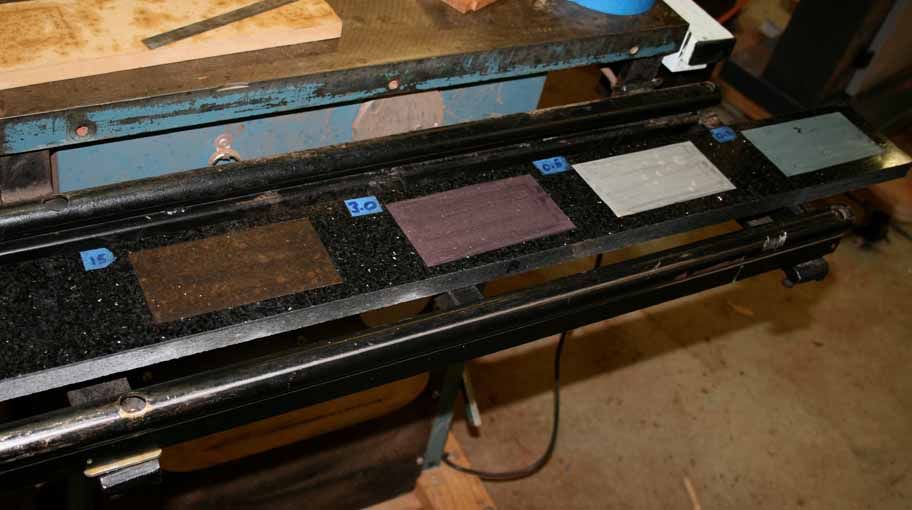

I experienced little difficulty adjusting down from the length of my Shaptons to the 5 1/2" length of these sheets. My honing included freehand and guide use. As a result I recommended that the standard 6" x 3" sheets be offered for sale, with the economics of the price range in mind (I am sure that I was only one voice among several). As good as these sheets are - and they are very good and long-lasting - they are still a consumable, and this gets costly over time.

With regard water (or water-detergent) versus oil as a lubricant/cleaner, the original instructions were for plain water. I tried this, and immediately recommended water-plus-detergent, which is better. Within a few days both LV and I simultaneously discovered that oil was better. I recommended Camilia Oil as this is both light and does not affect the finish on wood. It is a significant step up from the water-detergent mix. Perhaps Wilbur will confirm how much a difference as he tried it after I badgered him to do so :)

Does the oil soften the mylar substratum? I cannot say, but in months of using it I have not noticed this.

Regards from Perth

Derek

Re: Diamond film

#4

Confirmed

wilbur

I tried out the diamond films using oil to carry off the swarf. I used mineral oil. Actually, it was baby oil, which is the same stuff, but smells nicer. :D

The oil worked much better than water in terms of managing the swarf. So much so, I thought, that if I was in charge of the Lee Valley catalog, I would remove any mention of using water for this purpose.

I also tried water with some detergent. Oil still wins hands down.

I still like my waterstones better, though. :D

Re: Diamond film

#5

data

Bill Tindall

nothing like data to dispel paranoia.

As far as length, once I get my bevel adjusted to the abrasive surface I want to pull the tool across the surface as far as the length of the abrasive will allow. At one time in my history I ground and polished metal test pieces. There was a rig for this task that was a fancy and expensive version of sticking abrasive sheet to a glass plate except this thing held the sheets on a ground cast iron plate and provided a flow of water for lubrication. The silicon carbide abrasive came in adhesive backed sheets about 3 x 12". It was efficient to use the entire length of the sheet and the test piece was only pulled across the abrasive. A back and forth motion hindered precise registration of the test piece to the abrasive. Perhaps this history is where I became fixed on using long abrasive formats and only pulling tools across abrasive. But in any case it is the only way I can successfully free-hand sharpen.

Re: Diamond film

#6

Re: Confirmed

TomD

I guess I will pass. I can certainly use oil, but I prefer methods that use no lubricant or in season use water.

Re: Diamond film

#7

Re: Confirmed

TomD

Has anyone tried using a paste? The thickened olive oil that is the carrier for diamond paste is OK, and I don't see why that wouldn't work here.

Re: Diamond film

#9

Re: do you mean apply diamond paste to Mylar?

TomD

I was thinking of a less yucky lubricant than oil, as far as woodworking is concerned. With machine oil I have to have a way of cleaning it, and I don't have a sink. In a sense it is oil, but thick olive oil. I suppose one way to source that material would be with a dab of finer diamond paste, though it might well abrade the mylar and ruin the film.

Re: Diamond film

#10

Lubricant for diamond paste

Steve Elliott

I was thinking of a less yucky lubricant than oil . . . .

Mineral spirits (paint thinner) has worked well for me when using diamond paste on cast iron and on worn-out chromium oxide lapping film. I just use a little to thin the paste down and to clean up as needed. Usually I end up with all the gunk on small pieces of paper towel and not on my hands.

For lapping the back of a blade WD-40 is better because it is much more slippery.

Re: Diamond film

#11

Re: Diamond film

Jim Barrett

Just received the "diamond film" from LV. Mounted the strips on a piece of 1/2 mdf. Just received a #4 LN HAF plane and proceeded to sharpen the blade. All I can say is WOW....not sure if it is a combination of the new plane and the diamond film but I am producing wonderful shavings. I used Camellia oil as a lubricant and that worked quite nice. I have water stones but I hate the mess...

Would I be better off mounting the film on glass or a granite plate?

Jim

Re: Diamond film

#12

Substrate

Bill Houghton, Sebastopol, CA

"Would I be better off mounting the film on glass or a granite plate?"

I'm no kind of expert, but I suspect the answer would be, "whichever you can get cheapest (that you're confident is flat)."

Re: Diamond film

#14

Dry, water or oil?

Derek Cohen (in Perth, Australia)

I can certainly use oil, but I prefer methods that use no lubricant or in season use water

One can use the diamond film in any way you choose. It still works well. However the best results come from an oil as lubricant, for both performance in abrading steel and longevity of the film. As I mentioned, I prefer Camilia Oil as it does not affect the finish, and many of us use it to preserve tools anyway.

Regards from Perth

Derek

Re: Diamond film

#15

Re: Diamond film

Jim Barrett

Sure that makes sense, duh...

Thanks,

Jim

Re: Diamond film

#16

Re: Diamond film

Cecil Nickerson in Halfmoon Bay

A B-grade granite surface plate (12X18) accurate to 1 ten thou will cost you about $40.00

Re: Diamond film

#17

rock source

Bill Tindall

trimmings at your local rock counter top fabrication place will cost nothing. The trimmings from back splash are particularly handy size.

Re: Diamond film

#18

Camilia Oil vs olive oil

Bill Tindall

Chemically these two oils are nearly identical, although they may differ in minor constituents. Has anyone tried substituting cheap and readily available olive oil for Camilia Oil in its various applications?

Re: Diamond film

#19

or used camilia oil on their pasta ?


Re: Diamond film

#21

Re: Camilia Oil vs olive oil

Alex Grigoriev

I'm afraid olive oil may gunk up, although it's considered non-drying.

Re: Diamond film

#22

Re: Diamond film

eliotandmax

I'm the first to admit that I'm not the hand tool expert of the ilk that I see on this site. (But I'd like to be!I can be as obsessive as the next guy.) I do have two diamond sharpening blocks( I think they go by the name, DMT or something like that; one is red and the other is green.) All this stuff about diamond film and paste has me wondering if I'm badly out of date. I also have a set of Norton water stones, including a flattening stone (which I'm sorry to confess I've never used), and these seem to work well. I mean I can shave the hairs off my arm, and the chisels cut nicely into soft wood across the grain.) But I am thinking I may be more or less out if it now? I really got worried when I see that there's a question about moving the chisel in only one direction!!! Can you give me some general advice? Thanks-- lost in sharpening land.

Re: Diamond film

#23

Re: Diamond film

Pam Niedermayer

This is more important when using sandpaper for sharpening since when you move the chisel forward while on the paper you increase the risk of rolling into the paper and dubbing the edge. Only pulling the edge allows you to control things a little better.

Pam

Re: Diamond film

#24

a summary of diamond sharpening

Bill Tindall

1. If you are sharpening some of the tool steel tools, which you likely do not have, diamond is the best way to cut these abrasive resistant materials. That said, if you read the information from Lee Valley, some of their water stones will sharpen the abrasive resistant tools steels, for example M2 steel.

2. Diamond abrasives cut faster under some circumstances, but again not an issue you likely need to worry about.

3. If you don't own any sharpening materials diamond abrasives can be a cheap way to get into sharpening.

Bottom line......if you are successful with what you are doing there is no need to consider diamond abrasives. Unless you are dealing with an abrasive resistant tool steel, diamond will not get an ordinary carbon steel tool any sharper.