New WoodChat!
Home Articles Forums Gallery Marketplace Videos

WoodCentral Forums

Knowledge You Can Build On — Est. 1998

Build it. Rock it. Rockler has your woodworking tools.

Bench questions

Posts

Re: Bench questions

#26

Re: Do you plan to mount your Moxon in the leg vis

Pam Niedermayer

OK, you're not going to respond to my question, presumably because you think it stupid since you plan to continue clamping the Moxon to the bench top. I think the Moxon mounting with f clamps that has to be done everytime you want to do dovetails is incredibly cumbersome and fiddly. So my first job would be to devise a way to mount it more quickly.

Pam

Re: Bench questions

#27

Like between dogs maybe....


Re: Bench questions

#28

What?  I'm more frugal than Bill Tindall?

Bill Houghton, Sebastopol, CA

I'm sitting here at the computer, thinking of my grandfather's bench, built with rather crude Douglas fir, with a bench stop consisting of a fine-grained piece of fir (the only fine-grained wood on the whole bench) that was a tight fit through a mortise in the benchtop.

It's a continuum, of course. Grandpa was building during the Depression, and his economic choices were limited, to say the least. He was some distance over toward the "use what you've got" end. At the other end, there are some folks (I'm not thinking of anyone here) with the money to buy furniture grade wood at boutique prices to build their benches.

I agree with Bill Tindall and others - a lot depends on how stable that species is. But if it's a stable wood, why not use what you have?

Re: Bench questions

#29

Re: legs

Patrick Gibbons

My legs are made from 4"x 4" so they are 3 1/2" square douglas fir. This is too small. Five inches is better and I would increase the three inch dimension you mention to four or five. Stout legs seem to me to be the main ingredient for stable benches.

Re: Bench questions

#30

With lateral thinking there is a solution ...

Derek Cohen (in Perth, Australia)

It's a continuum, of course. Grandpa was building during the Depression, and his economic choices were limited, to say the least. He was some distance over toward the "use what you've got" end. At the other end, there are some folks (I'm not thinking of anyone here) with the money to buy furniture grade wood at boutique prices to build their benches.

I agree with Bill Tindall and others - a lot depends on how stable that species is. But if it's a stable wood, why not use what you have?

Thanks Bill. Your post was just the incentive I needed to initiate my response, below.

I was going to post this a little later in the day - my day, that is. It is about 1 pm here, and we are just back from the beach. This gave me a chance to switch off and think about the options.

Firstly, I could go out and purchase the Jarrah boards to make the legs. There a couple of reasons why I do not do so. It is not simply that these would be expensive. Expensive? Very! I estimate that each leg would end up costing about $125 - $150. That is about $500-600 for the legs, and we have not yet got to the stretchers.

Why is Jarrah (Eucalyptus Marginata) so expensive? Because it has been over-logged in Western Australia for over 100 years, with the timber being exported around the world for bridges and roads. The trees only grow in Western Australia - no where else - and the forests have been decimated. The logging continues, in spite of the frequent protests from the Greens, because the public generally places money above the environment. I really do not wish to support this industry, and 90% of the Jarrah I use comes from salvage - old roof beams, old flooring, etc. Some from the renovations in our house (all the roof beams are rough sawn Jarrah), and some from skips (dumpsters) when houses are demolished (but now there are businesses buying up the old timber - that's OK with me. At least it gets a second life, and I will - and do - happily purchase that).

Secondly, let us not forget the most important factor here - this is a workbench, not a piece of furniture for the home! Yes, I would like to build a bench that is as faithful to the principles of Roubo, and guided by the recommendations of my friends on the forum, but it is still just a bench. Anything I do will be totally overkill compared to the bench I have been using for the past 18 years. I must add that, prior to the current bench (skinny cretin that it is :) ), my previous "bench" was a door over trestles. This lasted 7 years while we lived in and restored our previous house. So I have had 25 years working with poor benches. I do believe that anything better than I had will last another 25 years, at least. ;)

So ... I thought about what I had to work with, what wood I had on the rack, and hatched the following plan which I shall describe, and then go off and cut the parts to show you later ..

Bill H made sense when he argued against placing a mortice at the centre of a join. Bill T does not like laminating thick boards - but I don't have a problem with this if they are dry, and the Jarrah I have is Dry (chopping into this stuff is doubly hard as a result) and stable. Toms' story backs me up.

The solution is ... may be - I will hear from you I hope ... to create a sandwich with full width boards on the outside. Inside, the two sections I previously showed will be used, BUT one piece will be recut to sandwich a thick section which is centred in the fill. Now a mortice can be created in solid, un-edge-joined timber.

Since the added laminated with be about 3/4" thick each, I anticipate that the legs end up about 5" long x 4" thick.

Whatdoyouthink?

Pictures later.

Regards from Perth

Derek
Re: Bench questions

#31

Re: Like between dogs maybe....

Pam Niedermayer

Yeah, or even make a couple of over sized dog holes suitable for the Moxon.

Pam

Re: Bench questions

#32

Like Craftsman furniture?

Pam Niedermayer

I don't know how what you're planning to do with the legs is all that different from many legs built for Craftsman furniture, where a box is built around a core leg. Now people do that to make the legs quartersawn all the way around, but still, it's very similar.

Pam

Re: Bench questions

#33

Changes ...

Derek Cohen (in Perth, Australia)

Hi Pam

My apologies for not replying earlier.

I plan to build a new Moxon vise for the new bench. The idea of the Moxon is to hold the work up high, and a lower bench means that the old Moxon will not add much in the height department.

I think I mentioned that the new bench was to be 34" high. That is wrong - that was (is) my existing bench. The new bench needs to be about 31" (for my height of roughly 5' 10" ... we measure here in the metric -178cm). Some may say that 31" is still high but I am used to a higher bench, and dropping 3" is significant.

I agree with you that clamping the Moxon is clumsy. I will create a new system. Perhaps the end vise will be sufficient?

Regards from Perth

Derek

Re: Bench questions

#34

Exactly! Well almost ...

Derek Cohen (in Perth, Australia)

... The sides will not wrap around to cover the end grain.

I wasn't aware that this is a Craftsman Technique, per se, although I am aware of the method of wrapping a special board around a core of lesser quality.

Regards from Perth

Derek

Re: Bench questions

#35

New legs

Derek Cohen (in Perth, Australia)

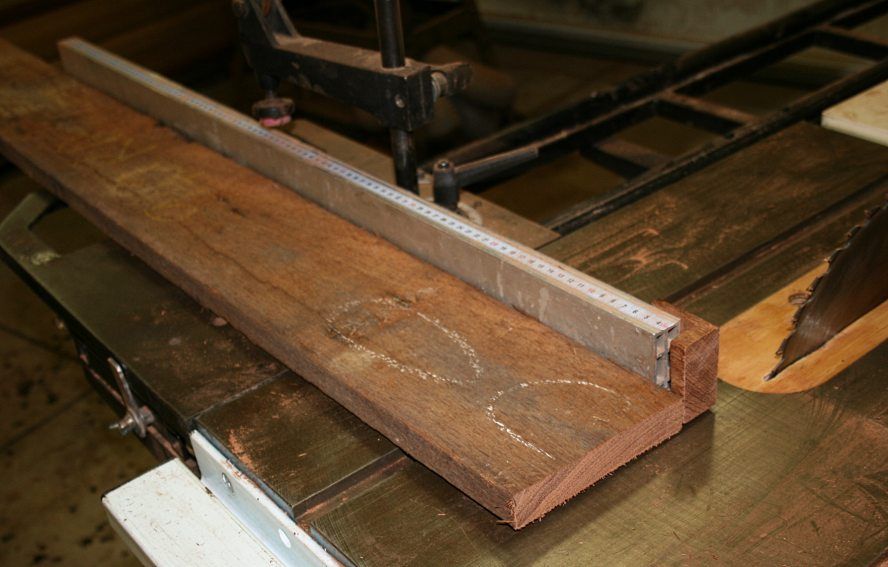
I spent the afternoon preparing the Jarrah boards for the outer part of the sandwich that will be the legs.

As I mentioned in an earlier post, I try and re-use reclaimed timber. Here is an example. Woolly and twisted ...


One side gets jointed then, because the thickness of the other side is so uneven, I use the bandsaw to cut to the approximate thickness before planing out the saw marks ...


The Jarrah "infill" was ripped to width on the tablesaw. There is now enough meat in the centre of each leg to accept a mortice ...


The wooden screw for the leg vise has a 2" diameter. This will easily fit into the 3" central section in these legs ..


The legs are yet to be glued up. Once done, final dimensioning will be done. The sides (end grain) could be stained to match the fronts. Or I am toying with the idea of mitering and wrapping boards around the infill.


The legs are now 5" wide and 3 5/8" thick.

Each leg weighs 10 kg (22 lbs).

The bench top is expected to weigh 80 kg (172 lbs).

Still to add in stretchers, chop, and end vise.

Regards from Perth

Derek

Re: Bench questions

#36

Re: New legs

roger lance

Following this bench build is going to be interesting....got to stock up on some popcorn and Foster's....

Re: Bench questions

#37

Jarrah properties and glued assemblies

Bill Tindall

With all the discussion about Jarrah I became more curious about this species. In particular I wondered why it was exported for bridges but not fine furniture. The answer was found in The Encyclopedia of Wood published by the US Department of Agriculture, Forest Products Lab. Of all the foreign and domestic species tabulated, Jarrah is one of the least stable (stability toward changes in moisture content) woods, exceeded only by ebony. Of the native US woods only persimmon comes close in instability. Of the woods typically used in furniture it is nearly twice as unstable. This species will be particularly difficult to dry without warping and checking.

There are two elements to stability relevant to furniture discussion. One is the overall volume change of the species in response to changes in moisture content(humidity). A measure of this property is the volumetric shrinkage that occurs upon drying the wood. For typical furniture woods this value ranges from 8-14%, and for Jarrah it is 19%. If something made from Jarrah will be in an environment subject to large humidity swings it will be especially important to use joinery tolerant of dimensional changes in the wood pieces.

The other factor is difference between radial and tangential shrinkage. This factor is of critical importance in gluing up assemblies such as a leg or butcher block. If this ratio is high, for example in the case of elm, changes in humidity will stress a joint that joins quartered and flat grain. The difference for Jarrah (2) is similar to typical furniture woods, and better than some. An assembly like the proposed leg with the various joined grain orientations in the assemblage should be no more stressed in response to humidity changes than a leg assembled from a typical furniture wood species.

That said, tabulated values are averages for a species. Individual boards may occasionally differ considerably, for better or worse.

Re: Bench questions

#38

Dimensional change

Warren in Lancaster, PA

Bill, I think a lot of researchers lump two kinds of moisture response together. One is dimensional change when drying and the other is dimensional change of seasoned wood from humidity changes. I don't doubt there is mild correlation, but seasoned wood is somewhat different. Ebony may shrink a lot, but we have had no problem using it for scientific instruments. I have a nice 19th century ebony sextant that my great uncle gave me as a boy.

Here is an example which suggests more complexity. I bought a glue pot about 30 years ago. One of my friends suggested I make a wooden cover so the glue would stay warmer and not dry out so fast when heated. He said that the cover would warp after a while. (It warps because it is warm and humid on the under side because of the glue.) Then I should reverse it and have it warp the other way. Eventually it would stop warping. I may have flipped my cover 10 or 12 times the first year, stable ever since.

Re: Bench questions

#39

You raise an important point

Bill Tindall

In these matters I look to Gene Wengert (I may have the last name spelled incorrectly) for data. While he was at VA Tech his group did a study on the response of wood to drying cycles. Unfortunately I have lost the publication from that study. However, I corresponded with Gene to confirm my recollection of the results. The results have relevance to air dried vs KD wood and the topic at hand.

The tabulated data for shrinkage is derived from measuring the volume change of a piece of wood from fully saturated to bone dry. It would be easy to dismiss these data as irrelevant to changes in dimension of KD wood in response to humidity changes. However, Gene said there was good correlation between the shrinkage data and stability in use. One only needs to look at the data to see that the widely used furniture woods are all stable by this measurement and that unstable woods, American Elm and Beech for example, were eschewed by furniture makers.

Furthermore, the shrinkage as a function of water content is approximately linear, consistent with the notion that water occupies volume in wood. When wood takes up water the wood swells in response. Furthermore, the response is species dependent; some swell more and some less.

It is said that the stability of KD wood is no different from air dried wood once each has equilibrated to the environment. The studies found otherwise, however the differences are not large. Wood dried lower that the moisture content it will experience in use will not regain quite as much moisture as wood air dried to the equilibrium value. Hence, it will not change dimension as much. It was speculated that some hygroscopic volatiles removed in the KD process were responsible for the small difference.

I have never seen data on volume changes for wood exposed to numerous cycles so I can not comment on whether old rafters exposed to hundreds of moisture cycles( to address the topic at hand) would be more stable that freshly KD lumber. If the equilibrium moisture content at some humidity level of these two examples are equal then I would predict that each would be equivalently stable or unstable. That would be a good experiment for someone to try. Persons that own bread boarded tables tell me they have seen approximately the same seasonal changes in width of the table, as "measured" by the long grain bread board, for many years suggesting that wood does not become more stable with age.

In the mean time I think it is prudent to take special precautions when building with woods that appear to be unstable and especially so for woods that have a large difference in tangential to radial shrinkage. Furthermore, one can expect considerable difficulties in drying these woods. Dismiss the warning if your experience differs.