New WoodChat!
Home Articles Forums Gallery Marketplace Videos

WoodCentral Forums

Knowledge You Can Build On — Est. 1998

Super Resolution Thermal Imaging Camera

Chisel Blade Testing - 5 Steels

Posts

Chisel Blade Testing - 5 Steels

#1

Chisel Blade Testing - 5 Steels

Derek Cohen (in Perth, Australia)

There has been considerable discussion about the merits of the "new" powdered metal super steels over the past year. Of course these are not new steels - they have been around quite a while and "old hat" to knife makers. However they represent new possibilities for woodworkers in the form of longer-lasting edges.
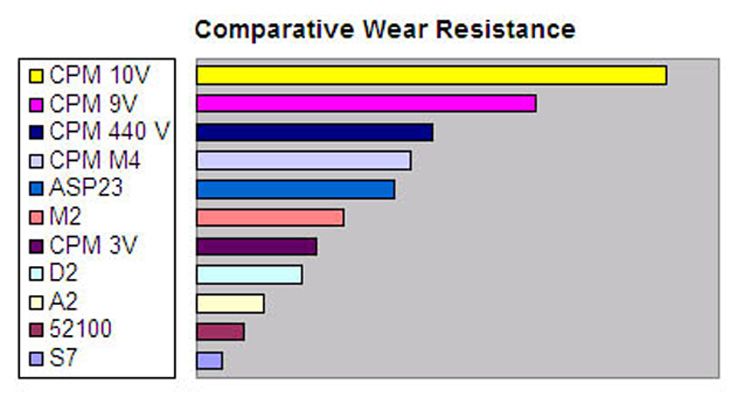

Longer lasting edges reflect high abrasion resistance, and the challenge with these super steels is to find an efficient and economical sharpening regime. Put away the Japanese waterstones, even the ceramic variety. Hide the sandpaper, and don't even admit to thinking that you may try oil stones .... none of these are effective. Yes, my Professional Shaptons do work, but ever so slowly, and you will be fooled (as I was) into believing that you have a working edge. The only medium that works effectively is diamond. I used diamond paste on a cast iron substrate with 40, 10, and 0.5 micron grits. With diamond, these steels were sharpened as easily as my A2 and laminated Japanese blades are on Pro Shaptons.

Using the above regime, all chisels easily pared Radiata Pine end grain as a pre-assessment screening.

The Steels

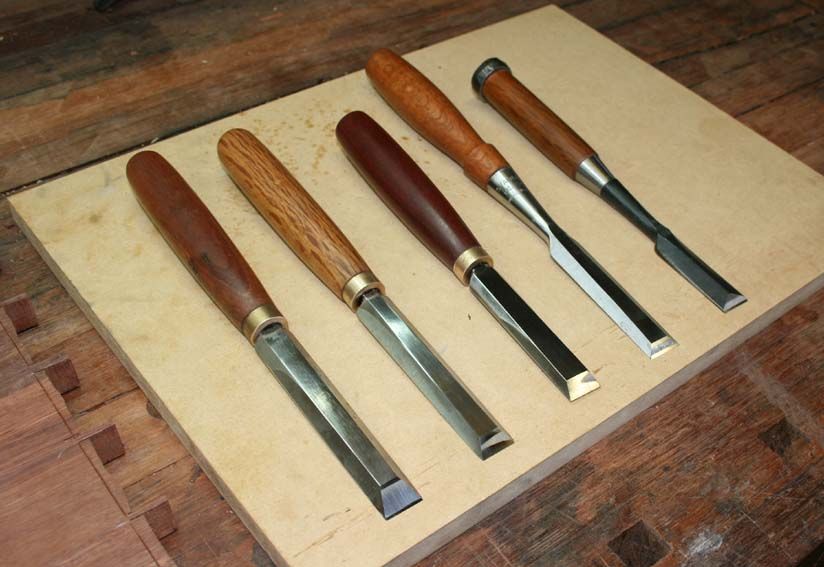
There are three powdered metal chisels, CPM 3V, CPM 10V and CPM M4. These blades were supplied by John Payne, who arranged for their heat treating. Hopefully John will join the thread and provide some details about their hardness and heat treating.

As a measure of control, I added a vintage Stanley 750 chisel, which is likely to be W1 steel. I also added a 30-year old Koyamaichi dovetail chisel, which I believe to be white steel. Stu Tierney will no doubt challenge me if I am incorrect :)

Five 3/4" chisels: 3V, 10V, M4, W1 (Stanley), and Laminated White (Koyamaichi)

The Test

I wanted a Real World evaluation, and so took the opportunity to chop out the dovetail pins in a 3/4" thick Jarrah carcase for a cabinet I am constructing. Each pin was 45mm in length.
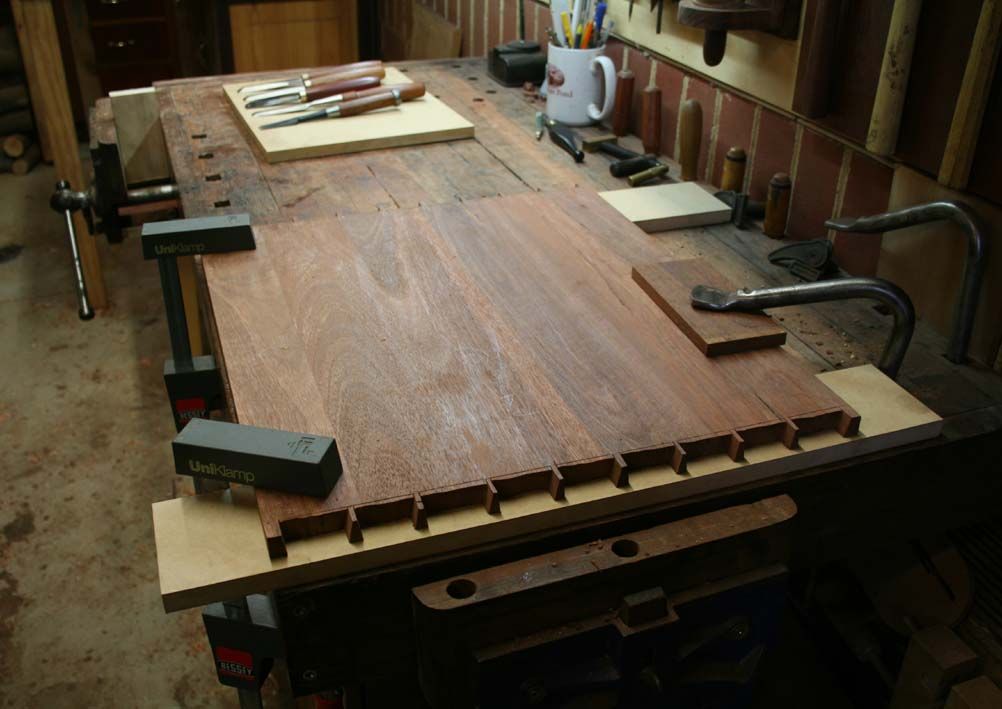

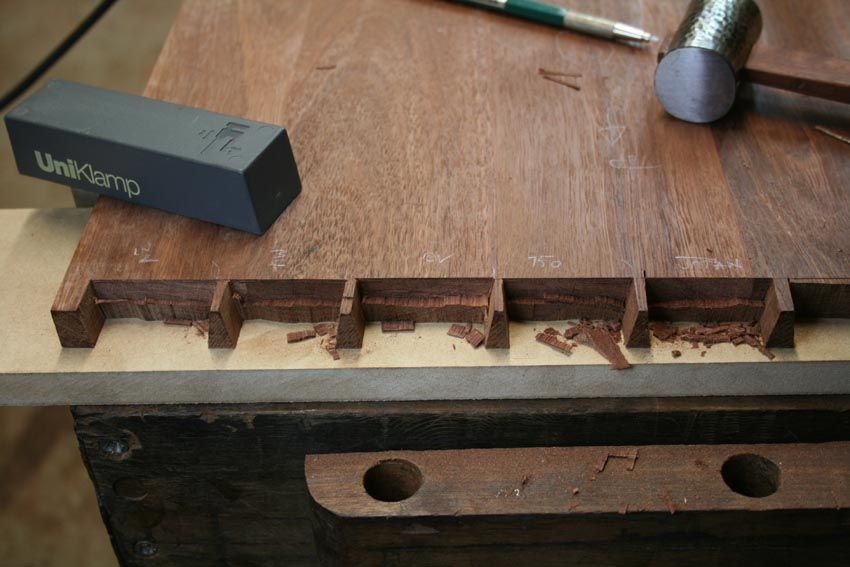
The method involved chopping out one half of a pin waste with each chisel in approximately 1/16" - 1/32" slices, checking the blade subjectively for a wire edge (by touch), testing the edge for sharpness by paring end grain Radiata Pine, turning the Jarrah board over and completing the removal of waste, and repeating the checks. At the conclusion, the blade edges were photographed at 200 magnification.

Half way ...
The Results

All the chisels were able to chop Jarrah waste even when the edges were dull. Few could pare end grain Pine comfortably after chopping the first half of the Pin waste, and only one chisel stood out as a tool of significant worth, the Koyamaichi. In second place was the M4 chisel, with the 3V coming in after this. The Stanley and 10V came in at the tail, with the Stanley just shading the 10V.

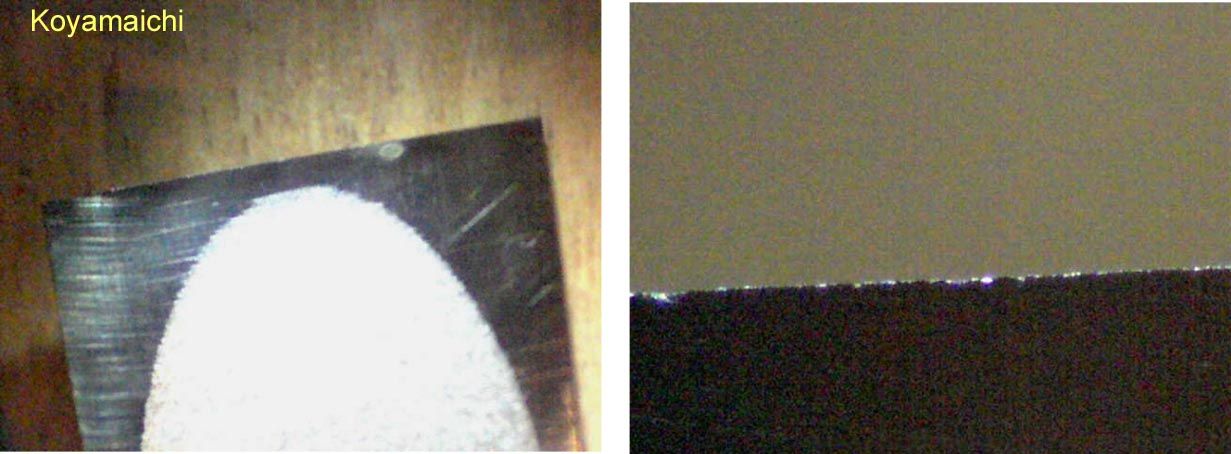
The Koyamaichi was outstanding. Not only did it fail to evidence signs of a wire edge (i.e. steel edge folding) at the half-way stage, but it was still paring end grain after 9 full dovetails. By contrast, only the M4 and 3V chisels were able to pare end grain at the end of a single dovetail, and at this stage they performed less well than the Koyamaichi did at the end of 9!

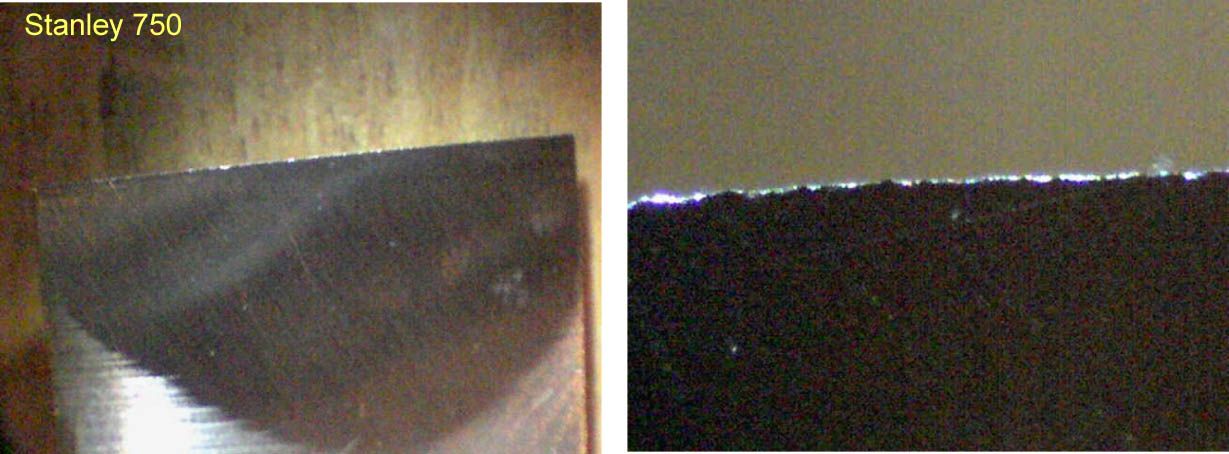
What of the Stanley? Well it did not disgrace itself and, in fact, did a very decent job. The 3V was tested initially with a 25 degree bevel (as this was the angle recommended). The Stanley (also with a 25 degree bevel) was better than the 3V in all departments (edge holding and performance) at this stage. However the 3V improved significantly when the bevel angle was increased to 30 degrees.

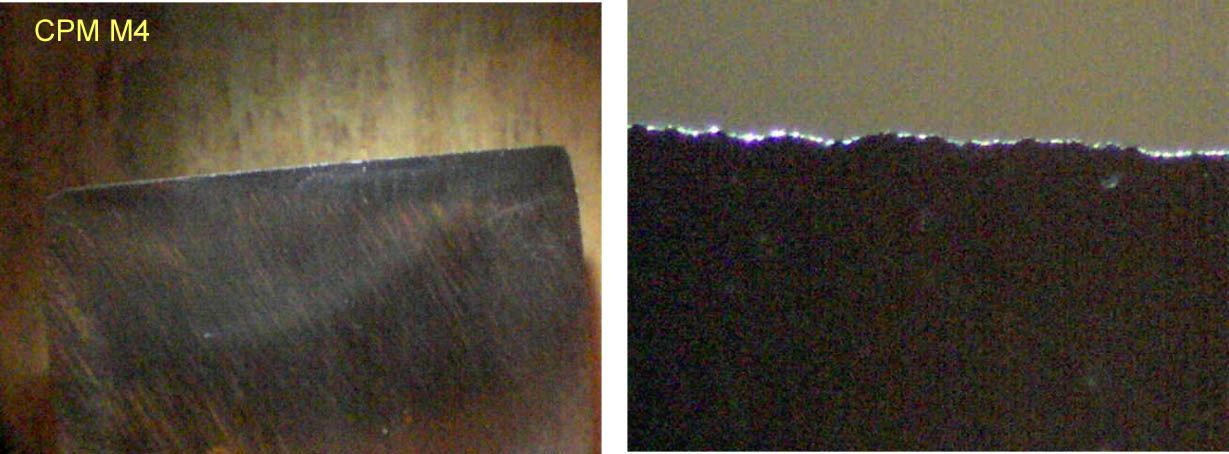
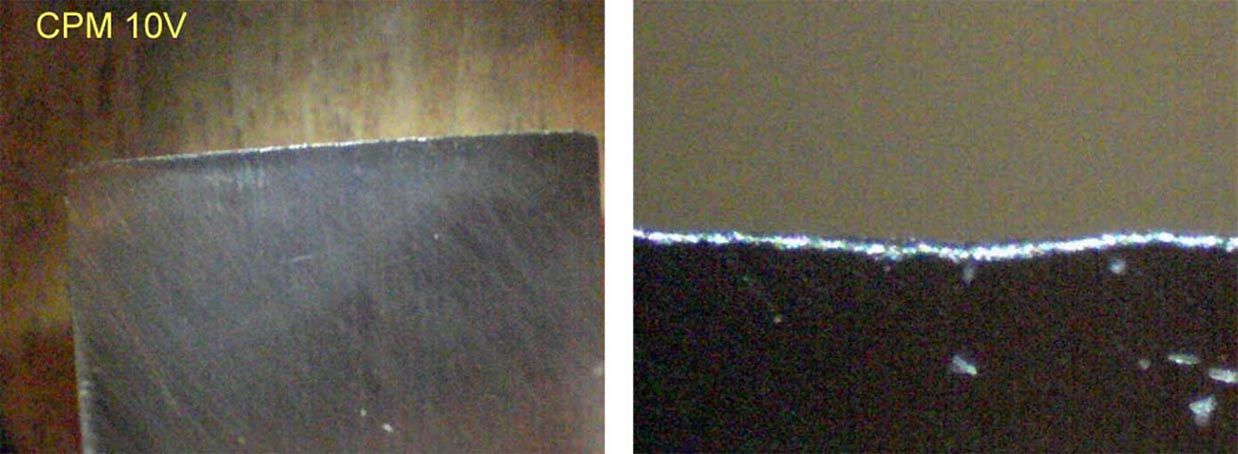
The Koyamaichi, M4 and 10V were given 30 degree bevels at the start (all recommended angles). This appears to be a good choice as the latter two blades developed only a fine wire edge. The wire edge on the Koyamachi was difficult to find.

Images

The images are in a set of two, with the first a magnification of 10X of the back of the blade, and the second image a magnification at 200x.

Koyamaichi ...

M4 ...

3V - note that the top images are with a 25 degree bevel, and the lower at 30 degrees ...


Stanley 750 ...

10V ...

In Summary

Relatively better performances from 3V and M4, and superlative performances from Koyamaichi laminated white steel.

Will there be a different presentation when the test is repeated, and will these results differ from blades used for planing?

Regards from Perth

Derek

Re: Chisel Blade Testing - 5 Steels

#2

Re: Chisel Blade Testing - 5 Steels

joel moskowitz

"Stanley 750 chisel, which is likely to be W1 st"

Unlikely - probably drop forged 01 - a spark test should solve the id problem.

White Steel = essentially W1 but what makes it sing is the drawing out by hand and the hardness you can achieve if you laminate your cutting edge to something softer.

It also should be mentioned that within the O1, W1 and other alloys there is a reasonable variation on characteristics based on the particular source of steel and refinement that was done at the mill.

What is most interesting about your test is that the traditional alloys held up as expected and the modern stuff (which is harder to forge and form) wasn't a grand slam ahead.

Re: Chisel Blade Testing - 5 Steels

#3

Re: Chisel Blade Testing - 5 Steels

Steve Elliott

Interesting stuff, Derek!

Based on the bevel angles you're testing at, I'm pretty sure most of the edges are being degraded by chipping rather than wear abrasion. The chisels that retained their edges the best have the highest impact resistance (W1 has about twice the impact resistance of O1 and eight times that of M4.)

When I was testing plane blades I found the best performance came when the bevel angle was just large enough to prevent chipping. At that angle the edges lost sharpness due to abrasion, and were able to cut well for considerably longer than if they chipped during their initial cuts.

I recently bought some vintage British mortise (mortice?) chisels and haven't sharpened them yet. They're laminated steel and even with the tough W1 edge their bevel angles at the tip range from 32 to 39 degrees. The edges show some wear but no chipping.

I'd be interested to know how the 5 alloys compare when used at a higher bevel angle.

Thanks for sharing your results.

Re: Chisel Blade Testing - 5 Steels

#4

Stephen Shepherd

Re: Chisel Blade Testing - 5 Steels

Stephen Shepherd

I am not sure how the other blades are made but I think it is an unfair test as you are comparing 4 steel chisels and 1 laminated chisel. I am not at all surprised in the results, but I think the steel plays only a small roll in the function of the chisels.

What I think is important is the fact that they are laid steel blades, subject to forge hardening.

Stephen

Re: Chisel Blade Testing - 5 Steels

#5

Five other chisels

Warren in Lancaster, PA

I never heard before that Stanley chisels might be made of W-1. I am not a fan of Stanley chisels, but from your report it seems like the Stanley outperformed the 3V when both were the same 25 angle. It seems extremely odd that you chose to give the 3V a shot at an even playing field with the others at 30 degrees, but did not try this for the Stanley. If "the 3V improved significantly when the bevel angle was increased", might not the Stanley also?

I tried the test with five of my chisels:

Greaves 1828

Butcher late 19th c

Greenlee 1930

Marples 1983

Cherubini 2008

I used Carya ovata (Janka 1880), and then repeated the test without sharpening with Diospyros virginiana (Janka 2300). None of the chisels had any trouble paring pine, but the Marples did not give the fresh and clean surface of the others.

Re: Chisel Blade Testing - 5 Steels

#6

Re: Chisel Blade Testing - 5 Steels

joel moskowitz

The more I think about it the more Derek's test confirms that IMHO where advanced alloys can be useful in plane blades, for chisels it's really hard to beat good old FORGED carbon steel. Up until recently western chisel makers with drop forging equipment were getting sloppier and sloppier in grinding and heat treating and only various Japanese makers were making great chisels. Now with both Ashley Iles and Stanley making fine O1 chisels (and AI even hand forges one line for better edge retention) we are sort of back where the west was in 1930. The best Japanese chisels are still better but o1 isn't too shabby. When you consider the added cost of PM materials you start to wonder if the main reason why anyone is making PM chisels for any reason other not having forging equipment.

For a private person making chisels for themselves grinding advanced alloys makes a lot of sense and for factories the capital investment to make drop forging is enormous so just grinding also makes sense. But if you have forging equipment you can make a great chisel from simple steel, fairly inexpensively.

Re: Chisel Blade Testing - 5 Steels

#7

Re: Chisel Blade Testing - 5 Steels

Derek Cohen (in Perth, Australia)

Thanks for the clarification of the steels, Joel. I suspected that the 750 may be O1 rather than W1. Is there a history behind the choice of these two steels that you can say something about?

Regards from Perth

Derek

Re: Chisel Blade Testing - 5 Steels

#8

Re: Chisel Blade Testing - 5 Steels

Derek Cohen (in Perth, Australia)

Hi Steve

From the wire edge and the images it appeared to me that the edges were folding rather than chipping. This suggests that the steels could possibly have been harder (exception here being the Koyamaichi), and I would really like to hear back from John (who is a pilot and may not be available at this time). I know that he used a reputable company for the heat treating.

Regards from Perth

Derek

Re: Chisel Blade Testing - 5 Steels

#9

Some conclusions

Derek Cohen (in Perth, Australia)

What these results are indicating is that PM steel is probably better suited to plane blades or paring chisels than chisels used for chopping. They have great wear resistance, but are not significantly different with regard impact resistance.

Note this this is only the first round. I would have liked to have included an A2 blade but did not have one (the testing was something of a spur-of-the-moment thing). Also, I need to try higher bevel angles on all (except the Koyamaichi) and see what difference this makes).

Any other ideas to include?

Regards from Perth

Derek

Re: Chisel Blade Testing - 5 Steels

#10

Re: Chisel Blade Testing - 5 Steels

wilbur

I agree that the forging process has a significant impact on the performance of a Japanese chisel, and shows that there are other factors that go into the performance of any given tool other than the material used to make it.

I'd trot out my chicken/Jacques Pepin analogy, but we'll wind up planning a WC potluck if I do that again. ;)

Re: Chisel Blade Testing - 5 Steels

#11

Re: Some conclusions

Larry Williams

While I'm tempted to laugh and suggest exotic steels are ideal for bevel-up planes, I have a different opinion than your conclusions.

I think it largely comes down to heat treating. I don't see anywhere that laminated steel would have an impact on edge failure that close to the edge. The Japanese chisel and, most likely, the Stanley 750 were heat treated with individual attention by a skilled person.

The spread in alloy specifications make a pretty big difference in ideal heat treating for each batch of steel. For instance the specification range of carbon in O-1 steel means that ideal temperature will vary by nearly 200�. A a person reasonably skilled in heat treating can create a condition where, when working with individual tools, the steel will reach uniform critical temperature for each tool.

Modern exotic steels need long soaks at high temperatures in an inert atmosphere. This removes individual skill from the equation and turns control over to instruments and dealing with working on the high side of averages. This is great for high volume but it also means that ideal heat treating for an individual tool is the exception rather than the rule.

For high carbon steel the ideal is to bring the tool to a uniform critical temperature for that specific tool's alloy content without going above critical temperature or keeping it there for longer than is absolutely necessary. This is what produces the finest grain while maintaining maximum carbon content. Steels that develop carbide inclusions, like A-2 or D-2, require long soaks above critical temperature in an inert atmosphere to form the carbides. This guarantees a coarse grained steel but the inert atmosphere limits carbon loss.

Furnace schedules need to be modified for the size of tool(s) being heat treated. I can't help but wonder how many commercial heat treaters are going to fine-tune a furnace schedule for a single tool. Unless you can precisely adjust the furnace schedule for each tool and its alloy content, I don't think you can get accurate results for tests like this involving exotic steels. It's easy to get it exactly right with high carbon steel when heat treating one tool at a time. I think that's what the results for the Japanese chisel shows.

BTW, all wear resistance isn't the same. There's abrasive wear resistance and adhesive wear resistance. If you're working most North American woods the dulling wear you'll most likely experience is adhesive wear. A-2 and O-1 have nearly identical resistance to adhesive wear.

Re: Chisel Blade Testing - 5 Steels

#12

Re: Chisel Blade Testing - 5 Steels

joel moskowitz

"I'd trot out my chicken/Jacques Pepin analogy, but we'll wind up planning a WC potluck if I do that again."

And what's wrong with that?

Re: Chisel Blade Testing - 5 Steels

#13

Re: Chisel Blade Testing - 5 Steels

joel moskowitz

Most professional toolmakers I know consider the end product of O1 and W1 about the same. This isn't exactly true because heat treating and forging play a big part. Japanese Blue steel chisels are essentially O1 and we all know that they are great super performing tools made of both materials. THe devil is in the details.

W1 is easier to weld than O1 but it is considerably harder to harden and temper without problems. (cracking and warping). Now here in my shop we make tools out of W1 all the time. We never have problems - the reason is that we are doing ones twoseys so we don't worry about consistency. In a production heat treating shop W1 is problematic so even if it can theoretically make a finer grain and sharper steel I don't know anyone wanting to use it. Ashley Iles roundback dovetail chisels and all their carving tools are hand forged 01 and have great edge retention. Drop forged chisels can also be very good.

So I cannot imagine Stanley at any time in the last century using W1 if they could get O1.

The real problem with chisels in the past 50 years has been poor grinding and inconsistent heat treat. The latter problem is caused by very large heat treat furnaces which simply aren't as consistent at keeping uniform temperature. Modern facilities and QC take care of this problem. Smaller companies have no problem with that and new Stanley production shows that if a large company WANTS to produce a good chisel they can. It's not about fancy steels or anything.

Re: Chisel Blade Testing - 5 Steels

#14

I agree

Bill Tindall

They look like the typical deformation failures.

Re: Chisel Blade Testing - 5 Steels

#15

I agree

Bill Tindall

I believe that toughness is the most important inherant steel performance metric for a chisel and O1 has excellent toughness. However, see my ohter post...

Re: Chisel Blade Testing - 5 Steels

#18

Comments

Bill Tindall

1. A nobel and useful initial contribution for a daunting task. If he objective is to compare steel for this particular application an additonal varible must be investigated, namely , optimizing heat treatment for each steel as had been done for the commercial chisels. This became more work that I wanted to undertake so I quite metal working and went back to wood!

2. Once again, I do not believe that wear resistance is the relevant metric for this chisel application. Rather, hardness and toughness are the metrics that will predict performance.

3. Every steel has a trade off between toughness and hardness that is a function of heat treating schedule. Hence, heat treatment is a critical variable in determining "best" steel.

4. The heat treat for the commercial chisels tested was presumably optimized for hardness and toughness for the steel used by each company. Likely, the heat treat on the other steels was not optimized for this chisel application. If no chipping was observed, likely the steel could have been made harder, and therefor more resistant to the deformation failure as was observed in some cases. The 3V result looks like it was less than Rc 60. Knife makers have found this steel can me made harder than 58-60 and still preserve adeaquate toughness.

Re: Chisel Blade Testing - 5 Steels

#19

Re: Where is the reply Bill?

Bill Tindall

I am traveling and on someone else's computer key board. I type poorly to begin with, but on this key board it is disaster! I may add more when I get home tomorrow.

Re: Chisel Blade Testing - 5 Steels

#20

agree on importance of heat treat

Bill Tindall

given the overwhelming contribution of heat treating to performance it is a daunting task to compare the optimum performance of this vs that steel. As you pointed out, the commercial steels have likely been optimized, while the others were likely not.l

Re: Chisel Blade Testing - 5 Steels

#21

Totally agree, especially with # 4, ...

Derek Cohen (in Perth, Australia)

... hence the reason why I wanted John to provide details on the hardness, etc. The fact that the edges folded rather than chipped emphasised that the steel could have been harder.

Regards from Perth

Derek

Re: Chisel Blade Testing - 5 Steels

#22

Wow Bill...you agreed 3 out of 4 times....

roger lance

you must be in a very agreeable state this morning !!

Re: Chisel Blade Testing - 5 Steels

#23

Re: I missed on the first read-through

David Weaver

that the Koyamaichi was already at 30 degrees.

i'm not surprised that the V10 and m4 chisels didn't fare well. My HSS plane irons do not fare well unless they have about 30 degrees or so, and they do fare very very very well at 35, but they exhibit the same tendency of any HSS tools to release carbides and leave small lines in the work. That makes them a good "smoother before the final smoother" in really nasty woods.

I am surprised by the 3v chisel, though, that it didn't do as well as the KI chisel, but I have always been well pleased by my KI dovetail chisels and when they're out, I use them for anything I have going on where a chisel needs to be struck.

I don't know what the V10 is good for, I don't think it's great for woodworkers, but the M4 should make a good plane iron, as should the 3v. If it doesn't, I won't be able to make sense of why my mystery chinese HSS irons last much longer - especially in difficult woods - than any other iron I have, including some well regarded japanese irons.

Re: Chisel Blade Testing - 5 Steels

#24

Re: Chisel Blade Testing - 5 Steels

John Payne

Derek

You've been busy! I saw your post Saturday evening but was down in Santiago, Chile and only had my iPhone with me then. No way was I going to try to write a response using just that. I'm back home now and got a little sleep so here goes.

The heat treating of all the CPM steels was done by Mid-South Metallurgical. They specialize in these types of steels and were recommended by Crucible Metals and numerous custom knife makers. The RC hardness for each steel was based on recommendations from Crucible and from custom knife makers who have been using these steels for many years. Neither of these sources had experience in making wood working tools so I made an educated guess based on their inputs. For the CPM-3V I had it hardened to RC61. It's above the upper end of the recommended hardness range for it (58-60), but even at this hardness it's more impact resistant than A2, and both groups said it was noticeably more wear resistant at RC61 than RC60. The knife makers said they have had no problems with chipping at that hardness and it would still pass the ABS Bladesmith test of being bent 90� in both directions without cracking or breaking. It is used in knives and tools for special forces at RC59 and the guys that make these say that at that hardness, "you cannot break it". The CPM-M4 was heat treated to RC64, higher than I had asked for. It's working range is 61 - 65, I think RC 62-63 would be about optimal for it. At RC64 it is more impact resistant than D2, and many times more wear resistant but the edge may be more prone to chipping. The CPM -10V was hardened to RC60, it's working hardness range is 60 - 63, but at each point of additional harness, impact resistance drops and it's not high to begin with. At RC60, it's about the same as D2 and it's wear resistance it higher than any of the other steels in the test. I didn't think it would make a good chisel for chopping, but included it for testing purposes.

As for the results of the test, I was a little surprised in 3V's performance, but not M4 or the 10V. I'm not familiar with Jarrah but a little research showed that it's harder than Purpleheart which I find as pretty tough stuff. 3V will bend or fold before it breaks, and will develop the small microscopic chips in the edge as it wears. With a 25� bevel it handles cherry, walnut, and curly maple without any problems. I think Chuck Bender or EODdave could shine some light in this area as they have had 3V chisels in their hands longer than any others. I believe Chuck uses his with a 25� hollow ground bevel and Dave at 35�. I don't think either has had an edge failure and use these constantly. It does very well as a plane blade, even when used on knots, glue lines, etc. Could there be a heat treating problem with this chisel? It's always a possibility but this one was out of the original batch and was heat treated at the same time as the ones used by Chuck and Dave. I agree with one of the comments that griding off 1/8" and trying it again may remove that possibility.

M4 was steel that I thought could be a surprise. It does make a great plane blade and at the proper hardness may also do very well in chisels. Again, I have people using them in our domestic hardwoods and have not heard of a failure yet.

10V was an experiment. Our Friar has 3 of them, 2 paring chisels and one for chopping. As a paring chisel with a 25� bevel it does very well and holds its edge for a very long time. As Peter mentioned he has the chopping chisel at 30� with a 35� micro bevel. He recently cut dovetails in Purpleheart without an edge failure. Honestly I doubt if I'll make any more chisels out of it. I think there's better stuff out there and it is extremely difficult to work. Much more so than other steels. However, it makes an incredible turning tool. I have a couple tools made out of it and I honestly can't remember when I last sharpened them.

For future tests try using them for paring in several woods, including Jarrah, and chopping in not such a hard wood, I think the results may be quite different. Because Jarrah is so hard it may be testing the impact resistance of the steel more than it's edge holding ability. If I new I'd be working in such a hard wood with one of these steels I'd change the bevel angle definitely higher than 25�. Even with that said, the Japanese chisel did out performed these it in chopping this wood. So if I worked stuff like this regularly, I'd definitely go with them. But in the case of Dave who chops a ton of dovetails per weekend in curly maple, the 3V held it's edge longer in this less tough wood than his laminated Japanese chisels. So it may just depend on what you will be using these for. That's what testing is all about and I know you will run them through very through tests and present a thorough and unbiased review.

Another note on these steels. I'd love to test them all at several different hardnesses, but each change is $75 a pop so you see how that could add up, my pockets aren't that deep.

I'm fading after being up all night, but if anyone has questions. I'd be happy to answer.

John

Re: Chisel Blade Testing - 5 Steels

#25

Re: Chisel Blade Testing - 5 Steels

David Weaver

Dave's unfortunate situation with his japanese chisels, though, was that they were either iyoroi or matsumura. I can't remember which, but as I have both of those, as well as the KIs and neither is a match for the KIs. Fractionally as durable.

But the 3V has me confused, i would like to see the test rerun with the chisel ground back 1/8th.

I'm not a threat to change out my chisels, which are iyoroi bench chisels and KI dovetail chisels, and japanese parers, but I expect something funny is going on with the 3V after some of the abuse videos I've seen of knives made out of it - things I would never do with regular high carbon steel.

john, i can't remember if you said you had some plane irons made, but 3V seems to me on the spec sheet that it would make an ideal plane iron. Are there any of them out there around 60 hardness?