Re: tail vise vs. end vise
Wiley Horne--So. Calif.
>Hi Joe,
Truth in posting: I have a larger bench and a smaller bench, and they both have LV twin-screw end vises.
This topic comes up every few years. Lurking in the background, generally unspoken, is the fact that the 'cool factor' of the traditional Scandinavian bench is unbeatable. It's just too cool.
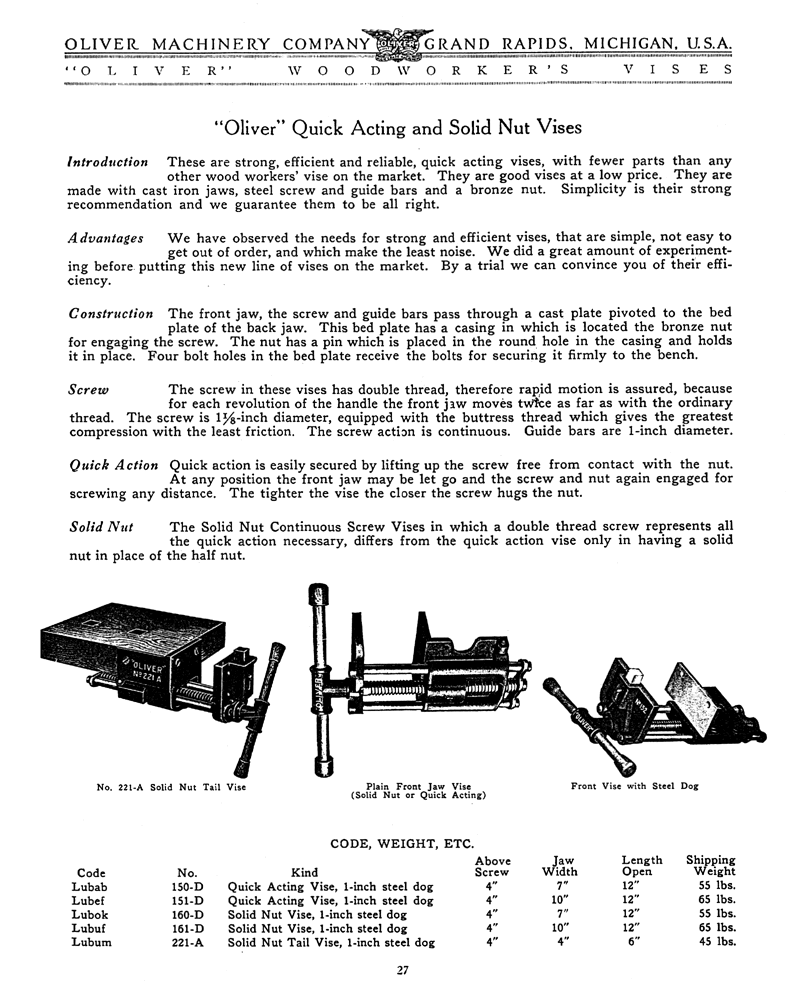
But the argument I recall goes something like this. When it comes to applying a line of force along the front edge of the bench, nothing does as well as a tail vise. This is because the vise is mechanically resistant (a) to racking laterally, (b) to racking vertically, and (c) to deflecting downward under planing pressure. This is of course assuming a perfect installation--don't know how difficult this is to achieve.
So if you don't have a tail vise, but want the equal, then you are going to have to take measures to ensure that your alternative vise is equally resistant to lateral racking, vertical racking, and deflecting downward under pressure. In the case of my twin-screw vises, there is no lateral racking through design of the vise. However, there is inherent vertical play, which has to be taken up by planing a taper into the front face of the vise so that the jaw will stand up vertical _under load_ (rather than leaning backward under load). turning to downward deflection, if you follow Lee Valley's instruction sheet, the vise will deflect downward a bit under load, because there is a 1/16" gap between the top of the main screws and the blocking one installs under the bench top. What I did to overcome this, and others have done the same, is install zero-clearance blocking under the bench top, so that the screws are constrained. In this case, the jaws can be opened about 5" before the cantilevering begins to cause deflection.
Incidentally, in regard to Patrick's caution about dog holes, the twin-screw doesn't present this problem, because you can place your dog holes outboard of the main screws with no ill effects. Mine dog holes are centered about 1-1/2" from the front edge of the bench. But that is a real concern, and one needs to have a solution or else deal with the problem that Patrick brought up.
So in like manner, whatever other vise one uses for an end vise, you have these 3 issues to address: horizontal racking, vertical racking, and downward deflection.
So the argument for the tail vise is simple: Why deal with problems? Use the vise that is designed not to have these problems. My personal answer to this is: Yeah, but I don't have the 10 feet or more of floor footprint required for that style bench. Or I would have one.
Now I am prepared to argue that there are practical advantages and huge flexibilities to a twin-screw end vise that a tail vise does not have. Maybe we'll get to that later in this thread. In other words, the basic argument for a tail vise is: Nothing does the job of a tail vise as well as a tail vise. To which I am ready to argue, yes, but there are other considerations which may make the end vise a better choice in a particular set of real-life circumstances.
Wiley