Home Articles Forums Gallery Marketplace Videos

WoodCentral Forums

Knowledge You Can Build On — Est. 1998

Premium Live Edge Slabs, Hand-Selected in the Berkshires. Shop Unique Hardwood Pieces.

Bowsaw Mark 1

Posts

Re: Bowsaw Mark 1

#51

Re: I think Thom's point

ThomD

>It's a little more than that, it is that for wood as a flexible spring the wood needs to be wider in direct proportion to the greater weight of the heavier piece. The idea that wood of any weight within a wide range of appropriate species has a similar ability to store energy/weight is actually a new idea in bows, though the basis of it may be in wood tech somewhere. Might not be though, because wood tech deals with a fairly narrow range of commercial structural species.

What happens when you load up a structure like a bow saw is that it tightens up to the point where a blade of any significant thickness is not going to elongate all that much, and the compression strut is pretty nearly infinitely incompressible at these loads though it might come out of column, so if you have small narrow bow limbs in the design they may start to bend, and you are actually in bow territory.

At that point if you are using a marginal wood species compared to the original, and you want it to perform well, and you don't want to make the nice profile shape look indelicate, add in thickness the extra weight of wood that the heavier species that is typical would have.

Re: Bowsaw Mark 1

#52

Re: And for that matter,

ThomD

>Maple is used even more extensively in cores of composite wood and glass bows. I don't think it has much use in self-bows, though it is perfectly useable under the weight guidelines mentioned. Composite bows take the major tensile and compressive forces on the glass or carbon fiber (or sinew and horn in the old days), while the maple core would be in more neutral territory. There the main criteria are compression resistence perp to grain, stability ease of machining, gluing, availability, etc...

Re: Bowsaw Mark 1

#53

Nice Clean Break,

Victor P

>Glue it carefully and use it as a display piece. Other than the break, nice work there.

I think I would be inclined to do the very same design again if I had some very straight grain hickory to work with. Someone else posted the relative strengths of Hickory showing that a 10% run out of grain has a significantly lower strength for this application.

Victor

Re: Bowsaw Mark 1

#54

Jesper, Denmark

Re: Bowsaw Mark 1: Arm Failure photos

Jesper, Denmark

>Hi Dom, Grain direction and run-off done you in. As I see it the fracture STARTED at the top - nearest the strings, and once started, it just peeled away.

Turn the grain 90� and you would not have had the problem.

Just IMHO of course.

Re: Bowsaw Mark 1

#55

Is this true?

Bill Tindall, E.TN

>In general does wood have a different modulus of rupture when the load is perpendicular to growth rings vs parallel? The limited mechanical data I have does not specify this orientation which could imply that they are equal in strength. Anybody have data?

Re: Bowsaw Mark 1

#56

Re: Is this true?

Warren in Lancaster, PA

>I don't think the orientation had anything to do with Dominic's problem. It was obvious from the before picture last week that there was runout and the break was just where one would have expected. I think that Hickory splits more easily along the earlywood pores, so Dominic's design maybe more vulnerable if quartersawn.

As Adam said last week, the modulus of rupture data assumes continuous fibers, not runout. I think some species would have slightly different rupture values for quartersawn and flatsawn.

Re: Bowsaw Mark 1

#57

Re: Is this true?

ThomD

>The general rule being it is stronger and stiffer when loads are radial as they would be in the tree. In many structural applications this also works out to be the most stable orientation. Texts I have while they are careful about growth ring orientation, have only one column for modulus of rupture or elasticity. Conversely the same texts have two columns for compression perp. and parallel to growth rings. So I think there is minimal difference even if certain practices are adhered to.

In good aircraft, bow, and sailboat practice there are always other factors governing growth ring orientation, most notably stability, If one has a structural element and it is adhered on edge to another element, then the reliability of those bonds, dimensional stability of surfaces is at least as important as strength which can be dealt with through adjustments to scantlings.

I have one EAA publication that seems to say there is no strength difference in growth ring orientation.

In tropical woods there are no growth rings anyway, so it is sometimes difficult to actually figure out what is going on. This can be dangerous if assumptions are made about growth ring slope that are not born out in the piece.

Re: Bowsaw Mark 1

#58

Re: Bowsaw Mark 1: Arm Failure photos

Dominic in Buck's County PA

>Jesper,

Thanks for the input. Last night I cut some hickory from a rough sawn plank of 8/4. I was careful to orient the grain 90 deg to what was in my first attempt. While I was at it, I also cut up some more pieces so that I could make several more pair or arms. Worst case scenario, I screw up and have a spare to continue with. Best case, I make an additional set of workable parts for a second bowsaw. :>)

Thanks again,

Dominic

Re: Bowsaw Mark 1

#59

Re: Is this true?

Victor P

>Louisville Slugger and other baseball bats always had their lables stamped in the wood (ash) on the flat of the grain parallel to growth rings. When the bat is held out in front of the batter the lable faces up. This is so that when stricking the ball you present the bat with the growth rings perpendicular to the force. Otherwise, you had a greater chance of breaking the bat. This is from many years ago when we played continuous games (lasting for days) on a sand lot near my house. Now that being said, I'll call a friend or two to confirm.

Regards

Victor - in Hot and Humid Houston

Re: Bowsaw Mark 1

#60

Re: Is this true?

Adam Cherubini

>Woodhandbook 4 has the data, Bill, as I said earlier. Check tension perpendicular to the grain. The pictures confirm exactly what I predicted.

Adam

Re: Bowsaw Mark 1

#61

Re: Bowsaw Mark 1: Arm Failure photos

Adam Cherubini

>I'm sticking with hickory for this project. It's strong, plentiful, locally available, has a history of use in this application,

I'm sorry to hear you saying that. No, hickory does not have a history of use in this application. In fact, I don't think you will find a single English style turning saw with this bow shape made form Hickory. I think Joel played a little loose and fast with this one if he led you to believe Hickory was the traditional wood of choice for this tool.

I think Hickory can be used successfully (depending on whether you have continuous fibers from handle to the area under the string). But in that case, pine would probably work. The question I have is whether beech or maple would have survived your design. I doubt it.

Just make sure you have continuous fibers from string to handle and you should be okay. Also note that whatever the cross section is of those continuous fibers, that's all the material you have working for you. Everything else is "just for pretty" as the Amish say.

Adam

Re: Bowsaw Mark 1

#62

Re: Is this true?

ThomD

>On bats it would also have a lot to do with the compression parallel and perp to grain, in other words denting or spliting, which is different than mod rup.

I think we are discussing this because someone higher in the thread said "orientation" when all they were refering to was getting the growth ring direction to better match the load path on the item and minimize failures relative to excess growth ring slope. i.e. to reduce the condition that led to the short grain failure, as one does in riving chair parts or bows. There is nothing incorrect about that useage since people rarely use correct terminology, and it is certainly one possible meaning of orienting. But it can be misleading in this case, if people are thinking vertical vs. flat grain.

Re: Bowsaw Mark 1

#63

Question for Adam

Patrick Gibbons, Katy, TX

>You say that hickory does not have a history for usage in this case and point out that English bow saws use beech exclusively, not hickory. Hickory is native to North America and beech, native to England, was already a good choice requiring no expensive imported wood to take its place to make a better product. I pointed out earlier that Sloane suggested hickory to be the choice here in eary America where native beech was also available. Was Sloane wrong? Was hickory used more here in the Colonies than beech? It would seem to me that if Americans used hickory in place of beech when both were readily available that would negate your argument. I just don't know if the premise is true or not, that is, hickory prefered over beech by Americans.

Re: Bowsaw Mark 1

#64

Re: Question for Adam

Adam Cherubini, NJ

>Sloane was wrong about a great many things, Patrick. His books are beautiful works of art, inspired by old tools and their products. But I don't get the sense he had much personal experience with tools. The turning saw he refers to as hickory looks a lot like Dominic's. Can't imagine it would survive real use for the same reason Dom's failed. That's simple physics. Who knows if the saw that inspired the drawing was actually hickory. It looks a lot like the saw in Sturbridges's collection today depicted in Jay Gaynor's book "Tools:...".

Don't tell Bugbear, but Joel's saw is a beautiful copy of Duncan Phyfe's (regardless of what his ad copy says). Joel loves the Phyfe chest. His Gramercy saws are very good copies of the Phyfe saws. And the Phyfe chest is in New York. I believe Joel has seen it. There aren't that many of these saws over here. I could probably point to a half dozen of these, mostly pictures in books.

As for Americans using hickory to make their turning saws, there's this sense that there were lots of colonial (pre 1776) cabinetmakers working on the frontier. I don't think that's quite true. I'm sure there were some (like the Dominys). I also think there's a sense that American cabinetmakers were making their own tools. Or that frontiersmen and farmers all had English turning saws, or knew what they were, or wanted them. This is a specialized tool.

My guess is the overwhelming percentage of English style turning saws on North America were made in England of beech.

I guess if there's a teachable moment here it's that sometimes the form is connected to the material. Be careful how you substitute.

Now I'm going to say it here clearly so we can end this discussion. Joel is a friend of mine, He's very smart. One can, and I'm sure he has, tweaked his design and the orientation of his stock to produce a nice light strong tool. For those of you making your own, use maple or beech if you don't want to carefully align your stock.

Better yet, recognize that as simple as this tool seems, it's actually a bit more complex than that. Just buy it from Joel complete and forget about it. I got to use one in Berea and I really liked it. I had trouble giving it back. I've seen Chirs Storb's. He bought Joel's kit and made the saw carefully to Joel's designs. That saw hangs in the conservation lab at the Philadelphia Museum of Art and is no nicer than Joel's production version.

Peace?

Adam

Re: Bowsaw Mark 1

#65

mortise

paul womack

>Am I the only one who's noticed a major design/construction difference between Joel's saw and Dominics?

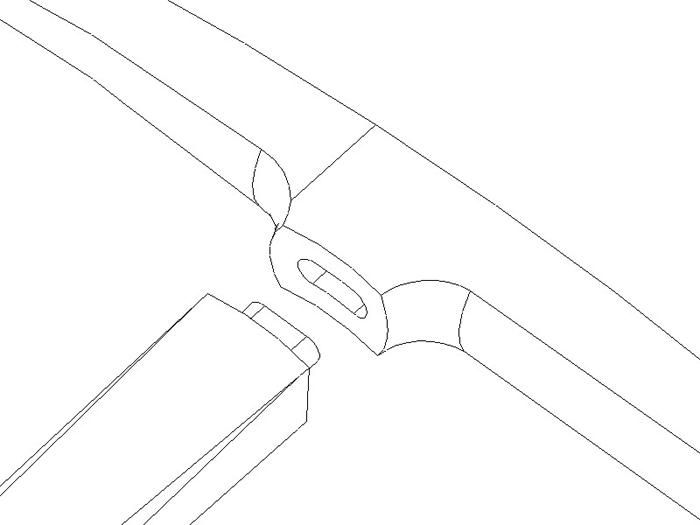
In Joel's design (and pretty much every English example I've seen - they're common over here) the mortise is effectively in an extra piece of wood on the arm - leaving a CONTINUOUS arm.

Dominic appears to have removed this "housing" and cut the mortise in the arm proper. This would seem to weaken the arm greatly.

Joel's diagram:


The problem is indeed compounded by grain direction.

BTW, here in England I've seen bowsaws in mahogany, beech (doh!) box and oak, so it appears timber choice is not critical - I would rate hickory an excellent functional choice.

BugBear

Re: Bowsaw Mark 1

#66

Ad Copy - Joel

paul womack

>Don't tell Bugbear, but Joel's saw is a beautiful copy of Duncan Phyfe's (regardless of what his ad copy says). Joel loves the Phyfe chest. His Gramercy saws are very good copies of the Phyfe saws. And the Phyfe chest is in New York. I believe Joel has seen it. There aren't that many of these saws over here. I could probably point to a half dozen of these, mostly pictures in books.

You got some editing and fessing up to do, Joel?

BugBear

Re: Bowsaw Mark 1

#67

Re: Ad Copy - Joel *LINK*

Joel

>Bugbear,

If you read my article on the design of Bow saws we specifically site Phyfe's saw as one important source of the design. We changed some details to make it possible to make by machine. The key eyeopener was the lack of weight in the saw. The main change was that early turning saws used 1/4" stock steel blades that were thinned all along to 3/16" or less - which isn't practical to do in production and our blades I think are thinner, narrower, and better than the old one anyway. Holtzaphel (who I always misspell) mentions a pinned blade which is faster for pierced work, but we thought of that independently before noticing it in Holtzaphel.

IIRC Chris Storb's saw is a closer copy of the Phyfe saw, made of QSO (which I guess Adam doesn't approve of either ) and in fact is even lighter than our production saw. I used it at the Connect-to-the -craft show and it awesome.

So I don't think I have any fessing up to do, but please read my design document and you will know exactly how we arrived at our final design.


The Design of Bowsaws

Re: Bowsaw Mark 1

#68

Dominic in Bucks County PA

Re: mortise

Dominic in Bucks County PA

>"Dominic appears to have removed this "housing" and cut the mortise in the arm proper. This would seem to weaken the arm greatly"

Yes, I mistakenly went with a flat cheek as opposed to a raised one. This happened as a result of trying to recover from a botched job on the cheek. I thought I had mentioned this in one of the replies here. I guess in my responses on another forum. So I weakened the arm by reducing the cross section, then make a mortice on the flat. In hindsight not really a smart move.

Re: Bowsaw Mark 1

#69

Ad Copy - Joel

paul womack

>If you read my article on the design of Bow saws we specifically site Phyfe's saw as one important source of the design.

Yes - I read and quoted that. I read it as a long, interesting and detailed account of a design process, viewing as many original saws as possible, and evaluating the merit of each design feature, singly and in combination.

So I was rather surprised when Adam said your final design was just a copy of the Duncan Phyfe saw.

BugBear