Home Articles Forums Gallery Marketplace Videos

WoodCentral Forums

Knowledge You Can Build On — Est. 1998

This $39 jig will make you a WOODWORKING GOD!

Bowsaw Mark 1

Posts

Re: Bowsaw Mark 1

#26

Re: Bowsaw Mark 1

Dominic Greco in Bucks County Pa

>Wilbur,

I'll try to take a photo tonight. And after examining the break in more detail, I can see that it occurred right at the point where the profile was narrowest. It's no surprise that if you couple that defect with some over zealous tightening of the toggle by your's truly that you end up with a broken bowsaw arm. :>)

Re: Bowsaw Mark 1

#27

Re: Bowsaw Mark 1

Dominic in Buck's County PA

>I got heavy handed with tightening the cord and it cracked at a section of the arm I made too thin.

I just milled out some more pieces of hickory and was more mindful of the grain orientation. When I cut the pieces this time, I'm leaving them a bit more generous in that region than I did with the Mark 1 version.

Re: Bowsaw Mark 1

#28

flatwise tension

Adam Cherubini, NJ

>Bill,

I don't think modulus of rupture is the right thing to look at. It assumes continuous fibers (like an axe handle). Stuff like planes or saw handles have really short grain. I'd check flatwise tension, what wood handbook 4 calls "tension perpendicular to the grain".

When you look at those numbers beech is second only to a single species of red oak (pin oak). Nothing else comes close. There isn't much data for hickory. I don't think hickory is a good choice for this application and this is why there is missing data. Hickory and oak really rely on continuous fibers. Just don't tell Joel I said so or he'll never leave me alone!

btw, maple wasn't as good which may be another reason maple woudn't be as good as beech to make planes out of. I think all of us who work with beech now how resilient it is anecdotally.

Adam

Re: Bowsaw Mark 1

#29

Jesper, Denmark

Re: Bowsaw Mark 1

Jesper, Denmark

>Dom, The growth rings on your saw arms are at 90� to the pull of the blade and the tightening string. If they were parallel to the pull, the arms would be stronger.

Also, you have introduced a weakness in the arms by having the mortice in the arms. The standard store-bought saw and Dave Andersons version both avoid this by having the mortice in the stretcher or no mortice at all.

The stretcher is in compression, not subject to bending forces, so the mortices there are not weakening it, The arms are most highly loaded from bending forces at the stretcher, so a mortice there weakens it at the worst point.

Re: Bowsaw Mark 1

#30

Re: flatwise tension

Pam Niedermayer, Austin, TX

>If I had any hickory it would be the first wood I'd try for a bow saw. After all, didn't it used to be used to make golf clubs shafts (persimmon for the heads), which undergo similar forces.

Pam

Re: Bowsaw Mark 1

#31

Re: flatwise tension *LINK*

Joel

>Adam,

below is a link to everything I know about bowsaws. And we are really talking about a English turning saw, not a larger European framesaw.

For all your theory that Hickory or Oak aren't appropriate the minuscule failure rate of the hickory bow saws I know suggest failure is caused by one of two things: massive overtightening - because people don't always understand how much tension is actually on the frame with a think cord (so overtightening is easy to do), and bad grain orientation. Certainly Beech works too and if you make your own saw you can make it out of anything but it's easier to get good hickory than beech and I think hickory might even be a little lighter, which is a real advantage.


everything I know about turning saws

Re: Bowsaw Mark 1

#32

bow saw design *LINK*

paul womack

>1) Joel's patterns are none too forgiving. He copied a saw that was pretty close to the edge.

No - that's quite wrong.

To quote the site:

"Though it might be tempting, we do not want to slavishly copy an old pattern. "

and "We looked at every bow saw we could find..."

The whole story is in the link.

BugBear


Joel on bow saws

Re: Bowsaw Mark 1

#33

Re: flatwise tension

Adam Cherubini, NJ

>If you look carefully at Dom's saw, the upper arms have quite a bit of short grain. That makes this item different from a golf club or axe handle or a windsor chair spindle. What you want engineering-wise is uninterrupted fibers from top to bottom.

Adam

Re: Bowsaw Mark 1

#34

Re: flatwise tension

Pam Niedermayer, Austin, TX

>If you look carefully at Dom's saw, the upper arms have quite a bit of short grain. That makes this item different from a golf club or axe handle or a windsor chair spindle. What you want engineering-wise is uninterrupted fibers from top to bottom.

I don't know of any good reason not to make the arms round, but even rectangular can yield uninterrupted fibers from top to botton, very much like a golf club. Also the action isn't that far off, given that you get tension on bending the fibers with resilience to rebound. Sounds like the only type golf club I've used. And bending rather than breaking.

Pam

Re: Bowsaw Mark 1

#35

my saw

roninkokomo

>I made mine from Birdseye Maple. I left my arms rectangular ...i.e. no shaping.. The look may offend you but is works great! and I have the inch and a half wide german blades and it is the best rip saw I own.... by a wide margin... I can actually cut a straight line with it :)

Re: Bowsaw Mark 1

#37

what?

roninkokomo

>My saw or the straight line that I cut?

Dom I am not sure I can post up a photo. I'll see

Re: Bowsaw Mark 1

#39

Funny thing

Dan Donaldson

>I have a spokeshave that I made that is the same way. I took the block of wood and put in a hock blade. It worked so well that I never bothered to shape the handles, so it is still a square block of wood with a blade in the middle. :-)

Re: Bowsaw Mark 1

#40

Re: flatwise tension

ThomD

>The problem in the design is that it has that Lyre shape (that I don't personally like), and that creates an opportunity for short grain. This is not a terribly stressed item copmpared to a bow with tips the size of a little finger. Grain alignment is everything. Adam is saying that Hickory has minimal split resistense, I think. And I don't know about that one way or the other, though it does cleave nicely. I would certainly prefer maple.

The outcome of a lot of bow research is that it doesn't mater what species of wood you use so much as how much you use. There turns out to be almost no difference in the bow potential of many species as long as the width of limbs is designed to correspond to the weight of materials. This surprised me, but it is proven time and again. In the old days only two woods were deamed suitable, Yew and Osage. But with proper adjustment of the limb width a wide range of wood species will have high performance, with hickory being one of the top candidates. Of course with bows short grain is not an option for even a second.

Where I think a silly design like this could easily get off the rails would be if it was designed for something like rosewood, and ended up being executed in a much lighter North American wood. It would help to make the wood thicker. Not destroy the fine detail of the lyre design, just make it a little wider from the end on view.

Elm would be a good option for anyone who could get it, but did not have access to anything other than board woods with standard grain orientation. Elm is very split resistant. Unfortunately it isn't terrible easy to find.

Another way to reduce the strain on the saw would be to make sure to use a key that can engage the crossarm every 180 degrees, rather than 360.

Chinese bow saws have a very pleasing shape, and are much straighter limbed for better strength. Couldn't find any pictures online.

Re: Bowsaw Mark 1

#41

Re: flatwise tension

Pam Niedermayer, Austin, TX

>The outcome of a lot of bow research is that it doesn't mater what species of wood you use so much as how much you use. There turns out to be almost no difference in the bow potential of many species as long as the width of limbs is designed to correspond to the weight of materials.

The width of material would pretty much determine the weight, no?

Pam

Re: Bowsaw Mark 1

#43

bow saw design *LINK*

paul womack

>For all your theory that Hickory or Oak aren't appropriate the minuscule failure rate of the hickory bow saws

Hickory is quite widely used for (archery) bows, for crying out loud.

I think that's quite a good "stress test", and hickory emphatically passes.

BugBear


Joel on bow saws

Re: Bowsaw Mark 1

#44

bow design

paul womack

>The width of material would pretty much determine the weight, no?

I think density would be another factor :-)

BugBear

Re: Bowsaw Mark 1

#45

Re: bow design

Pam Niedermayer, Austin, TX

>Well, yeah, but within the species....blah, blah. :)

Pam

Re: Bowsaw Mark 1

#46

And for that matter,

Bruce, a MN Galoot

>maple is used even more in archery bows.

bruce

Re: Bowsaw Mark 1

#47

Bowsaw design

Derek Cohen (in Perth, Australia)

>Hi Dominic

I think that Jesper made a couple of good points.

First off I compliment you on your efforts, but I have to say that your bowsaw is not a true copy of the Gramercy. It misses out on an important factor - the tenon/mortice area is almost absent on yours. Here is the Gramercy saw ..


Here is a picture of one I built some years ago that is even more defined in that area ..
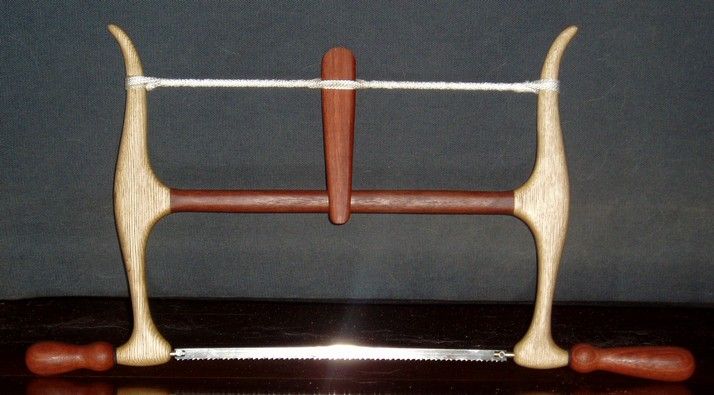

Joel notes on his website, "bow saws" or "turning saws" evolved with thinner, lighter frames, and very narrow blades for cutting tight curves.

Now my saw may be even thinner than yours. It is made from "American Oak", as the wood was called when given to me. The crossbar is Jarrah. It is small, only 11" wide, and was originally designed to cut dovetails. It works OK but rarely use it as I prefer Western saws. My plan is now to add a fretsaw blade. As skinny as it is, it manages to hold a fair amount of stress.

Althought the grain on yours (at the upper ends) does not look like it remained straight, it does not bend to weaken the thin area, but (to my eye) should in fact strength it. I can't see that this created a weak link.

Mine will probably make a better fretsaw than a dovetail saw. I suspect yours - with a beefed up mortice area - will be much better still.

Regards from Perth

Derek

Re: Bowsaw Mark 1

#48

I think Thom's point

Bill Houghton, Sebastopol, CA

>is that lighter woods might require a wider bow to achieve the same strength as heavier woods.

Re: Bowsaw Mark 1

#49

Re: I think Thom's point

Pam Niedermayer, Austin, TX

>OK, I guess I think that goes almost without saying; but doesn't hurt to say it all.

Pam

Re: Bowsaw Mark 1

#50

Bowsaw Mark 1: Arm Failure photos

Dominic in Buck's County PA

>OK, I finally had a chance to take photos of the broken bowsaw arm.

Photobucket

Photobucket

Photobucket

Notice in the first photo how the one arm is much thinner than the other? Also, the break line follows the grain. So I introduce a weak point, and then add a bit too much force. The fracture then follows the easiest path and you get what happened here. Making the cheek faces flat didn't help either.

So, what did I learn?


  1. Don't reduce the cross section up near the point where deflection will be greatest! In fact, I MAY err on the side of caution and make the arms a tad thicker here.


  2. Orientation of the grain is critical. My next set of bowsaw arms will be rift sawn (or quarter sawn?) as much as possible. In other words, the grain will be 90 deg to that you see in the filed piece. In addition, the blank will be oriented such that the grain will follow the curve of the arm a lot closer.(i.e: no grain running off the edge)


  3. Form all the mortises, drill all the holes, shape the face of the cheek, and fit the cross piece BEFORE final shaping (while the wood is flat)! This will help to keep the points of attachment in the same plane.


I'm sticking with hickory for this project. It's strong, plentiful, locally available, has a history of use in this application,.....and I just bought a rough sawn 8' x 7" x 8/4 piece of hickory this morning for for $2.25/bd ft. :>)

See ya around,

Dominic