My new Heiji ryoba (long, lots of pics)
wilbur
>(This one's for you, Wiley!)
It's probably not a real secret that I like using Japanese saws. Up to now, the Japanese saws I've been using have been the Gyokucho replaceable blade saws, which are indeed very nice saws. But having read about the Yaitaki saws that Wiley, Pam, Denis, and others have written about, I got real curious about how a handmade Japanese saw might be like.
Problem is, there aren't many Japanese saw makers working these days. There was Yaitaki, but he's retired now. There's Mitsukawa. And that seemed to be it, until I started exchanging emails with So Yamashita, who is living in Australia, and has a website that sells Japanese tools (www.japan-tool.com). So's a great guy. He has a wealth of information about Japanese tools and their makers. He also has many tools that sell in nosebleed price ranges.
I initially emailed So about the Japanese saws that he had listed on his website, which seemed to be all "New Old Stock". I asked him if any of the makers of the saws he carried were still working, since I didn't want to be in the situation of having a saw by a maker that I really liked, and wanting to get more, but then finding that all of the old stock was out. Also, I felt that if I was looking for a handmade Japanese saw, I should do my part to keep that industry alive by supporting an active sawmaker.
So then told me about Nakaya Heiji. Heiji is a 5th generation saw maker who's apparently well known in Japan, but not so much in the U.S. His saws are usually completely handmade. Many "handmade" Japanese saws are made with machine pressed steel blanks. Heiji does every step by hand, including the initial forging of the blanks.
When So told me the price of the Heiji saws, which were about US$550, I pretty much passed out. It is probably true that making a saw by hand is probably one of the most labor intensive tool making processes out there (I'm sure Mike Wenzloff will agree), between the forging of the blank, the tempering, the scraping of the blade, the tensioning, the cutting, setting, and sharpening of the teeth. There's a very good video showing the making of a Japanese saw by hand, which gave me a lot more respect for this process. The video's in Japanese, but you'll be able to pick up what's going on just by watching.
After a while, and after picking Wiley Horne's brain (not for the first time, and not for the last time, I'm sure), I emailed So back about ordering a handmade saw, but that I thought that the Heiji saws were out of my price range. So told me that if I was interested, Heiji could make me a not-completely-handmade saw, using a machine pressed blank, if the saw wasn't too long, and that would be a less expensive way to go.
I thought a lot about what kind of saw I wanted, but decided that what I needed most was a smallish saw for joinery cuts. I asked a ton of questions which So patiently answered, and finally decided that the best way to get what I needed was to just have So order a 210 mm ryoba from Heiji, made with the machine pressed blank, set up to make joinery cuts in 4/4 North American hardwoods, especially paying attention to the rip side of the ryoba, which I was intending to use for dovetail cuts, and trusting that Heiji would know what to do.
About a month later, this comes in the mail.


It's a lot prettier than my Gyokucho saws, for sure!
Looking at the Heiji ryoba, there are some definite differences between the two. The blade of the Gyokucho ryoba that I have (no. 611, 240 mm, which is optimized for hardwoods) is an even 0.018" throughout. On the Heiji, there is a taper along the length of the blade from the handle end (0.027") to the toe (0.015"). The Heiji's blade seems more flexible.
Here's a closeup of the rip teeth. The Gyokucho is on the left, and the Heiji is on the right. You can see the little tool marks on each individual tooth on the Heiji ryoba, as well as the marks from scraping the blade of the ryoba.

And a closeup of the crosscut teeth. Again, the Gyokucho is on the left, and the Heiji is on the right.

The teeth on both the crosscut and rip sides are slightly more closely spaced on the Heiji. Like all ryobas, the rip teeth have a progressive pitch, with a finer tpi near the handle and a coarser tpi towards the toe. The rip and crosscut teeth have a different profiles, as you can see from the pictures above, with the gullets between the teeth seeming to be deeper on the Heiji. The crosscut teeth have a more aggressive looking profile, as well.
By the way, I'm just trying to describe what I see. I have almost no idea what these differences mean in the world of saw tooth profile theory.
So how does this saw perform? Well, I wanted a good joinery saw, so let's cut some dovetails. I took a piece of 3/4" thick white oak, and marked off some sample dovetail cuts.

As you can see, some of these lines are for softwood dovetail angles, and some are for hardwood. :@)
I proceeded to saw away. Here are the front and back sides of the board after I finished cutting.
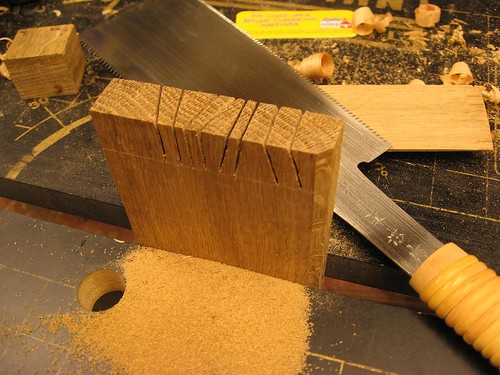

No pencil lines left. Staying on line was really easy with this saw. Who needs a backed saw for cutting dovetails? It doesn't look like I do anymore!
By the way, there's one thing that I've always had an issue with dovetail saws and dozukis. I always had the feeling that the back of the saw would get in the way of my looking at the line. That's why I was interested in seeing if I could use a ryoba for cutting dovetails, knowing that the pulling action of a Japanese saw would keep the cut very straight.
After trying out various cuts with this saw, especially dovetail and other rip cuts, I don't think that this saw will win any speed records for rip cuts, although it seems to cut pretty fast. I don't have much experience using western dovetail saws, so I don't know how this compares, but for the record, after the initial small strokes to get the cut started, it took about 18-20 strokes to get down to the baseline (3/4") in this 3/4" piece of white oak with the Heiji saw.
Now, to be fair, I'm able to do the same thing with my Gyokucho hardwood ryoba. But the actual cutting seemed to be more smooth with the Heiji, probably because of the tapering. It's difficult trying to describe the difference between the smoothness of the cuts. The best that I can come up with is that it's probably the handsaw equivalent of the difference between an average hand plane and a fully tuned and sharpened Lie-Nielsen. I also felt that in other cuts that I made I was able to steer the Heiji more easily than the Gyokucho.
But where the Heiji really shined was in cuts that it wasn't really designed for.
(Warning: graphic pictures of hand tool abuse coming up.)
Here's the block of wood that I got the 3/4" white oak scrap for the dovetail cuts above.

This might look familiar, if you spend too much time on wooddorking [sic] internet forums like I do. It's the same piece of 8/4 white oak that I used in my Imai chisel torture test that caused much consternation on another forum.
Here's how I got my test board for dovetail cuts.
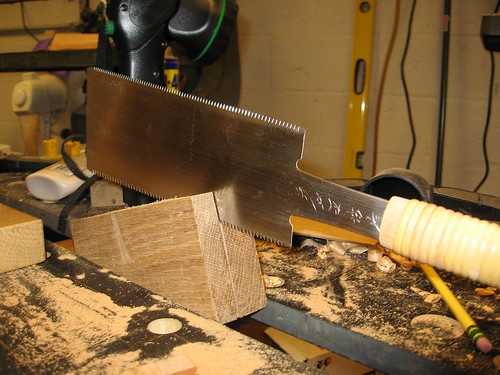
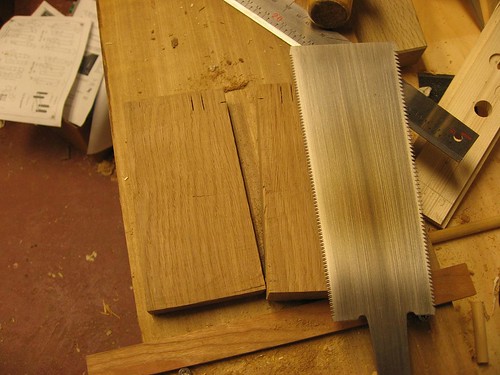
Staying on line for the long cut on the longer side with this saw was a piece of cake. I started the cut on the far corner, and focused on aiming the saw all the way to the end of the cut on the near corner. I didn't even look at the line along the cut. The pulling action of the cut keeps the ryoba in a straight line.
I also crosscut this 8/4 white oak board with the Heiji ryoba, but forgot to take pictures of that process. This picture is a staged recreation of the pieces. I can't believe how well the crosscut side of the Heiji ryoba cuts. Not only am I getting a clean cut, but the surprising thing is how aggressively the crosscut teeth goes through wood. The crosscutting action of the Heiji is noticeably more aggressive than the Gyokucho.
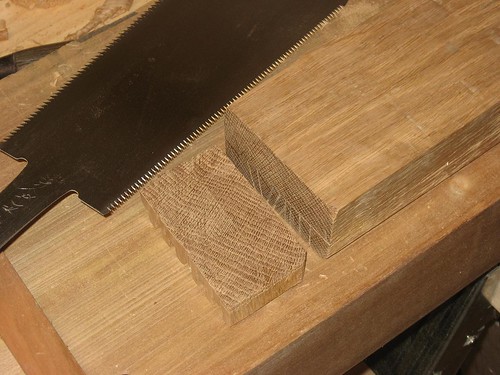
So if anyone's worried about using Japanese saws in hardwoods, don't worry about it. All of the teeth of my little ryoba survived this 8/4 white oak.
Again, to be fair, I can do the same thing with my Gyokucho saw. But the Heiji ryoba, even it's woefully undersized for this sort of operation, cut noticeably more smoothly than the Gyokucho in this 8/4 stock. This was a bigger difference than when I was making joinery cuts in 4/4 stock. I think that the tapering of the Heiji ryoba is the biggest contributor to this.
I wish that I could tell you how much my saw cost, but I'm still waiting for So to send me an invoice. You're reading that correctly: he sent me the saw without any payment or deposit. Based on an estimate that he gave me, it's probably going to be in the same price range as a pair of Wenzloff rip and crosscut tenon saws.
I really love using this saw. I have a hard time seeing how using a hand forged blank would improve the cutting action of this saw at all. The only minor nit that I have is that I sometimes wish that the rip teeth had a slightly finer tpi, to make it a bit easier to start the cut, but I think that this is also a break-in issue, as the saw is so new. I have found that since I got the saw, starting cuts is getting easier. I sometimes wish that I had gotten a 240 mm ryoba from Heiji instead, but overall I'm glad that I have a ryoba that's a different size than the one I already have. I also sometimes think that I should have gone for the completely handmade ryoba instead of the machine pressed blank, but then I realize that that saw can wait for the day that my skills are good enough for a saw like that. Besides that, my wife would really kill me if I got that saw now, and my boys need their father. :@)
Thanks to Wiley for letting me bounce ideas off of him, and for giving me the nerve to order the saw. This is the second most expensive tool that I have, after my 10" jointer/planer combo. I didn't even pay this much for my bandsaw (thanks, Craigslist!). If in the future I am trying to retire and find that my 401(k) is replaced with a pile of handmade Japanese saws, Wiley's the one to blame. :@)


