Home Articles Forums Gallery Marketplace Videos

WoodCentral Forums

Knowledge You Can Build On — Est. 1998

Fast and affordable laser cutting – so you can make the parts you can’t find anywhere else

Toothed blades

Posts

Toothed blades

#1

Toothed blades

Denis Ch�nard, Orl�ans, Ont.

>Anyone uses them?

I bought one of these blades for a plane of mine, and another for my scraper plane. In practice I've never used them, I guess it's one of those "supposed to have" things, at least until I get to use them...

One of the stated uses for a toothed blade is to work difficult areas to reduce tearout, after which a finely set smoother is used to clean up. Makes sense in principle, except that I haven't had the need for that so far, handplanes are so good these days that the need for toothed blades might have disappeared.

Another stated use (for the scraper blade) is to "rough up" a surface for veneering, the grooves increasing the surface area for better adhesion. That one doesn't make sense to me, I thought that a smooth surface provides for best adhesion. What am I missing here?

Please educate me...

DC

Re: Toothed blades

#2

Re: Toothed blades

Stephen Shepherd in the State of Deseret

>I use them all the time, I have two toothing or 'keying' planes and a scraper set up with a toothed blade.

Musical instrument makers use them to work on curly woods such as maple and sycamore. They finish up with a card scraper.

I use them for all joints that I can use them on. It makes for a better glue joint by exposing more surface area for the glue to grip.

They are also called truing or truthing planes because they will make a true flat surface. Then minor scraping and the work is done.

Works great on knots, burls, curl, &c.

Stephen

Re: Toothed blades

#3

Re: Toothed blades

Brent in Montreal

>Hi Denis,

I've used them to get better adhesion on paper backed veneer.

Re: Toothed blades

#4

Re: Toothed blades

John Aniano in central NJ...

>Denis,

I just got back from the Williamsburg VA Symposium on the Seaton tool chest, etc. We learned the usefulness of the toothing plane to facilitate hammer veneering, using of course, hot hide glue. The toothing plane was used on both the veneer (~3/32"+ thick) and the substrate gluing surfaces. Ed and Marcus made it look easy!

John

Re: Toothed blades

#5

Re: Toothed blades

Barryvabeach

>Denis, I was also in Col Williamsburg and wanted to add that Ed and Marcus, which were my favorite part, said that toothing helped the veneer adhere to the substrate regardless of the direction. That is, if the toothing on the substrate went front to back, it didn't matter whether the toothing on the veneer went side to side or front to back, it still came out better than no toothing.

Re: Toothed blades

#6

apples and oranges

Larry Williams

>There's considerable difference in the cutting action and geometry of traditional toothed irons compared the modern ones available. The old blades were cut like files are cut and the tops of the teeth angle off in one direction and are very slightly under cut in the other direction. Modern "toothed blades" have machined teeth, they're flat on top and just have grooves machined on each side. The old irons also have many more teeth per inch than those made today. I'd have to go back through our records to find how many teeth per inch Marcus' planes have but it seems they were in the neighborhood of 25 or 30.

Re: Toothed blades

#7

Re: Toothed blades

Paul Kierstead

>On the veneering, it provides mechanical lock. Unless there is some kind of chemical bond, smooth surfaces do not bond as well as rough ones. Hence why we may rough up certain kinds of very smooth surfaces. As a guess, I would expect it would be more necessary on very closed grained woods, as open pored woods would seem to provide good mechanical lock naturally.

Re: Toothed blades

#8

Re: Toothed blades

Robin Corell in Atascadero Ca

>Because hide glue doesn�t penetrate the cell walls like yellow glue, it relies on the surface bond for its strength. A toothed surface effectively increases the bondable surface for the same square inches of joint surface.

With yellow glue a toothed surface can actually reduce the strength of a joint. So if you only use yellow glue you can send your toothing irons to Stephen or I and we will put them to good use.

Robin

Re: Toothed blades

#9

Re: apples and oranges

Pam Niedermayer - Austin, TX

>So the old toothed blades would produce a surface that's generally roughed up rather than a series of tracks?

If so, that would explain a lot to me, since with the tracks it seems so unlikely that the tracks would line up properly that the gluing surface would be reduced, not enlarged.

Pam

Re: Toothed blades

#10

Re: apples and oranges

Stephen Shepherd in the State of Deseret

>I am a bit confused, Larry wrote in part:

'The old blades were cut like files are cut and the tops of the teeth angle off in one direction and are very slightly under cut in the other direction. Modern "toothed blades" have machined teeth, they're flat on top and just have grooves machined on each side.'

I don't understand your description of old blades. The grooves are cut in the laid steel part of the blade and it is sharpened like a plane iron, no back bevel.

I have not seen a modern toothed blade, so I can't comment but why are the grooves machined on each side? I have made a couple of toothing blades, using modern single irons and just cut the grooves into the flat side then resharpen the bevel.

The old keying blades do have very fine (i.e. many grooves) teeth and they are not always regularly spaced but they are fine. The ones I make are not that fine but they seem to work just fine.

Stephen

Re: Toothed blades

#11

Modern Glue research

David Charlesworth

>Hoadley and others, state clearly that modern research has proved that smooth surfaces make better/stronger glue joints.

Can anyone produce any quantitative research data for the old practice of toothing veneered surfaces please?

I have my doubts.

David Charlesworth

Re: Toothed blades

#12

Re: Modern Glue research

Stephen Shepherd in the State of Deseret

>That is modern research for modern glue.

According to the leading authorities on adhesive technology (including hide glue) indicate that intentional roughing will improve the glue bond by 5 to 30%. I can give you a bibliography if your want.

As for toothing, I have had 35 years experience mostly working with old stuff and a variety and number of objects have toothing marks, not just on the substrate and veneer but also on joints in furniture and other objects. I have old ivory piano keys with the evidence still on the back side.

If intentional roughing the surface doesn't work why would all of those craftsman in the past do it for hundreds of years?

They used those blades for something as the picture illustrates, it started as a full length blade and has been sharpened so just a bit of the serations are remaining.

Stephen


img

Re: Toothed blades

#13

Re: Modern Glue research

Paul Kierstead

>If intentional roughing the surface doesn't work why would all of those craftsman in the past do it for hundreds of years?

Although I accept the long held practices have enough authority that they warrant close inspection, it does not automatically lend them truth. There are certainly beliefs, ideas and practices that were held for very long periods of time that were blatantly false.

One of the differences probably relate to porousness and penetration. For example, it is easy to verify (empirically) that on a non-porous surface using something like epoxy, the bond is better if the surface is roughed up. Now to theorize: Now wood is porous, so one would tend to believe that it doesn't need roughed up, but both the species of wood and the glue used may sway that enough that in some cases. I would doubt that there is a universal hard and fast rule.

Re: Toothed blades

#14

Re: Modern Glue research

David Charlesworth

>Stephen,

Yes please, some bibliography would be most helpful, this question has been bothering me for over 30 years.

I know that it was done but have no proof that it should have been done!!

best wishes,

David

Re: Toothed blades

#15

A Brief Bibliography

Stephen Shepherd in the State of Deseret

>Bibliography

Animal Proteins by Hugh Garner Bennett � D. Van Nostrand Company, New York 1921

Bone Products and Manures by Thomas Lambert - Scott, Greenwood & Co. London 1901

The Chemistry and Technology of Gelatine and Glue by Robert H. Bogue - McGraw-Hill, NY 1922

Cabinetmaking & Millwork by Alf A. Dahl and J. Douglas Willson - American Technical Society, Chicago 1953

Adhesion and Adhesives N. A. de Bruyne and R. Houwink, ed., (2 vol., 2d ed. 1965-67)

The Science of Adhesive Joints, J.J. Bickerman, Academic Press, New York & London 1968

The Technology of Adhesives by John Delmonte - Reinhold NY 1947

Short History of Technology by T. K. Derry & T. I. Williams - Claredon Press, Oxford University Press, London 1960

Woodwork for Secondary Schools by Griffith, Ira Samuel - The Manual Arts Press, Peoria, Illinois 1916

The Principles of Woodworking by Holtrop, William F and Hjorth, Herman - The Bruce Publishing Company 1961

Adhesion and Adhesives (ed.) R. Houwink & G. Salomon Vol. 1 & II - Elsevier Publishing Co., Amsterdam 1965 (A. M. Kragh & J. Wootton)

Adhesion and Adhesives: Science and Technology, A. J. Kinloch, (1987).

Adhesive Technology Handbook by Arthur H. Landrock - Noyes Publishing, Park Ridge, NJ 1985

Glue, Gelatine, Animal Charcoal, Phosphorus, Cements, Paste and Mucilage by F. Dawidowsky, Henry Carey Baird & Co., Philadelphia, 1905

Glue and Gelatin by Jerome Alexander - Chemical Catalogue Co., American Chemical Society, monograph series. 1923

Glue and Gelatine by Paul I. Smith, Sir Isaac Pitman & Sons, Ltd., London, 1929

Glues and Gelatine A Treatise on the Methods of Testing and Use � by R. Livingston Fernbach � Archibald Constable and Co, Ltd., London 1907

Glue and Glue Testing Samuel Rideal, Scott, Greenwood & Co., London 1900

Encyclopedia of Science & Technology - McGraw-Hill 8th Edition NY 1997

Ancient Carpenters' Tools by Henry C. Mercer - Bucks County Historical Society by Horizon Press 1929-1975

Mechanics Exercises or the Doctrine of Handy-Works, Joseph Barozzi Moxon, 1638-1703

Advanced Wood Adhesive Technology by A. Pizzi - Marcel Dekker, Inc. NY 1994

Handbook of Adhesive Technology by A. Pizzi, K.L. Mittal (ed.) - Marcel Dekker, Inc. NY 1994

The Conservation of Antiquities and Works of Art, by Plenderleith, H.J., and Werner, AEA, Oxford University Press, New York, 1976. 2nd Ed. Reprinted 1974, 1976.

Fundamentals of the Woodworking Trades by John F. Reid & Gordon H. Higgins, John Wiley & sons, Inc., NY 1931

Shepherds� Compleat Early Nineteenth Century Woodworker, by Shepherd, Stephen A & Victoria L., Green River Forge, Salt Lake City, 1981, Softbound , Solanum horribilis Publishing 2004.

The Principles of Chemistry, Illustrated by Simple Experiments, by Julius Adolph St�ckhardt, translated by C. H. Pierce, John Bartlett, Cambridge 1854

The Chemistry of Colloids by Richard Zsigmondy et al, John Wiley & Sons, New York, 1917

Handbook of Adhesives (ed.) Iving Skeist - Chapman Hill, NY 1990

The Builders Pocket Manual, A. C. Smeaton, 1847

Old Furniture: Understanding the Craftsman�s Art, by Smith, Nancy A., Little, Brown and Co., Boston, New York, 1975.

Surface Activity - Principles, Phenomena & Application. by Kaoru Tsujii, Academic Press, San Diego, 1998

Science and Technology of Gelatin (ed.) A. G. Ward, A. Court - Academic Press, London 1977

Adhesives for Wood Restoration by Donald C. Williams, Professional Refinishers Group

Harper�s Popular Cyclopedia of United States History by Benson J. Lossing, LL.D., Harper & Brothers Publishers, New York and London, 1898

Dictionary of Woodworking by R.A. Salaman, 1975, Astragal Press, Mendham, NJ

Stephen, I've done my homework

Re: Toothed blades

#16

Re:Brief great snakes!!!!

David Charlesworth

>Stephen,

Thank you. Great joke ~;-)#

Most impressive.

Please can you recommend one where some testing has been quantified?

I don't think I can afford to buy all of those.....

David

Re: Toothed blades

#17

Re:Brief great snakes!!!!

Stephen Shepherd in the State of Deseret

>David,

No Joke. And I don't think you could afford them, I couldn't, I found them in the Material Sciences Library at the University of Nevada in Reno, great library by the way. Most of the volumnes cost several hundred dollars apeice.

These are from the research I have been doing on my Hide Glue Book. Any of the following have research about toothing including formulae for determining roughness of the surface.

A lot more than just roughening the surface is involved, besides a place for mechanical entanglement of the glue, there are changes in surface tension and the roughness produces more places for hydrogen bonding to occur because of more exposed hydroxyl groups.

Here are the 'latest' sources:

Advanced Wood Adhesive Technology by A. Pizzi - Marcel Dekker, Inc. NY 1994

Handbook of Adhesive Technology by A. Pizzi, K.L. Mittal (ed.) - Marcel Dekker, Inc. NY 1994

Adhesion and Adhesives (ed.) R. Houwink & G. Salomon Vol. 1 & II - Elsevier Publishing Co., Amsterdam 1965 (A. M. Kragh & J. Wootton)

Adhesion and Adhesives: Science and Technology, A. J. Kinloch, (1987).

Adhesive Technology Handbook by Arthur H. Landrock - Noyes Publishing, Park Ridge, NJ 1985

Handbook of Adhesives (ed.) Iving Skeist - Chapman Hill, NY 1990

Have fun reading.

Stephen

Re: Toothed blades

#18

Re:Brief great snakes!!!!

Pam Niedermayer - Austin, TX

>A lot more than just roughening the surface is involved, besides a place for mechanical entanglement of the glue, there are changes in surface tension and the roughness produces more places for hydrogen bonding to occur because of more exposed hydroxyl groups.

And this is precisely where my problem with toothing for glue performance lies. I ask again, as I did last week, how does planing tracks in two mating pieces aid bonding? Do you seriously think the tracks line up, nest, so that the mating surface area is increased? I think they don't; therefore, you get a smaller bonding area when tracks are planed. Pure mechanics.

Pam

Re: Toothed blades

#19

Re:Brief great snakes!!!!

Stephen Shepherd in the State of Deseret

>Pam,

I shall respond as I did last week.

'If you look closely at a toothed or keyed surface you will see that the wood has a series of small thin ridges of wood that actually expose more glue surface area. Not only does it expose more glue surface area, it also exposes more pores of the wood, which will also increase the ability for the glue to make a better mechanical adhesive joint... The intentional roughing of the surface will increase the holding ability of the hide glue from 5 to 30% and may effect both the kinetics and thermodynamics of wetting of the hide glue. Toothing or keying also helps reduce the problem of starving a hot hide glue joint because of excessive clamp pressure as the roughed surface cannot be completely starved of glue. Toothing will also handle case-hardened and refractory surfaces on wood.'

The key or tooth is quite small as Larry Williams mentioned the blades can have upwards of 48 teeth per inch, so they are quite fine. I am not saying that they tiny grooves line up in some sort of exotic micro tongue and groove joint, that is just silly.

It is a matter of mechanics (in my Hide Glue Book, I mention quantum mechanics) and physics and chemistry of the adhesive as well as the morphology and topography and physics and chemistry of the wood.

There is more too it than mechanical entanglement, there is hydrogen bonding, valance bonding, chemical bonding, electrostatic bonding, Fermi and London levels, van der Waal forces, chemisorption and I could go on and on. (Which I do in my Book). All of these are enhanced or benefit by roughing the surface prior to using an adhesive.

Stephen

Re: Toothed blades

#20

Re:Brief great snakes!!!!

MikeW

>In a technical sense, the glue area is greater on keyed surfaces at the expense of mating surface. Whether there is true efficacy is a separate issue.

For a gap filling glue (epoxy or hide) and due to the very minimal depth of the bottom of a keyed surface, there is no issue of lessening the bond strength. Neither of those glues appreciate high clamping pressure.

However, because the keys are so shallow, I doubt there is appreciable loss of strength even with a PVA glue. Heck, a slightly loose tenon has a greater issue with loss of glue strength with a PVA glue (and once again, the gap filling glues have greater tolerance of the tight-snug-loose continuim--but favoring snug-loose).

Now, a vintage toothing, or keying, blade is a different animal than the toothed blades made currently. These I believe to be better suited for agressive planing in problematic woods and or areas (like knots).

I don't have a stake in this conversation. These are simply my observations.

Take care, Mike

Re: Toothed blades

#21

Re:Brief great snakes!!!!

r payne

>It seems to me the question is how rough?

A planed surface is different from one sanded with 60 grit and different still from one sanded to 220. In my experience a glass smooth surface (not that it is really possible in wood) doesn't stick as well as one roughly sanded.

From what I gather reading this thread I don't think the intention of the toothed plane for roughing is to create big grooves so much as leave the surface well I suppose furry is a good word. That at least is the impression I get from a wood surface I've filed.

Does this muddy the waters any?

ron

Re: Toothed blades

#22

Re:Brief great snakes!!!!

Pam Niedermayer - Austin, TX

>OK, but just because there's more surface area doesn't mean the larger area will be available for mating. Is this the purpose of hammered veneering? To make a larger surface area available for mating?

What you and Mike seem to be saying is that some gap filling property of hide glue can take advantage of the larger surface area, that the glue will fill those areas not mated. Is this true? Is this desirable? Just from a logical standpoint I'd think smaller to no gaps would make a sturdier joint.

Pam

Re: Toothed blades

#23

Re:Brief great snakes!!!!

Pam Niedermayer - Austin, TX

>I think what I'm asking is the efficacy of "mating" keyed surfaces.

Now, a vintage toothing, or keying, blade is a different animal than the toothed blades made currently. These I believe to be better suited for agressive planing in problematic woods and or areas (like knots).

I find this very interesting. I have some old toothed blades and at least one new one (from LN), will have to compare them more closely when I get a chance.

I don't have any personal stake in this either, but would like to know, since it seems this could affect the quality of my furniture.

Pam

Re: Toothed blades

#24

Re: old toothing blades

paul womack

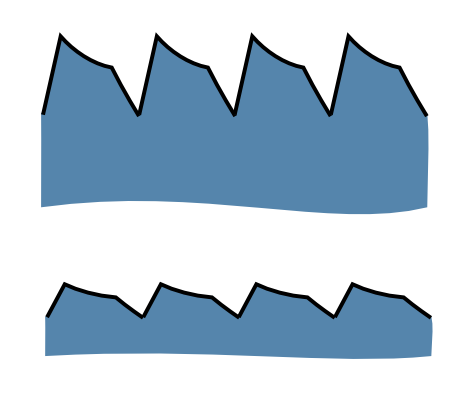
>Now, a vintage toothing, or keying, blade is a different animal than the toothed blades made currently. These I believe to be better suited for agressive planing in problematic woods and or areas (like knots).

old tool thread


Diagram of old toothing plane blade, upper is edge as seen, lower is perpendicular cross section of blade

BugBear

Re: Toothed blades

#25

Re:Brief great snakes!!!!

Stephen Shepherd in the State of Deseret

>Pam,

The increased surface area is very small, it is the very small irregularities that help the glue grip.

As for veneer of course it is better to have a good tight joint between the two and a flat substrate. This helps reduce telegraphing as the hide glue pulls the veneer down.

A thin glue joint is always better than a thick glue joint.

Stephen