WoodCentral Forums

Est. 1998 — 27 years of woodworking knowledge

Hirsch chisel tool review

Posts

Hirsch chisel tool review

#1

Hirsch chisel tool review

The Hand Tool Curmudgeon

>I posted this elsewhere and thought you might get a kick out of an "Adam, the old tool curmudgeon" tool review. The subject is Hirsch/two cherries forming chisels. Ready?

I have a set of Hirsch chisels which are pretty highly regarded, often recommended, and I can't stand them. Its not the quality of the steel but everything else I don't like. And frankly, I find that frustrtating. Its obvious that they CAN build a great chisel, but in my opinion, they have decided not to.

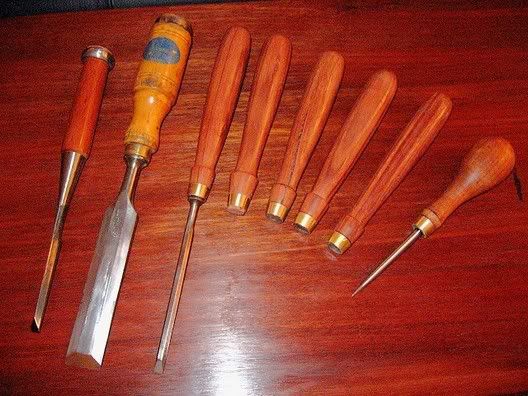
What I have are 2, 6, 10, 12, 16, 20mm firmers. I mic'ed them instead of assuming their names were accurate. As it turns out, they were very accurate.

The 2mm is pretty much a joke. Its .075 wide, so just a little over a sixteenth. Its a worthless tool in my shop.

The 6mm (.235) is light of 1/4" by .015. So if I plow a 1/4" groove for a drawer bottom, I have to fuss with this chisel to clean it up. I'd much rather have a chisel the exact width of my plow iron and my 1/4" mortiser (I do have, its just not my Hirsch). This chisel I should probably grind down to a heavy 3/16", taking .015 off each edge, eliminating the dubbed edge that resulted from the excessive polishing. In fairness, unpolished chisels are available.

The 10mm (.396) is a heavy three eights. This chisel is a decent size for London pattern dts, albeit a bit big- especially for half blinds in 4/4 stock. Otherwise, 0.4" is an awkward size in cabinetry. Its too big for a groove in 4/4 stock, and its a really huge mortise.

The 12mm (.471) is my favorite of the lot. Its a decent size for carcass dovetails. I really like having chisels 7/16", 8/16", and 9/16" for carcass dovetails. Hirsch only offers the 12mm and possibly the 10mm in this size range, the 10 being a bit too small, for carcass dts, a bit too large for London pattern drawers as mentioned earlier. But feel free to consider this nit picking. This is a good chisel.

The 16mm is pretty darn close to 5/8" and I find its an even swap for a 5/8" chisel- which I use for the pins on half blinds.

The 20mm is fine. I like a chisel wider than 3/4" to clean up 3/4" rabbets. This chisel I mic'ed at .789. Ditto, I like a 1-1/2" chisel for clean up tenons cheeks. I don't feel as strongly about these big sizes as I do about the smaller. But I wish they had different handles. When you use a chisel all day, you quickly realize that you can't hold the things like screwdrivers, relying on the tightness of your grip to operate them. Well, unless you enjoy prying your fingers open each morning. The alternative is the time honored open palm push from the butt end. The tiny bolstered butt ends make this uncomfortable, eliminating fully half of my technique.

The blades on all these chisels are a tiny bit thick for my tastes, though they are better than the Stanley 750's I have. When chopping a dt, penetration matters. These chisels can hold their edges with low (20+ degrees). But they'd work better if they were reduced in thickness by 75%. Like everything else about these chisels, they've shackled their fine steel to really thoughtless features, limiting the usefulness and performance of what could have been great chisels.

My feeling about these chisels is that they reflect the general ignorance about hand tool work. In keeping with every chisel review I've read over the last 10 years, Hirsch/Kirschen/ECE have mistaken the function of a chisel for edge holding. In fact, softer chisels with good patterns (blade shapes) and nice handles can be advantageous. They require more frequent honing, but they are easier to hone.

In all, I hate the handles, resent the dubbing, and feel U.S. cabinetmakers are screwed out of a decent 1/4", 5/16", and 3/8" chisel. The fact that the steel is as good as it gets doesn't make up for their missing sizes.

Adam

hand tool curmudgeon

Re: Hirsch chisel tool review

#2

Interesting...

Denis Ch�nard, Orl�ans, Ont.

>Thanks Adam for the review.

I was wondering about the metric sizes of Japanese chisels being a problem in use, and was reassured by many that they didn't have a problem. I'm "glad" (not really, but you get the point) that someone's experience confirms my concerns...

Just ordered some Japanese chisels, in the expectation of getting rid of my Marples, but for now at least I think the blue ones will stay in the shop...

DC

Re: Hirsch chisel tool review

#3

Tell us how you really feel!

Paul in NJ

>If I didn't have so many chisels I probably would get 0 sweep carving tools for bench chisels. I think they would be great.

Paul Dzioba

Re: Hirsch chisel tool review

#4

Re: Hirsch chisel tool review

Rob Brophy Niagara Falls

>Adam,

While I share your preference for old tools, most of your problems seem to be with the metric system.

Pictures of the chisels in question would help readers make up their own minds....do you have a link to photos of these 'forming' chisels? Lee Valley sells firmer chisels by Hirsch, and while not my taste they seem perfectly serviceable. If these are the chisels in question, I wouldn't want to accuse you of reflecting a general ignorance of hand tool work, but aren't they designed for use with a mallet? Investigate 'paring' chisels for hand work.

I would suggest that you make new, more comfortable handles for these chisels as craftsmen have done for centuries, but perhaps if you prefer "a chisel wider than 3/4" to clean up 3/4" rabbets" it might be beyond your ability at this point in your career. Keep trying, you will pick up the skills eventually.

"and feel U.S. cabinetmakers are screwed out of a decent 1/4", 5/16", and 3/8" chisel."

Well, maybe someone in the U.S. should make a good set of 'imperial' chisels instead of feeling it is owed to them by countries who have chosen to use a different system of measure. Oh wait, the US -is- one of those countries and was one of the seventeen signatory nations of the Convention du Metre in 1875.

Rob...another curmudgeon who happily builds in Imperial and SI

Re: Hirsch chisel tool review

#5

US cabinetmakers

adam Cherubini, NJ

>I was careful to write U.S. cabinetmakers because I don't know what the tools and stock sizes are available in other countries. If you have metric table saw blades (or however you plow a groove) and metric stock, my comments are invalid. I actually prefer the metric system. But I have english tools and I'm more efficient when i can get them all working together.

Adam

Re: Hirsch chisel tool review

#6

Re: Interesting... OT Rant warning *LINK*

Miles

>Well, DC, there is a very simple modern solution to the incompatibility of metric chisels and your shop.... lobby for USA to join the rest of the world in using SI units ;-)

I'm old enough to work happily in Imperial and Metric, but much of the time, metric is preferable. As soon as you start converting units (especially science & tech ones) metric becomes a huge advantage. Ever try working out how many kWh you need when you are heating something and the insulation properties are given in BTU/hr/sq.ft/degF? Horrible! (and there are 5 different BTU's to choose from IIRR)

Don't even think about diffusivities or anything more elaborate unless a calculator is handy!

US paper sizes are also DUMB, vs ISO system - you can't even perfectly enlarge Letter onto 11*17 because they are not the same shape! Developed country? Ha ha ha!

Please don't be offended, I'm just letting off steam on a bad day. I love you all really :)

Miles

pS I suspect that bugbear would be able to give a professional's perspective on funny paper sizes, as he writes printer drivers...


ISO - So sensible

Re: Hirsch chisel tool review

#7

To me....

HC Sakman

>...metric/sae chisel sizes do not pose any problem to my work.

Chico...

Re: Hirsch chisel tool review

#8

This is too funny Rob!

HC Sakman

>You said: "Well, maybe someone in the U.S. should make a good set of 'imperial' chisels instead of feeling it is owed to them by countries who have chosen to use a different system of measure."

Well... excuse me but I'll tell you without using any adjectives.

US is the ONLY country insisting on using fahrenheit (I hate the most) and imperial system on the roads and daily trade. THE ONLY ONE! The rest of the world is using metric, inc. UK & Australia.

Sorry, I felt the urge to divulge this info upon what you said.

Chico...

Re: Hirsch chisel tool review

#9

Besides there're already US made imperial chisels

HC Sakman

>

Re: Hirsch chisel tool review

#10

Re: Hirsch chisel tool review

thomd

>I certainly do prefer the Client State measurement system when it comes to making comaparisons between the calories in a chocolate bar and the amount of heat it takes to raise the temperature of 1cc or water one degree. For measureing up cabinets, I stopped worrying about that level of math after the grade three math final was over.

I have a couple of Hirsch mortising chisels and they are the ugliest things ever, with handles as large as a prize winning carrot, that taper the wrong way so every thunk of the mallet is resoundingly transmited to the hamd

Re: Hirsch chisel tool review

#11

Re: Hirsch chisel tool review

Pam Niedermayer - Austin, TX

>What everyone else said vis a vis metric. Also, if you want thinner chisels, don't buy firmers, which are intended to be extra strong, therefore thick. For bashing dovetails, why not get some nice shinogi, strong and thin for most of their width?

Other than that, good review. :)

Pam

Re: Hirsch chisel tool review

#12

Re: Hirsch chisel tool review

Norman (Ottawa, Ont.)

>Hi Adam,

"The 2mm is pretty much a joke. Its .075 wide, so just a little over a sixteenth. Its a worthless tool in my shop. "

This size is invaluable when paring or lightly chopping very narrow dovetail pins. I use it often in my shop.

Hirsch (bevel edge) = Two Cherries ( bevel edge)

Are these the bevel-edge chisels you are referring to because they are highly rated Western type chisels. They aren't very high -end chisels nor are they at the bottom of the pack. They're probably very good value for the price. The older Hirsch had eight-side handles ( kind of ugly), the newer ones are more rounded ,,, exactly like the Two Cherries.

Norman

Re: Hirsch chisel tool review

#13

Re: Hirsch chisel tool review

thomd

>Why not? Because I get all my best baluster designs from European chisels.

Re: Hirsch chisel tool review

#14

:)

Pam Niedermayer - Austin, TX

>

Re: Hirsch chisel tool review

#15

More observations, and thoughts along the way

Derek Cohen (in Perth, Australia)

>Hi Adam

I am not sure what came first, this Review or whether it was inspired by the thread we both very recently contributed to on Knots. It is becoming a smaller web, and there are interesting crossover topics.

The background is simply that a forum member stated his desire to buy a set of Two Cherries chisels (which we all know by now are the same as the Hirsch variety, only a tad more expensive). Since it was a done deal already, I just piped up that he should get the unpolished variety (which are also cheaper) since the backs of the polished variety require flattening. Adam then noted his dislike of the handles with their bolsters, which I also find (for my taste) too thick and too short in a paring chisel.

Here are the Two Cherries in polished and unpolished versions (as from the Craftsman Studio website:


By coincidence, I have just begun on a task that I have been promising myself to do for a few years - replacing the handles of my paring chisels, which are Bergs (and which remind me a little of the Two Cherries - the handles of which are not as "bad" but similar). I have picked my "set" up individually over the years. The handles have been abused by many hammers. I prefer to push them, so the new handles are optimised for this (no bolsters). If I have to chop on a chisel I use Japanese chisels.

Here is what I made up today (I am no expert with a lathe). For comparison is a Matsumura dovetail chisel (you can see how much shorter it is) and a Berg 1" (you can see how chunky it is). These handles are for 1/8" - 1/2". The 3/4" and 1" are a little thicker to balance the heavier blade and accommodate the thicker tang.


Adam responded on Knots, When they round the edges of the flat back over, that radius goes all the way to the sharpened edge. If you leave the radius and just hone the bevel, the corners of the blade will be dull. You could profile them over like a smoother's blade. But I don't recommend it. You need a nice crisp corners on a firming chisel. I've seen paring chisels with a cambered edge, but not firmers. So this is a pretty big deal.

Those points you make are very true. Just yesterday I was flattening the backs of some chisels for a friend. In this case I was using the disk sander on my belt sander combo (in the jig I wrote about recently). This acts like a surface grinder. All I needed was a couple of seconds on a 600 grit disk to reveal the highs and lows. What became apparent was that the corners at the back of the bevel were cambered, which the result that the blade would have to cut as per a smoother's cambered blade (i.e. if blown up, the shape would resemble a scalloped out groove). Putting a flat across the blade restored the full cutting edge.

It later occurred to me that this situation might explain some of the observations/complaints of users of the Veritas Honing Guide Mk II, that is, those who say that they have chisels that will not remain square in the guide. The reason for the blade skewing is likely that there is a high point on which the back of the blade is rotating. I am wondering now whether there is a relationship between this experience and chisels with polished backs? Perhaps some of you who have had this experience can comment.

Regards from Perth

Derek

Re: Hirsch chisel tool review

#16

Worhtless?

Scott Burr in Ben Lomond, CA

>I'm always using "very" thin chisles...a lot.

Just courious why you dislike it?

Re: Hirsch chisel tool review

#17

Sorry, This was directeded to Adam's post

Scott Burr hangin' in Ben Lomond

>

Re: Hirsch chisel tool review

#18

Spot on!

david charlesworth

>Here here!

Agree with every point.

David Charlesworth

Re: Hirsch chisel tool review

#19

Re: Interesting... OT Rant warning

Moses Yoder in White Pigeon, MI

>Any intelligent person soon realizes how superior the metric system is and wonders why anyone would use the Imperial system. It's a mystery.

Re: Hirsch chisel tool review

#20

Re: Worhtless?

adam Cherubini, NJ

>If you think about my work, and my approaches, especially to chisels, you can see why a tiny chisel would be particularly unhelpful. Chisels are prime movers in my shop, defining, more than refining features. I don't make many 1/16 features. Obviously when I bought the chisel, I thought it would be helpful. But I bought these probably 7 years ago and I've never used that chisel. An 1/8" chisel I have found some use for. But not this one. Its like working with a sharpened finishing nail.

Re: Hirsch chisel tool review

#21

In all fairness...

John in New Mexico

>The real problem is the incompatability between an old plow plane that makes a 1/4" groove, and a modern European chisel that is 6mm, for example. I think part of the acceptance of mixed units like this has to do with a lot of us being "hybrid" woodworkers who use either a table saw or router to make dados and such. If all of Adam's other tools were calibrated in mm, he'd be left just the ridiculous polish and lumpy handles to complain about.

I'm starting to feel better about my ugly, $5 Sandvik's I always dream of replacing with some sexy new set with wood handles and handsome stickers ;).

John

Re: Hirsch chisel tool review

#22

why the obsesssion with size?

Ian (in Sydney, Australia)

>Adam

Whilst I appreciate that your review was in part in jest, I'm responding seriously. Also I don't intend any of what follows as an attack on your integrity, knowledge or skill.

For a person who practices woodworking from a time when standards varied from town to town I find some of your comments intreagueing, especially your obsession with size.

I believe it is pointless to compare modern metric (or imperial) tools � made in an era of standardised measures � with those from the 18th century.

I understand your desire for tools to complement each other, but for the era within which you work there was no mass market in tools. At best there were master blacksmiths who might have made batches of cutting edges for sale by travelling merchants. Each batch would be subtly different in size.

More likley, you would have commissioned the village blacksmith to make you a set of cutting edges that matched. This worthy would set out to make a chisel that, in width, was for example 1/384th of the length of 16 male left feet � at one time the "standard foot" in Gosslar (a silver mining town in Germany) was determined by arranging heel-to-toe the left feet of the first 16 men to leave church on Sunday morning and dividing the resulting distance in half 4 times � so 1/2in was equal to 1/384 of the length of 16 left feet.

The blacksmith would get close but it was up to the wood craftsman to make the final adjustment, hence the reason mortise gauges have two pins.

You would have then built the plane bodies and chisel handles around these cutting edges.

Leaving aside issues arround how Hirsh (and Two Cherries) finish the backs of their blades, your comments about usefulness in your shop would only be fair if you were to modify some of your planes to match the METRIC width of the chisels � 2, 6, 10, 12, 16, 20mm.

ian

Re: Hirsch chisel tool review

#23

That's the point, right?

adam Cherubini, NJ

>That's it John and Rob. It IS the metric sizes and the fact that they don't FIT into my shop.

The deeper message is that there's more to a chisel than paring a joint. We typically review and choose chisels based solely on their edge holding ability. What I'm suggesting is that chisels should be chosen like saws, with specific jobs in mind. Edge holding is one attribute in their ability to complete a job, but its probably not the most important.

Of course there are fine chisels made in English sizes. Ashley Illes comes to mind. Or LN who very carefully chose useful sizes to make up their basic set (I was very impressed by this). But even Sorby, whose chisels we routinely trounce, meet several of my critieria for a good chisel but fail miserably the ONLY criteria used by contemporary reviews.

FWIW, I don't like doing tool reviews. But in this case, I thought I had some good one liners and a semi interesting under story. I'm glad you guys enjoyed my pot stirring!

Adam

Re: Hirsch chisel tool review

#24

Aretifism among the English? Sets me wondering...

woodburnbob

>Were these 16 church folks wearing shoes or not? Indeed, did a churchgoer in those days wear socks? It would be silly of me to think they weren't wearing clothes, I suppose.

Must have been a lot of touching of body parts going on while lining up all those left feet. Too bad these historical events happened before photography; I wouldn't mind seeing a picture of it. I do have a few old time photos of 20 or so Depression era fellows standing in a line and releaving themselves...shot from the back, of course. Now makes me wonder if it wasn't some sort of group comment on the idea of men getting in line to have their appendages measured or marked.

Oh, well, it did get me looking around, wherein I noticed a new word, new to me anyway:

Aretifism, a sexual attraction to people who are without footwear, is a synonym to podophilia, although the connotation is slightly different (attraction to the unclad foot vs. attraction to the foot itself).(http://en.wikipedia.org/wiki/Foot_fetishism)

Re: Hirsch chisel tool review

#25

Great writing

woodburnbob

>Me, too, I really liked reading your "review" as well. It's not that I care that much about 2 cherries or the metric/foot stuff. It's that I really enjoyed your style of direct and concrete statements. There was a subtle undercurrent of comical rant, which I especially enjoyed. More power to you.

👍 This page answered my questions

Your vote helps other woodworkers quickly find the answers and techniques that actually work in the shop.