WoodCentral Forums

Est. 1998 — 27 years of woodworking knowledge

Socket vs Tang, and Berg chisels

Posts

Socket vs Tang, and Berg chisels

#1

Socket vs Tang, and Berg chisels

Derek Cohen (in Perth, Australia)

>As I'm sure everyone is aware, chisel handles are fixed to the metal body by either a socket or a tang.

I assume that socket chisels are the stronger design and, consequently, that they are designed for striking. I also seem to recall that this is a later design (in term of vintage) than the tanged variety since sockets are more difficult to construct and a relatively more recent introduction.

For a while now I have been slowly building a set of Berg chisels specifically for paring. The one's I have are all tanged. I really love the fine beveled edges that slip easily into dovetails. I don't stike them, preferring to pare. I have not compared these to the socketed variety, and was wondering what the difference was. One might assume that tangs are lighter than sockets, and that this would be an advantage in this type of use, but my socketed Witherbys are as light as these Bergs.

I also wonder about their age, and whether the fact that they are tanged has anything to do with age.

Anyone with information here?

Regards from Perh

Derek

Re: Socket vs Tang, and Berg chisels

#2

Re: Socket vs Tang, and Berg chisels

joel

>Your basic assumption is incorrect.

Real English mortise Chisels which are no longer made are all tanged. and they were made for really heavy striking. Sash mortise chisels were either socket or tanged. Paring chisels are usually tanged but socketed ones certainly have their fans. English Bench chisels are usually tanged.

How well a handle holds up has a lot to do with what it's being used for. Socketed handles, as long as you get the angle of taper correct are a lot easier to install. Tanged handles are more complicated, esepcially in the old days with hand forged bolsters. Barry Iles explained to me that with hand forging the tang of the chisel may not be perfectly centered in the bolster and in relationship to the rest of the chisel. So you can't just drill a hole in the center of a handle and expect it to work. What they do is they check each tool and drill the handles slightly offset as needed for each handle. What a PAIN.

As far as I can guess, (without getting up and doing more research), the low tech but skilled English tool companies mostly, but not entirely used tanged handles. in The US, where bigger companies with more machinery but less hand skill abounded used more sockets. The problem with socketed chisels is that unless the wood is really try the handles can easily work loose over time. Otherwise it's really 6 of 1 half dozen of the other and whatever feels good in the hand - as there are differences in balance and weight.

Japanese chisels are all tanged - with a ferrulle ground in to look socketed.

Re: Socket vs Tang, and Berg chisels

#3

"Real English mortise Chisels"

Don Thompson - Cutler Ridge, Florida

>Do you have any pix?

Re: Socket vs Tang, and Berg chisels

#4

Re: "Real English mortise Chisels"

joel

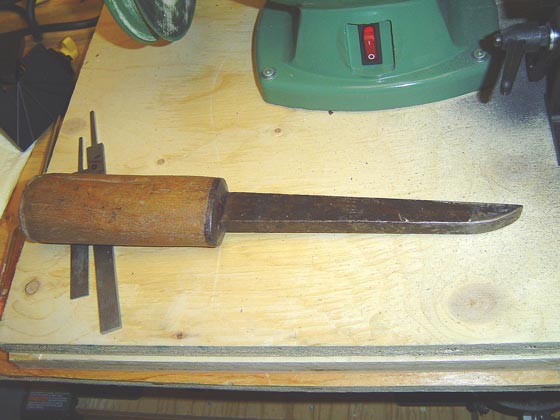
>incidently - these don't even have a ferrule but they can take enormous abuse (which is what they were designed for) (sorry about the crappy picture but it's the only one I have.)


img

Re: Socket vs Tang, and Berg chisels

#5

I disagree

Todd Hughes

>I would think that a socketed handle is much harder to make because you have to have to turn the section that goes in the socket so that it fits just right.To long, to small, to big , to short and it won't fit.While with a tang all you do is drill a hole in the handle, really nothing to fit with in reason. I have seen many old chisels including some older 18th. century examples and don't recall ever seeing any other then maybe a few rough "farm" forged ones where the tang was off center.Any smith that could make a good chisel would sure make the tang in line with the chisel. As someone that has made both types it is MUCH MUCH harder to get a socket to line up straight with the chisel , never mind the added difficulty in making them. Also I don't know about socketed chisels getting loose as the dry out, a properly hafted socketed chisel has a space between the back of the chisel and the shoulder on the handle. If the wood shrinks the handle will move up into the socket further thus tightening it up.....I don't think there is any question that an avarage socket chisel can take more pounding then a normal tang chisel. This is why most if not all larger heavy duty chisels are socketed. The "Pig Sticker" type tang mortice chisels were made with with very oversize handles in an attempt to get around this problime and most that I see still either have replaced handles, busted handles or no handles at all ......Todd

Re: Socket vs Tang, and Berg chisels

#6

Re: I disagree

joel

>the overwhelming # of surviving socket chisels were made in big forges where the socket is totally consistent one to another. THerefore it is really easy to mass produce handles that fit. The Stanley 750 being a great example. On a onesy twosey repair getting the taper right is really hard. it's pretty common to see old socket chisels with loose or missing handles.

At Ashley Iles today they still hand forge the bolsters and tang of each carving tool. Consequently as Barry Iles says they still have to indiviudlaly drill and fit each handle. It is the job of the cutler to do this. It's a small amount - not easily noticed - but you notice it if it goes wrong. Refitting a new handle onesy twoset is really easy. it's rare for me to see tanged chisels with loose handles - the handle may be broken or missing but it hasn't fallen off.

As for strength - well - you don't see many chisels broken at the tang or under the socket. sO that isn't really an issue. You see broken handles and occasionally broken blades.

As for pounding it's the same - a socked chisels you pound into the socket, in a tanged chisel (properly made) you pound into the bolster. Same difference.

"This is why most if not all larger heavy duty chisels are socketed" in the US only. In England it's the opposite for the reasons previously posted.

Your point on why mortise chisels have such a heavy handle makes sense and if you think about it a socketed sash mortise chisel will have a weaker wood section at the top of the socket than a similar wood tanged chisel with a big wood handle. so the tanged version will be stronger.

Incidnetly as for replaced handles you are dealing in tools in the US. In the UK it's was pretty easy to get a nice set of mortice chisels with original handles. On my set most of the handles are original. Only the very oldest chisels have replaced handles - I have one mortise chisel that is 200+ years old that has a replaced handle. But after 200 years of getting the crap beat out of it it makes sense that the handle could mushroom - espcesially considering the handles weren't hooped.

Re: Socket vs Tang, and Berg chisels

#7

Wait a minute Joel.

Bob Hackett

>A tanged chisel is by nature a wedge and a wedge will cause the handle to split sooner or later if abused.The only thing keeping the handle from splitting is the ferrule and the bolster and the bolster on most chisels is pretty wimpy.Most of the handle failures I`ve seen on tanged chisels come from the bolster being driven into the handle and the handle being split above the ferrule blasting the handle apart in the middle.

Ashley Isles may be hand forging thier tangs but most American maufacturers used the same type of machines to forge tangs as they did to forge sockets only the machines were smaller.The tang was formed and the bolster upset and formed in the same operation and were always dead center on the blade because that`s the way the dies made them.

The machinery and dies were cheaper to make and the chisel used less steel so it was cheaper to make.A tang was buried in the handle so it did not require finishing unlike a socket with had to be hand finished to the same standard as the blade thus adding yet another step and more cost.

Most socket chisels with failed handles that I`ve seen(and I`ve seen alot)failed because the handle was beat into failure and followed grain runout thru the side.The only other type of failures I`ve seen have either been from being hammered sideways or the outer areas of the handle were split away by having the hoop beaten down onto it or having an ill fitted socket beat up past the shoulder.

I just don`t see any tanged chisel and handle,even a mortice chisel being able to withstand anywhere near the abuse that it takes to kill a socket chisel`s handle.

I`m with Todd on the mortice chisel handle opinion.I have seen very few "pig stickers" with intact handles and thier tangs tell why.Unless they`re bound by steel hoops top and bottom they`re just set up to fail.Once you put an iron ferrule on a mortice chisel don`t you just have a poor excuse for a socket chisel?

I have seen(and repaired) lot more handle-less socket chisels than I would have liked to.Even though the socket is horribly mushroomed they still have what`s left of the handle in the socket.The tanged chisels that were beat past reason had no wood,ferrule and usually only part of the bolster left and the end of the tang was maybe slightly mushroomed.Once the wood disappeared there was nothing for the moron to beat on so they stopped.

Being in the shipbuilding business you get to see more than your fair share of man`s unhumanity to tools and in the chisel arena even the morons and gorillas knew that while socket chisels may cost more they could stand more abuse before being reduced to total scrap.

Most US chisel producers made both tanged and socketed chisels and the socketed versions were always more money for the same quality blade.If sockets were easier to produce and inferior in performance then why didn`t the price reflect that?

The folks at Ashley Isles may be telling you one thing,what I and my boatbuilding friends see says something completely different.

Mainely,Bob-Who hopes he hasn`t upset Todd by agreeing with him again.

Re: Socket vs Tang, and Berg chisels

#8

Better picture

Frank D.

>Here's a better picture of an old tanged mortise chisel. The bolster is welded to the blade (forge welded I was told) and seems quite sturdy. The handle has no cracks, just a bit of wood that seems to have been gouged away (it looks like a crack, near the top of the handle, but it isn't). I don't know haw old the chisel is though, it says "Ward Warranted" and has the initials WP with some kind of logo. The handle is very slightly crooked but I don't know if it was made that way or if it's because of use. There's leather on the top of the handle where the mallet strikes.

FWIW,

Frank


img

Re: Socket vs Tang, and Berg chisels

#9

Re: Wait a minute Joel- typing takes a long time

joel

>By Todd's reasoning a mortise chisel has more wood at the bolster so should be stronger than a socket. And this is true.

How do you use a mortise chisel - you mallet it in as deep as you can, on a special build low string bench, and then lever the waste out. A 1/4" wide mortise chisel has about a 1" or 1 1/4" wood section at it's weakest point. Very strong. THe socketed version has maybe 3/4" at the point where the socket ends (it's weakest point). THe full bolsters take the force of the mallet so unless you have a crappy handle or you misuse the handle it transmitts the force.

Inutitively you would think that at the very least a ferrule would be important for an English mostice chisel and a hoop but - they weren't. In English tool catalogs socketed chisels were offered but not for mortising.

Also the design is I think an older design than the American socketed sash mortise chisels. As far as I know English mortise chisels were never manufactured here.

Of the thousands of chisels that were made only a small fraction have survived. hooped chisels can take more abuse, but a true mortise chisel works better if not abused. If that was not the case why did the English who relied on hand tools for a longer period than the Americans continue to buy them?

As for manufacture using a die that bangs out the tang and bolster or not is mostly a factor in how big a drop hammer you have. to make socketed tools you need even larger equipment. In the US most chisels were made by large companies with large machines in large factories. In Sheffield, where Barry Iles is from, and where he trained, most chisels, up until the 1960's were made by little meisters, working independently on or offsite for larger makers. CArving tools are still made this way because there is so much other forging that must be done by hand anyway. Chisels are no longer made this way.

Marples (1909) did offer a series of socketed chsiels, none labeled Mortise chisels, and the selection was dwarfed by their tanged offerings. OF the pages of tanged offerings there were four different types of full bolster tanged mortise chisel, all offered unhandled or with a variety of handles.

I should mention that if you find a toolkit from a working cabinetmaker in the US from C. 1900-1940 the chances they would have any English Mortise chisels are nil. But the tools they would have would be well maintained. Ditto for the English - but here you find nice sets of mortice chisels, in fine condition, and they sell today for a very pretty penny.

Odd tools, rusted out stuff, things in a garage, went thought a lot of abuse and aren't indicative of how people used the tools.

Re: Socket vs Tang, and Berg chisels

#10

Some historical notes

joel

>One more thing worth mentioning. In the American catalogs I have 3 make it clear what they are offering as a mortise chisel the others have no picture.

THe 1897 Cas A Strelinger catalog which only had house brand chisels they mention several lines of new "millwrights" and socket firmer chisel. THe only Thing they call a mortise chisel is a [english] Ward & Payne Mortise chisel.

THe 1908 Hemmecher Schlemmer Catalog lists only one style of socketed mortise Chisel - buck brothers #48

THe 1890 Buck Brothers catalog lists only the #48 as a mortise chisel being suitable for all heavy work but they also list similar but lighter socket firmer chisels and several styles, all similar including coachmaker's and millwrights. THe #48 is only 6 3/4" long in the blade and appear to me to be proportioned after sash mortise chisels (by that time most of the heavy mortising in the furnigure industry was done by machine but the construction industry was booming) but as I don't have the range in from of me to compare I don't have a sense how heavy they were in comparison to the other varieties. It is clear from the text of the catalogs that the socketed style was reasonably new certainly post civil war I'm guessing the 1880's.

Re: Socket vs Tang, and Berg chisels

#11

A few more examples

Derek Cohen (in Perth, Australia)

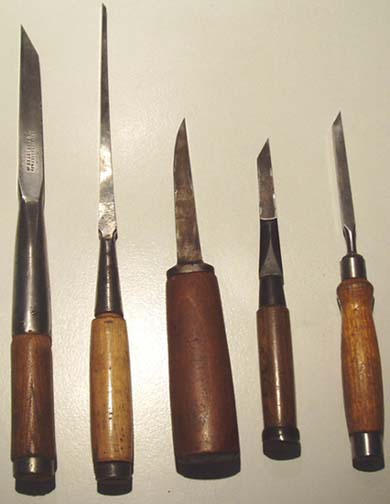
>Here are a few more examples of socketed and tanged mortice chisels for everyone's interest.

From L to R:

Ibbottson (UK), Witherby (USA), Sorby (UK), Japanese, Titan (Australia)

Regards from Perth

Derek


img

Re: Socket vs Tang, and Berg chisels

#12

... and the Berg chisels?

Derek Cohen (in Perth, Australia)

>Any information specically about tanged vs socketed Berg chisels?

Were they a parallel line, with one cheaper/more expensive than the other?

Were they intended for different uses?

Is one line older than the other?

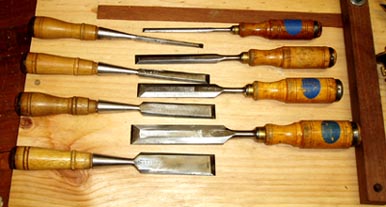
Here is a pic of the Bergs (tanged) and Witherbys (socketed) chisels.

Regards from Perth

Derek


img

Re: Socket vs Tang, and Berg chisels

#13

Re: A few more examples

joel

>THe Chisel on the left would be called a "socket chisel" in the appropriate tool catalog. But of course you could use it for mortising. The witherby would be a millwrights chisel (way too thin, long,and elegant for mortising) and would snap in heavy use. Pesonally I would even be wary of using it for sash mortising.

Re: Socket vs Tang, and Berg chisels

#14

Re: A few more examples

Don Thompson - Cutler Ridge, Florida

>Interesting. I see that two of the three have particularly fat handles. Number two has a considerable taper all along the blade. Also noticeable is the curve from the bezel, as Lee mentions in his sharpening book.

Thanks, folks!

Re: Socket vs Tang, and Berg chisels

#15

Pig Stickers?

Don Thompson - Cutler Ridge, Florida

>Are these what are known as "pig stickers"? I had guessed when reading the OTL that it meant any old big mortise chisel.

Re: Socket vs Tang, and Berg chisels

#16

Re: "Real English mortise Chisels"

paul womack

>The BACK of the bolster is flat, so the (also flat) end of the handle just bears down. All the tang does is keep the handle centred.

These babies can take real, man-size abuse.

(BTW, nice driveby on the Ibbotson Derek)

BugBear

Re: Socket vs Tang, and Berg chisels

#17

Re: Pig Stickers?

joel

>yes but I truly hate the term. (which BTW seem to be of a fairly modern coinage)

Re: Socket vs Tang, and Berg chisels

#18

Re: Pig Stickers?

William R. Duffield on the Cohansey

>As I understand the term, which I believe was coined by or very near to Patrick Leach, only the tanged and bolstered chisel in the center of the photo is a proper "pig sticker". He has had some ugly things to say about #6 foreplanes and other quite useful tools, as well.

Re: Socket vs Tang, and Berg chisels

#19

Re: A few more examples

Dennis

>for what it is worth, this is flea market pick up this summer,not sure of maker,hard to read but sure has to be English "pig sticker" that was used and abuse, notice the grind on it, but i will get around to correcting that soon, it is 1/4" one so will get used for sure

Dennis

remove nospam for email


img

Re: Socket vs Tang, and Berg chisels

#20

Re: A few more examples

Don Thompson - Cutler Ridge, Florida

>Hey, Dennis,

We gotta talk about your flea market / auction sites!

I would definitely buy that one!

Re: Socket vs Tang, and Berg chisels

#21

That pic was just to make us feel bad, right?

Bill Houghton, Sebastopol, CA

>Nice looking chisels. At least I think so; it's hard to see the screen through the drool film on it.

Re: Socket vs Tang, and Berg chisels

#22

Re: A few more examples

paul womack

>not sure of maker

My guess would be Ward & Payne. I'm pretty sure I can see "ARD" in the middle there.

Excellent maker.

Here's a related discussion from the OLDTOOL list.

BugBear

Re: Socket vs Tang, and Berg chisels

#24

Re: ... and the Berg chisels?

Bob Hackett

>I only have 2,both socketed.The two I have are the only chisels I`ve come across that rival the laminated chisels I own.The non-laminated Swans and Whiterbys come close but the Bergs have the edge(pun intended).

I was wondering why they chose to leave a raised collar around the top of the sockets.I almost filed it back on the first chisel I found.I noticed that it was forged that way after alittle cleaning and while it seemed odd at first that raised band now fits nicely between fingers when choking up on the blade.

Both the Bergs I have were handled in local hornbeam and hooped.They hold a keen edge and don`t fold in heavy chopping.It`s nice to be able to drive thru rough work with a mallet and then pare with the same chisel.They`re the ones I grab from the rack when I`m going to be working away from the shop as I know I can depend on them.

I plan on getting more if I can find them at a reasonable price,lately they seem to be held in the same esteem as Swan,Whitherby and Charles Buck.I guess the cat`s out of the bag.

Mainely,Bob

Re: Socket vs Tang, and Berg chisels

#25

this may help

Dennis

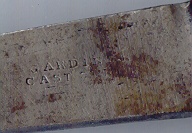
>Really not sure but looks like " GARDIN " with the " CAST S " under . On the handle is some kind of scroll letter's or mark under the owner stamp that is stamped on both side's...Js WEYBURN

Thanks for the info BugBear.

Dennis,who is going rust hunting this week for sure


img

👍 This page answered my questions

Your vote helps other woodworkers quickly find the answers and techniques that actually work in the shop.