Re: A couple questions
Adam Cherubini, NJ
>Hi Frank,
Obviously different guys have different opinions on this subject. If you look at traditionl tools as I do and compare tools within tool families (e.g. surface planes, backsaws etc), you begin to see similarities in designs and techniques. I come up with the techniques I recommend based on these observations and my experiences. Otherwise, we're all in the same boat over here, the SS Clueless.
Just in case you're interested:
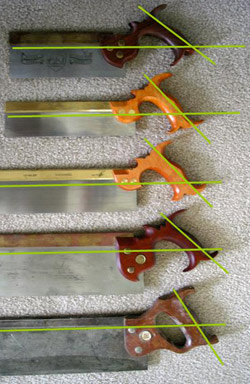
In some cases, saws are a good example, you see modern manufacturers paring away the features once thought to be critical (or typical of other tools in the family). It appears to me this is done in ignorance or for reasons few of us appreciate (i.e. cutting costs, marketing to unskilled users, etc). I'm thinking of saw handle angles, which really lies at the heart of your discomfort.
Here's a step by step. See if this doesn't work better for you.
1) The work should be held vertically. Don�t cock it sideways for tails to make the sawing vertical. The top of the board should be nearly elbow height (if possible/practical).
2) Set your gauge to the mating board, and mark across your board on both faces.
3) Mark the tails or pins (your choice) on the face facing you and the end grain. I use a mechanical pencil, but the traditional tool is a striking knife. Frankly, I love my striking knife and swear by it, but I don�t use it for this.
4) Whether your saw has a traditional open handle or a straight handle, hold the saw with a relaxed grip, with fore finger extended (pointing). The natural position of the blade will now be roughly 45 degrees toe up. These handles are designed for this position. Begin the cut at the near corner. Rotate your wrist to progress dead on both lines (end grain and face) at once. If you start to screw up, hold the good line and lay down in the bad. But keep in mind, when cutting tails first, you only need to maintain the end grain square line. When cutting pins first, you only need the square face line, not the end grain line.
5) After you�ve sawn the two lines you see, tilt the toe down and saw through the remaining stock blind using the near side kerf to guide you. This isn�t the time to fix a wayward cut. That will have to done later with a chisel. This will be the only time your wrist will be funny at all.
Try that, and see how it works for you.
Adam