By request: anvil stand, other PICS
David Barnett - Venice, FL
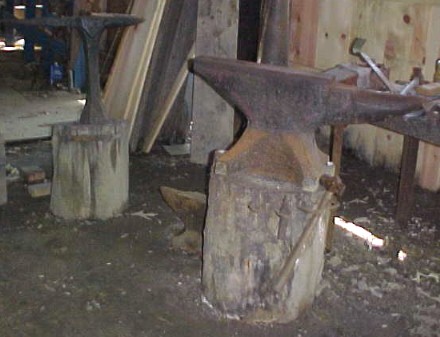
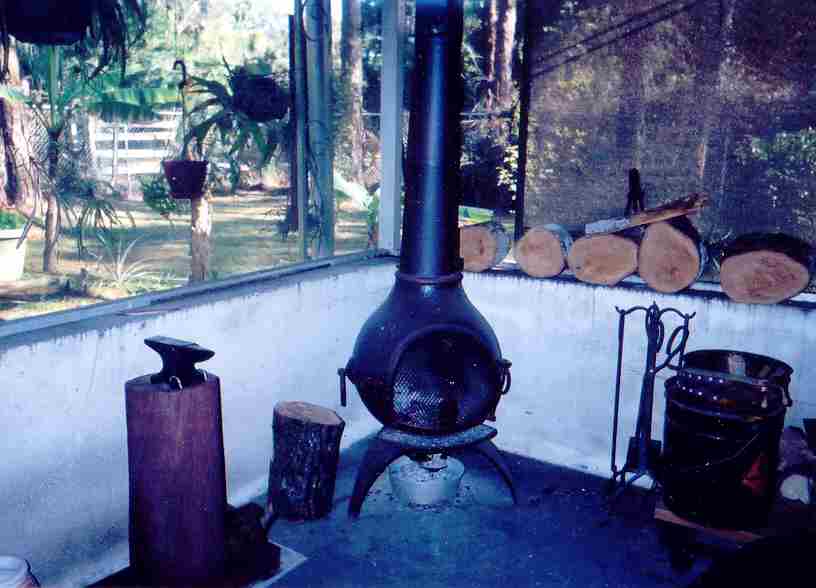
>Several Islanders n�e Ponders, most recently Roger Nixon, asked for a closer pic of my anvil stand shown in this not-so-recent photo of my humble atelier:

So here it is, every bit as good as stump for what I do on it, which is mostly to cold forge non-ferrous metals. A lot of small steel tools do get formed on it, though, for woodworking and goldsmithing alike.

Construction is very simple and handtool friendly, even for a beginner, as there are no mortises or tenons. The stretcher has two embedded 3/4" threaded rods connecting the 14" wide glued-up legs. In turn, the legs have captured 1/2" rods from the top bearers through the sleds, and the sleds are held fast by two half-laps to the sled stretcher. Bevels on bearer and sled slopes are mostly cut with a spokeshave. Easy.

I shot this detail of the lap joint with flash and desaturated it to show the bevels and kerfs. I also highlighted the dust lines to counter the prevailing belief that my shop doubles as a surgery.

Obviously, I favor walnut for bases where heavy pounding is likely to be involved, and truss rods through trestles to hold things tightly together.
My repousse bench is another example, although it differs from the captured and invisible rods in the anvil stand, using instead long open grooves to house the truss rods. These were cut deeply to center the rods and were ploughed entirely with my little workhorse Stanley #50. It performed like a champ on what I thought might be a somewhat brutal challenge. This nightshot conveys what illuminating one's workspace with less than a 100 watts of Ott bulbs will do (5800 degs Kelvin). The dayshot shows how everything's bathed in gorgeous North light every morning. After ten years of New England winters, I don't take this for granted. The light's far better for working than for photography, though. At least with my limitations.


You can get a sense of scale with the 34" high 'pounding bench' against the oak goldsmith's bench, also of truss construction but four inches taller for stone setting and other delicate work. This is the corner where I spend most of time.

The little oak stand to the left of the goldsmith's bench has hidden truss rods in glued-up legs. Notice the hodgepodge of different oaks. Both the bench and stand were built entirely of scraps and cuttoffs, together costing no more than twenty bucks. That was back in 'Hardwood Heaven', though; not Florida.

Notice the sled foot on the right. You'll see I'm not terribly particular when it's ten below zero Fahrenheit and road's a sheet of ice. I could've cut into a big oak beam for wider stock, but no, I'm saving that for something a more important than utility furniture. That's what I thought at the time, anyway.
Frugal? Or just an excuse to play with that little router plane? I'm not above considating a questionable hairline crack with a dutchman.