WoodCentral Forums

Est. 1998 — 27 years of woodworking knowledge

Plywood dovetail problem

Posts

Plywood dovetail problem

#1

Plywood dovetail problem

I'm working on the 1/2" plywood drawer boxes for the Norm Abram workshop hutch that I'm building for my brother. Time constraints prohibit doing dovetails by hand, but using a router and my 7116 Omnijig is producing less than optimal results. When cutting pins, the plys separate and break off. It's as if there were almost no glue between the ply. I've tried several different backer boards on both sides of the plywood on which I'm cutting pins. MDF has turned out to be the best. By carefully avoiding routing the backer board all the way to the point of the jig fingers, I am able to leave enough material strength to help prevent splintering the pins. If I just follow the fingers, the pin created on the backer board is so small, it breaks off when the plywood pin splits. This method is not 100% effective, but it helps. I'm too far along now to do much different, but for future reference, I'd love to know of a better way to cut plywood dovetails with a router. Is there some way to saturate the edge of the plywood with some kind of adhesive to prevent the ply separating?

Re: Plywood dovetail problem

#2

Re: Plywood dovetail problem

Pat.....the issue might just be the quality of the plywood......after the build, try an experiment with 1/2" Baltic Birch ply to see if you would have the same problem......I'm guessing you won't......


Re: Plywood dovetail problem

#3

Re: Plywood dovetail problem, sometime less is more.

Pat, your dovetails in plywood is a waste of time that doesn't really make any sense. The fact that you used plywood has already diminished the appeal of the woodworking wonks, and I would argue that just gluing and stapling the sides is probably just as strong, or maybe stronger. Plus I'll bet I could bang the 4 sides together faster than you can clamp one corner in your jig. Back through the years of building kitchens where that was my normal, whenever I got a measurement wrong, if I tried to knock one apart, it would always break the materials up so badly that I had to start all over. Finally if I had to correct a mistake, I found that placing it back on the table-saw and cutting the sides and bottom to the new size worked better.

Oh, I might add, that stapling the bottom onto the bottom of the sides on about 2" centers just adds to the strength. That edge is hidden by side mount Acuride type slides, or the L angle type that wrap the corner, so really all your talking about is seeing two staples on the box corner, rather than dovetail in plywood? When it comes down to it, that isn't worth the PITA!

Oh, and if you think plowing a groove for the bottom to fit into the sides is better, I always found that always fell in line with where the hardware screws hit, diminishing their grip, not to mention stapling it on the bottom gains a bout 1/2" of depth in every drawer. 

Having said all that, lest you all think I only do sloppy work, the kitchen I'm doing at the moment have solid wood dovetail drawers on Blum soft, or self closing slides. and some of the upper cabinets are solid QS oak, with hand cut dovetail corners, which will please the woodworking wonks that I mentioned above. Otherwise 99% of other People won't ever notice that. :-)

But I'm sure your brother will appreciate the work you have put into this.


Re: Plywood dovetail problem

#4

The solution to your problem is to use a better quality plywood

I would be surprised if you had this problem with a "Baltic Birch" quality product.  I have assembled some jigs with dovetails in a quality plywood without having the problem you observe. 


For those looking for a quality plywood.....order from made in NC,  Columbia Forest Products, available by special order from Home Depot and elsewhere.  Hardwood cores that plays nice when working it. 


Re: Plywood dovetail problem

#5

A nit to be picked

I agree that plywood drawers can, and probably should, be assembled more than adequate with joints less fiddly than dovetails. We differ on bottom installation though. 

"I always found that always fell in line with where the hardware screws hit,"

 Accuride side mounts can be mounted anywhere on the drawer side.  I usually put them about 1/3 way up from bottom. To my eye they look like they belong in this location.   I prefer to rebate the sides and set the bottom into this rebate. The convenience of this self squaring of the drawer by the bottom compensates for the minor task of cutting the rebates. 


Re: Plywood dovetail problem

#6

Lesson learned

Next time I'll order better plywood. My neighbor used to own a lumber store and I could always get better quality lumber there than the big box stores. He recently sold out to a chain lumber store. This is my first purchase from them, and needless to say, I'm disappointed.


Re: Plywood dovetail problem

#8

Re: Lesson learned

Don't feel bad about making the wrong decision. First question when buying is manufacturing country. Import plywood should always be you last choice. The adhesive in plywood changed when formaldehyde was removed. Import companies don't seem to have figured out the best replacement.


Re: Plywood dovetail problem

#9

Re: Plywood dovetail problem

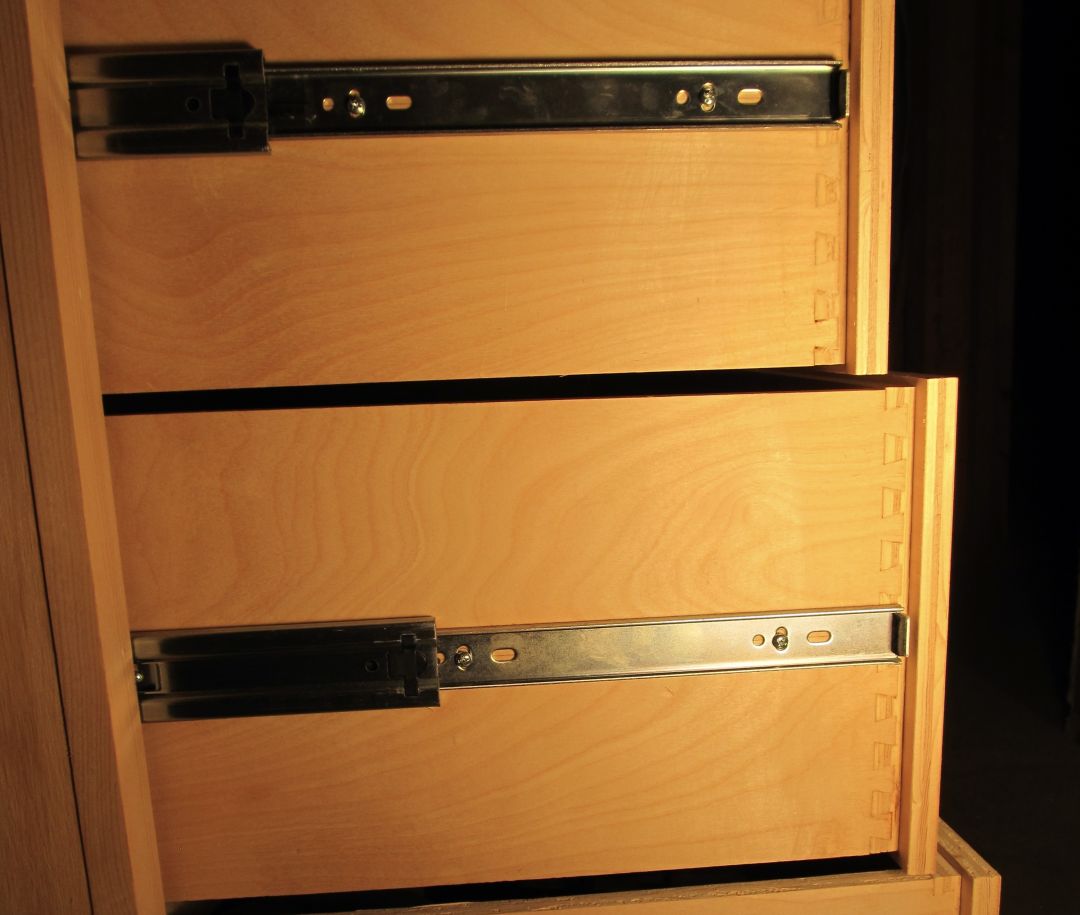
This picture is of some shop drawers I made years ago using the same jig as you and a cheaper American made plywood that had actual glue between the plys.......

as you can see......it worked out well and resulted in a very useful piece of shop furniture......


Re: Plywood dovetail problem

#10

Question about that Columbia Forest Products plywood

You state that you feel this is a high quality plywood.  When I look for this at Home Depot's site, I see a product called Purebond birch.  Is this the plywood you referred to?  I do not consider this equivalent to the baltic birch I've used in the past.  This plywood has 7 and 5 ply construction for 3/4 and 1/2 inch thickness versus 13 and 9 ply in baltic birch.  Maybe I'm not finding the right product at HD.


Re: Plywood dovetail problem

#11

Re: The solution to your problem is to use a better quality plywood

I made some dovetailed drawers out of 5/8" birch plywood and had to be very careful cutting the DT's. This plywood had many thin plies like Baltic birch but came in 4 X 8' sheets.  It was an MCM piece and the plywood drawers seemed to fit the style, do able but tedious.

A few weeks ago I made some kitchen cabinet drawers (rabbets but no DT's) out of some 1/2" or 12mm Baltic Birch plywood that came in 5' x 5' sheets. I have been hoarding a couple of sheets of it for 2 or 3 years waiting for just such an occasion.  BB grade, beautiful stuff with very few boat patches and lots of plies.  my habit is to assemble the drawer and then run a trim router around the top with a 1/4" round over bit in it.  This way I can round over everything except the front of the front (It gets a maple overlay front).  I was shocked when the round over bit kicked shards off the top edges the size of popsicle sticks.  I changed the bit for a new one and the problem continued.  I was able to repair the drawers but it was a PITA.  As I added screws to the drawers I found the top ply was poorly glued.

I guess (hope) I got a bad sheet.  I have made dozens if not hundreds of drawers like this and never had a problem.

The solution would be better plywood, but that is what I thought I bought.


Re: Plywood dovetail problem

#12

answers

Columbia makes dozens of products that can be ordered through Home Depot and others.  Begin with the Columbia web site, which unfortunately has gone green and become nearly hopeless confusing.  But in summery, you can special order any hardwood veneer on a poplar core here in the SE.  .  I have found this product to be of high quality.


And you can order something called "Euro" something or another made in Poland.  It is a multi-ply all hardwood plywood that is dense.  I have used this product where I needed a stiff plywood of high quality. 


👍 This page answered my questions

Your vote helps other woodworkers quickly find the answers and techniques that actually work in the shop.