WoodCentral Forums

Est. 1998 — 27 years of woodworking knowledge

Useful jigs/fixtures.......#1

Posts

Useful jigs/fixtures.......#1

#1

Useful jigs/fixtures.......#1

roger lance

I'm showing some jigs I use that are very helpful to me......hopefully, someone else will find them helpful as well.

If you have a bench like mine which does not have holes for holdfasts, you have an issue with holding some work pieces such as drawer parts for chisel work while dovetailing. My bench has a large storage base with 8 drawers which hold nearly all of my hand tools.....it is very convenient to have these tools at the bench and I like this arrangement.....but, there are trade offs.....holdfasts being one in this case.

As a remedy, I came up with this jig (at least I think I came up with it.....could be someone else's)......


The jig is adjustable (t-tracks).....I made mine to accommodate parts up to 10" wide......I made some shims to increase the capacity of the jig to hold thicker pieces......the two toggle clamps secure the work very well.....this has proven to be a good solution.

Re: Useful jigs/fixtures.......#1

#2

Re: Useful jigs/fixtures.......#1

John K Jordan

I like that. I don't do drawer parts, dovetails, and such but it would be so useful at times.

JKJ

Re: Useful jigs/fixtures.......#1

#3

Re: Useful jigs/fixtures.......#1

roger lance

John.....I use it to hold any number of things for various work including a base I recently made for a bench light.....


which was shaped on the lathe.

Re: Useful jigs/fixtures.......#1

#4

questioning the Useful jigs/fixtures.......#1

Bill Tindall, E.Tn.

If you have a bench like mine which does not have holes for holdfasts

You have contributed some useful additions to my building of stuff and for these contributions I am grateful. But I am going to criticize this idea so that others have an alternative to consider. People on the Forum often get prickly when their ideas are criticized. As the famous scientist John Tyndall explained to the Royal Society when he offered an alternative explanation to the geologists on the origin of "slatey cleavage", I am criticizing the idea, not the person the idea came from. Don't take it personal. Critiquing ideas is what moves us forward.

I had a bench like yours with no holes. And then I worked at a bench with holes in the Headley shop. I came home and overcame my reluctance to drill holes in my bench. And as time has passed I have drilled ever more holes in my bench to better accommodate the work. It's a bench not the dining room table. And if I ever decide a hole has become an annoyance, it can be plugged. (some have carried this idea to the extreme and we will likely soon be offered an example. Working on "Swiss Cheese" could have its disadvantages, I think)

I don't use holdfasts near as often as I use the dog in the vise and a stop in one of the ever growing number of holes aligned with it.

What you describe has merit on my drill press table.....to be considered.

To drill holes I used a guide made from a piece of 2" oak with a guide hole drilled in. The guide is clamped to the bench where a hole is needed.

Re: Useful jigs/fixtures.......#1

#5

Re: Useful jigs/fixtures.......#1

Derek Cohen (in Perth, Australia)

Hi Roger

Your jig is very interesting, for a couple of reasons.

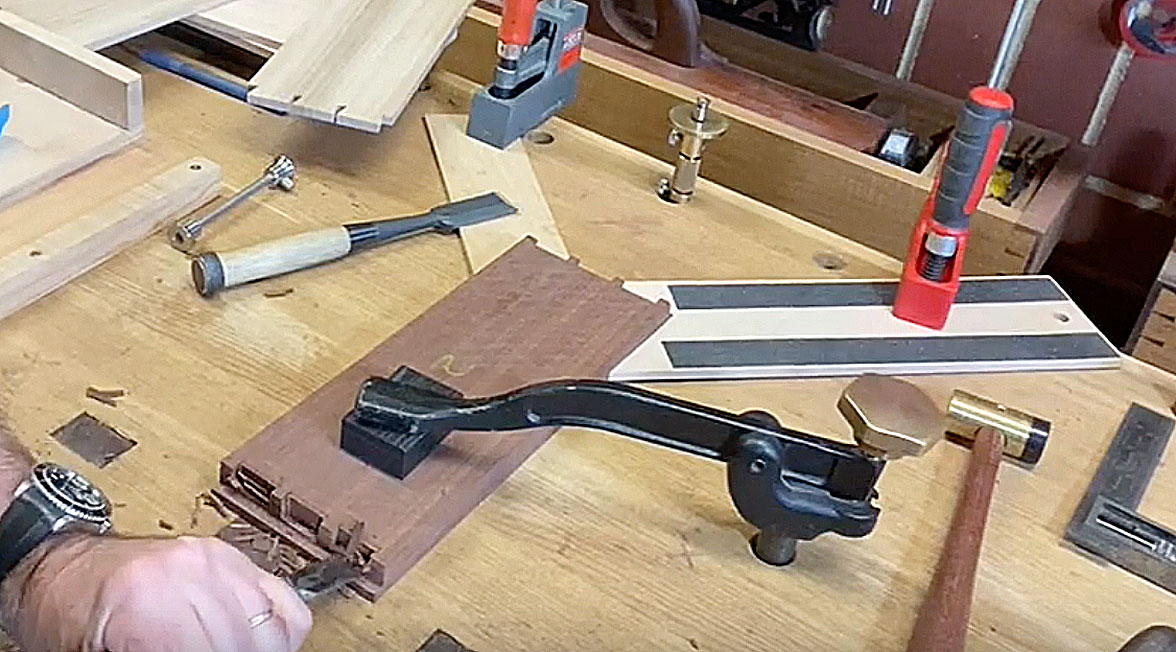
The first is that I was using my version of this yesterday. Mine is quite different in concept, but does the same function. In your case, you were holding the board down to router out dovetail waste. In my case, I was holding down the board to chop out dovetail waste.


What this is made of is two Doe's Feet (or a Doe's Foot x2.

This is Doe's foot - just a bit of scrap with a right angle sawn out ...


It does not look like much, but placed at the corner of a board and clamped down, it will resist any movement.


You could plane diagonally across that, and it will not move!

In the first picture, there are two set up behind the board, and as I chop horizontally, the board remains solid. Check out the video I just posted to the forum for a demonstration (this comes from the video).

The second issue is the absence of dog holes on your bench. Why? Hold downs are just the best thing since sliced bread! Your jig does a great job of overcoming this, but I do believe that dog holes would open up a new life for you! :)

Regards from Perth

Derek

Re: Useful jigs/fixtures.......#1

#6

Re: Useful jigs/fixtures.......#1

Bill Tindall, E.Tn.

Seems like a complicated arrangement whose result could have been achieved by using the two back clamps to simply fix the drawer front to the end of the bench. Because of the alternative way I remove this waste I need to fix the board 90 degrees to the orientation shown. But again it is a simple matter of two clamps to fix the board to the front edge of the bench.

Re: Useful jigs/fixtures.......#1

#7

Re: Useful jigs/fixtures.......#1

Derek Cohen (in Perth, Australia)

Seems like a complicated arrangement whose result could have been achieved by using the two back clamps to simply fix the drawer front to the end of the bench. Because of the alternative way I remove this waste I need to fix the board 90 degrees to the orientation shown. But again it is a simple matter of two clamps to fix the board to the front edge of the bench.

Bill, I did try clamps first. They did not hold the board when I chopped the waste on the horizontal. This action pushed the board back.

The Doe's feet do an amazing job at work holding. Indeed, one can use them in place of a tail vise. Some do. They are small, and yet very versatile. I simply set two up at each corner, and clamped them down.

Regards from Perth

Derek

Re: Useful jigs/fixtures.......#1

#8

Re: questioning the Useful jigs/fixtures.......#1

roger lance

Once again, you are missing a very important consideration for a bench like mine.....no offense intended. The base is not the usual leg style with connecting stretchers.....if, my base were this style, I'd have drilled holes for holdfasts.....no question. If you would look beyond your need to "critize" the bench as a dining room table and not a mere work surface, you would begin to understand that you really can't drill holes in that top as those holes would be going into the drawers below the top. Having the end of a holdfast coming down into a drawer full of tools was not, I felt, a good idea or design choice......you may disagree with that.

So, in designing the bench, there were decisions to make and realities to face. One element that gets completely overlooked in discussions like this (and should be underlined and in capital letters) is that the bench I made is made to fit the space and layout of the room in which it sits......and is shaped and positioned in that room to also allow for the positioning of the other tools and benches that will be in that space......and done in such a way that everything works well together and that (very importantly) there is room for the woodworker to move around freely. Not everything is perfect.....this can be criticized and that can be singled out and criticized.....but, that misses the point.

Furthermore, things like my bench are a function of their point in time. The hardware I wanted to use for my bench was not available......the bench I wanted that I saw in Landis' "The Workbench Book" was using special made hardware......maybe by a blacksmith or machine shop.....I wasn't about to complicate building a bench and pursuing that kind of sourcing.....and BenchCrafted and Lake Erie didn't yet exist. I wanted to make a bench that would sit out on the shop floor.....give me access from all four sides.....but, the shop space would not allow that.....not and have everything else work out.

And where was I going to store tools??.....have organization and some degree of protection for expensive hand tools??

There were a number of Shaker benches in Landis.....including the cover.....that bench offered some solutions for me. I do not think I've seen a Shaker bench with holes for holdfasts.....not if there is drawers and tool storage in the base.....there maybe one somewhere; but, its the exception.

There is the option to lower the drawer section in the base and create a space between the bottom of the top and the top of the tool cabinet and that space will allow for holdfasts to be used.....but, at a cost of lost tool storage. I chose tool storage.

I've never commented on your "bench".....one way or the other.....it's yours......work on what you want to work on......it's irrelevant to me......I wish my bench were irrelevant to you.....and you could look at a simple jig and find a way to improve it or, at least, see how it would be useful.

Re: Useful jigs/fixtures.......#1

#9

universal uses

John K Jordan

Bill, your points are interesting and may apply to a traditional woodworking workbench and the way many people work. However, the assumptions driving your alternative may be somewhat narrow-minded. With due respect but to paraphrase, this is not a criticism of you but of the idea that drilling holes will, in general, improve a workbench, and by implication, mine. All uses are not universal.

I believe the alternative does not apply to the one flat work surface in my shop, the way I purposely constructed the workbench, the way I work with wood, and the things I often do on the surface not remotely related to woodworking. For example some past uses of my bench were designing and constructing delicate electronic gear, laying out optical gear, finger top spinning competitions, chemistry experiments for kids, photography, making large sketches, preparing alpaca fiber for spinning, analyzing fecal samples with a centrifuge and microscope, delicate surgery on farm animals, and dissecting a peacock.


I'm sure others have different needs but for some of my uses I want no holes in the surface and I don't want to store and clamp a seamless, flat work surface on the top.

I appreciate the alternative perspective, but for me Roger's flexible approach, with some variation, appears a perfect solution for my use with certain woodworking tasks and when working with metals and plastics. Thanks again.

JKJ

Re: Useful jigs/fixtures.......#1

#10

Re: Useful jigs/fixtures.......#1

roger lance

Derek.....Not only did I watch your video yesterday, your video is what prompted me to make my post. When I came upon your setup about 25 minutes into your video I reluctantly succumbed to showing my jig as I knew that the discussion of it would not go as I hoped (improvements.....other applications.....etc) but, would lead to me having to defend myself in some way for which I have very little energy.

I've been very careful to include the wording "a bench like mine"......which is essentially a work surface resting on a tool cabinet. That is not your style of bench.....were my bench like yours, I'd have holdfasts. See my more prolonged answer to Bill.

Re: Useful jigs/fixtures.......#1

#11

Re: universal uses

roger lance

You getting it has made my post worthwhile.

Re: Useful jigs/fixtures.......#1

#12

Re: Useful jigs/fixtures.......#1

Derek Cohen (in Perth, Australia)

Ahha, Rodger. That is why you do not have hold downs!

But we have the same concept, some idea. Just different ways to do it. That's what it is about! :)

No apology needed.

Regards from Perth

Derek

Re: Useful jigs/fixtures.......#1

#13

Re: Useful jigs/fixtures.......#1

roger lance

Exactly.....same goal.....different approach.

Re: Useful jigs/fixtures.......#1

#14

Re: universal uses +1

Mark Mandell - Gone Round In New Jersey

Completely agree!

Re: Useful jigs/fixtures.......#1

#15

Considerations before the holes...

David Weaver

i remember when Ron Brese made an elaborate shaker bench. It was pretty, and I'm sure there have been folks who have seen the type and thought of the usefulness of the storage under it, but I went a different route precisely due to the situation you're in, but for one additional reason, too.

The first reason was just so I could drill holes all over the thing and put tool boxes under it instead for storage as my at-bench storage is a few planes and small tools. If the tool boxes need to come out so that I can stuff something through a hole, they can be lifted out.

The second reason was that I knew I dreamed of a bench that I could beat. Yours looks pristine on the surface. I don't have the discipline or patience. I don't get stain, oil, glue, chisel marks, etc, on my bench on purpose, but it happens.

I don't often build furniture, but I cut a few rows of half blinds this weekend because the mrs. has a request. They're not as sloppy as they could be, but I cut them as fast as i could because they'll be covered with moulding, and I didn't want to have to pare anything after cutting, so they're ever so slightly oversize. Everyone here knows that they seem to still have a mechanical fit somewhere even with small gaps.

At any rate, I was reminded why I like a wooden screw simple leg vise on the front and why I have holes all over my bench (guitar making doesn't require much, and planemaking requires them only to be near the front board).

I think this is an important consideration from before we even start talking about fixtures - anyone who is thinking of making a bench, some of those posted are fine cabinets more or less with a thick top.

if I had your bench, I don't know how integral the cabinets are to the structure, but I'd think about removing the top one or two to be able to use holdfasts and every manner of gadgetry that fits in common round dog holes.

Just because I would do it doesn't mean I expect you would, too.

Re: Useful jigs/fixtures.......#1

#16

Re: Considerations before the holes...

roger lance

I'm amused by you perceiving me as "being in a situation" with my bench and lack of holes for holdfasts. I'm very happy with the bench.....very happy with the tool storage below the work surface......very happy with the tool tray. Being "in a situation" is really a matter of personal perspective.

Ron Brese makes some very high-end planes......which means he has a limited market. I'm assuming he chose to make Shaker benches to make some money and to take advantage of the BenchCrafted type hardware that was getting to be popular at that time.....I hope he did well. I did not make this bench to sell; but, to use.

My bench may look pristine in my photos.....it is not.....there are tool marks all over.....the bench top has had one serious flattening in it's 30 years and has also had an occasional lite clean-up with a scraper. It has never been abused......think Frank Klauze......he worked on his bench everyday for his entire career......moved that bench to his retirement shop and continues to work on it......and it is pristine. There is something in the way I was raised about valuing the things I have which makes me regard things in a manner that doesn't allow me to abuse them.

For nasty, dirty work.....or work that could stain the bench, etc, etc.....I have an assembly table that sits between my bench and tablesaw.....


even that I try to keep in good condition.

Re: Useful jigs/fixtures.......#1

#17

Re: Considerations before the holes...

roger lance

David.....what about George's bench?.....he did a lot of metal work which is dirtier than wood.....did he have two benches?.....one for metal and one for working wood.

Was his wood bench kept pristine?.....interested to know.....

Re: Useful jigs/fixtures.......#1

#18

being in a situation...

David Weaver

...is a state of mind. Whatever you have, you can always work with it if you are determined to.

If you love the way you're working, it doesn't matter what anyone else loves.

I think the average person would find a bench with dog holes easier to use for a variety of things, but not everyone is the average person.

And there are a LOT of people who refuse to allow any marks be made on their benches.

Re: Useful jigs/fixtures.......#1

#19

Re: Considerations before the holes...

David Weaver

George has a two floor independent building for his shop, so he doesn't have to do any metalworking on his woodworking bench. he may, anyway.

He's mentioned a few times that his recent projects have been consignment work or restoration and his bench ends up being a parking spot for a lot of junk, and it's filthy (not sure what he means by that).

I don't think he's done any heavy hand work for quite some time (this is the mid 1990s - looks crowded. The work surface is being used, but I'm sure he was doing the heavy work making guitars with power tools).

http://www.cybozone.com/fg/wilson3.html#wilson12

Guitars leave my bench unhurt. Tools and furniture, not so much. I know george thinks (making) furniture is boring or uninteresting - he's said that publicly, I just don't remember the exact word he used.

Re: Useful jigs/fixtures.......#1

#20

reply

Bill Tindall, E.Tn.

You are advocating your holding device, or at least I presumed you were. Hence, its utility for holding stuff is fair game for critiquing as a means of holding stuff on a bench.

I own holdfasts but rarely use them. However, I use stops in holes in line with the dog on the vise often....indispensable. The leg on the stop need only be 1-2" long. In fact my first few holes have a vise screw under them. Properly positioned, one with a longer leg would make an effective drawer stop :)

Re: Useful jigs/fixtures.......#1

#21

loosing sight of the beginning

Bill Tindall, E.Tn.

Roger posted a means of holding stuff, . The conversation is holding furniture parts on a bench, not butchering deer. I offered an alternative means of holding stuff of similar function, widely used by people that build furniture, I think for good reason.

Now to address the universality question. I only own one bench. On one corner there is a large machinist vise. I repair farm machinery on it. It has the best light for filing saws of all kinds. If it requires a large flat surface and good lighting it gets done on my bench, and that includes holding furniture parts. If you aren't holding furniture parts you probably don't need holes or Roger's clamps and we are in a different conversation.

Re: Useful jigs/fixtures.......#1

#22

Re: Useful jigs/fixtures.......#1

Don Stephan

For me, it is extremely helpful to see others' methods of work, even if I don't find something suited to my approaches. Sometimes I also reconsider posting a comment and don't because of of the occasional response that comes across as repeatedly arguing a method of work, glue, or something else is wrong wrong wrong. Everyone is entitled to their opinion, and again I feel enriched by reading of other opinions.

Re: Useful jigs/fixtures.......#1

#23

Re: Useful jigs/fixtures.......#1

Jim Dillon

Roger, that is a very useful looking jig, especially adaptable for my own workbench, which is very much like yours, where I also decided to prioritize storage over other needs. Thanks for posting. Jim

Re: Useful jigs/fixtures.......#1

#24

Here's one....

John in NM

I bet its only useful to me though :D


This is for cutting the top curve of a grip I make. I've lost count now how many I've made over the last 12 years or so, maybe a thousand or more.

The cut as shown is way too heavy, I used to do that and it got very nerve wracking and I wore out bits quickly. Now I have an improved version of this jig and use it cutting off only 1/16" or less.

Re: Useful jigs/fixtures.......#1

#25

Re: Here's one....

David Weaver

Similar to the typical home shop finishing of a guitar body 1.5-1.75 inches of wood thickness, lots of endgrain and plenty of chatter.

There's much more to work with on guitar bodies, though and it's possible to spokeshave a lot of the wood off closer to the line. But it's also possible to do the low-wit method of letting the bearing bit take a partial cut and come back (due to the size and ability to hold the piece).

The combination of fast dulling of the bit and super sharpness needed for that size of the cut makes it always seem like something isn't as sharp/good/stable as it could be.

I buy long straight cut bits for that work, cheap ones ($16 or so with a bearing) and can't say I've been disappointed by them.

👍 This page answered my questions

Your vote helps other woodworkers quickly find the answers and techniques that actually work in the shop.