WoodCentral Forums

Est. 1998 — 27 years of woodworking knowledge

Improving the shape of the Lee Valley Chisel

Posts

Improving the shape of the Lee Valley Chisel

#1

Improving the shape of the Lee Valley Chisel

Bill Tindall, E.Tn.

I have been contemplating improving my LV chisel for some time. The tipping point was my day in the Headley shop. Steve Hamilton was given a LV chisel by one of their students. His thoughts on it- a bit more difficult to sharpen, superior edge holding, hated the thick blade. I felt the same about the blade thickness. It would be curious to know why they chose to make the blade so thick at the base. From a use perspective it is both unnecessary and cumbersome and a departure from the shape of vintage blades. (Steve uses a thin blade vintage Marples)


I have been doing a lot of dovetailing and this chisel with its superior steel sits in my chisel rack unused. I don't like holding it.

So, I had at it. With a bench grinder and 60 grit pink wheel I free hand ground away the unnecessary metal at the base with the goal of removing all the taper. (I got most of it in round 1) The result of the free-hand was pretty ugly. But, a few seconds on a flat 50 grit belt sander and the multitude of facets from my crude hand grinding were flattened. The result looked like it could have( and should have) come from the factory. I don't have all the taper gone, but for now it is good enough and likely won't do more.

Re: Improving the shape of the Lee Valley Chisel

#2

Re: Improving the shape of the Lee Valley Chisel

david weaver

Heavy tapered blades seem to be the preference for new users, and as long as I can remember, there's been some notion that a heavier feeling tool is one that will stand up longer in use.

I don't know what people intend to do with their chisels, but I'm sure some of it is unholy when they're first starting (prying, etc with bench chisels, hitting them while they're flopping around, etc - trying super heavy hammers or whatever else comes to mind for them).

I consider lie nielsen's planes to be on the tubby side, and a bit nose heavy because of it. I'd prefer using a stanley 4 to a lie nielsen 4 day to day, though I can't deny the quality in the LN plane is really great. Clifton and woodcraft's bedrock copies one-up LN and go even heavier. I have no clue what the virtue is, but it's very popular with people who are just starting. Once they get some experience, they won't feel like they need a plane that's heavy enough to dampen the feel of tearout occurring.

There are still some die forged european companies (like stubai) making longer inexpensive relatively thin and light chisels. I don't think many people favor them in the guru circles because they're intended to be gripped at the handle, and beginners have a problem getting/dragging/angling a chisel to a mark with a handle grip.

Long story short, I wouldn't expect anyone serving the end of the market where money is spent (new users with some age and some savings) to be putting their tools on a diet any time soon.

Re: Improving the shape of the Lee Valley Chisel

#3

Altering the shape of the LV Chisel......

roger lance

If altering the shape of this chisel makes it more to your liking, I say good for you.....you paid the price, its your tool, this makes it feel better to you when you use it.....then have at it.....grind away.

But, as for me, my hands adapt easily to the shape LV made.....and without discomfort or sense that there is an issue that needs change.....I'll just use them as is.....stock vs. super modified.

Re: Improving the shape of the Lee Valley Chisel

#4

stock vs. super modified

david weaver

starting to sound like race cars or stihl timberbersports!!

Re: Improving the shape of the Lee Valley Chisel

#5

Re: stock vs. super modified

roger lance

Did you use to have those TV/radio ads where the guy would yell, "Sunday, Sunday.....at the US 131 Dragway.....Big Daddy vs. Shirley Muldowney.....be there!!"

Those were the days when guys were modifying any and everything.....like Tim The Toolman Taylor.......

Re: Improving the shape of the Lee Valley Chisel

#6

Re: Improving the shape of the Lee Valley Chisel

Joe shelton

Bill, you start the day terrorizing poor little snakes, and now you brutalize steel after you praise its quality.

Next you'll put a D-handle on that blighted thing.

Doesn't Milwaukee make a 20v alternative?

:D

Re: Improving the shape of the Lee Valley Chisel

#7

"we'll sell you the entire seat....

david weaver

....but you'll only need the edddddggggggeeee!!!!

I remember those ads.

"The buck" was the local venue for me "SEE YOU AT THE BUCK!!".

"TRACTOR PULLERS, MONSTER TRUCKS, DIRT BIKES, ATV TRICK RIDERS...."

It was the audio version of writing in all capital letters.

Re: Improving the shape of the Lee Valley Chisel

#8

My money would be on Shirley


Re: Improving the shape of the Lee Valley Chisel

#9

Kneale Brownson

Must be from the Midwest:  Sunday at Detroit Dragw


Re: Improving the shape of the Lee Valley Chisel

#10

Improving the handle

Bill Tindall, E.Tn.


I have some of these fluorescent plastic handles. Do you think they would look good in the LV chisel?

Re: Improving the shape of the Lee Valley Chisel

#11

Re: Improving the shape of the Lee Valley Chisel

Warren in Lancaster, PA

We had this discussion before, when there was still time for LV to make changes, (2011). I suggested that the chisels were way too thick, and Rob Lee came on the Hand Tool forum and tried to convince me that what I had seen at Woodworking in America were just some "early prototypes" and that the real chisels would be thinner.

Traditional chisels were tapered, but much thinner at the bevel, like 1/16, and thicker at the neck where strength it is helpful. Overall though, a lighter tool. I think that if I were altering one as you did, I would have reduced the thickness all the way from bolster (what there is of it) to bevel.

Re: Improving the shape of the Lee Valley Chisel

#12

Re: Improving the shape of the Lee Valley Chisel

Barry Irby

I can't believe you didn't forge it....

I know very little about chisel design, but I thought the heavy tapered blades were for timber framers and the lighter thinner blades were for shop/furniture work.

Now that you have had a few days, how are you liking it? Looks good to me. How does it feel in hand?

Re: Improving the shape of the Lee Valley Chisel

#14

Round 1

Bill Tindall, E.Tn.

As stated this grinding was Round 1. This steel does not yield metal to the grinder readily. Round 1 continued thinning until my stamina ran out. It was actually a break from dovetailing a trapezoidal box where I had screwed up the orientation of the pins on one joint and needed to vent some frustration.

Re: Improving the shape of the Lee Valley Chisel

#15

Re: Improving the shape of the Lee Valley Chisel

Bill Tindall, E.Tn.

Now that you have had a few days, how are you liking it?

I like it much better. I should have tinned it a bit more. May get around to it some day. for now I need to finish the corner cupboard. The polygon drawer and box behind the drawer has slowed me more than anticipated.

Re: Improving the shape of the Lee Valley Chisel

#16

Re: Though it's a bit more work...

david weaver

...i wonder why it wouldn't be better just to scout forged bolster chisels from the golden era.

I've bought a lot of things, and so have a fairly good idea of what would be good and what wouldn't. I'm sure the LV chisels are great chisels, but it's unlikely that I'd prefer one to a ward or i.sorby chisel, so I have those and generally use those types for day to day work.

On average, I have probably paid for really good versions of those, about half of the cost of the V11 chisels. Needless to say, I've made no modifications to any of them. i'd refer to their edge holding as about 1/2 white steel. White steel being something a little better than V11 for chisels, but by all accounts, V11 holds up better than most western O1 type chisels, like an ashley iles (that comes to mind also as a chisel now that the name comes up - where you'd get the thinner chord and lighter weight, without any modification and at a price half or less than the V11 - edge holding is such that sharpening is infrequent, certainly not something that needs to be improved by anyone who can sharpen anything).

Anyway, the tang style forged bolster I. Sorby, older marples (like way older) and Ward chisels are really the top of the heap for use.

The benefit to V11 chisels and other "it" tools is that if you don't modify them, selling them is extremely easy - as long as they're still in production and can be compared price-wise. Someone hoping to sell a set of these 20 years after they're out of production will probably get an unpleasant surprise. Once these are bought and ground, though, they will be worth a fraction of their initial price - which is OK if you're sure you're going to keep them, but not so much if you go a different direction in a couple of years.

Leading back to the wards, et al. Those will not be declining in value any time soon.

Re: Improving the shape of the Lee Valley Chisel

#17

That's a lot of work...

Joe in a Cleveland suburb

for a paint can opener.

:D

Re: Improving the shape of the Lee Valley Chisel

#18

Re: That's a lot of work...

John in NM

Opener? Heaven forbid! Everyone knows that those are used to STIR the paint! :D

Re: Improving the shape of the Lee Valley Chisel

#19

Re: It'll be less good....

david weaver

....at mixing epoxy once the cross section is smaller, though.

And at picking it up and slathering it on.

Re: Improving the shape of the Lee Valley Chisel

#20

Re: Round 1

Bruce, a MN Galoot

You need a friend with a surface grinder and magnetic chuck. It would make short, accurate work of that project without endangering the temper.

Re: Improving the shape of the Lee Valley Chisel

#21

Improving or personalising?

Derek Cohen (in Perth, Australia)

Bill, I am not convinced ... and you do not say what size chisel you are using. It is relevant.

There are many different types of chisels, and many preferences among users. For a start, I have chisels I prefer for chopping waste, and chisels I prefer for paring. The all rounders (that do it all) we refer to as bench chisels. Even among them, there are variations in what one is better at than another.

The bench chisels I turn to for chopping dovetails are Koyamaichi white steel and Veritas PM-V11. The ones that I prefer for finer detail are the Blue Spruce (A2) and Marples Boxwood (O1 ... what I refer to as O1 here for all chisels probably has variations, but it is close enough for the purpose). I also have another set of chisels, Stanley 750 (vintage ones I modified slightly ala LN, but these are O1).

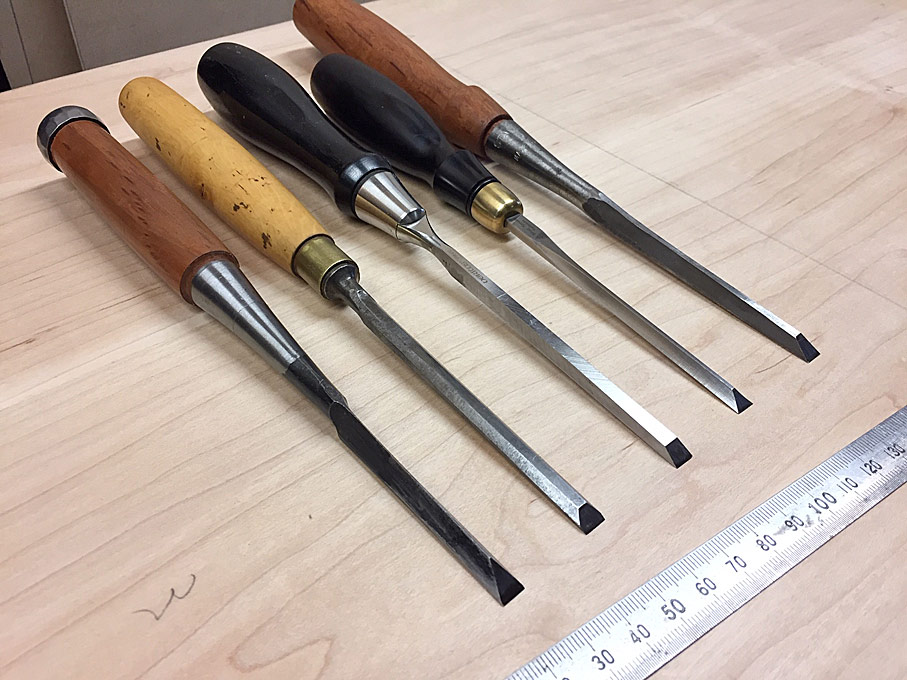
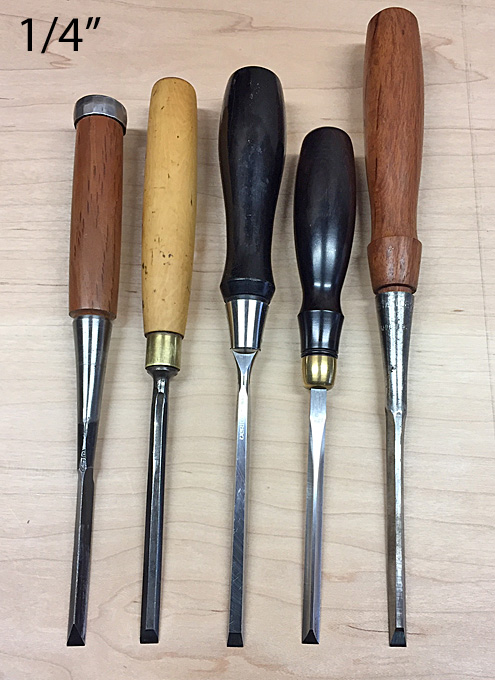
1/4" chisels: Koyamaichi, Marples, Veritas, Blue Spruce, and Stanley


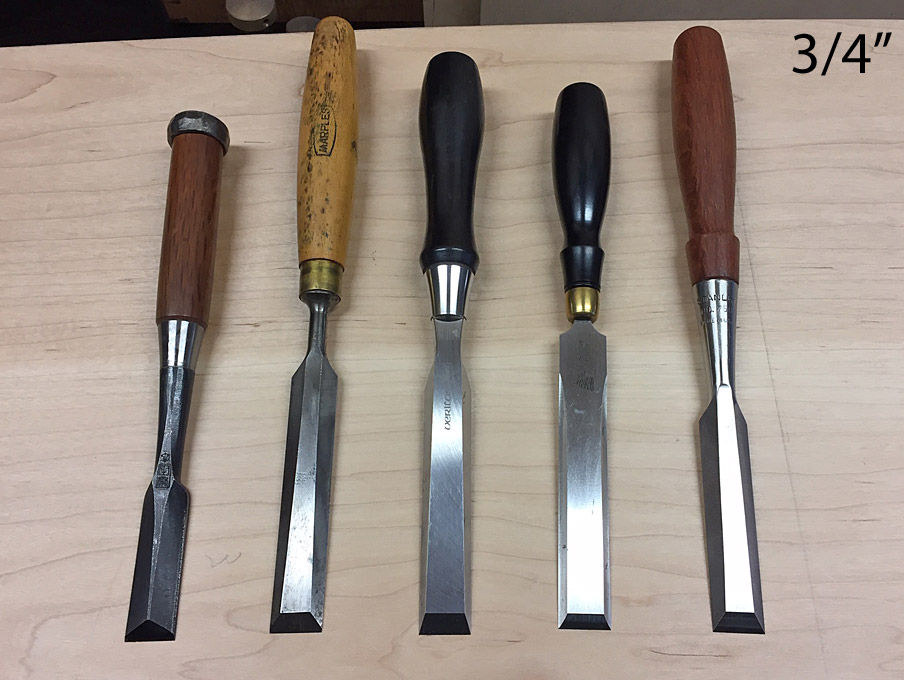
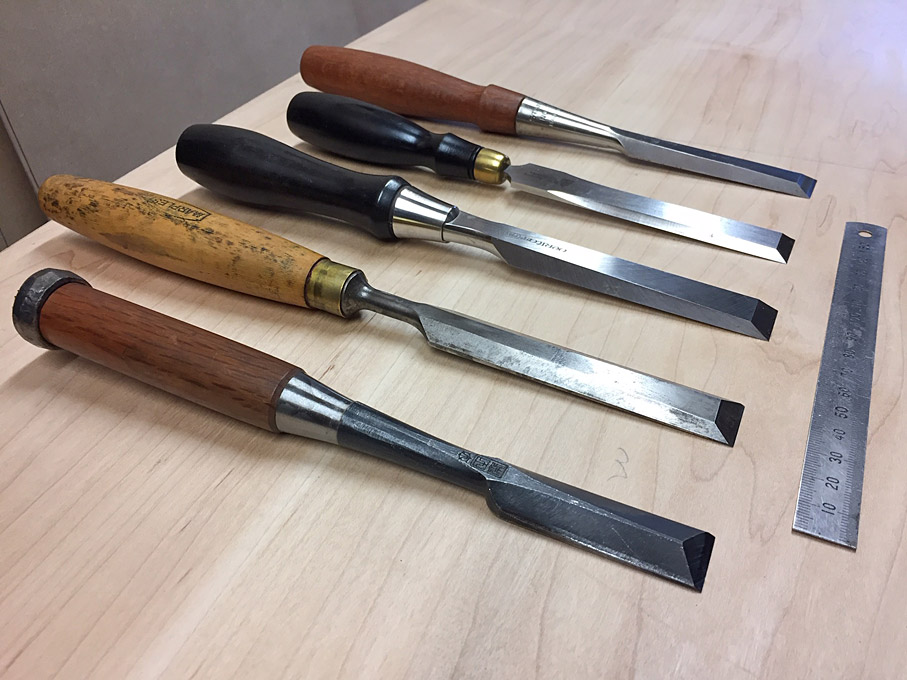
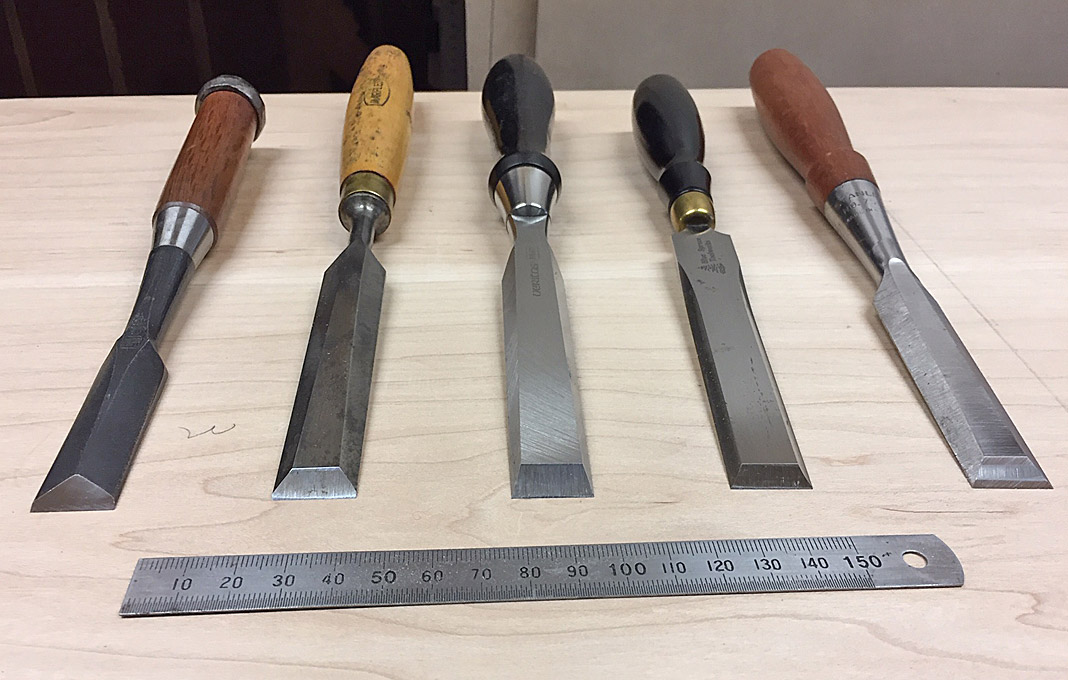
3/4" chisels: Koyamaichi, Marples, Veritas, Blue Spruce, and Stanley
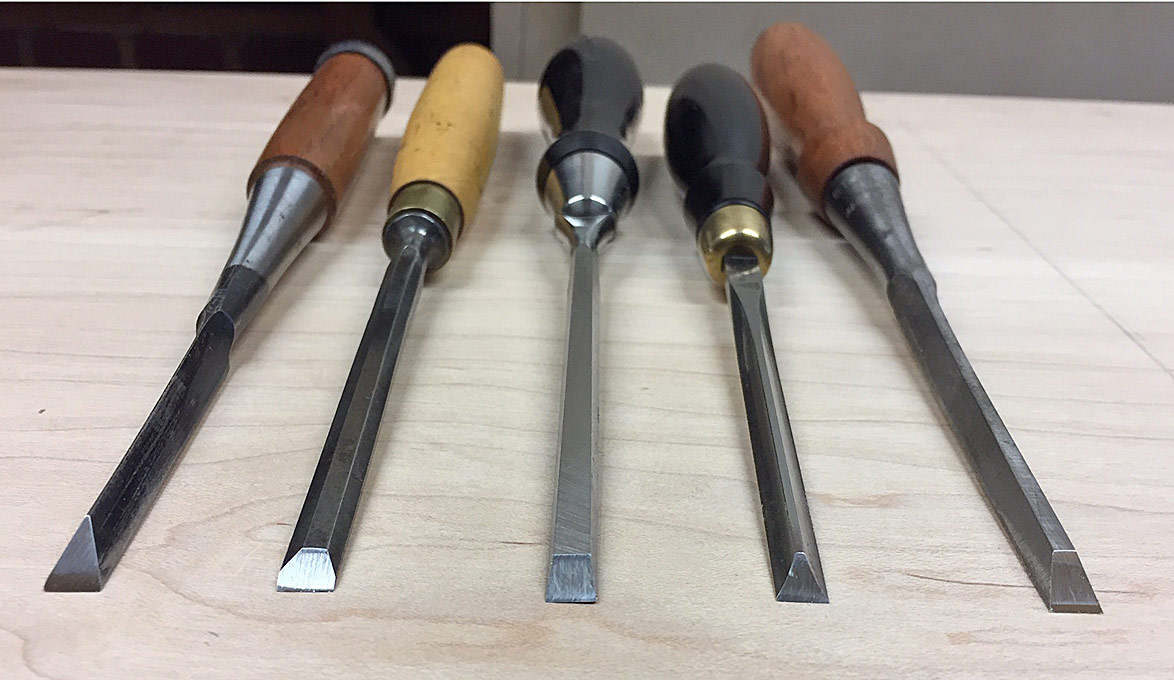


Some details: thickness (in mm) at start of blade vs start of bevel

Koyamaichi 1/4": 8.5/5.4 ..... 3/4": 8.0/4.7

Marples ..... .. 4.3/2.5 ..... 6.1/3.6

Veritas ....... 5.0/3.0 ..... 7.0/4.1

Blue Spruce .... 3.2/3.2 ..... 3.2/3.2

Stanley #750 .... 8.7/4.2 ..... 6.6/3.7

In practice, when paring, there is a little difference between the 1/4" Blue Spruce and the 1/4" Veritas. I prefer the BS for very fine work, but I very much doubt that another could say the same without a direct comparison. The BS is a very slim blade, and there is no other that comes close. The Marples is next best in regard to slimness and lightness. These are great chisels in the hand. Their downside is that I do not like using a hammer with the BS, and the edge holding of the Marples is not remotely in the same universe.

When using a mallet/gennou, The Koyamaichi come out on top, not just because they hold an edge longest, but they are designed to be used this way. The Veritas come second because they are well-balanced and hold an edge almost as long. None of the others come close to these two.

Now the 3/4" chisels are a different ball game. Frankly, I'd rather use a proper paring chisel, such as the Kiyohisa I have. However, if using one of these to pare with, I'd go with the Stanley and the Marples - because of the long handles. Having decided this, I now look at the dimensions and notes that their blades are slimmest at the bevel end, and overall they have a similar size. My least favourite for this task is the Veritas, as it is chunky, and the Blue Spruce, because it is too small. However, using a mallet/gennou, and I would reverse the Veritas in this. The Koyamaichi and the Veritas feel stable and solid to hold and hit.

Regards from Perth

Derek

Re: Improving the shape of the Lee Valley Chisel

#23

Re: I'd toss out...

david weaver

..the blue spruce chisel. It's basically a nice handle with very subpar metalwork. It's always irritated me to see those because they are just flat stock stuck into a nice handle, and I'd imagine some of the other toolmakers making chisels probably think the same.

the marples later era that you have is on the thicker side of English chisels as the blades got thicker and the bevels larger. Earlier chisels would be a fair bit thinner along their full length. I have no idea why that is other than the chance that marples' customer was less woodworker and more site carpenter.

I still think it's a plain standard issue that the average beginner is going to pick up two chisels and buy the heavier one of the two, and that if LV mentioned to warren that later chisels would be thinned, their pool of testers probably decided otherwise.

I won't make any promises to measure any chisels, because I'll probably forget, but I'd be curious as to what the ashley iles chisels measure and what older flatter proportion english chisels would measure.

If I were making the chisels LV was making, I would leave them heavier. If I were making infill planes and selling them, I don't current buyers would want to hear that a 2" spiers infill was often about the same weight as a stanley 4. I'd just make them heavier because that's what sells now. Perceived margin of safety in chisels, and perceived better performance in planes (due to wanting an isolated feel from what's going on at the edge). There are heavier old infill planes, but they are the minority.

Re: Improving the shape of the Lee Valley Chisel

#24

Re: I'd toss out...

Derek Cohen (in Perth, Australia)

..the blue spruce chisel. It's basically a nice handle with very subpar metalwork.

David, the smaller sizes of the Blue Spruce chisels are amazing for detail work. Yes, I know that A2 steel is not flavour of the month - it's not my first choice of steel either, but I bought the set I have a dozen years ago, before I knew better :) I like using these chisels. I like their balance. I like their nimbleness. They get very sharp. You can find out yourself - I'll lend them to you next time you make a set of compound dovetails. :)

Regards from Perth

Derek

Re: Improving the shape of the Lee Valley Chisel

#25

Not what I mean...

david weaver

..the A2 steel, that's not what I'm talking about. I don't love it, but it's not like you can't use it and sharpen it.

What I'm saying is that I don't consider it reasonable to take a piece of flat stock and stab it in a handle and call it a $100 chisel. It doesn't really matter what type the stock is.

Every other chisel that you have shown tapers from the tang down to the blade. the flat stock type of chisel with no ferrule, etc, is a shop made level tool, no matter how neat the handles are and how neat the side grind.

I went out and browsed the chisel range and the bench chisels are slightly better, they're stock ground from a taper as I can see, but LV and LN's chisels look like they are round stock wasted off in a CNC machine by turning and then grinding.

The marples may have been made similarly, but the initial shapes were probably drop forged (disregard discussion about forge or no forge, that's a matter of economical shaping).

It's just my opinion, you're not getting what you're paying for with a $75-$110 chisel like that when it's just flat stock stuffed into a handle. It's not like chisels weren't stamped out of flat stock and done that way in the past, but only the very lowest chisel-shaped objects were done like that.

👍 This page answered my questions

Your vote helps other woodworkers quickly find the answers and techniques that actually work in the shop.