WoodCentral Forums

Est. 1998 — 27 years of woodworking knowledge

How do you make mortice and tenon joints?

Posts

Re: How do you make mortice and tenon joints?

#26

Engineering considerations

Bill Tindall, E.Tn.

First, my question is generic to any M&T joint not just making a frame and panel to fill the back of a cabinet. About everything I make has M&T joints in it. I want to settle on one way to do most all my M&T needs.

Scribing the shoulders and chiseling to the scribe line is reliable and quick for me. I will continue to use this means to establishing crisp shoulders on a tenon of some predetermined length. I need to optimize quick and reliable cheek thickness and location.

Facts that guide the decision:

Within the high accuracy of a proper M&T fit one can not rely on the lumber stock being the same thickness throughout a project. Working off a reference face will make the task of proper fit more reliable.

It is relatively easy to adjust either the wood or the cutter in small increments if the adjustment is driven by a fine screw. Router, router table lift and mortise machine fall into this category.

Things that slide easily with a scale to detect relative movement are next best. Table saw or band saw fence would fall into this category. Of these, my table saw fence is easier to accurately adjust than my band saw fence.

Heavy, difficult to slide adjustments with no scale are worst. This situation describs my Delta tenoning jig. I need to abandon struggling to employ this tedious approach.

For either hand chopping or a mortising machine, my preferred techniques, the mortise width is fixed so that the tenon thickness must be accurately adjusted to it. However, in either case the position of the mortise can be accurately established, centered or not.

Only two variables are left to be set with high accuracy- position of either the mortise or tenon relative to which ever part was cut first and thickness of tenon. I think tenon thickness is most challenging. Hence, "best' will be to do these two operations on the machine(s) that does them most accurately and precisely. I think I see the preferred paths from here. I need to learn more about what Bob and Mark are doing. Or I need to come up with a way to accurately adjust my band saw fence, or buy one that can be.

Re: How do you make mortice and tenon joints?

#27

Re: Engineering considerations

Mark Hennebury

Bill, this is a rough idea of using the router table.

Again many variables; router bit diameter, tenon length, you can use a sled, or the table and a mitre guage, or just a block of wood. you may have to do several passes, to get the tenon length. You can reference your tenon on the fence.

Doing tenons this way and flipping means that you add an extra margin of error.

Generally you should work from one reference face when you can. If you have to flip then it is imperative to have your stock as precise as you can, the best way to do this is dress all of your stock to thickness in the same place on your thickness planer.

Flipping will center your tenon.

You can do offset tenons, by cutting all of one face first then adjusting your router bit height and doing all of the other sides. or by using a spacer and a set router height.

Using your fence to cut tenons on both ends is also adding a margin of error as you are relying on your stock to be perfectly cut to length.

the best way is to cut one end against the fence and remove the fence to cut the other end. reference the cut shoulder against a stop, this ensures that shoulder to shoulder space is precise, regardless of any minor error in stock length.

As a rule;

Set up each operation as accurately as possible to eliminate error.

Assume that each operation still has error.

Set up the next operation to negate any possible error created by the previous operation,

This way you eliminate accumulating errors.

This is the Project management process to which i refereed.

This is the reasoning for referencing off of one face or edge, etc.

You can cut tenons on the router alone, or rough cut on the bandsaw and trim on the router.


Re: How do you make mortice and tenon joints?

#28

Re: Engineering considerations

Mark Hennebury

I made my fist slot mortiser many years ago from a Makita 2040 thicknessplaner like the one in this photo.

I mounted a table off to the side. It was clamped to the main table with two 1.5" x 3" x 30" approx. so it was removable. got an adapter machined up to mount a chuck on the end of the cutterhead spindle, and made a cross-slide table arrangement to mount on the side table. I used the planer table crank to raise and lower the table for mortise height adjustment and my cross-slide to cut the mortise, worked great for many years.


Re: How do you make mortice and tenon joints?

#29

Check your email

Mark Mandell - Gone Round In New Jersey

I can't post Bill's plan here on WC, even with credit given, but I can send to you.

Re: How do you make mortice and tenon joints?

#30

Re: How do you make mortice and tenon joints?

Bill Tindall, E.Tn.

I have always utilized 4 shoulders too. For some things it is nice to have some lateral adjustment flexibility of the tenoned piece. The shoulders top and bottom cover up the gap.

Re: How do you make mortice and tenon joints?

#31

Re: How do you make mortice and tenon joints?

Virgil Johnson

Hi Jim. Before I "splurged" on the Woodcraft jig I used a wooden shop built jig that held the stock vertical that rode on my Biesemeyer table saw fence. It was very accurate (as long as I worked from one face) easy to setup and worked well for pieces up to 18" or so. I looked for it to past a pic but I must have scrapped it. As you can see in the pic I milled/drilled about 4# of extra cast iron off of the castings of the new jig to make it less top heavy.

Re: How do you make mortice and tenon joints?

#32

Picture?

Bill Tindall, E.Tn.

Upon study, several good tips in your description. I am adept at moving a table saw fence tiny amounts and your tip on getting this setting adjusted to the initial mortise makes sense.

I envision problems holding the piece to be tenoned securely and vertical while sawing the cheeks. You have obvioulsy solved this problem.....how?

Re: How do you make mortice and tenon joints?

#33

Those who Commit to plan A.....

Mark Hennebury

Don't need a plan B.

Re: How do you make mortice and tenon joints?

#34

Re: Picture?

William Duffield

https://www.abebooks.com/servlet/SearchResults?sts=t&cm_sp=SearchF-_-home-_-Results&an=hylton&tn=router+magic&kn=&isbn=

You should just get yourself a copy of Router Magic. It's probably the most useful book on using routers. Right now, at the link above, the cheapest used copy is less than $4. I keep my copy in the bottom of my router table cabinet.

Re: How do you make mortice and tenon joints?

#35

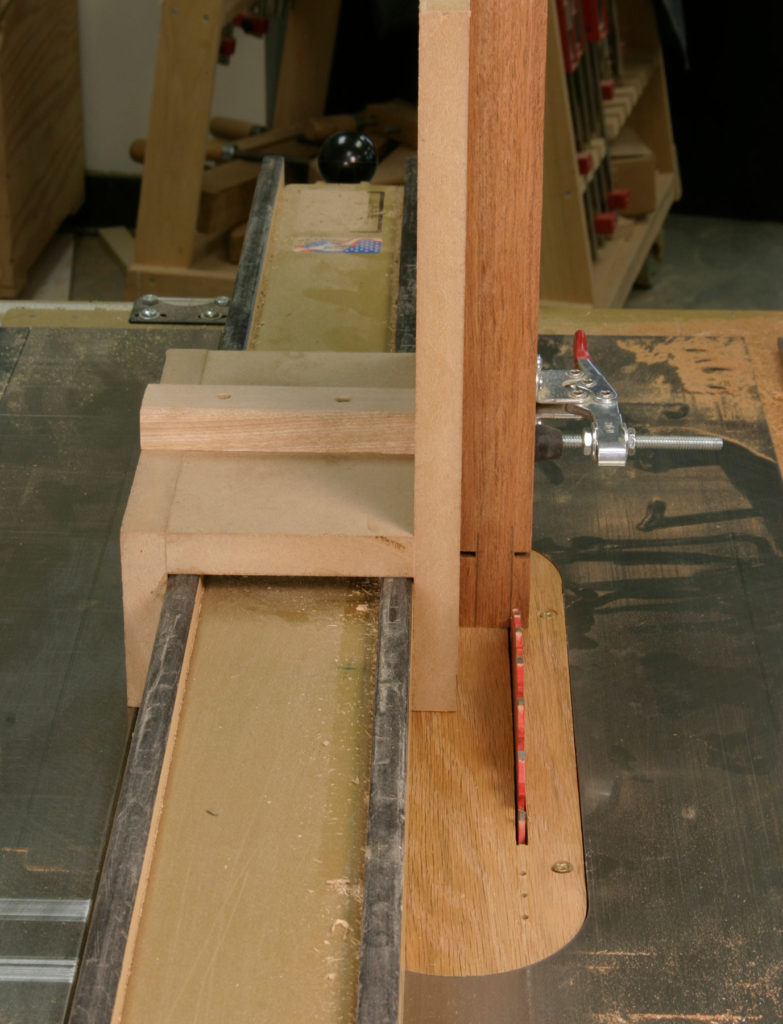
Here you go Bill *LINK*

Bob Lang

Hi Bill,

Couldn't scrunch my photos small enough to upload directly. There is another image and a verbose explanation in the blog post at the link.

Bob Lang


img

My Tenon Jig

Re: How do you make mortice and tenon joints?

#36

Cabient Making and Millwork.....

Bill Tindall, E.Tn.

It was my first woodworking book . I studied it for hours. And then put it away years ago I suppose because I thought I knew it all. >( Must dig it out and look up the jig. Do you think it would work as well on an original Delta fence?

Do I understand correctly that you prepare the M&T joint from oversized thickness and then plane? to get flush joints?

Re: How do you make mortice and tenon joints?

#37

Re: Cabient Making and Millwork.....

Bob Lang

Almost every technique published by anybody in any format in the last 40 years or so can be found in "Cabinet Making & Millwork".

I'm pretty fussy about milling stock. My thinking is that near perfect parts make everything else easier. My earlier comment on thickness might lead you to think otherwise. I've known people who thought there was some magic in hitting exactly 3/4" in thickness - make a piece exactly 3/4" thick, remove exactly 1/4" from each side and you have exactly 1/4" remaining. I'm not one of those people.

To my eye 3/4" looks skinny and in a lot of the Arts & Crafts period pieces I make 13/16" is more typical and there are often varying thicknesses in adjacent pieces-doors sit 1/16" back from the surrounding frame, etc. I usually aim for TAP (thick as possible) from 4/4 stock when milling the thickest parts I need, then mill smaller sizes. If it says 7/8" in the drawing and I have two clean, parallel faces at 29/32" I move on. My fractional dial calipers are an essential part of this process.

The wild card in making good parts is the planer. Variations in thickness, however small need to be resolved at some point and that's what a plane is for. I plane off the high places in an assembled door, but I don't plane the entire door to reach a specific thickness.

Bob Lang

Re: How do you make mortice and tenon joints?

#38

Ditto

Bill Tindall, E.Tn.

I never plane to a target thickness unless what I am planing needs to fit into something of predetermined size. With care I can usually coax about 7/8 out of commercial 4/4 lumber and I like this thickness for almost anything, especially tops.

Re: How do you make mortice and tenon joints?

#39

video cutting tenons *LINK*

Mark Hennebury

Just saw this on my facebook page, thought it might be of interest.


tenons

Re: How do you make mortice and tenon joints?

#40

Re: video cutting tenons

Barry Irby

Under powered? Dull Blade? Scary in any language?

Re: How do you make mortice and tenon joints?

#41

Re: Engineering considerations

Hank Knight

Bill said, "Heavy, difficult to slide adjustments with no scale are worst. This situation describes my Delta tenoning jig. I need to abandon struggling to employ this tedious approach."

I have a Delta tenoning jig and I find it precise and very easy to adjust. It has a (relatively) fine screw adjustment for the tenon thickness and can be locked down securely when the desired position is dialed in. It holds the workpiece securely at any angle - most commonly at 90 degrees. It is, however, heavy, but I find that a plus once I get the beast on the saw table. It runs in one of the table saw's miter slots and all the adjustments are made on the jig. The table saw fence is not involved at all. The fit and finish are a little rough, but it adjusts smoothly and the jig works just fine. I do not find it tedious to use at all.

Re: How do you make mortice and tenon joints?

#42

missing

Bill Tindall, E.Tn.

Other than heavy my model of tenoning jig is missing the handy features you describe.

Re: How do you make mortice and tenon joints?

#43

Re: missing

Barry Irby

Mine has considerable lash or backlash or slop. If you are moving it to the right and continue to move right, you can move it in very small increments. Increments is the wrong word, because the movement is not incremental, but it moves very slowly and in very small amounts in response to tiny turns of the screw. BUT, if you go too far and need to backup you have to turn the screw a significant amount to get any movement at all and then turn it significantly the other way to start moving right again.

Is there a relatively easy way to remove the lash?

Re: How do you make mortice and tenon joints?

#44

Re: Cabient Making and Millwork.....

Tony - Memphis

Hello Mr. Lang. Ironically, I was looking at an old copy of Woodworking? . It was the issue with the walnut cabinet on the cover. In one of the articles. it was mentioned (by Chris S I believe) that he left the stiles and rails at different thicknesses before assembly. Thought that was an interesting concept. My joints are never 'prefect' and require cleanup with a smoother anyway. Wondering how this concept works out?

Tony

Re: How do you make mortice and tenon joints?

#45

Re: missing

Hank Knight

Mine has a little backlash - but not much, and it's pretty smooth travel in both directions.

Re: How do you make mortice and tenon joints?

#46

Re: missing

Bruce, a MN Galoot

Do you happen to know the model number? My tenon jig is shop made, and, while adequate, it would be really nice to have a little better control than a “nudge.”

Re: How do you make mortice and tenon joints?

#47

Two models of jig...

John in NM

I seem to remember that Bill has the older version of this jig, rather than the modern one made overseas. No idea which one is better, thought I've used my foreign made one often enough to be happy with the results. Ironically, the left hand adjusting screw is the part I find most difficult, I always turn it the wrong way first!

Re: How do you make mortice and tenon joints?

#48

Made me look it up . . . *LINK*

Bob Lang

In that article ("Build a Better Cabinet" in the autumn 2008 issue of the now defunct "Woodworking Magazine") Chris does talk about planing the rails first (before assembly) then planing the stiles later on to match the thickness. That's his idea not mine.

I prepare all my rails and stiles to the same thickness, cut the joints and assemble. I don't live in a world where minor discrepancies in joinery conveniently arrange themselves where it will be easy for me to correct, so I shave off the high spots after assembly or in a dry-run assembly.

Link below is to an old blog post at PopWood where I go on at great length on this subject.

Bob Lang


https://www.popularwoodworking.com/whatplanesaregoodfor/

Re: How do you make mortice and tenon joints?

#50

Re: Made me look it up . . .

Tony - Memphis

Hmmm, the link reports a 404 not found error for me.

Yeah, I do the same. There is an old video by Phil Lowe (FWW video) on fitting doors. That's where I learned most of my habits. Not that I'm any good at it, but... And thank goodness the door he made was warped - he showed how to fix that too - and I've never made a perfectly flat, well anything.

On a side note, I learned to mount the door on the chosen hinges before fine tuning too (or just buy real good hinges). I fit a door all nice and even and was proud of my persistence and patience (neither a strong point of mine) and then when I hung it...the hinge slop bit me. I look at it every time I'm in the shop. Its my drill bit cabinet. Nowadays, I usually buy hinges that cost as much as the wood for the cabinet!

👍 This page answered my questions

Your vote helps other woodworkers quickly find the answers and techniques that actually work in the shop.