WoodCentral Forums

Est. 1998 — 27 years of woodworking knowledge

Raising the panel

Posts

Re: Raising the panel

#26

Re: Comments on Jig shown

roger lance

My vertical is made from 3/4" bb ply......about as stable as ply gets.....

Now, I'll say a couple of things about possible improvements. First, the size/dimension of this ply piece is really accidental.....it was made from a piece of available scrap that was on hand at the time and made some sense for this purpose. If I were to make this again, I might opt for a longer piece of ply that would secure a longer panel for raising.

Second, the long cut outs for clamps has worked well.....I get all kinds of holds on a work piece.....but, I might not cut those slots all the way thru the top.....but leave a couple of inches of ply at the top of each slot to help maintain the flatness on the bb ply panel. I could attach a board at the top.....on the back side.....and screw into each section of the bb ply panel to keep it flat if necessary. A "strong back" kind of thing.

Third, it takes a little while to set up the fence with those two spacer boards. Back then, the wide Biesmeyer fences were coming on and I saw some advantage to make the jig surround the fence and be a little wider. The jig runs very well over the fence......I've waxed the fence boards and the inside surfaces of the jig.....runs real smooth.

But, like anything else, it can be made better.....improved. Just takes a little thinking.

Re: Raising the panel

#27

One advantage that I can see

Henry Higginbotham

When you go back next week to cut another one (for whatever reason), you'll get the exact same cut much more easily than fiddling with blade tilt.

The disadvantage, of course, is one more dedicated jig that has to be stored away someplace.

Re: Raising the panel

#28

Re: One advantage that I can see

Barry Irby

Couldn't you set up the tilted jig for your most standard angle and then tilt the blade, even with that jig for the "custom" work?

I tend to make prototype or proof of concept jigs sort of cobbled together, use them for the project at hand, and then store them until I can remember what they are for.

Re: Raising the panel

#29

Is this angle critical in any application?

Bill Tindall, E.Tn.

"fiddling with blade tilt. " ?

I have no doubt that I can reset my blade angle to within 1/4 degree. I doubt one can see 2 degree difference. The only thing that is critical is bade height and distance from fence to blade. These values determine groove width necessary to accommodate the panel and where the bevel meets the vertical shoulder. Yes, bevel angle has an effect but not much with expected error of resetting.

Re: Raising the panel

#30

some boudaries needed to this claim

Bill Tindall, E.Tn.

So how big are the panels that you raise? You can keep a 32" tall panel flat against a 4" fence while you push the panel across the blade? I can't. The slightest wiggle leaves a semicircular saw mark to be planed or sanded out.

Re: Raising the panel

#31

Re: some boudaries needed to this claim

William Duffield

You need to plane or sand out the saw cut surface anyhow. But you have a point. At some scale, you are going to want a taller auxiliary fence.

That brings up a question/comment on you picture of planing the bevel with your L-N #4. Wouldn't it work better to use something like a #10 1/4 (carriage maker's rabbet plane), since it will plane all the way into the corner of the bevel, and its nicker will further clean up the corner? I'm not implying you are doing it wrong, just that a specialty plane might save a step and a little time. The advantage of a #10 or #10 1/4 over rabbet block planes and shoulder planes is that they have a chip breaker and a wider blade.

Re: Raising the panel

#32

Re: Comments on Jig shown

William Duffield

Nope, you can never have enough clamps, and you can never have enough dog holes. ;)

If you made the vertical part of the fence an inch and a half thick or so, you might even use holdfasts instead of modified F-clamps to hold the panels. :D NO! Don't try this at home! The more I think about it, the more things I realize are wrong with it: The holdfasts will ding up the panels. Every time you set or release a holdfast you knock the fence out of adjustment. If a holdfast is improperly set and releases unexpectedly and the dog hole is too low, it could swing down and engage the spinning blade.

Re: Raising the panel

#33

YIKES!

Bill Tindall, E.Tn.

I got cold chills reading your hazard analysis.

Re: Raising the panel

#34

Graveling the "slipery slope"

Bill Tindall, E.Tn.

You are right about the suboptimum choice of planing tools. However, I threw gravel on the "slippery slope" of hand tooling some time ago. If I can conjure some way to accomplish a task, in this case with #4 and scraper, that avoids a tool purchase I will go that route. And Roger....that includes jigs :D

Re: Raising the panel

#35

Re: Graveling the "slipery slope"

roger lance

Bill.....like anything else, a person can have too many jigs. I reached that point a while back and I'll have you know that last year I began riding myself of unnecessary, little used, poorly designed jigs.

Now, my attention is on jigs that are essential to the type of woodworking I do. No point in having a jig just to have a jig. The shop is too small and life is too short.

Re: Raising the panel

#36

Re: some boudaries needed to this claim

Derek Cohen (in Perth, Australia)

So how big are the panels that you raise? You can keep a 32" tall panel flat against a 4" fence while you push the panel across the blade? I can't. The slightest wiggle leaves a semicircular saw mark to be planed or sanded out.

This is when handplanes come into their own. No vertical work. All done flat on a bench.

Not many will have this plane, the Veritas Jack Rabbet Plane (used with and angle fence) ...


It does nice work.

Regards from Perth

Derek

Re: Raising the panel

#37

Re: some boudaries needed to this claim

roger lance

Derek.....I can't sleep very well this night.....good to see you here.....is that fence angled by a wood wedge?

Beautiful panel that.....wonderful grain. What project did it go into?

Re: Raising the panel

#38

Re: some boudaries needed to this claim

Derek Cohen (in Perth, Australia)

Derek.....I can't sleep very well this night.....good to see you here.....is that fence angled by a wood wedge?

Beautiful panel that.....wonderful grain. What project did it go into?

Roger, I'll try my best to put you to sleep. :)

The fence is angled ...


It fits a few planes, including the Veritas Skew Rabbet Plane.

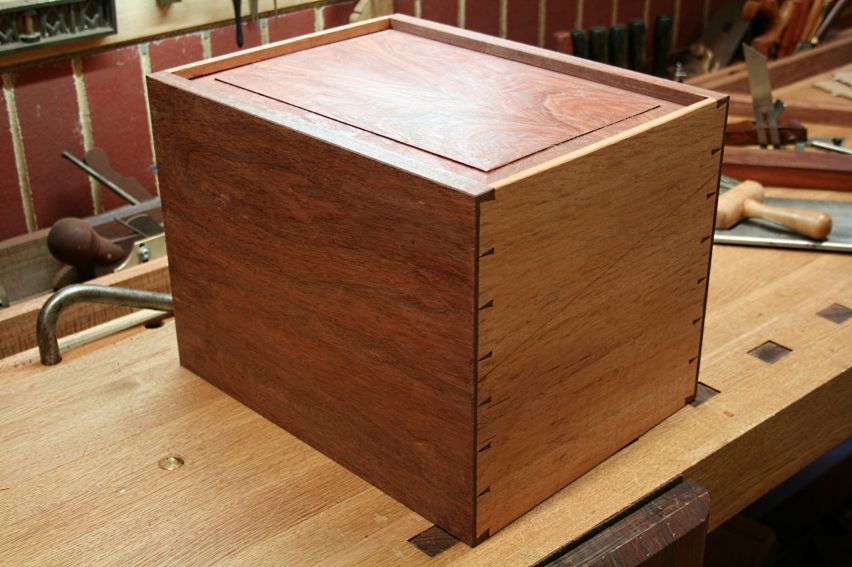
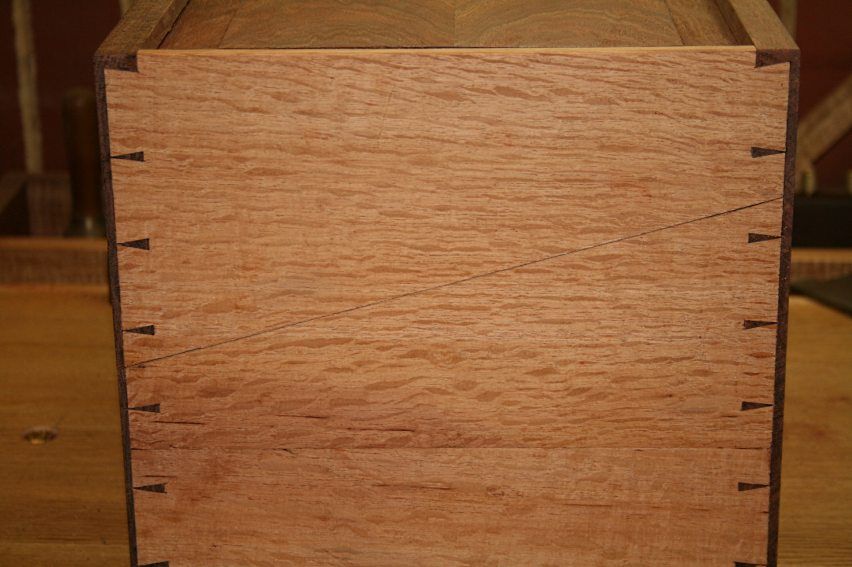
The raised panel became the top of this box ...


Which, after some thought, was sawn in two ...


One half became a box for a plough I built ...


... and the other half, with the raised panel, became this writing desk ...


And lost underneath it!


There ... sleepy yet ;)

Regards from Perth

Derek

Re: Raising the panel

#39

Re: some boudaries needed to this claim

roger lance

Derek.....I had a major back surgery about a month ago.....I'm doing very well; but, some nights have their issues. I was in sleepy-by-land before your reply post.

Shame that panel is lost to continuous view.....oh well.

That LV jack rabbet plane is offered with O1, A2, or PMV-11 blades. Any thoughts on the steel choice for use on this plane? The panel was probably jarrah.....very hard.....but, might O1 give cleaner results? (and more frequent sharpenings).

Re: Raising the panel

#40

This myth needs to be put to rest

Bill Tindall, E.Tn.

"might O1 give cleaner results"

I presume you are thinking that there is some difference in how refined (sharp) the edges of these steels can made. Any of the steels commonly used in tools can be made equivalently sharp- O-1, A-2, PMV11, M2,M4, 440 series, CPM-3V etc.

In the case of steel alloyed with tungsten or vanadium, it might take diamonds to sharpen them, but they can be sharpened to the same degree as simple carbon steel.

PMV11 has a composition that suggests that relatively soft Arkansas stones might not be optimum for sharpening, but I don't know this conjecture to be true. In any case, given the proper sharpening media they all can be made equivalent. Only how fast they dull will be different. And in spite of Lee Valley's claim, how fast they dull will be inversely correlated with how resistant they are to sharping.

Re: Raising the panel

#41

Re: This myth needs to be put to rest

Derek Cohen (in Perth, Australia)

might O1 give cleaner results

Roger, I doubt that you will find much of a difference, if any, between O1 and PM-V11 in regard to sharpness. As I understand from discussions (not what I have been told by LV), PM-V11 is close to D2. Now D2 is a "coarse" steel which has highish abrasion-resistance. In the case of PM-V11, which is a powdered metal technology, it is made with a similar fine grain to O1 ... hence the similarity in use. In practice, it holds an edge as long as D2, which is many times that of O1.

Bill, I agree with you that all the steels get sharp, perhaps not as "sharp" as each other, but at least as sharp as we need them to be to do good work. Like you, I have said for years that sharpening these steels (all of which I have used) depends on the sharpening medium used. Diamond is a great leveller.

What I do not know much about - and where the important issues exist, I strongly suspect - is not how how these steels get sharp, but how they fail. Some chip, some wear slowly, etc. Any thoughts here?

Regards from Perth

Derek

Re: Raising the panel

#42

tool's steel discussion

Bill Tindall, E.Tn.

PMV11 does remotely resemble D2 composition, but properties are greatly different. The most obvious difference is that PMV11 is a stainless steel, easily confirmed by simple corrosion testing for those that don't know its trade name and composition.

Edges fail by abrasion, chipping and folding/deformation, facts easily shown by examination with a suitable microscope. Steel properties of hardness, toughness, and abrasion resistance of the alloying carbides determine the fate of the edge when used for planing and chiseling.

The first picture shows the edge of an M2 steel chisel used for chopping. This M2 lacked toughness and the edged micro-chipped.


The second picture shows the edge of an O-1 type steel Sorby chisel used for chopping. This steel was not hardened sufficiently and its edge folded.


Re: Raising the panel

#43

I like that one...

John in NM

It is very like what I was trying to describe, but mine is longer, 90 degrees to the table, and on the last one I left off the fence side of the box. I use it for some pattern work on the router table too, when shaping the end of a long skinny part I make often.

I think when I make another, I will do something more like that one - boxing the fence side at 90 makes sense to me if the other side is tilted. That way I have a dedicated panel raising side and on the other side a 90 I can use for other applications like the router table.

👍 This page answered my questions

Your vote helps other woodworkers quickly find the answers and techniques that actually work in the shop.