WoodCentral Forums

Est. 1998 — 27 years of woodworking knowledge

Hastening dovetail making

Posts

Re: Hastening dovetail making

#26

Re: A different take on the matter

TomD

"Rather I admired the fact that he (probably a he) was able to make attractive furniture that would last, at a price ordinary folks could afford. I'm honored to own it."

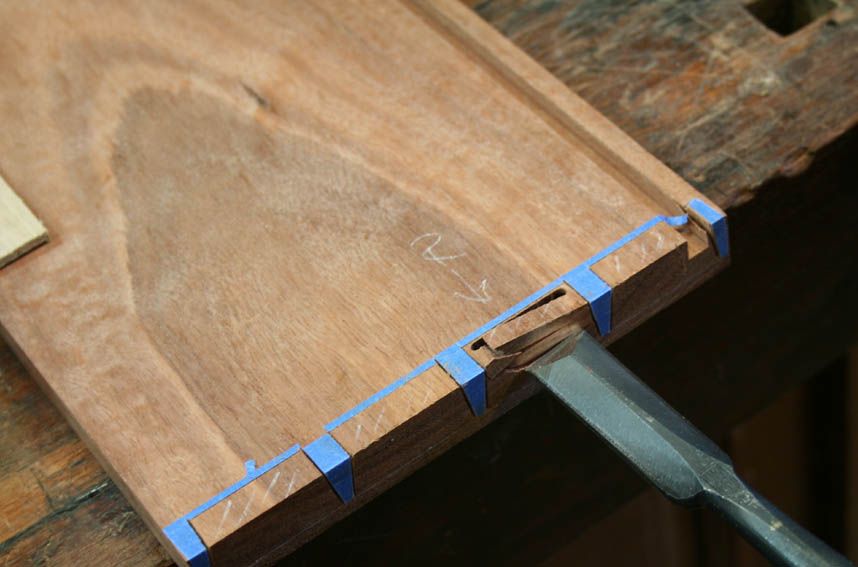
So the part of this that is tricky is: "at a price ordinary folks could afford". I gather the point you are making is because he was not particularly skilled, and did messy work, his product was more affordable. That could be true in the sense that he was not particularly skilled and simply couldn't ask as much for his work, but the evident lack of skill did not translate into greater speed. It isn't faster to oversaw the ends. All you have to do is hammer a scraper, or putty knife down the line. That squares out the whole socket, and leaves you a perfect result.

Almost certainly the work you see is not a distillation of efficient technique, it is some poor guy who never got through the door of a proper cabinetshop; didn't have youtube or anything else. Of course he could only copy the stuff that was on the outside. Anyone can see that. He didn't know how they did the dovetails in better shops, nobody was ever going to show him. We, however, have had 30 years of extreme dovetailing since Klausz made his first video. Anyone with anything to top that performance, can now get on youtube. We have a lot of inside information.

"that would last". We really don't know how well it lasts, why certain classes got rid of certain furniture. Rich people tend to replace stuff, middle class people hold onto the old stuff, there are so many factors, we only know a particular piece survived, that tells us virtually nothing.

Re: Hastening dovetail making

#27

Re: Hastening dovetail making

TomD

"When your tool, or more commonly a piece of scraper steel, is driven into the kerf, where does the wood go that was once in the kerf. It seems the only place it has to go is to the sides in the form of crushed wood fiber. Crushed wood fiber is not going to provide as favorable a glue surface as a chisel pared surface."

That is why it is a squared off thing like a scraper blade, none of the crushing goes to the sides, they look fine. However, your method if try\uly 10 seconds ish is great.

Re: Hastening dovetail making

#28

Re: Verisimilitude

TomD

"By itself, saving time seems like the poorest of reasons for employing a specific technique where the artisan is solely compensated for his or her efforts by a heightened enjoyment of those moments stolen from other pursuits or duties."

I enjoy the quest for perfection in techniques, and execution, unattainable of course. So if I am using inefficient techniques those aren't authentic, or pleasing to the spirit of my endeavour. Though once I get something completely wired, I don't seek to change my methods unless there were a compelling reason to, or I felt I would prefer or easily master the alternative.

Re: Hastening dovetail making

#29

Re: tool

TomD

That sounds like my method, mentioned here a while back. I started doing that around 97, when I was doing seminars. I just preferred to hit a putty knife. Of course anything obvious to one is likely obvious to another.

Re: Hastening dovetail making

#30

Re: How much time saved?

TomD

"I'd like the next generation in my family to admire my precision instead of wondering why I sawed past the line."

I don't particularly care what other people think, but I feel as you do because one thing you can be pretty sure about is they will not understand the endless trees we burned arguing about all this. They will not think we did it because "grandad was defined by his efficiency; his love of precision; his self-identification in old pieces of furniture. They are just going to think we sucked.

Basically this is proto-political: Like chairman Mao wearing pyjamas to be "with the people";, or all those execs who roll up their sleeves and take their jackets off as though they just got back from a lunchbox break outdoors and are going to settle into 4 hours of hot lathe work. How does one define oneself, and what inauthentic act would one commit for the crowd. It's just easier to pass excellence off as excellence, it leaves less room for misunderstanding, though it isn't as PC as it once was.

Re: Hastening dovetail making

#31

Re: Hastening dovetail making

jesse cloud

I guess my fundamental question is why do something that makes the appearance of your drawers suffer to save time. A decent jig can crank out a pile of drawers in very little time.

I don't use dovetail jigs because I think hand cut dovetails look better and I am willing to put in the time it takes. I think that if time was a big factor, I would probably resort to a jig, where they will admittedly look mass produced, rather than make cuts like that.

I will confess, I do sometimes make cuts like that, but its due to poor skills rather than efficiency. ;)

Re: Hastening dovetail making

#32

Re: Hastening dovetail making

Derek Cohen (in Perth, Australia)

Bill, several years ago I posted a series of pictorials on the Hand Tool forum about removing waste from dovetail half blind sockets (drawer fronts only). I was building a matching pair of miltary chests, each of which had 6 drawers - so there were plenty for experientation.

Each method was timed to assess relative efficiency. The drawer fronts were Jarrah, which is a very hard wood, and also vulnerable to splitting.

The quickest method of waste removal came from using a combination of power and hand tools. I only hand saw dovetails, and often these involve very narrow "London" tails. The thought of using power tools for this job was scary, however I had been shown a method by a friend, Neil Erasmus, a professional high end furniture maker based in Perth. This was identical to the method you used. Neil preferred a small router and a 1/8" upcut spiral blade.

I was encouraged by his success, however I think like a hand tool user, and came up with an alternate method: Instead of routing into the end grain, I chose to rout into the cross grain (this example shows my tentative first effort - I could have routed closer to the ends) ...


This made it easy to split out the rest of the waste with a chisel ...


The corners of the socket had been deepened using the kerfing chisel, and clean up was quick ..


I do not use a router today - I may if I had that many drawers to do again - instead, I simply drill out the line, or close to the line, and split out the waste. It is efficient, less effort than chopping it all out. I am not racing the clock.

Regards from Perth

Derek

Re: Hastening dovetail making

#33

that's where we disagree

Bill Tindall, E.Tn.

"I guess my fundamental question is why do something that makes the appearance of your drawers suffer to save time."

I believe the appearance of my drawers is adequate and not suffering in any way.

There is way too much of the notion that Tom D professed when he jumped to the presumptuous conclusion that just because the antique drawer was not made to Krenov standards the cabinet maker was lacking in skill. No, the cabinet maker had the good sense to put his time and skill into where it would show. We need to get beyond judging furniture by its drawers.

I believe that fretting over how the inside of a cabinet looks is a modern phenomena, advocated by "life style wood workers" and Galley managers. This notion is supported from my poking into antique furniture. If you go to the Philadelphia museum that has furniture, one of the pieces in the showcase collection has drawers made from shingles. I've poked in it and know. Its outside appearance is not lacking in any way.

Krenov "taught" us to finish the backs of our cabinets and even the backs of our drawers as lovingly as the case top. Misguided, is my comment to that philosophy. I'd rather spend the time on the next piece of furniture I need to make. It might be that if the interior finishing standards of modern custom furniture were reset to 1800 more people would afford it. To repeat, my father-in-law bought a house full of well made attractive custom furniture (mostly mahogany) on a middle class salary.

Re: Hastening dovetail making

#34

PS

Bill Tindall, E.Tn.

I hope these discussions cause one person to make something with hand cut dovetails that would have otherwise been too intimidated to try. The standard is, does it hold the drawer together.

Re: Hastening dovetail making

#35

Re: PS

Bruce, a MN Galoot

I haven’t read it, but one conclusion that Zach Dillinger reached in a recent book on hand woodworking is that any time spent on a surface that doesn’t show is wasted.

Re: Hastening dovetail making

#36

Different comparisons

Brian Holcombe

Commercially handmade furniture is the current standard for comparison to buyers and so someone unfamiliar with the differences in technique will be comparing those overcuts to 'handmade' dovetails that are mainly a product of careful work at the table saw

Those makers of their era were making to sell. The same is done currently but with different comparison made.

I know a good few makers currently making truly handmade furniture, their work is tight for that same reason, becuase gaps and overcuts are looked differently now.

Re: Hastening dovetail making

#37

Re: PS

Derek Cohen (in Perth, Australia)

Hi Bruce

I cannot subscribe to that view .... if one builds with an eye to what is seen, then what is not seen is vulnerable to being second rate.

Why should I make traditional mortice-and-tenon joints? After all, how would anyone tell the difference between this and a domino?

Why should I build a cabinet using full blind dovetails? They look like mitres from the outside.

Why not cut all my dovetails on a jig with a router ... if they are of little aesthetic value?

I think of it this way: some cars are basic, and that is perfectly OK. Others have refinements that are appreciated by their owners, who are willing to pay for the extra time and thought that went into them. These are two different worlds. I would not like to see them being reduced to one rule. If someone is building a reproduction, then reproduce it warts and all. But that does not constitute the only way.

Regards from Perth

Derek

Re: Hastening dovetail making

#38

Agee entirely

Bill Tindall, E.Tn.

"because gaps and overcuts are looked (at) differently now".

I think the Period Reproduction makers "get away with Period Correct " choices because they can claim, honestly, that it is period correct. The rest of us are held to the standard set by the current influence leaders, unless we can, or choose to, ignore them.

I am in the fortunate situation that I can ignore Krenov's building philosophical musings, to take but one example, and there are many, because I don't sell through galleries, nor enter contests, nor is my work a reflection of my person. As I have said before, a chest of drawers coming out of my shop is a place to put your socks, that someone is waiting for. I have at least a 2 year backlog.

Re: Hastening dovetail making

#39

Re: that's where we disagree

TomD

""There is way too much of the notion that Tom D professed when he jumped to the presumptuous conclusion that just because the antique drawer was not made to Krenov standards the cabinet maker was lacking in skill."

So:

- It is no more presumptuous to guess he was great, good, or a hack. None of us known. The idea of identifying the work done by various guilds through the dovetails they used is, however, one of long standing. The various degrees were often identified as carpenter dovetails, joiner dovetails, and cabinetmaker dovetails. I found these ideas in place with joiners in Belfast when I partied with them, but they may just have been reading the same magazines the rest of us did. Whatever the utility of these categories, they don't originate with Krenov or me.

As to weather one should judge work by drawers, perhaps not. Maybe we could carry this over to cars and not worry about the engines or drivetrains.

- I am not, however, talking about Krenov standards. The piece that you showed is the Ikea of it's day, except Ikea knows what it is doing, that guy was not in possession of the full range of choices. Today even routers make perfect looking joints so one has to have a passion for faking the funk to adopt bottom of the barrel standards. At either end of the spectrum there lies impractical cabinetmaking. Ignorance through to perfectionism.

"We need to get beyond judging furniture by its drawers."

Maybe we could carry this over to cars and not worry about the engines or drivetrains.

"No, the cabinet maker had the good sense to put his time and skill into where it would show."

How do you know? apparently anything on the inside of the case is invisible? But it isn't actually, you know full well it is there, and as a mater of impracticality will steadfastly ignore it, or invent fanciful justifications. Think of the effort required to ignore the obvious. Reminds me of my favorite kid's story: "There are no Such Things as Dragons". A family confronts the problem they have to deal with while living with a dragon that gets larger and larger until they stop ignoring it.

Let me tell you how this sorts out in the real world. People who are too whatever to bother with M&T joints seized on the biscuit joiners when they became generally available even though they clearly lacked some of the feature of M&T joints, and they are pretty good. But as soon as the Domino became available those who could shifted to that tool, because, you know, biscuits aren't that strong.

Same thing happened with bowl bottoms, as soon as decent alternatives to, say, plugging the bottom of the bowl became available most turners moved to them. In this case they were actually faster techniques, and gave turners new artistic freedom, and all around a better product.

I don't know if you have ever owned a good pair of shoes, but the leather soles are finished so they shine, even though they are destined to walk were other people temporarily park their dogs. People actually do notice details. More than that, they may like to have things they hadn't previously seen pointed out to them.

Re: Hastening dovetail making

#40

Re: that's where we disagree

TomD

"It might be that if the interior finishing standards of modern custom furniture were reset to 1800 more people would afford it."

Well obviously you don't know much about the standards of the 1800, they were far higher than those today in probably all of the West.

Why would you want more people to buy furniture they still can't afford even if the price came down a lot. The money for the builders is up market. In your world, nobody buys anything.

Krenov does not typify the high end. His style was largely very simple, he focused on very well designed pieces that had a through and through integrity. Pre marketry.

That generation had the accidental opportunity to re-introduce craft standards, against a backdrop of modern architectural theory that made it possible to make a living selling something as execution simple as a Conoid Chair.

Re: Hastening dovetail making

#41

Re: PS

TomD

"I hope these discussions cause one person to make something with hand cut dovetails that would have otherwise been too intimidated to try. The standard is, does it hold the drawer together."

That isn't the standard, that standard is often met by nails, dowels, and other methods. Even sheet metal. If the word dovetails comes up, you passed practical utilitarian standards long ago.

Re: Hastening dovetail making

#42

Re: PS

TomD

"I haven’t read it, but one conclusion that Zach Dillinger reached in a recent book on hand woodworking is that any time spent on a surface that doesn’t show is wasted."

Don't know him, can't vouch for him. Does he work exclusively in veneered particle board? Not a new idea to say the least. And it is odd to see the finishes people (other than me) put on boats when you consider that furniture has an actual tradition of being made to a high standard across the board. While boats have not.

Re: Hastening dovetail making

#43

Re: that's where we disagree

TomD

" It might be that if the interior finishing standards of modern custom furniture were reset to 1800 more people would afford it."

I think there is ample evidence that back in the day, people were very particular about furniture, it was more like today's new car in the driveway. An expression of wealth, or prosperity. That pushed both ways, if they could have had a more ostentatious piece, they would have, other than say the Shakers. So if they could have pumped up the visible and ignored unseen details and not been called on it, they probably would have and did. But only up to a point, word gets around.

And that is also double edged in it's implications for today:

- For those who claim not to care what other people think about their work, to adopt a standard that is

based on the needs of people who were consumed by what other people thought; just ends up copying a style of furniture that is driven by the very thing they reject.

The post WWII aesthetic worked really well for furniture. It could be stripped of unnecessary ornament, not unnecessary care in construction. The beauty could come from the richness of ideas in it (like one guy's shop could come up with the Maloof Rocker). You could enjoy touching any part of it, and wood is by itself beautiful, which was something buildings often lacked. Building might have beautiful forms, but were somewhat dead in materials. And even today, wood is still the best material for chairs that are not upholstered.

The Maloof Rocker also shows that the whole craft is not as fussy as is suggested about fancy joinery, it is held together with lag bolts. But it works in that case, and nobody cares. If it was held together with lags and had a few unfinished saw cuts to catch your wife's stocking on, history might have been less kind.

Re: Hastening dovetail making

#44

Re: that's where we disagree

TM Stock

A good speech should be like a woman's skirt; long enough to cover the subject and short enough to create interest.

- Winston S. Churchill

Content of memorandum spelling out expectations of one of my former brigade commanders when being briefed by his staff:

Be there; be brief; be gone.

In other words, I'd love to see your last three posts consolidated and edited so that I can better understand and appreciate your argument.

Re: Hastening dovetail making

#45

Hastening dovetail drawer making......

roger lance

Bill.....I've not read all the posts in this thread.....if someone has referenced what I'm about to, my apologies.....But, I thought you'd get a kick out of watching a YouTube video titled....."Just Another Dovetailing Video - with Christian Becksvoort"

At the end of this video, this highly acclaimed hand tool woodworker makes use of an extremely maligned power tool to complete his drawer.....its in the spirit of your post.

Re: Hastening dovetail making

#46

No right or wrong here

jesse cloud

I think maybe we are making a mountain out of a molehill. We all chose styles of furniture and styles of work for our own reasons. To argue about which style is best is as silly as how done a steak should be - the answer lies in taste and that is totally personal.

If I made furniture for a living, I would take any shortcut that would not be noticed by the market I sell to. Even more reluctantly I would probably design to whatever style is currently selling rather than one that pleases my own sensibilities.

If I liked period style design or enjoyed vicariously connecting to that history, then so be it.

Thankfully, I have the luxury of working in a design style I admire, not having to

be very concerned with cost of materials or labor, and not accepting due dates. That means that for me it makes sense to take my time and do the best I can. If those conditions were different, I would certainly be taking another side in this argument and I don't mean to be critical of anyone who does.

👍 This page answered my questions

Your vote helps other woodworkers quickly find the answers and techniques that actually work in the shop.