WoodCentral Forums

Est. 1998 — 27 years of woodworking knowledge

Hastening dovetail making

Posts

Hastening dovetail making

#1

Hastening dovetail making

Bill Tindall, E.Tn.

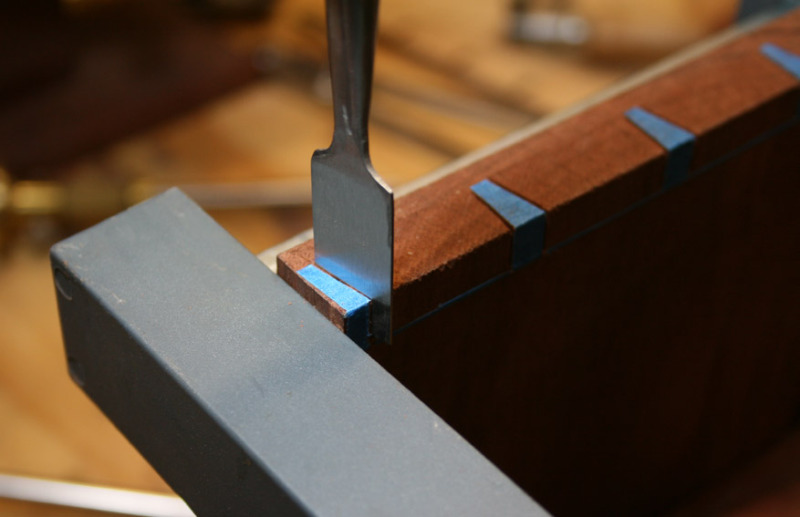
I am long past seeing how perfect I can make a dovetail and well into how fast I can make them. Something one sees on antiques where the maker was keeping the prices down is over sawn saw kerfs. On half blinds the pin board (drawer front)is over sawn as shown in PIC 1. The Headley shop routinely practices this Period Correct technique and this picture is from a desk they were making.


Depending on how this waste is removed over sawing the pin board can speed up waste removal. In my case over sawing the pin board does not aid the way I remove this waste and I don't like the looks of these saw kerfs on the inside of the drawer.


I do slightly over saw the tail board (drawer side) as shown in the second picture. If the kerf is under sawn a pesky sliver of waste remains that has to be pared away. Diddling with pesky waste in the pin hole of the tail board became one of my largest wastes of time. I have been working on not having to diddle with the sockets after the tails are sawn and the pin waste chopped away.

Slightly over sawing the tails has been a great time saver. The extended kerfs are noticed only by other woodworkers who scrutinize dovetails looking for lapses of technique. I don't have many visitors so its seldom an issue. Perfection is best, but I don't have the time for perfection on this issue.
Re: Hastening dovetail making

#2

Re: Hastening dovetail making

Derek Cohen (in Perth, Australia)

Bill, those corners in half blind sockets are more easily and more quickly cleared if you deepen the kerf. The overcutting is aimed at deepening the kerf. I also do not like to extend the saw cut to do this, and so many years ago I followed the lead of Tage Frid in wacking a piece of bandsaw blade into the sawn kerf to deepen it.

Several years ago I made a tool - I refer to it as a kerfing chisel - for this purpose. There are details on my website: http://www.inthewoodshop.com/ShopMadeTools/KerfChisel.html


Let me remind anyone who makes it add a clamp before use. This is a precaution to prevent splitting, which is rare. The method works well, and speeds up clearance of waste.

Regards from Perth

Derek

Re: Hastening dovetail making

#3

How much time saved?

Dick Coers

Curious how much time you save by over sawing? I guess I'd rather take the extra 10 minutes or so to saw them to the line. I'd like the next generation in my family to admire my precision instead of wondering why I sawed past the line.

Re: Hastening dovetail making

#5

Jack Guzman from Maine

tool

Jack Guzman from Maine

Derek,I also made such a tool and was inspired to do so by Tage Frid. I sharpened one edge of a 3/4" wide putty knife. After clamping to prevent a split I hammer the edge of the knife to the bottom of the kerf. Yours is alot nicer(as most of your handmade tools are). ---Jack

Re: Hastening dovetail making

#6

Re: tool

Derek Cohen (in Perth, Australia)

I sharpened one edge of a 3/4" wide putty knife.

Thanks for the compliment, Jack.

Incidentally, the edge of my blade is not sharpened. It is deliberately square/blunt to avoid the possibility of levering the grain.

Regards from Perth

Derek

Re: Hastening dovetail making

#7

While I don't oversaw...

John in NM

I do recognize that this was a standard practice seen in antique furniture, used when that 10 minutes per joint did actually matter - that would be a how many hours of shop time on a full chest of drawers? Probably about the amount of time that it takes to mill out all the drawer joints for that same chest with a machine setup - makes perfect sense why they did it and why they would jump at the chance to use the modern machine instead.

Anyone making period reproductions should be aware of the practice and why it was used.

Re: Hastening dovetail making

#8

Verisimilitude

TM Stock

I get what Bill's saying - verisimilitude in craft is more than just the outward appearance of the crafted object. It's one thing to attend Mr. Headley's lecture on time-saving methods employed by the Hay shop's master and staff, and another when hands, eye, and noggin all seem to connect with near-audible 'ah hah!'

By itself, saving time seems like the poorest of reasons for employing a specific technique where the artisan is solely compensated for his or her efforts by a heightened enjoyment of those moments stolen from other pursuits or duties. Within the context of making a period piece by hand, however, I can see Bill's rationale as better satisfying his desire to slip back into a 17th or 18th century cabinetmaker's shop for those few fractions of hours.

Re: Hastening dovetail making

#9

Jack Guzman from Maine

Re: tool

Jack Guzman from Maine

Good point. Same concept for how square cut nails work. Pushing the grain rather than spreading it. I will dull my edge.---Jack

Re: Hastening dovetail making

#10

Re: Hastening dovetail making

Bill Tindall, E.Tn.

"Bill, those corners in half blind sockets are more easily and more quickly cleared if you deepen the kerf."

As clearly noted in my original post, not in my hands. In the past few years I have made dozens of half blind drawers, so this statement is based on some experience. This is the one part of drawer making that goes so quickly that I see no room for improvement.


I turn the drawer front vertical in the vice. I choose a chisel wider than the pin is tall. I brace the chisel against my hip and pare away at the remaining pin waste with thrusting cuts. The saw kerf provides a depth mark for the paring. When the pared surface meets the saw kerf surface- done. I'll time one later and if this paring takes more than 10 seconds I will report the longer time. It is the time it takes to make about 5 thrusting cuts. Only the final cut to the kerf line is done with any accuracy.

Once pared the drawer front is already in position for a test fit to the mating side. I press the side onto the pins. If the alignment looks ok I move on. I don't fully seat the joint in a test fit. I tap the parts together just enough to ensure that they will be ok when I go to the final glued assembly.

When your tool, or more commonly a piece of scraper steel, is driven into the kerf, where does the wood go that was once in the kerf. It seems the only place it has to go is to the sides in the form of crushed wood fiber. Crushed wood fiber is not going to provide as favorable a glue surface as a chisel pared surface.

Re: Hastening dovetail making

#11

Adam of Oakland

also depends on the species of wood

Adam of Oakland

fitment of the joint is much easier in soft pine versus something very hard...

for me, i am just fine with oversawn. if i'm doing a run of DT joints in wood milled from the same larger stick of timber, i feel like i can get into a rhythm, and get pretty close without oversawing much after i've done a few. think about a chest of drawers where you're doing 8-12 boxes each with at least 2 sets of dovetails. lots of practice!

here's another fact though: if there's evidence that the joint was oversawn, i get warm fuzzies knowing that the joint wasnt chewed out by a screaming router bit. not that there's anything wrong with routers!!!

Re: Hastening dovetail making

#12

Techniques for saving time

Brian Holcombe

Bill,

Great post. One technique I use for saving time in half blinds is to eliminate paring. Paring is a great time sink and so ridding yourself of it is the best time saver.

I use a fishtail type chisel along with a normal bench chisel if the socket is wide enough, otherwise I use the fishtail chisel alone.

I chop bevel down until I reach about .010" above the gauge mark on the end grain. I continue chopping in this fashion until I reach the same spot on the side grain. At which point I chop down with the chisel bevel out, and finish the joint by paring the floor with the fishtail chisel in one push.

I over-cut the socket but I do not over-cut the tail. In making my furniture it would be looked upon harshly by modern eyes where the socket over-cuts are almost never seen.

Re: Hastening dovetail making

#13

Clarification requested

Bill Tindall, E.Tn.

"I over-cut the socket but I do not over-cut the tail. In making my furniture it would be looked upon harshly by modern eyes where the socket over-cuts are almost never seen"

Do I understand correctly......?

You saw the pins(sockets) deep enough that paring is unnecessary on the sides of the pins(sockets), as sawed in the Headley drawer front?

I don't understand the 2nd sentence. How are socket cuts not seen in a half blind drawer front? I am presuming the harsh looks would be focused on overcut tails? (The only harsh looks I get are from relatives on subsequent visits who see insufficient progress on the furniture they order) I agree entirely with paring consuming a lot of drawer building time.

I was told by someone that built drawers in an English factory that the quota for a day was 6 for a typical chest of drawers. I learned how the tails were cut to achieve this rate but never thought to ask how the sockets were excavated. That would have been a handy piece of information. Next time I get an opportunity I need to see if the drawer fronts are overcut in English furniture.

Food for thought.....I have never seen a drawer removed on the Antiques Road Show and a comment made about its construction and how its construction details affected value. Antique value seems to be only a result of outside appearance. I believe drawer fetish is a modern phenomena, at least in western furniture.

Re: Hastening dovetail making

#14

Re: Hastening dovetail making

Keith Newton

You may enjoy using the chisel more, but have you ever tried using a multi-tool to make some of these cuts? A 2x2 clamped on the lines or slightly shy would make a nice guide, allowing you to cut the bulk of that out easily.

If you haven't used these tools much, since there isn't any gullet to clear the chips, rather than just shoving them straight in, they work best by rocking and traversing, to give the chips a way out.

Re: Hastening dovetail making

#16

Re:  Clarification requested

Brian Holcombe

I'm selling in a venue where every detail is excruciated over so my techniques will certainly depart from that and it takes longer to build than someone who was making for a market in which function and traditional aesthetic are peak importance, and apparently speed.

No one looks inside a drawer to the back of the drawer face, at least I've never seen anyone do so and remark negatively on the results.

My over cuts extend into the back side of the drawer face but cannot be seen on any exposed surfaces on the drawer exterior or sides.

Many who examine my furniture pull a drawer out and look at the sides.

Re: Hastening dovetail making

#17

Look up Fein Multi tool, or Bosch Multi tool


Re: Hastening dovetail making

#18

Re: What is a multitool?  *LINK*


Fein MultiMaster

Re: Hastening dovetail making

#19

Re: What is a multitool? *LINK*

Keith Newton

Here is a link to the PC brand, but all of the tool brands have them. I was sure they were a gimmick but needed one for a certain job, so I picked up a cheap Harbor Freight one. It turned out to be one of those tools that surprises, and makes you wonder how you ever got by without one. I've used mine on lots of joints, like squaring up the ends of routed mortises, and plenty of other inside corner joints.

The $20 HF is loud and not pleasant to use, so I would advise buying a better brand like Makita, PC or Bosch.


https://www.amazon.com/PORTER-CABLE-PC250MTK-Oscillating-Multi-Tool-Accessories/dp/B004XQVC9A/ref=sr_1_1?ie=UTF8&qid=1507047945&sr=8-1&keywords=Porter+cable+electric+multi-tool

Re: Hastening dovetail making

#20

I've not tried that...

John in NM

But we've certainly found the multitool very useful in remodeling work. Cuts box holes in drywall like nobody's business!

They strike me as a bit light duty for joinery work, but I did recently reflect that the action is a lot like a Maka mortiser, just vastly smaller!

Re: Hastening dovetail making

#21

Re:  Clarification requested

jesse cloud

Most of the quality furniture back then was commissioned by the very wealthy. I suspect they didn't care much about the inside of the drawer because they were seen only by maids, butlers, and/or slaves.

Hence they were very concerned with the outside presentation of the piece, but not so much by what was going on inside.

Re: Hastening dovetail making

#22

Re:  Clarification requested

Brian Holcombe

Sure, and you have to remove the drawer to comfortably view the inside of the drawer face. So not many people do that. :D

Re: Hastening dovetail making

#23

A different take on the matter

Bill Tindall, E.Tn.

My wife's father was a middle classed insurance salesman, not wealthy by any means. Their house was largely furnished with furniture made by a shop in Utica, NY. An example is this small maple table.


The turnings are crisp and the drawer cock beaded. These and other refinements enhance its outward appearance. And it was affordable to a middle class family in 1930 or thereabouts and remains in use.


The drawer internal parts are clearly made as quickly as possible. The dovetails are few and the fit less than perfect. But the drawer has remained functional for decades and will continue to last.

This is the kind of old furniture I get to see, not the show pieces of their day. Key points are that it is affordable furniture that was built to last and look good.


I have another piece made about 1850. The drawers are even more quickly sawed.

It gave me a connection to the maker to see the saw kerfs and the chisel hole where the sides were stacked and chopped and the chisel broke through and made a mark in the underneath side. I've been there and done that.

In scrutinizing these pieces, likely the only time these drawers were ever scrutinized, did I berate the maker for the "sloppy" drawer work? Hell no. Rather I admired the fact that he (probably a he) was able to make attractive furniture that would last, at a price ordinary folks could afford. I'm honored to own it.

Re: Hastening dovetail making

#24

Re: A different take on the matter

William Duffield

I suspect the cockbeaded drawer front is veneered, too.

Could you comment on the joinery between the front legs and the drawer case? The two pegs or plugged nails, maybe, that show on the front of each leg are curiously placed.

Re: Hastening dovetail making

#25

my best guess

Bill Tindall, E.Tn.

...unattractive decorative pins.

👍 This page answered my questions

Your vote helps other woodworkers quickly find the answers and techniques that actually work in the shop.