A friend has a bedroom door that doesn't latch. The door latch doesn't line up with the mortise in the door frame; it misses by about a half inch. I'm thinking the door frame is out of square. I have no idea how it would have gotten out of square, other than the previous owner screwed it up somehow. The house (built in 1988) showed evidence of some bizarre DIY projects.
So, I've been asked to fix the door so it latches properly. It seems like a straightforward job:
- remove the casement trim (left, right, and top) from both inside and outside
- use a sawzall to cut the nails holding the door frame into the door opening
- shim the door frame so the door closes and latches properly
- nail the door frame into place through the shims
easy fixed by enlarging the mortise and getting a larger strike plate, why go to all the other work when the door is all ready their and trimed in ? It won't make any difference if the door is out of square a little?, did you use a square to see if it is out of square , and by how much , i would tell the guy what you are going to do, and i am sure it would be fine, if not that is a lot of work for just a simple fix, if you can see that the frame is out of square than i would do the tare out and fix square than , but if not do the easy fix , good luck
I used to be a builder, then a home Inspector, now I am buying and remodeling houses to either rent or flip. I've installed and fixed hundreds of doors.
It seems that what you missing is you have not analyzed the problem. Was the door installed wrong or has the house moved? (This may be important if the house is moving now.)
How are prehung doors done in your neck of the woods? Locally we use "split jambs". The two halves of the jamb "telescope" together. That might make a difference if you decide to remove the jamb.
When I hang a prehung door, I install the part with the door on it in the opening and adjust it so that the hinges are plumb. With the door closed, put the level on the face of the door, make sure the hinges are in a straight line and plumb. Drive or shoot and nail through the facing at each hinge.Then put the level on the hinge knuckles at a right angle to the door and see if they are plumb. You can flex the trim enough in most cases to get the door plumb Slide shims under the jamb above and below the hinges so they are snug and nail through them to hold the jamb and door plumb in that direction also. Then adjust the rest of the casing to fit the door. I actually dry fit the jamb in the opening to be sure all this will work and there is room for all the adjustments. If there is going to be carpet, I hold the jamb as much as half an inch off the floor, but check the strike side to be sure that will work, because if the floor is not level, that side of the jamb may be tool long or too short. Openings for doors are seldom perfect and you end up finessing the jamb to make it fit the door and opening.
In your case I would be looking at the gap or margin around the door. Especially at the top or head jamb. And I would be looking to see if the door is still original and square or if it has been cut off at an angle. There is the possibility the door jamb was miss-manufactured to begin with. If the margin across the top of the door is good now and you reset the jamb to cause the strike to line up, the top of the door will be off by "that much". Whether the door was poorly installed, miss-manufactured, or adjusted to compensate for a moving house, I can't think of a way that resetting the jamb won't cause a problem at the head jamb.
I think the others are correct. The best answer may be to install a larger strike plate and move the opening. The borgs have them in the door department up to five inches wide. Line it up, cut around it with a knife, mortise it in and drill a new hole.
to check level across the floor under the door. If it is a wooden floor, with crawl space, there may be a need to go under the house, and add another pier.
I have seen plenty of occasions where a customer made last minute changes of walls, which shifted the load off where they were planed, and even where the foundation and piers were off quite a bit.
And then add to that, anybody with a skill-saw hammer and truck, can claim to be a carpenter, without knowing which end of the hammer to hold, much less good framing practices. But even supposedly good builders and framers can make mistakes, or miss things, and a remodeler, probably wouldn't even bother to look under, before making changes.
Are all the hinge screws tight? I've run into situations where all it takes is a quick retightening.Also you can sometimes adjust the door with a longer screw in one of the top hinge holes.---Jack
If the door latch is hitting a half inch low on the strike plate, I bet dollars to doughnuts that the gap at the top with the door closed goes from a sliver on the hinge side to at least 3/8" on the strike side. There will also be a larger gap at the bottom on the strike side than the top in the vertical gap, and on the hinge side, a bigger gap at the top than the bottom. Basically, the door has sagged in the opening and will be in a sort of "kitty-corner" orientation to the frame.
I fix doors like this all the time when I have to paint them. The easiest fix is to take out the center screw of the top and middle hinges (or any screws that are closer to the center of the jamb than the others), and replace them with 3" screws of the same color. Do not use drywall screws! Make sure all the other screws are tight as well. If they're stripped, drill out the hole to 1/4" or 3/8" and glue in a piece of dowel rod, then reinsert the screw once the glue dries (super glue is adequate for this).
THIS is something I failed to discuss. Jason has pretty much nailed this. If the gap across the top of the door is as Jason described, either the door sagged in the opening or the house "settled" on the hinge side. Its hard to imagine the door could sag so much that the strike is off by 1/2" Without the upper edge of the door hitting the jamb or having been trimmed.
The reason I put "settled" in quotes is as a Home Inspector I "see" settlement as some part of the house sinking into the earth. This is different from some part like a floor joist sagging or something compressing from rot or termite damage.
This whole discussion brings up the fact that doors are very three dimensional and not as simple as they seem.
I use a plug cutter and make plugs out of wood similar to the jambs in several sizes and carry a bag of them with me as part of my tool kit. I like the fact that the grain runs in the "right" direction and the plugs are slightly tapered. Drill the right sized hole, a little yellow glue, drive the plug gently home, trim it off and carry on.
drywall screws are not strong. Look at them and see how thin the shank is. Deck screws can be ok in a #8 or greater size. But if you want to resist a thief breaching the door, or need to hold up a home made heavy hardwood door, #10 hardened screws (McFeeley for example) are best. And I like them long enough to sink securely through the hinge and into the door opening framing. For extra security I use plywood or solid wood shims under the hinges, about 3 1/2 x 6", and will glue them in for an entry door. The result is that the door becomes the weakest part of the entry and not the jam or framing.
I don't remember when I learned this, and it may not be universal, but I believe generally hinge screws are #9. Doesn't sound like much, but a #8 is slightly (but obviously) too small to fill the countersing, and a #10 leaves the head slightly proud and can cause binding if all the screws are that size. I've had first person experience with this.
I found Lowes actually has #9s in their specialty drawers (usually opposite the wall with all the other fasteners) although possibly not in the length we're talking about. #9s are available through Grainger (theoretically—I ordered some online and they never came in, which is how I found the ones at Lowes).
For me, this may be the best kept secret in woodworking. I hope this helps.
The hinges Lowe's is carrying now come with a long screw. I use at least one per hinge in the jamb. If I have spares, I save them for the next door that needs one. I have use what I call deck screws, also purchased at Lowe's, and they have been fine. IIRC the heads fill the countersink nicely. I have had no trouble with the size and certainly no binding. If the heads were slightly over sized I would enlarge the countersink.
I agree with Bill, Screws, and big ones for exterior doors.
My experience is that for interior, factory pre-hung doors, a #8x3" screw is sufficient. The head is slightly smaller than the factory hinge screws, but large enough to bear on the countersink without being noticeable.
On exterior, factory pre-hung doors, I typically go for the SPAX brand screws (which use a #3 Philips bit) and have a larger head. A #8 will go right through the hinge hole on many doors.
Since I often remove doors to paint them, I've learned many different ways of adjusting them, and just automatically do so in order to not get blamed for their poor operation (which may or may not have been due to the paint). Unfortunately, it's often the case that I have to tell a customer that their builder hired a hack carpenter to install cr@p doors and there's only so much I can do (I've seen a strike plate that was drilled out by a spade bit--looked like it was done by a badger). At least the cheap, hollow-core doors don't tend to sag as easily.
Years ago my mothers house was broken into and robbed. Insurance paid up all was recovered and life went on. However I remarked that the thieves were knowlegeable in carpentry. They didn't damage the front door. They simply pried it out and set it aside. The only fasteners holding the door frame in were finish nails through the exterior molding.---Jack
People moved into their new house and slammed the front door. The Door, frame and all fell out of the opening and tumbled down the front steps. In a panic, they called the builder. His answer, "I know you are upset, but why did you call me? It's your house!"
You are correct that the #9 is the perfect fit. And, as seen in the picture, the heads of robust #10's stock out a bit. But In my experience they don't stick out enough to interfere with the door closing.
The long screws into the framing are grey painted ones
I did get square corner hinges though, I don't like the rounded ones. I've noticed though, that no one notices the hinges but me, and look at me like I'm a bit off if I point them out!
I said I knew him, Not a friend. As a Home Inspector one of the things I do is Expert Witness testimony. I have appeared against this guy four times. At one point, the opposing attorney tried to disqualify me on the basis of personal animosity. He asked if I could appear against him so much without personally disliking him. I said yes. Then could I explain how I felt about him personally? Love him like a brother! He's a major par of my income. The Jury laughed out loud. The lawyer looked embarrassed. The trial went on.
On one of his houses he passed a roof truss directly through the chimney. Not just inside the masonry of the flue, but right through the opening of the flue. You could look up the flue and see the truss parts. They were charred. Never did understand why they did not burn and burn the house down. His answer was that trusses are "engineered" and the builder could not cut them on site.


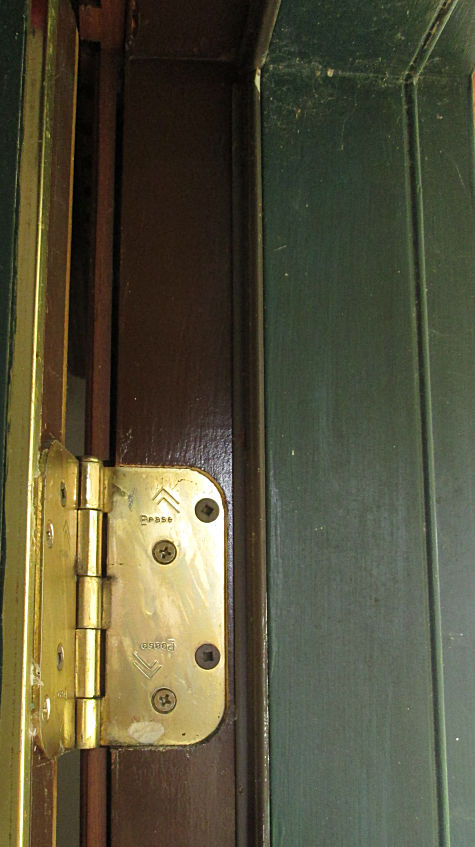 You are correct that the #9 is the perfect fit. And, as seen in the picture, the heads of robust #10's stock out a bit. But In my experience they don't stick out enough to interfere with the door closing.
