Very basic tablesaw question
eliot d
How high relative to the top of the stock do you set your blade for crosscuts and for rip cuts?
Knowledge You Can Build On — Est. 1998
Very basic tablesaw question
eliot d
How high relative to the top of the stock do you set your blade for crosscuts and for rip cuts?
Re: Very basic tablesaw question
John McGaw
Assuming a through-cut, I set mine high enough so that the bottoms of the gullets are at/above the surface of the work.
Re: Very basic tablesaw question
eliot d
Yes, but is there something to be said on rip cuts for setting the blade somewhat higher? I'm thinking about downward force at the cutting edge.
Re: Very basic tablesaw question
John McGaw
Well, I guess that if that is an important factor with your equipment you could raise the blade as high as it will go. Personally I find that with a properly-aligned fence, a sharp blade, a powerful motor, and featherboards/alignment wheels restraining the stock as required downward force isn't much of a consideration. Add to that the idea that my hand is headed directly toward the blade (with a push stick of course, but still headed in that direction) having the blade no higher than necessary is of some small comfort. If it is taking a lot of force to get the stock through the cut then something is definitely wrong and that is a good sign that I should stop and reconsider.
Re: Very basic tablesaw question
Bill Howatt
There is no doubt that minimizing blade exposure is probably safer regarding cutting your body parts but I believe this benefit can be totally eliminated and the situation made even better with a blade guard.
This issue has been debated many times but I'm in the camp that says kickback can be minimized by having the blade higher. If you look at the forces, the major component of force back towards the operator is at the top of the blade, once it is past the top the forces are towards the operator and down to the table. So if you can keep the work away from the top of the blade the kickback force is reduced and the further away the better. This primarily of concern when the kerf sides catch the upward motion of the teeth and the workpiece is lifted. A splitter should minimize this but sometimes forces in cut wood are very strong and pinching can occur.
Like the blade guard reducing the cutting hazard, proper use of other devices such as featherboards, including featherboards or things like Board Buddies to keep the workpiece down on the table and above all a well-aligned TS blade, splitter and fence will remove kickback issues.
Still, I keep the blade high with a guard, lower if for some rare reason I can't use a guard.
Not everybody agrees with this but it's the way I see it.
Bill
What the Freud tech person said....
Bill Tindall, E.Tn.
...and what makes the most sense.
let us start with what makes the most sense.....The old timer with all his fingers told me if the blade was just above what was being cut a slip would result in a nasty cut. He left it as an exercise to think about the result if the blade was high above the surface being cut.
Technical: the angles of the teeth, relative to the wood, as they are driven through the material can be optimized for "best" cutting. The angle that the tooth engages the material depends on how far above the table surface the tooth engages the material. On a typical blade designed for cutting 4/4 stock the blade was designed to cut with the teeth half above the stock surface.
So, for both a safety and technical consideration set the blade to be just above what you are cutting.
disagree
Bill Tindall, E.Tn.
"having the blade no higher than necessary is of some small comfort."
It is a great comfort.
As much as I have stood in front of a table saw those rare occasions when it may be necessary to raise the blade to near full height leave me substantially discomforted.

I agree with Bill on this one
Ellis Walentine
... and for good measure, I called my old associate Paul Anthony, who wrote The
Complete Illustrated Guide to Tablesaws for Taunton Press a few years back. We agreed that having the blade sticking out more than, say, 3/8" from the top surface of the workpiece, is disquieting at best and a valid safety concern at worst. The force vectors where the cutting action occurs are undoubtedly different, depending on the blade height. I just don't know if that is as serious a concern as the safety factor, as you will apply the required feed pressure regardless. One other factor is the cut quality, which, with modern blades such as those made by Forrest and Freud, will actually be improved by keeping the blade lower in the cut, as the infinitesimal side clearance grinds on those teeth helps them track faithfully in the kerf, that being the key to their performance. On iffy materials like plywood and melamine boards, the choice of blade geometry, rake, grind and elevation all contribute to cut quality and should be experimented with to assure the best results.
Ellis
Re: Very basic tablesaw question
Tony-Memphis
I have to admit that I have never given it a whole lot of thought. I normally set mine at around an inch - i use a push stick that is 3/4" thick plywood and I use it as a quick reference to set the blade "a little higher than that." Over the weekend, I was working with some cherry and getting some chipping on the crosscuts. I raised the blade a litltle and guess what?!? The cuts were much cleaner. Can't tell you what the height was, but I probably have it set to a little over an inch now.
Tony
Freud's Responce to Question
Howard Acheson
Here is the response from Freud a few years ago. They no longer have a representative on the forums but the answer is probably the same today.
QUOTE
I feel this one has been rehashed a few times but I must interject again that if you are using the correct Freud blade for the application, the blade should be set so that 1/2 of a tooth is protruding through the material. So, if you are cutting 3" thick material with a 10" blade, the blade would be at full height. The idea is to have 3-5 teeth in the cut when ripping and 5-7 for crosscut and manmade materials. If you cannot acheive this and keep the blade at 1/2 tooth height, you have the wrong blade for the application.
------------------
Charles M
Freud, Inc.
CLOSE QUOTE
Howie......................
Re: Very basic tablesaw question *LINK*
Rick Christopherson
This is an area where I strongly disagree with the older, conventional wisdom. The very first article of mine that was published was actually on this very topic. The original version of that article can be found at the link below.
The wisdom of keeping the blade low is predicated on the idea that the workpiece is still going to be there when something goes wrong. There are 2 reasons why this is a a bad concept: 1) The low blade height actually increases the chances for something bad happening, and 2) When something bad does happen, the workpiece is likely long gone before your hand comes into contact with the blade.
So the thought that your injuries will be minimized if only a fraction of an inch of the blade is exposed is false, because if the workpiece vanishes in a heartbeat and is flying through the air behind you, the full height of the blade above the saw is exposed to your hand before your hand reaches it.
The lower blade height puts more load on the saw, the blade, and your need to feed the stock. These things combine to increase the risk of something bad happening.
I do want to point out that I'm not suggesting raising your blade to its maximum height either. A decade ago, a woodworker that I know misinterpreted what I wrote and raised his blade to maximum height. This created a greater danger where none should have existed when his home-made push-stick broke. That incident is what prompted my other article about push-sticks versus push-shoes.
The low blade height tries to minimize the damage when a problem occurs, but unfortunately, it actually creates the problem that you are trying to minimize the damage for. That's a reactionary philosophy. I prefer to be proactive, and prevent the accident in the first place.
I've actually been involved in a legal court case as an expert witness where this topic was a significant strategy for the other side. When they read my full report, they withdrew from the case and settled.
Here is a more recent graphic I have created regarding this topic. (Edit: Oh, I just noticed that the photo has a label "RAC-10". I forgot, but that means that this image was actually used in the court case I mentioned above.)
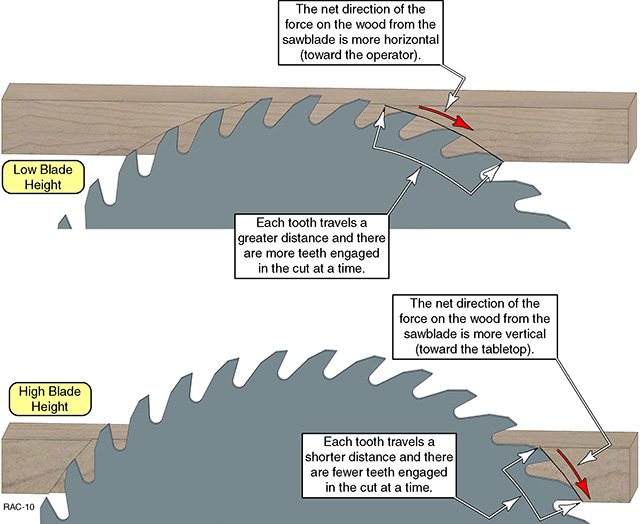
http://www.waterfront-woods.com/Articles/Tablesaw/tablesaw.htm
Re: Very basic tablesaw question
John Lucas
Having read through all the responses I have to ask one question. How many of you have had kick back. In the 25+ years I 've used a table saw I've had one. That was my fault. I was cutting 4" square blocks using the fence with a 3/4" block as a method of getting the repeated cuts. I thought the 3/4" block would allow room for the cut 4" blocks to get away from the blade. Well one of the rotated and a diagonal block 4" is wider than 4 3/4". It threw it back at me very forcefully. Other than that one time I've never had a kick back and I've cut an awful lot of wood.
For that reason I go with the keep the blade low to avoid injury if possible. For interest sake I have tried the blade high technique and can't really feel any difference. Maybe there is, and maybe it only happens at critical times when it's too late to move but I sure feel more comfortable with the blade low. I do of course always use a push stick.
Re: Very basic tablesaw question
eliot d
Your response is in keeping with the general idea in my post. I kind of, sort of, thought just what you have said -- and I mentioned it in my second post above. Still, I also had this lingering thought that a higher blade height could do more cutting damage should there be an accident. I'll continue to do what I have always done, which is to say rip with some additional height -- but certainly not maximum height for most cuts. I think it's interesting that one of the replies mentioned a cleaner cut it a bit more height.
Since you've written about all this, please let me ask you another question that's not usually covered: do you advocate using the entire length of the fence when ripping , say a two foot long board? In other words, should one set the workpiece off from the fence with a shorter straight board , which acts like a secondary fence? I read somewhere that the whole fence should be used only for large stock like a large plywood sheet.
Re: Very basic tablesaw question
Rick Christopherson
Elliot,
I've read of people advocating a shorter fence, but I disagree with it. I have a Unifence, so I can pull it back if I want. I have tried it out of curiosity, and I do not like the lack of control toward the end of the cut. As you approach the end of the cut, the registration surface of the board on the fence gets very short, and this can result in the workpiece skewing.
Re: Very basic tablesaw question
Sgian Dubh
Rick, I find it interesting that you experience a lack of control of the wood toward the end of a rip cut when using a short set fence. You must be doing something wrong, but I'm not sure what the problem is, but I'll speculate on that issue later. In nearly forty years of using European type saws with adjustable rip fences, always set short for the ripping of solid wood, I don't think I've ever really felt that I'm not in control of the cut all the way through to the end. But there is a significant factor or two to consider: it's not just the rip fence that controls the cut because the plate of the blade and the riving knife both play a role. Once the rip cut is established with a short set fence the wood passes alongside the blade plate, passes by the upcutting rear teeth, and almost immediately after that it's running past the riving knife. The arrangement of these parts makes the operation virtually self guiding once the cut is established, and in a sense, the fence is the primary guide, with blade plate, and the riving knife acting as secondary guides. Of course, the wood can close on the kerf, but that's where the riving knife comes in by helping to reduce the ability of the wood to pinch on the blade. And a short set rip fence allows wood that springs open after the cut to spring away from the blade, whereas a long fence forces the wood tighter onto it, and on to those upcutting rear teeth if there's also no riving knife or splitter.
I can fully see that a short set rip fence along with the usual American style saw set-up, ie, no crown guard and no sign of even those minimally useful splitters that the machines are usually supplied with would lead to a sense of being out of control, but that isn't the case with European style saws. In fact, here in the UK using saws as Americans do in our professional workshops is heavily frowned upon, and actively discouraged by the Health and Safety Executive. Over here, using a table saw or rip saw without the crown guard and riving knife isn't actually illegal if alternative adequate guarding can be devised for particular operations, eg, non-through cuts. But in almost all normal sawing operations, such as ripping and cross cutting, injuries that occur where the riving knife and crown guard have been removed can result in prosecution of the employer, temporary or permanent closure of the business, etc.
Moving on to another issue, I am not at all convinced by your argument for setting the blade high for rip cuts, a position you illustrated in an earlier post. You've got arrows in the wrong place I believe. In my experience kickback doesn't develop as the wood is being chopped by the downward cutting front teeth, which your red arrows seem to suggest, whatever height the blade is set at. The likelihood of kickback occuring is surely primarily linked to what happens after the mid point of the saw blade. This where the upspinning part of the blade is, along with the upcutting rear teeth, and it's here that there is a greater tendency for the wood to lift and be chucked back at the operator. Get past the blade altogether, and your wood, if it pinches, mostly pinches on the riving knife which I've found goes a long way to preventing kickback. Of course if you're in the habit of using a saw for ripping with a long rip fence, no riving knife and no crown guard (typical in the US as I know having lived and worked there) then all bets on avoiding the kickback are off.
I have to admit that I witnessed some cracking kickbacks in the US workshops I worked in, and every one of them was caused by what, to me, seemed obviously sloppy table saw practices. Slainte.
Kickback, experience keeps it at bay
Bill Tindall, E.Tn.
When I first started woodworking I got some spectacular kickbacks. I have not have one in over 20 years. I believe that they are caused by inexperience and can be avoided by simply knowing when they occur and avoiding these circumstances.
The easiest rout to avoiding the possibility is to use small thin kerf blades, for example 7 1/2 x 1/16 kerf. For demo purposes I have not been able to generate a kickback with these small blades. Apparently there is too little energy stored in the blade to accelerate the wood coupled with less engagement force of teeth to wood to initiate throwing it.
There is almost no cut I encounter in building stuff that requires a blade larger that that mentioned.
Re: Very basic tablesaw question
hennebury
This is a link to a video of the European setup.
http://www.youtube.com/watch?v=luS0q1GmjxM
another video link to European setup
hennebury
http://www.youtube.com/watch?v=OOCEjb7FyKs
Re: Very basic tablesaw question
roger lance
Eliot.....since the subject of kickback has come up and since I'm currently working on rough stock to get it flat/square, I'm reminded that you should have stock S2S before using a tablesaw.....that is have an edge and a face flat and square to each other which is accomplished on a power jointer or with hand planes.....the piece comes off the tablesaw S3S with both edges square to the flat face and parallel to each other.....and now to the planer to work on the second face....if you have to rip a rough board, use the bandsaw (much safer than a tablesaw) and avoid kickback.
Re: another video link to European setup
Sgian Dubh
Mark, those two links pretty much summarise table ripping technique and compliance with UK regulations. The methodolgy demonstrated I think is extremely effective at preventing two things.
1. Accidental contact between any part of the body, the hands in particular, and the blade.
2. Real reduction in the chances of kickback occurring through the application of effective technique and appropriate machine set up, ie, the fence position, crown guard, mouth piece if fitted to the crown guard, and proper setting of the riving knife. Slainte.
Re: another video link to European setup
Mark Hennebury
Hi Richard, i read your post and it makes perfect sense to me.
i have two old English Robinson variety saws ET/E & ZT/E with an 18" blades and often work with the blade 4 1/2" above the table and a couple of inches above the wood, although i must admit that i have not been using the riving knife and short fence or crown guard.

I have seen these videos before, but never bothered to change my ways, after reading your post and giving it some thought, i went back to the videos and think that at this point in my life i will make the change and work a little safer.
The big question for me is, if this is proven to a lot safer way of working;
Why is this standard in Europe and not in North America?
My table saws are from the early 50's and have a riving knife, crown guard with the adjustable front piece and the short fence, so this is not new.
We all hear about, and most of us have seen or had serious kickback accidents, that for the most part don't need to happen, and this seems to be an easy fix, so why is this way not universally accepted.
The Sawstop maker has been pushing to get the law regarding saws changed to accept his technology because of all table-saw accidents, yet adopting this system as common practice would seem to avoid many of those accidents, and require no major changes to normal equipment, and a easy change for operators.
Why is it not used in North America?
Are there comparative statistics?

Re: Two silly mistakes in demo.....
Jesper, Denmark
The man is wearing a tie - bad choice around rotating machinery.
Secondly, he has a top pocket full of potential missiles if he bends over a bit too far. Not very smart.
Re: Two silly mistakes in demo.....
Mark Hennebury
Doesn't everyone wear a tie 
I dont generally use safety guards of any sort but i am careful, i always roll up my sleeves up when using the jointer etc. Don't like anything that could get caught in the machine, so a tie is probably not the best gear, pencils go in the back pocket.
Re: another video link to European setup
Rick ChristophersonWhy is this standard in Europe and not in North America?
Because the saws are different. Look at the size of the blades and the height of the blades in those videos. Those setups definitely require a different operation than what domestic saws utilize here.
Using those 2 push sticks on a U.S. saw, you may as well paint a bull's eye on your chest. They afford so little control over the workpiece that the likelihood of a kickback on a U.S. saw would be extremely high. You can get away with it on that type of saw shown in the video, but you will not get away with it for very long on a U.S. saw, especially for those advocating the low blade height.
People buy into the method because it is the European thing to do, but don't realize that the equipment isn't the same.
Different... as in more dangerous?
Mark Hennebury
That's only a 7 1/2" saw blade.... the mans a Hobbit.
i wouldn't think that every saw in Europe has a 24" sawblade.
I don't believe that this method only works on 24" sawblades.
Changing the length of the push-sticks to suit a smaller saw doesn't seem like a big deal to me, Anyway nobody suggested using the long push-sticks on a typical North American set-up.
I do know that in North America, Kick-back is an "acceptable" hazard of the trade.
Woodworkers already tend to act like they have a "target on their chest" and live in constant fear of kickback, I hear lots of talk about "never standing in the line of fire" and such.
We have just gone through a huge debate about making it mandatory to have Saw-stop on every saw in North America, enforced by law, and it nearly passed!
So the saws in North America are about to be made considerable different then they presently are.
So, saying the Saws in Europe are just different doesn't make sense when the questions was:
Is it a safer method?
and if so:
Why has it not been adopted in North America?
because if it is, maybe the saws in North America "should be" different.
If there are less accidents, it might be worth considering the change.
Does anyone "know" if it is safer, is there data/evidence to support that?
If it is indeed proven safer, then maybe North American saws should be made the same.
So is saw safety, equipment related or operator related?
Is it lack of any organised training standards?
Are the accident statistics mostly from hobbyists or professionals?
Is it to do with the new DIY attitududes prevelent in our society.
There was a time when only tradesmen used machinery, now everyone has a home workshop shop.
So Is it to do with "hobby shop DIY attitude that has taken over and made commonplace by all the fix-up TV shows and Home depot type stores.
Cheap as dirt table saws available everywhere for anyone, most people have no training whatsoever with using them, who don't understand the dangers of using them.
The videos were obviously made in a school, where there was top of the line industrial machinery and competent instructors.
Maybe the proliferation of saw accidents is directly proportionate to the flood of hobbyshop tools on the market and the casual attitude toward buying and using them.
We seemed to have closed out all of the highschool shop classes, so kids don't get the training that they used to, so they don't have that as a starting point.
I saw my first saw accident at school shop class in England in 1969, a kid cut his finger off on a metal bandsaw, and the kids were throwing it around at each other. So I started off with good training and an acute awareness of the consequences of screwing up. This has served me well over the past forty odd years.
Mark


