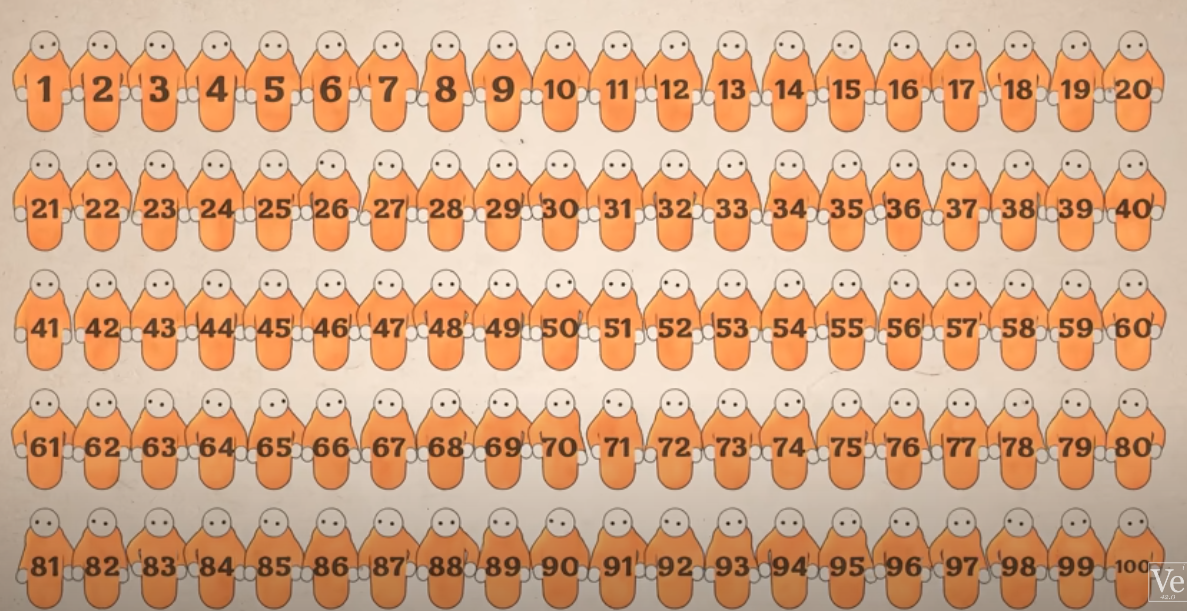
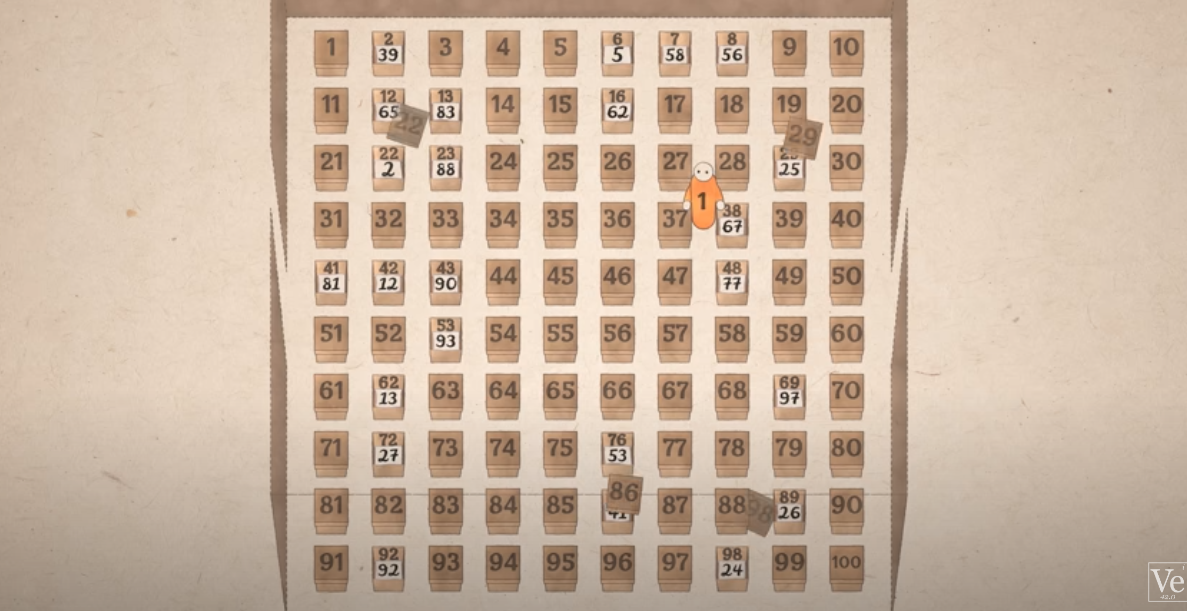
Consider the simpler problem with just 4 prisoners. There are 4 boxes, and the 4 boxes contain the numbers 1,2,3,4 in a random order. Each prisoner can open 2 boxes.
For prisoner 1, consider two schemes (call them scheme A and B). He can open boxes 1 and 2 (scheme A). Or he can open box 1 and then open the box that corresponds to the number he finds in box 1 (scheme B).
There are 4!=24 possible combinations of the numbers 1,2,3,4 that can be placed in boxes 1,2,3,4. There are 6 combinations where the number 1 is in box 1, as follows: (1,2,3,4 - 1,2,4,3 - 1,3,2,4 - 1,3,4,2 - 1,4,2,3 - 1,4,3,2). Similarly, there are 6 combinations where 2 is in box 1, 6 combinations where 3 is in box 1, and 6 where 4 is in box 1. Here are the combinations if 2 is in box 1 (2,1,3,4 - 2,1,4,3 - 2,3,1,4 - 2,3,4,1 - 2,4,1,3 - 2,4,3,1). Similarly when box 1 contains the number 3 and similarly when box 1 contains the number 4.
For scheme A, Prisoner 1 will be successful (find number 1) 6 times if the number 1 is in box 1, and 2 times when box 1 contains the number 2 but box 2 contains the number 1. And 2 times when box 1 contains the number 3 but box 2 contains the number 1 and 2 times when box 1 contains the number 4 but box 2 contains the number 1. So for scheme A, prisoner 1 will be successful 6+2+2+2 = 12 times.
It is easy to see that for scheme B, prisoner 1 will also be successful 6+2+2+2 =12 times. So to answer the question posed by Admin, there is no difference in this case for prisoner 1.