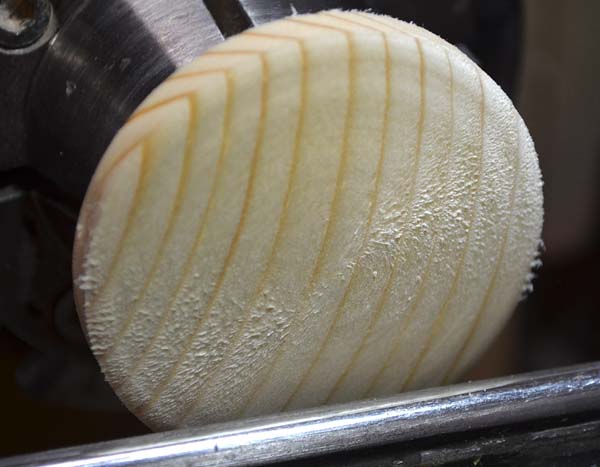
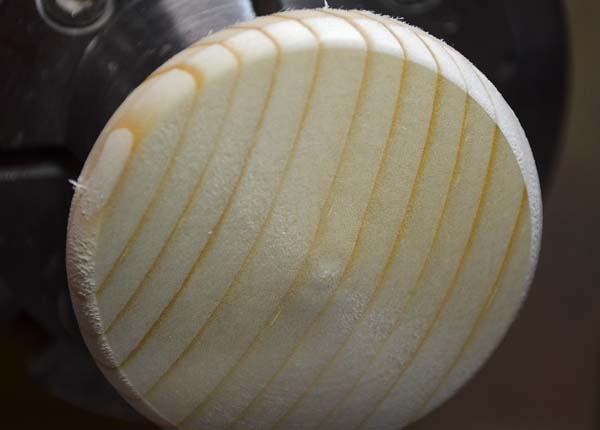
I was building a mock up for a new turning this morning. I was just using some crappy pine that really had a tendency to tearout. The first photo was done using a pull cut with my bowl gouge. The wings are much more acute than the tip and cut very cleanly on most woods. Especially when held with the handle very low so I had a steep sheer cut. As you can see it still left fuzzy tearout Easily sanded down on this wood but wanted to see how much cleaner my Mini Hercules would leave the surface. The bowl gouge had been sharpened earlier with not too many cuts done. The Mini Hercules has been used a lot for the past year with no cutter change. The bottom photo is doing a bevel rubbing push cut with the Mini Hercules. Much better.
I've had similar experiences. That's the reason I was pushing, er, telling the club about using the small Hercules on the "small squarish dished platters" - I got cleaner cuts with some woods, even when cutting uphill on the wings to eliminate chipping on the edges of the wings.
It would be interesting to compare the same cut on wood like that with the large Hercules (or Osprey). I haven't don't a careful test but my impression is the smaller diameter cutter cuts cleaner, perhaps because it's taking a smaller bite each rev.
John that's a bit misleading. Using a pull cut with one tool and a push cut with the other means you are literally reversing tool travel. As flat workers know when grain starts to tear the easiest solution is to turn the wood around or move tool in opposite direction.
If you do the same test again with the tool travelling in the same direction and get the same result then it's the tool not the motion.
That's the difference between scraping and cutting. John refers to a pull cut with the gouge, but the gouge bevel is not rubbing - its a variation on a scrape. Joe
The tool was traveling the same way on both cuts. On the pull cut the bowl gouge handle was down and the wood was crossing the wing at less than 45 degress which has proven to be a very clean cut for me. The pull cut was done from the center out. The push cut done by the Hercules was also from the center out so for all practical purposes the wood was crossing the cutting tip at very near the same angle. The wings on my bowl gouge are ground fairly acute. It is a Thompson V gouge with swept back wings.
Yes the bevel is rubbing. The pull cut is done with the handle down and the bevel on the wood, flute pointing toward me. This is not a scrape by a long stretch of the imagination. A scraping cut on this wood would have been really really nasty.
I'm not trying to mislead anyone. I try to make the cuts as close to similar as possible, more for my own information than than anything else. If a tool doesn't work I would tell you that also.
This has been an interesting and informative discussion, one which parallels my request to our Club Pres. to have a demo of these tools at a general meeting very soon. What I know about all this subject is Nothing and yet I have 2 tools (one I won) and they have never performed to my satisfaction. But then, I am an "old school guy" who still thinks scrapers have a critical role to play in the bottom of bowls, and on the sides, if you want to avoid a whole lot of sanding.
Yep. I have a number of hollowing tools. Have never had any great success with any of them. I know it's me, but nothing I try seems to work well. I can get the job done but it's never pleasant. LOL
First Drill out the center. It's so much easier than boring it out with a gouge or hollowing tool.
Use a sharp fairly small tool. I like either a Hunter #1 or 3/16" HSS cutter with a fresh grind. If you having to fight the cut, put a new fresh grind on. I like to put a slight negative rake on the top of the cutter and make sure the bevel below the cutter has enough relief to clear the wall when your cutting. Most of the time when people are fighting hollowing it's because the bevel is blunt. I like it about 70 degrees but it's not critical at all.
second. Don't cut straight across the grain or straight into it. If it's an end grain vessel put the tool into the center and pull it out at about 45 degrees. This is cutting with the grain and cuts a lot easier and with a lot less effort. I do like John Jordan taught in that I simply squeeze my left hand to make or 4 small cuts to the left moving the gouge a little deeper with each squeeze. This leaves a stair step that is easy to feel for the next pass. I hollow in stair steps from the lip down. so I make my 4 steps. Then make another set making this step wider. Then I move down and make another 4. Then move back up and make the first step wider, then the second step wider and now create a 3rd. Just keep doing that until you have reached the outer wall with the first step. Now you make bring the second step to the wall and then very gently drag the cutter up the wall to clean it up and get it to final thickness. Now you just keep going doing the same thing.
3 If you still don't have the wall even pull the tool from the bottom to the top as gently as possible. You just want to take off the tops of each uneven step. Sometime at this stage it's helpful to go to a cutter with a slightly longer edge.
Hollowing should not be difficult. I use the same technique as above with my capture bar rig. I just find it's easier with the captured bar but for smaller vessels I can have it hollowed by the time I get my captured bar set up. For deep vessels I find the captured bar systems are far easier and safer.
Learning to hollow on the Internet will not make it much more fun. Find someone to watch, then use their technique if you like it. It will cut months off your way to learning.
Sorry about that. The Hunter #1 comes in two styles and can be mounted in other peoples tools such as John Jordans or Lyle Jameison's, maybe David Ellsworths. Mike would be glad to answer your questions concerning if it will work in your tool shafts.
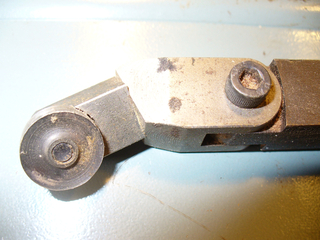
Should have been more clear. I have no trouble hollowing out boxes. It's bowls that I find a problem. I've got one that I think I SHOULD be able to set to get shavings but no matter how I set it I can't get a clean cut. Using brand new cutters I've tried adjusting the angle on the first link from straight through 90° and the angle on the cutting link from almost verticle to almost horizontal. I've got both a large one (picture) and a small one. No joy with either.
Maybe someone can tell me what I'm doing wrong. Or if this tool is hopeless, and what I sould try instead. I want to be able to get clean cuts while undercutting (sometimes pretty far) on a bowl. Here's a picture: