WoodCentral Forums

Est. 1998 — 27 years of woodworking knowledge

Question......

Posts

Question......

#1

Question......

roger lance

I'm not a turner.....but I have a lathe and I'm trying to become more competent on it.

So, I'm asking a much more knowledgeable group....How do I secure the head stock on this lathe from turning?? It does not have a specific feature built into the lathe that I'm aware of.....no mention of how to do this in the owners manual either.

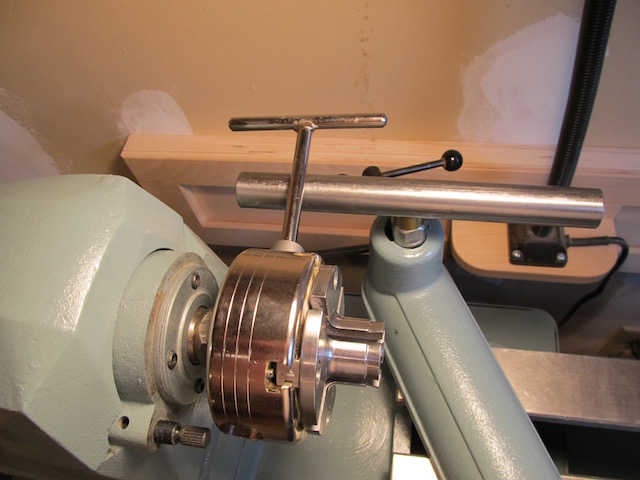
I've seen an interesting video by Mr. Beall who showed a method when using a spindle chuck......turn the bango/tool support around and use the chuck's tightening bar inserted in the chuck and resting on that backwards placed tool rest.....I've tried that.....it works.....but, I am curious if there is another way.

The lathe does have an indexing pin.....but this seems to flimsy to put much pressure on.....I fear that I'd only mess it up by depending on that to

stabilize the lathe spindle.

Re: Question......

#2

Jim Barbour

Re: Question......

Jim Barbour

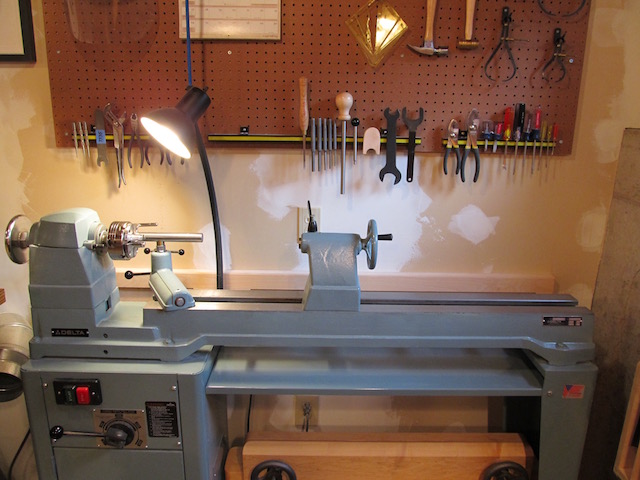
Since some lathes have a headstock that actually rotates for outboard turning, and this one does not appear to do so I am assuming you want to stop the spindle from rotating in the headstock, not the headstock itself rotating relative to the ways.

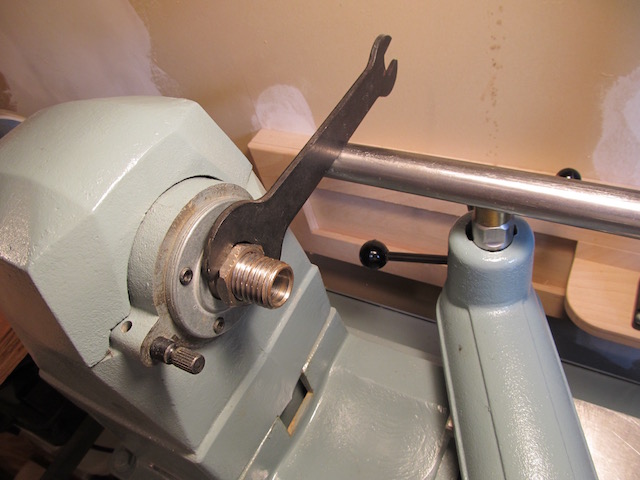
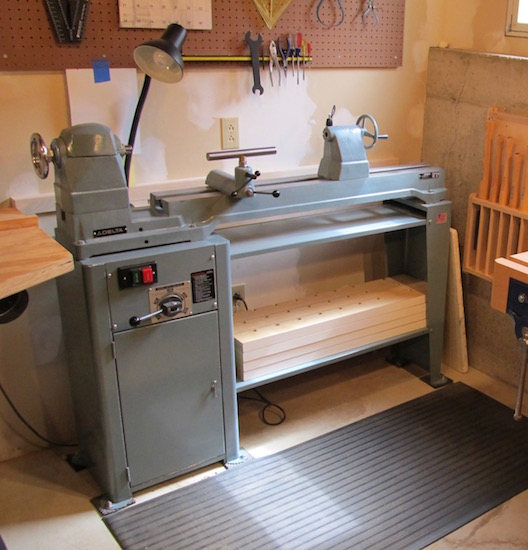
Many lathes have flats on the back end of the spindle and a dedicated wrench, like the one on the wall in your picture, to hold it while you remove a chuck. Others, mine among them, have a hole through the handwheel on the back end of the spindle through which a bar is inserted. On mine when I added a vacuum chuck I covered the hole and had to resort to other methods - yours may have such a hole under the handwheel.

One thing that will help keep chucks from seizing is to add a nylon washer between the chuck seat and the chuck itself. Others will point out that this will make the chuck to lathe contact less firm and thus less accurate in very small work, but many others will point out that they have never found a problem - probably due not working to the 10,000ths tolerance that some master turners attain. These washers are available from most dealers, or can simply be cut from an old milk jug or similar.

What is the make and model?

Re: Question......

#3

Re: Question......

John K Jordan

I'm not familiar with that lathe but if there is no device built in I might make a stop bar for the handwheel - if solid, drill a hole and hold with a pin on a bar (or a bent bar) and lever against the outboard end of the spindle.

JKJ

Re: Question......

#4

Re: Question......

David Walser

Roger -- I've not turned on that particular model of lathe. However, for many lathes of that era, you prevent the spindle from turning by use of a wrench. A spindle lock, like electronic variable speed control, became common a few decades after your lathe was made.

You say the lathe has an index wheel. For most purposes, that should suffice. My lathe's spindle lock is also its index wheel. Mine uses a spring-loaded steel pin to lock the spindle into one of 24 locations. The 1/4" diameter pin wouldn't be strong enough to stop the lathe if it were spinning full speed, but it's plenty strong to keep it from starting to spin! When someone forgets to unlock the spindle before turning the lathe one, all that happens is the belt starts to squeal -- very loudly! (I only know this because I've heard that squealing when others are using my lathe. I never forget to unlock the spindle. Honest. Would you believe hardly ever?)

Re: Question......

#5

Re: Question......

mikeee12345

What task are you trying to perform on the lathe?

If there is a problem you are encountering it might help if we have a better idea what the issue is.

I don't see a knockout rod hanging on the wall for your lathe.

Re: Question......

#6

Re: Question......

William Duffield

That's probably a Delta 12" gap bed Model 46-541P Wood Lathe.

Re: Question......

#7

more explanation......

roger lance

William is correct.....that is a Delta standard duty wood lathe....46-541....that does not enjoy much favor these days.....but, there were literally a million of them in their day.....mostly in school shops.

A more recent picture reveals that knockout bar Mikeee mentioned.....


This is the method that Mr. Beall demonstrated.....


And this is a similar method with a wrench that Jim and David spoke of.....


I'm just trying to find if there is some other way of doing this .....sometimes you need three hands and a more modern lathe eliminates this problem.

Re: Question......

#8

Are you trying to remove the chuck or index?

Dick Coers

The index pin is fine for the task of doing equally spaced work on bowls or spindles.

It is NOT appropriate, nor even designed, for removing the chuck or faceplates. Many have sheared off the pin attempting such a task. You must use the provided wrench.

That was the first lathe I owned. Once I found out what a real bowl turning lathe could be, I couldn't get rid of it fast enough. Noisy high maintenance reeves drive, and much too fast at the minimum speed for bowl work of much size. It is a fine example of vintage technology before turning became a wider endeavor of art and decorative turning. It's of the vintage where we didn't even have a scroll 4 jaw chuck. I'd even suggest it was in part a limiting factor for school children to produce much more than a small dog bowl style bowl. Nothing like the fear factor of turning a wet blank at 500 rpm on your first bowl!

Re: Question......

#9

Re: Are you trying to remove the chuck or index?

John K Jordan

>>>The index pin ... is NOT appropriate, nor even designed, for removing the chuck or faceplates. Many have sheared off the pin attempting such a task. You must use the provided wrench....


One guy with a new Grizzly lathe actually broke the headstock casting using the indexing pin as a spindle lock.

JKJ

Re: Question......

#10

Re: Are you trying to remove the chuck or index?

roger lance

Dick.....I'm happy for you that you were able to move on and get a real lathe.....but, this will work for me as I'm only doing spindle work and small turnings.....its just a cross I'll have to bare.

Re: Question......

#11

Re: Are you trying to remove the chuck or index?

roger lance

John.....I'm not using my index pin to lock-up the spindle.....indexing pins are only designed to index.

Re: Question......

#12

Re: more explanation......

David Walser

Roger -- My 1st lathe, the Harbor Freight #34706, doesn't have a spindle lock. It doesn't even have a hand wheel. To lock the spindle, I use a wrench. To make using the wrench easier, I made a "saddle" out of wood that fits in the "gap" between the headstock and the ways of the lathe's bed. The saddle fits over the bed of the lathe and holds the wrench in place. Typically, I leave the saddle in place as it generally doesn't get in the way when turning.

The saddle is constructed of plywood and is U-shaped. In use, the 'U' sits upside down on the bed of the lathe, in the gap and against the headstock. On the "bottom" of the U (the top-side in use), I've screwed a piece of 2x4 that was sized to fit into the wrench's open end and is tall enough to hold the wrench up against the spindle. To use, I simply slightly rotate the spindle to allow the wrench to slide onto the spindle while sliding over the 2x4 spline on the saddle. Quick and easy. The saddle locks the spindle fairly securely, but if need to use a lot of force, I support the wrench with one hand while applying force with the other. I hope my description makes sense.

Re: Question......

#13

Re: more explanation......

roger lance

David.....yes, your suggestion makes sense.....and also will work to secure the spindle from turning in both directions.

I'll have to give this some thought but I think you have offered a valid solution.

Thanks.

Re: Question......

#14

Have you explained why you want to stabilize?

Dick Coers

I guess I must have missed something here, but why are you trying to stabilize the spindle? You said it was not for taking off a chuck, but did you say why else? Sorry if I'm just a little slow here.

Re: Question......

#15

Leo Van Der Loo

Re: Question......

Leo Van Der Loo

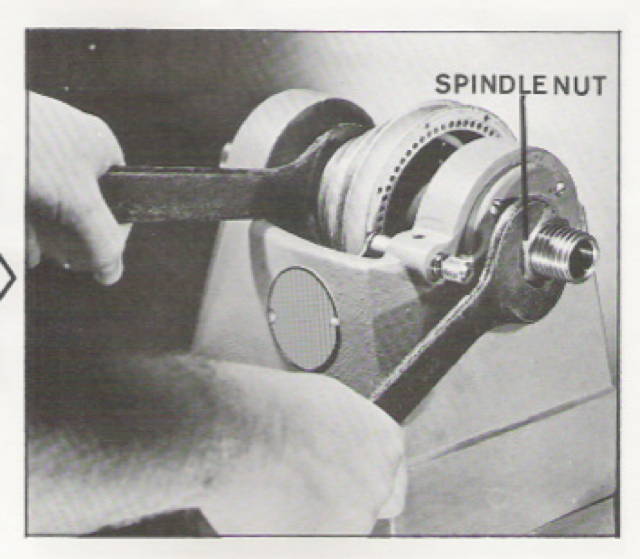
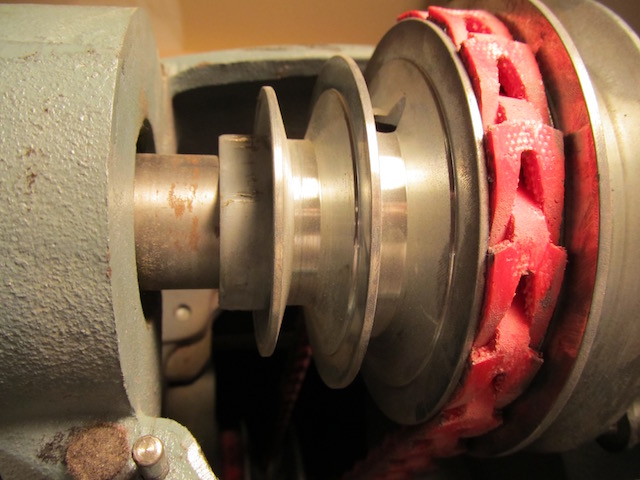
Those lathes do have a flat on the spindle behind the pulley, as in the picture.


Re: Question......

#16

Re: Are you trying to remove the chuck or index?

John K Jordan

>>>John.....I'm not using my index pin to lock-up the spindle.....indexing pins are only designed to index.


I didn't think so, but I mentioned that in case someone reading thought that might be a good idea. The thread from the fellow who broke his casting indicated the new Grizzly and perhaps some of the older models are designed it this way, I assume to save a few dollars. The gentleman wrote "According to my Manual they are indexing holes also used as a spindle lock." Some others in the thread proposed a solution to avoid this problem - use a different index hole on the casting with a little more metal around it. Yikes!

Do you think you will use the indexing? If so, I hope it's better than that on the Jet and Powermatic lathes - those are horrible! Not the least bit intuitive and the some of the angles I wanted were missing. Perhaps your lathe has better indexing. I bought an indexing wheel that fits on the spindle behind the chuck with many angles, all clearly labeled.

BTW, I always use a wrench to remove chucks. I've bought several used chucks and one was deformed from using a chuck key. Knowing this guy and seeing other damage to a second chuck from him, he probably used a cheater bar on everything. Or maybe he turned into the Hulk in his shop. :)

JKJ

Re: Question......

#17

Indexing mechanism......

roger lance

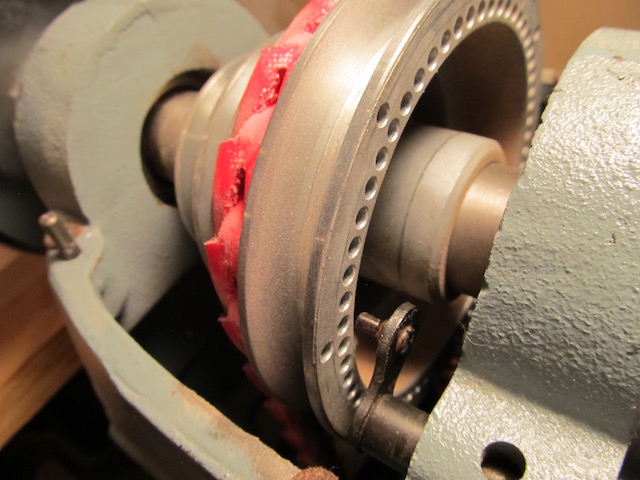
John.....I have not yet used this indexing feature.....I've not done any fluting on the lathe. But, the indexing wheel seems as though it would be usable: two rows of indexing holes.....one with 8 holes every 45*.....and the other with 60 holes every 6*.


Definitely, too flimsy for a reliable spindle lock.

Re: Question......

#18

The flat.....

roger lance

Leo.....that flat is part of the aluminum spindle pulley which is held in place by a set screw.....I wouldn't want to depend on that part to lock the spindle.


Your picture came from the owners manual.....maybe, you had/have a similar lathe.

Re: Question......

#19

Pretty sure they is a key in there.


Re: Question......

#20

Normal reasons.....

roger lance

Even in my limited turning experience, I've done things were it would have simplified life if I were able to lock the spindle from turning.

I'm assuming that most turners want to be able to lock their spindles from time to time as manufacturers have been incorporating that feature on more modern lathes.

Re: Question......

#21

That looks usable

John K Jordan

That might be limited on angles but sure would be easy to use. The design on the PM/Jet lathes has multiple holes in the side of the headstock and requires a secret code and handshake to use. Just for fun, look at page 27 in this manual:

content.jettools.com/assets/manuals/708359_man_EN.pdf

JKJ

Re: Question......

#22

Re: Question......

Lan Brady

Roger,

You have a very good(quality) machine. Only real difference to a new machine is the VF Drive. In reality, that is a convenience, not a necessity.

I am glad you asked questions rather than destroy your indexing system. With a little practice, your wrench and chuck key methods will become very easy. Good luck on your woodworking adventure.

Lan

Re: Question......

#23

Re: Question......

David Walser

I agree with Lan. This Delta model and similar Powermatic lathes from the same era are well made machines. If you're turning small projects or spindles, they are a good choice -- particularly if you upgrade to electronic speed control.

Dale Nish, the founder of Craft Supplies USA, had one of these lathes in his basement shop. He could have had any of the modern lathes, but he bought a quality used one from the local school district when they discontinued their shop classes. I asked him about it when he gave me a tour of his shop. (I was taking a class he was teaching at CSUSA and he'd invited all of us over to his house.) He said that for the small bird houses and ornaments he turned in his spare time, the old lathe was all he needed. And, if he wanted to turn something larger, he could always go to CSUSA. (Most of us don't have that option.)

Re: Question......

#24

Leo Van Der Loo

Re: The flat.....

Leo Van Der Loo

If you don’t trust the hold of the pulley, then you could use an outboard hand wheel, to hold the spindle from turning, a faceplate with a nice turned wooden disk would serve for that, for stubborn hold a hole drilled in the disk could have a metal rod inserted for more leveradge.

The faceplates for that lathe came with both left and right hand threads in them.

Re: Question......

#25

Re: Question......

roger lance

Thanks to Lan and David for your reassurance regarding this lathe. I happened to acquire it from a local tool company when they made a business move to discontinue selling small woodworking machines and rather concentrate on servicing the local commercial building firms (brilliant decision as this was perfectly timed before the commercial building explosion that occurred in Grand Rapids).

Over time, I bought a lot of Delta equipment. I got the lathe because they made me a very good deal. But, I had no prior experience with a lathe.....really, did not know what I was buying.....but, felt somewhat confident about this tool as there were so many in use.....especially in schools.

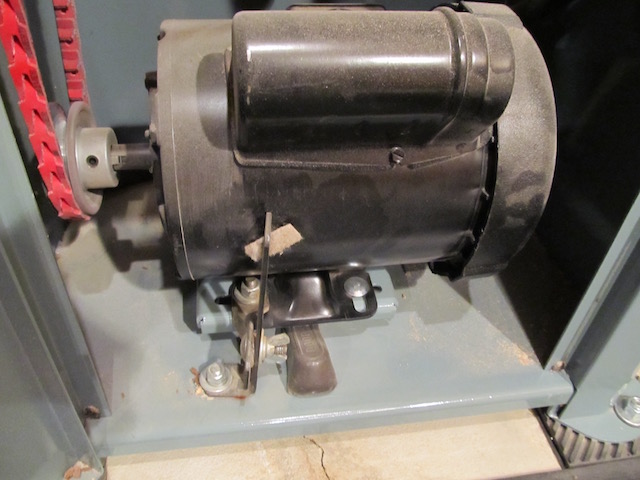
But, Dick was right.....this lathe was extremely loud when running.....so, I undertook to find ways to quit it down including sitting the lathe leveled on rubber spacers and then bolting it to the concrete floor.....and also placing a rubber door stop under the motor mount plate.....


which really quieted things considerably......can now have normal conversations and listened to the radio while working at the lathe.

👍 This page answered my questions

Your vote helps other woodworkers quickly find the answers and techniques that actually work in the shop.