WoodCentral Forums

Est. 1998 — 27 years of woodworking knowledge

Choosing a Hand Plane

Posts

Choosing a Hand Plane

#1

Alan Young

Choosing a Hand Plane

Alan Young

OK I've been here since 1998 or so....but mostly live on the main message board...here's the deal : my hand plane collection has never been too extensive and the kids are asking what I want for Christmas. I'm thinking of starting from the beginning-If you had to pic One Hand plane to *Start* your arsenal-what would you chose? Manufacturer/Size/Style- anything that causes you reach for that plane more often than the others- what would it be?

-Alan

Re: Choosing a Hand Plane

#2

Jack Guzman from Maine

Re: Choosing a Hand Plane

Jack Guzman from Maine

Alan,

It all depends on what you will be doing with it. A #5 jack plane is a very handy tool for many jobs. You can change the iron for different applications. A #7 is great if you want to do some jointing without a machine. Unless you have a good one a good quality block plane is a good place to start. Lie-nielsen and Lee Valley both have good ones. One other thing you could look at is a good finishing plane. A 4 1/2 or equivalent. It would help you learn to eliminate sandpaper for alot of finishing tasks.Enjoy---Jack

Re: Choosing a Hand Plane

#3

Re: Choosing a Hand Plane

Eric Kuehne

Hi Alan,

I'm going to go out on a limb and predict that virtually everyone will tell you to get either a 5 or a block plane. My thought (and I think a lot of the common wisdom) is that a 5 is arguably the most versatile of the bench planes. A 5 is pretty versatile for general planing tasks but can also be tuned to be a large smoother or a small jointer. Another option is to have a few blades for different tasks. You could have a dedicated smoothing blade and so on. Another option is to low angle or standard. Lots of choices and a tough question to answer.

I think the question you need to answer for yourself first is what do you want to do with it? Smooth, joint, dimension, milling?

I'm not trying to make a decision for you but rather pointing out some options and decision criteria.

Good luck in your hunt and welcome to the slippery slope. I'll be this won't be your last plane purchase.

Cheers,

Eric in Los Gatos

Re: Choosing a Hand Plane

#4

Re: Exercise in Futility!

William Duffield

Could you choose only one end mill for your milling machine, or one bit for your drill press?

For starters, you need at least five, and the lengths and widths you choose depend on the scale of the work you do. I would start with these, but if you can, you should try them out first, because you might want one larger or smaller:

5 Shoulder Plane: Veritas Medium [Small or Large] Shoulder Plane

4 Block Plane: either the Veritas low angle adjustable mouth block plane or the smaller L-N 102, whose mouth is not adjustable.

3 Jointer: L-N #7

2 Try Plane: L-N or Veritas Low Angle Bevel Up Jack

1 Smoother: Veritas Custom #4 [L-N #3 or Veritas #4-1/2] with standard 45° frog, traditional tote and low knob.

If you choose any of the Veritas planes, your first choice of blade should be PM-V11.

Re: Choosing a Hand Plane

#5

Re: Choosing a Hand Plane

TomD

In my case I would say a Japanese coarse plane, or a wooden Jack. But it all depends on the work you intend to do. Also, while I never make the "how much do you want to spend answer" In this case I would make an exceptions. Another very useful plane is a jointer. But it costs about 5 times a block.

Conventionally: block plane, smoother, jack or other plane that gets stuff happening quick like a scrub, and a jointer. If they want to do something fancy try a shoulder plane.

Re: Choosing a Hand Plane

#6

presumptious

Bill Tindall, E.Tn.

"For starters, you need at least five." While you need five who knows what others need. :| Depends on how you work. For example, in my case, admittedly off the reservation,........

5. The only thing I use a shoulder plane for is reducing the thickness of tenons because I can't saw them accurately. If I didn't have this need my shoulder plane would rarely be used.

4. Agree with the block plane but I have to admit I have never adjusted the mouth on it, ever.

3. If you own a power jointer #3 is useless. I have a 7 and have never used it for anything .

2. Try Plane: I don't have one nor have I seen any need for owning one.

1. Smoother: This might be a useful plane for those needing to smooth. But if sanding is not objectionable a smoother is of little value.

What I do use regularly is a "sizing plane". It could be your #1 plane in a #4 size. A "sizing plane" is used for removing small incremental amounts of wood from furniture parts so that they fit where ever they are supposed to fit. Personally I prefer a #5 for this task. My go to plane for sizing is a Bedrock #5. The only time I use a block plane is when the #5 won't fit. I have a #5 modified to be a scrub pane for the occasions where the shaving of the sizing plane is too dainty.

Re: Choosing a Hand Plane

#7

Agree....

John in NM

As I mentioned on the other side, when I worked for a production (mostly machine work) shop, I really only needed one plane, a 5 1/4 Stanley Handyman was the one.

Currently I most often grab the #5 for routine tasks, but do also use my homemade scrub, #4 and #7 as well as various block planes and shoulder planes. I could probably make do with just the 5, scrub, and 7 if I had to do so.

Re: Choosing a Hand Plane

#8

Disagree

Bill Houghton, Sebastopol, CA

The question was, what's the one plane I should have for starters. The old "introduction to woodworking" texts pretty consistently recommended a jack plane (No. 5 size) as the first plane.

I think it somewhat depends on how you envision using it. A block plane is so handy, it's hard to imagine not having one for easing or mildly chamfering edges, for trimming, for all kinds of uses. On the other hand, if you're thinking of using one to shape your work for those cases in which power tools just aren't right, then a No. 5 jack plane might be better.

My basic plane purchases were all used, so I can't report on new planes in these areas with anything but what I hear. There's fairly general agreement that Lie-Nielsen and Veritas (Lee Valley) are the champs here.

For a block plane, it's probably a toss-up between the LN adjustable mouth block plane and the Veritas basic planes - low angle in both cases. Some folks like the little ones, in which case, were it me, I'd go for the Veritas "apron plane."

As for a jack plane, I think Sir William Duffield is probably right: the Veritas custom plane, at a better price than Lie-Nielsen's equivalent plane.

Re: Choosing a Hand Plane

#9

Re: Choosing a Hand Plane

Hank Knight

Alan,

Your question is like asking what is the best flacor of ice cream. Everybody has a favorite and people seldom agree. If there is any consensus in the replies you have received, it's either a #5 jack or a block plane. Those two narrow the choices down to several dozen options. Again, everybody has their favorites. Mine are the Lie-Nielsen low angle Jack and the Lie-Nielsen #102 low angle block plane. Both of these planes are "general duty" planes rather than specialty planes that are limited to only one or two narrow applications. I use both of them for all kinds of things in my shop. I have a nice Bedrock standard #5 and several other block planes. I seldom use them, preferring instead the low angle Jack or the low angle little 102 block plane. Both planes are mechanically simple, easy to use and perform well in many situations. You wouldn't go wrong with either of these planes.

My $.02.

Hank

Re: Choosing a Hand Plane

#10

Re: presumptious

TomD

Smoothers and jointers are not useless if you have a power jointer, but it certainly makes a big difference on any tool purchase what you have in the shop overall. That said, not everyone can work that out before the purchases are in. In that case buying the basic tools is never a bad idea.

A lot of people today are using hand tools for a variety of reasons that do not include efficiency, though they can be efficient, but they want to use hand tools, quieter in some cases, less dust upstairs, connect with the past, whatever their reasons.

You can get by without a shoulder plane for sizing tenons, you just come across the tenon with a block plane, then you just come at the sliver left behind with a chisel. For occasional use I have often done that on large tenons.

A major factor on perceived utility is whether the person buying the planes has a real bench of whatever type. A real bench will move your planing from inefficient to efficient. All else equal.

Re: Choosing a Hand Plane

#11

Re: Choosing a Hand Plane

TomD

Chris Schwartz has who books on this stuff.

http://www.popularwoodworking.com/tools/understanding_bench_planes

http://www.popularwoodworking.com/woodworking-blogs/chris-schwarz-blog/handplanes-the-long-and-short-of-flat

http://woodandshop.com/woodworking-hand-tool-buying-guide-handplanes/

Bevel up planes are less popular these days than in some of that stuff.

Re: Choosing a Hand Plane

#12

Re: Choosing a Hand Plane

TomD

People's observations about the plane they could get by with if they only had one have three limitations:

1) we don't know what planes you already have entirely

2) The plane you can get by with in a particular shop is not the one plane you would have in another shop. Many cabinet shops have huge planers and jointers and tools like stroke sanders.

3) The efficient use of planes relies on having many types. Like more than a few.

Re: Choosing a Hand Plane

#13

Re: Choosing a Hand Plane

Joe shelton

The one plane which does the most for me, with the greatest ease, is the LN low angle jack.

The only problem with it is that it convinced me that planes are terrific tools, and that I needed more...

Re: Choosing a Hand Plane

#14

function begats form

Derek Cohen (in Perth, Australia)

OK I've been here since 1998 or so. Posted many pics over the years and learned So Much ...here's the deal: my hand plane collection has never been too extensive and the kids are asking what I want for Christmas. I'm thinking of starting from the beginning-If you had to pick One Hand plane to *Start* your arsenal-what would you chose? Manufacturer/Size/Style- anything that causes you reach for that plane more often than the others- what would it be

Hi Alan

Since you prepare your boards (getting them to size and flat) with machines, you are really looking at a couple of planes that will aid in tuning your work and/or finishing your work.

The type of tuning that planes do best is ...

1. chamfer edges (block plane)

2. square edges of boards and fine tune for length, such as drawer faces (shooting plane)

3. tweak the cheek of a tenon (I would not use a plane - I'd rather use a chisel or rasp. However, if I were using a plane, it would be a router plane)

4. chisel out hinge mortices (router plane)

5. smooth faces of boards (smoothing plane)

6. tune groove or dado width (side rabbet plane)

That should do for a start. I am ignoring dimensioning boards, such as with jack and jointer planes, since you use machines and just looking for a place to start.

Block Plane: my three of choice - LN #102, LN #60 1/2, Veritas DX60

Shooting plane: Veritas LA Jack. A wonderful BU plane that may be used for many tasks, such as a short jointer, but also as a plane on a shooting board. You will never look back.

router plane: Veritas Large Router Plane. Again, a very versatile plane, used for inlay, grooves, dados, mortice hinges, and tenon cheeks.

smoother: Veritas BU Smoother. There are many smoothers to choose from. However, I do not think that you are ready for the 911. Stick with the Golf. This is about easy-of-use and not about performance. The BUS performs as well as the best, and ideal for already-flat surfaces. The blade is the same as the Veritas LAJ, so can be swapped back-and-forth (BU planes use different bevel angles to create different cutting angles. Low angle for shooting and high angle for planing interlocked grain).

Side Rabbet Plane: LN #98/99

Re-posted from the Power Tool side.

Regards from Perth

Derek

Re: Choosing a Hand Plane

#15

Re: Choosing a Hand Plane

Jim Matthews

I do most of my planing with wooden body planes.

Cast iron quickly rusts in my basement shop.

While they're expensive, my favorite is thd ECE #711

they can be fiddly to set up at first but offer excellent control over depth of cut. The blades are excellent.

I like the similar size Veritas #4 among the current cast iton offerings.

You can manage a lot of tasks with either, when the blade is sharp.

Re: Choosing a Hand Plane

#16

Re: Choosing a Hand Plane

kim

The most versatile hand plane I've used is the LN #62 low angle jack. It can do everything from joinery to smoothing. As you need more performance in one particular area, say smoothing, you can continue using it for everything but while using your replacement for smoothing.

Kim

Re: Choosing a Hand Plane

#17

Alan Young

Re: Choosing a Hand Plane

Alan Young

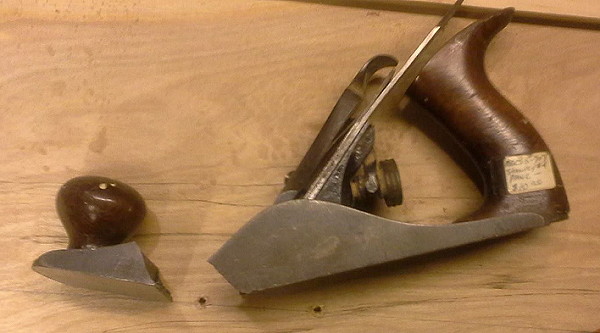
Thanks for all the comments! I realize this sort of question is in many ways unanswerable beyond "It depends..." My own usage of hand planes involves an old wooden antique smoothing plane-@18 in length, a Record #5 jack plane , an old No 4 1/2 Stanley Plane and a small unnamed block plane I picked up at an Upper Peninsula Michigan Home center last summer. About a month ago in a klutsy move I knocked the no 4 1/2 on the floor and destroyed it.


Till that point my main usage was the Record and the Stanley-I had the Stanley set to remove a slightly thicker shaving than the Record- My use is usually planing furniture joints or glue-ups as necessary- overall I don't do a lot of major surface planing-truth be told I just as often reach for a chisel-1/4 1/2 or 3/4 and "drag" it across surfaces as a scraper-Unconventional usage I suppose but I can See the material being removed and have developed a good feel for the pressure and angle required for these situations. This technique works especially well in smoothing inlays-after they have set but need the glue and slightly elevated height of inlay material removed and flattened to be level with the background surface. After reading these comments and doing some extra other searches I am convinced I could become a "plane guy" if I dedicated my budget and would soon wonder how I ever got along without some of the styles and sizes I don't have.

Re: Choosing a Hand Plane

#18

Re: Choosing a Hand Plane

John Pappas

Many good comments above....lots to think about. For what it is worth, you might find it interesting to watch Paul Sellers on UTube in some of his videos. His go-to plane is a Stanley #4. You will see him use it for everything.

Re: Choosing a Hand Plane

#19

An afterthought

Wiley Horne--So. Calif.

Hi Alan,

Terrible luck about that 4-1/2 :( . I suppose one option for you is just to get another 4-1/2, although the Stanley ones are pretty rare in good condition like yours was.

My stray thought: I think on every project I've done, there came a point where I needed a rebate plane. Maybe for dressing up a tenon cheek, or fitting cabinet doors which overlap in the center, or detailing the long tongues on a drawer bottom (when using slips), or for detailing a rebate in rails and stiles to accommodate glass and glass stops......the list goes on. You might compare this with your own experience.

Anyway. A large shoulder plane makes a usable all-purpose rebate plane. Yes, it's not the thing for heavy rebate work, because the shavings pile up in the escapement. But for detailing and trimming, it's great. I see advantage in getting a large, as it will do the medium's job as well as its own.

Wiley

Re: Choosing a Hand Plane

#20

Re: An afterthought

Derek Cohen (in Perth, Australia)

A large shoulder plane makes a usable all-purpose rebate plane. Yes, it's not the thing for heavy rebate work, because the shavings pile up in the escapement. But for detailing and trimming, it's great. I see advantage in getting a large, as it will do the medium's job as well as its own.

Hi Wiley

My take on the above. Just a difference preference set.

I have all three of the Veritas shoulder planes. The last one I acquired was the Large (1 1/4" wide), which I purchased on a visit to Canada 3 or 4 years ago.

I did so because I had heard the recommendations for so long, and decided I must be missing out. Well, it has sat on the shelf hardly touched in all this time. It is simply too large for anything practical - that is a personal statement, since I do prefer smaller planes with more feedback. Some use this size very successfully as an all rounder (that was my intention as well), planing cheeks as well as shoulders.

My preference is actually at the other end of the spectrum, the Small (1/2") shoulder plane. This is perfectly wide enough for shoulders, if you plane them (mostly I use a chisel). It is wide enough for most rebates. A better all round size is the Medium (3/4" wide), which you also agree on. For breadboard ends I use a filletster, and prefer a rabbet block plane (with a low centre of gravity) to fine tune over a wide Shoulder plane.

Regards from Perth

Derek

Re: Choosing a Hand Plane

#21

Shoulder planes

Brian Holcombe

I use a shoulder plane regularly....but almost never for the named purpose (shoulders) except on a rare occasion with very large shoulders if I screw up one of them (cut one slightly off from the other).

However useful I don't feel they are the plane I would consider for starting a collection.

I'd start with a #4 plane, likely LN or LV, whichever you prefer.

Re: Choosing a Hand Plane

#22

Re: Choosing a Hand Plane

Andy Lincoln, in Dearborn Mi

Alan,

You've gotten great advice from the other responses in this thread. WC always has the best answers and participation on many subjects. If you'd like to try and find a couple square feet of my shop and test drive some different planes I'm just down the road in Dearborn. I do have a ~couple ~ from Lie Nielsen,Lee Valley,Stanley,and others in various forms,shoulder planes,smoothers,block planes,etc . I could probably even arrange for you to say Hi to an old friend/former co-worker.

Re: Choosing a Hand Plane

#23

Alan Young

Thanks Andy! I sent you a Private e-mail


👍 This page answered my questions

Your vote helps other woodworkers quickly find the answers and techniques that actually work in the shop.