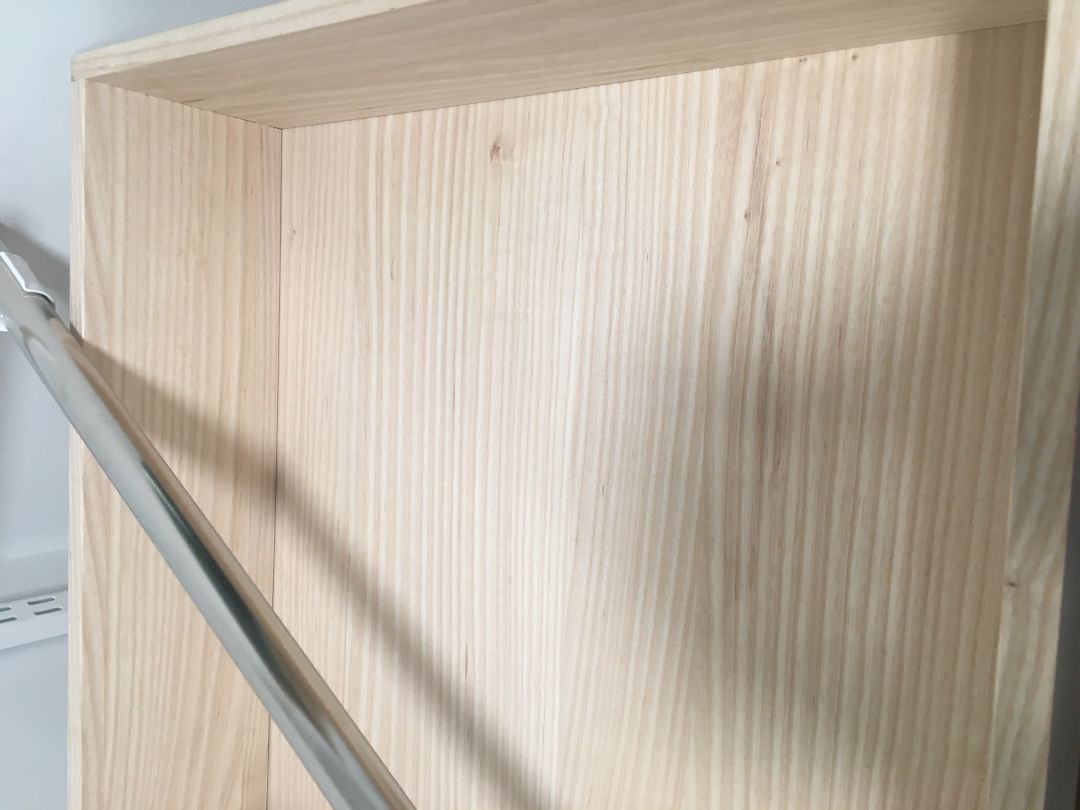
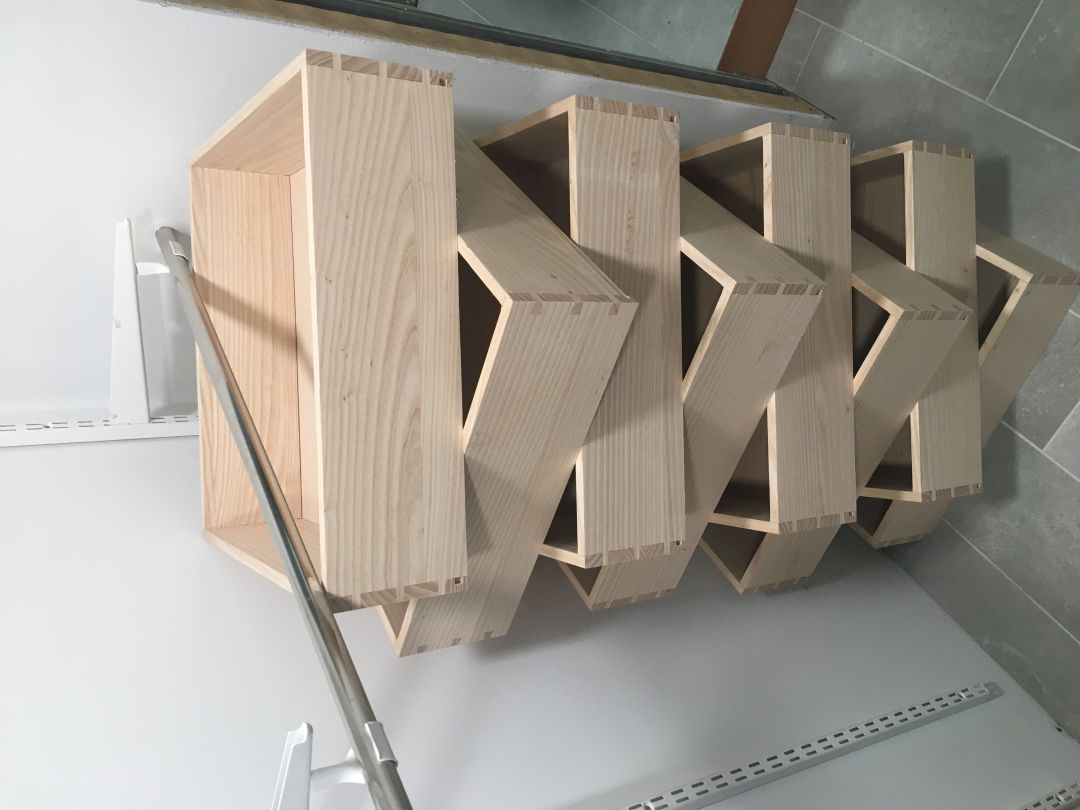
I haven't put a bottom panel in yet. These drawers are about 24 in. wide and 17 in. deep. Is 1/4 in. ply OK? Or should I spring for something thicker? The drawers are not meant for heavy stuff; still, I'm worried that the expanse is too much for 1/4.
Lay 3 boards on your workbench so that they have roughly the size of your drawer front and sides. Cut a panel out of 1/4" ply that is slightly larger than what you would use it in the drawer bottom (so that you can trim it to correct size if you do use 1/4"). Put that panel on top of the 3 boards and add weight to the center of the board. Pay attention to both sag and to how much the panel ends pull back. If you are okay with the amount of sag with your test weights and if that amount of weight would not pop the panel out of the rabbets, then you should be good with 1/4" without adding a support strip. Since there is so much variability in ply these days, be sure to do the test with the kind of ply that you would actually use (no offense, DAMHIKT).
I wouldn't see any problems using 1/4" plywood for a drawer of the size you mention. Since the bottom is plywood, I would enclose it on all four sides in the dado.
I once was the GC on a major home renovation (1m+). There was too much finish and built-in work for just my shop, so I hired various aspects out to other shops. One of them made a rather complicated built-in dresser, with drawer bottoms made of 1/4" plywood. They looked and performed well enough, but the customer *hated* the tinny sound and perceived lack of substance, so we swapped the bottoms out for 1/2" material. Problem solved.
If it were my cabinet, Eliot, I'd use at least 3/8" or 1/2" plywood and don't sweat the engineering. Shop cabinets often get heavy stuff loaded in them. Why try to go for the minimum thickness? What's the difference in cost? Would heavier stock have a negative impact on functionality?
Design is a funny thing. Every design should incorporate a safety factor, but that factor depends on a lot of variables. After you've built a lot of stuff, you develop an instinct for how much safety you need to build into a piece. If it's critical, you can figure it out to many decimal places. For my part, I find it more relaxing to overbuild things -- not dramatically, but safely.
There's a dance metaphor here, too, that pertains to woodworking nicely. You can learn to dance by following footprints on the floor, but once you hit your stride, you forget about the footprints and get into the zone. It's the difference between dancing and learning to dance. Sorry for the boring lecture.
I have 1/4" bottoms on the drawers of my shop cabinets, 24" and 28" wide. Since it's plywood, which is dimensionally stable, you can glue the plywood all the way around. Very strong, and that'll eliminate (I think) the tinny sound that Ellis warned about.
We often miss subtlety. Furniture with demuline features is intended to imply delicacy. However, it should not rattle or crush when you lean on it. It must contrast with its impression and be solid without showing the mass.
I constantly over design-build. It goes with the territory. If I were to put a chair designed for a weathered setting indoors it would be overwhelming. Ugly. The trick in separating exterior from interior design is mentally switching scale for appropriate fit. Because I do both exterior and interior work I am prone to exaggerate the mass, or lack of, in the products.
Who knows, Eliot, your benefactor might want to stack chisels, irons, and drill bits in your case drawers.
Eliot......building case goods......furniture......is not like spending an hour on the lathe and having a finished piece......I believe you are getting familiar with that reality......so, build it once and build it well......use good materials to begin with......over build it a little if in doubt.....¼" should be OK......but 3/8" will definitely be sufficient.....
Forget the soft redwood for the drawer fronts.......go get a nice quarter sawn board of a desirable hard wood and make all your fronts from that......you will not regret doing so.
What I'm amazed by is that you must have a very large collection of smaller hand tools that will fill eight drawers of the same smaller depth......
Re: Could use some advice, use quarter saw solid wood bottoms
I'm building a bathroom vanity that has drawers of similar size. In my case I used quarter sawn Ash 9/16" thick and used left over ash to make quarter sawn bottoms. Sold wood much stiffer than plywood and with quarter sawn bottoms expansion should not be problem. Ash came from tree cut down several years ago and quarter sawn on bandsaw.
I have a bunch of the redwood, and I thought because it is so soft that using it for my first half blinds would make things easier. Wrong! Perhaps I'll use it later for the small boxes that I make.
As for all the same size drawers, I have to admit that I just wanted to get on with it. But I do have a bunch of things I can put in them: things like marking gauges, calipers -- KERF MAKERS! They're all up in shelves or stuck on magnetic holders now.
And you're so right about turning: it's much faster; and-- I don't like to admit it--but I seem to have a better feeling for it that I do for this stuff.
Re: Could use some advice, use quarter saw solid wood bottoms
Those are cut using a Keller Dovetail jig set for tight fit and assembled with hide glue.� I typically set the jig up to make tails and pins slightly proud and trim flush.� The ash was too hard to trim with chisel so used hand plane with CPM M4 tool steel blade.� A blade you've seen before. If you index the Keller Jig all of the draw parts are interchangeable.�
Drawers will be installed into vanity with full extension Accuride slides with soft close feature.�
Ellis, your customer was a brother from another mother (or sister from another mister). I don’t know why, but I hear that same thing in so many wood drawers, and it irritates me. It’s also one of the reasons I don’t care for laminate/floating floors—the higher-pitched footfalls make it sound cheap and fake (which it is…). U.S. automakers knew this a long time ago when it came to car doors and the sound they make when they’re shut. Japanese and European automakers took much longer to figure it out for the vehicles they sell in the U.S.
You can almost feel the difference when you walk in an over-built house versus one that was built to code, but just barely (many builders strive to reach code, when it should be viewed as a minimum and a starting place, IMHO). Yes, if you’re building a $1B skyscraper, you need to value-engineer to meet both budget and structural concerns, but in a piece of furniture for personal use, what’s a couple extra bucks for some added gravitas?
I used redwood for the front of the first drawer, and most on this site have been advising me to use something less soft. I scored a bunch of the redwood free from a fellow in CT last summer.
I decided to take the advice offered here and reached for some different boards (that I recently also got free from a neighbor here in Maryland.) But as soon as I started cleaning up these boards, I saw that they are also redwood.
What's the chance of that happening?
Since the gods are clearly speaking to me, I'll do another drawer front in redwood and see if my skills improve on the half blinds. (The one I did doesn't look half bad anyway.)
If I were doing these I would use 1/4" Baltic Birch plywood. Five plies and vastly superior to the stuff you get at the big box store. I recently made some replacement drawers for kitchen cabinets and while not as big as yours, I glued them in all the way around and I will wager you could stand in them.
I have two shop cabinets with shallow drawers lager than yours and they have 1/4" bottoms of construction grade plywood and they have served me well for over forty years and they have way too many tools in them, some are very heavily loaded.
If they drawers sound tinny to you you can glue a strip or two across the bottom either of hardwood or plywood. and You can line the drawers with some of that thin rubber tool drawer padding. I would like it better if it were not black. You may also be able to find drawer liner material that has Anti-Rust treatment.
The tinny sound has never bothered me. I suspect it goes away when you load the drawer and even if it doesn't you will be placing your tools gently and not throwing them in.