
A WOODCENTRAL EXCLUSIVEAn editors tour of the Robland factory and the Belgian woodworking scene
by Ellis Walentine
When Torben Helshoj of Laguna Tools called me and asked whether I was interested in touring the Robland factory and some Belgian woodworking shops with a group of editors from the American woodworking press, I didn’t hesitate a moment—sure I’d go. I had the feeling it was going to be a good trip.

I had been through machinery manufacturing plants in the U.S. and the Far East in the past, and I was very interested to see how European factories compared. I had also written an article about combination machines in 1992 for American Woodworker and was anxious to see firsthand how these machines fit into their native European woodworking scene. What motivated their design? What kinds of woodworkers used them? What role does limited space play in the European woodworker’s decision to purchase a combination machine instead of separate specialized machines? Why haven’t these machines found greater acceptance in the United States?
During our five-day stay in Belgium, I found answers—or at least informed opinions—to most of my questions. I also found that Belgium produces some of the best food, beer and chocolates in the world.
Here—exclusively for WoodCentral visitors—is a recap of the trip in words and photos. I hope you enjoy it!
Arrival in Belgium

Our entourage consisted of eight woodworking editors, mostly from the trade press, along with Torben and Catherine Helshoj, the principals of Laguna Tools in Laguna Beach, CA, the sole North American importer of Robland equipment.
We rendezvoused early Wednesday morning at the Brussels airport, somewhat bleary-eyed after our long flights from various departure points in the U.S. A waiting van spirited us off to our hotel in the lovely medieval city of Bruges, some 100 km to the west. The ride, almost entirely on a six-lane divided highway, was harrowing, to say the least. Belgian drivers have elevated tailgating to the level of a fine art, swerving from lane to lane at speeds only Formula racers could love. After assuring ourselves that it was a good day to die, we managed to carry on some lively conversations, mostly gossip about woodworking magazines.

Upon our arrival at the hotel, we retired to our quarters for a couple hours of much-needed shuteye to try to shake off the jet lag. The rest of the afternoon was mainly spent walking around the picturesque old city, with its many canals, cobblestone streets, cathedrals and quaint Flemish architecture, dating back primarily to the fifteenth through eighteenth centuries. We tried valiantly if not altogether successfully not to spend all our hard-earned cash in the glitzy shops that line the main thoroughfares and tiny back streets of the city. Its truly a Christmas shoppers paradise, the air filled with faint strains of old Bing Crosby Christmas tunes.
Bruges in December


The Robland Tour
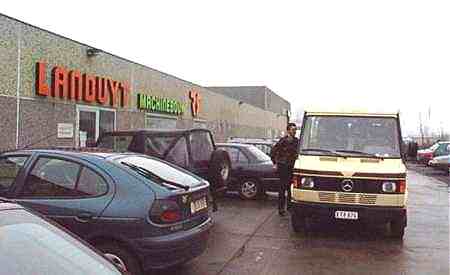
After an enormous continental breakfast buffet and vast quantities of delicious Belgian coffee, we boarded the van for the main event of the tripa tour of the Robland factory, located in an industrial area just a few miles from the center of town. Best known in the U.S. for its X31 five-function combination machine, Robland-Landuyt nv (the official name of the company) manufactures a variety of combination machines, tablesaws, shapers, industrial-duty panel saws, molding machines and dust collectors.
Founded in 1972, in a tiny 1,100-sq.ft. facility by the Robert Landuyt family of Bruges, Roblands initial mission was to manufacture combination machines for the hobby woodworking market. Their first years production totaled a mere 100 machines. Over the years, the company gradually added larger, professional woodworking machinery to the product line. This year, Robland will produce over 7000 machines including 5500 combination machines and their worldwide sales volume will exceed 704 million BEF (Belgian francs), or about $22 million. Their chief competitors include Felder, the Austrian high-end combination machine maker, and Altendorf, the German panel saw manufacturer.
Roblands manufacturing philosophy, as outlined by their sales director, Guido Blomme, has always been to acquire and use the latest technologies in their factory including CAD/CAM capabilities, CNC machining centers, laser cutters and other state-of-the-art metalworking equipment. According to Yves Damman, Roblands technical supervisor, the company prefers to manufacture almost all their parts in-house. The only parts purchased from outside vendors are motors, electrical controls, aluminum extrusions, and raw castings for machine beds and tables. This self-contained manufacturing approach helps to keep costs down, while ensuring tighter control over quality.

Another closely followed tenet at Robland, according to company officials, is the corporate belief in “over-engineering.” Robland machines are not lightweights, by any stretch of the imagination. The X31 combination machine, for example, tips the scales at over 1,100 lbs. Robland believes that the additional mass of extra-beefy table castings and heavy welded-steel bases helps to dampen vibrations and improve the quality of the cut. As a longtime fan of heavy old American machinery, I didnt need to be persuaded about the value of extra mass.


Combination Machines

One of the main reasons I came along on this trip was to see if I could find out why combination machines are apparently so popular in Europe, while they remain relatively scarce in America.
Combination machines are well-suited to small, one-man shops because they combine several major machines in a single chassis, making them more economical to buy and easier to fit into tight spaces like garages and basements.
American public opinion about combination machines, according to Guido Blomme, Robland’s sales manager, has been biased by what he terms the “Shopsmith phenomenon,” referring to the lathe-based “multi-purpose” machines manufactured by Shopsmith Inc., of Dayton, OH. Shopsmith has sold over a half-million of these machines in the course of the companys 51-year history, and countless thousands of Taiwanese knockoffs have also made their way into the shops of amateur American woodworkers, who are attracted by the prospect of getting up and running in a hurry and at a low price.
Shopsmiths, which operate off a single 1 1/8 HP motor, are lightweight machines compared with European-style, tablesaw-based machines. They require a fair amount of fiddling in order to convert from one function to another. In contrast, European combination machines, including the Robland X31, weigh over five times as much as a Shopsmith Mark V and are powered by as many as three 3-5 HP motors. Each function–tablesaw, shaper, jointer, planer, mortiser–is a heavy-duty, dedicated machine in itself, and changeover time is negligible.
We learned that there is a thriving population of hobbyist and part-time professional woodworkers in Belgium and, presumably, in other Western European countries as well. Generations of these hobbyists learned their woodworking on combination machines in the school systems, so they are used to the idea. Many do not sell enough of their work to justify the expense of separate woodworking machines, nor do they have the room in their homes or outbuildings for several dedicated machines, so “combo” combination machines are popular.

I had expected to find combination machines in larger shops as well; but, according to Ludo Leirens, a machinery dealer we visited in the village of Kalken, commercial shops in Europe are only interested in separate, larger machines. Apparently, as soon as there is more than one worker in the shop, combination machines become logistically outmoded. Professional woodworkers who own combination machines generally move up to separate machines–notably panel saws, line drilling machines and edgebanders–and reserve their combination machines for a single dedicated function, such as jointing or slot mortising. The same fate catches up with many Shopsmith machines in the U.S. as their owners advance to heavier-duty, individual machines.
Sneak Peek
6-in.-thick block of aluminum that was precision-cut with a specialized machine that uses a fine strand of electrified copper wire to cut effortlessly through thick metals, including steel, with better precision and surface quality than any other available method. Robland uses this machine to mock up sliding-table track sections for analysis before committing to expensive extrusion dies.

The E300 incorporates Robland’s latest product innovations, including an ingenious arbor-tilting mechanism that keeps the blade exactly centered in the table slot regardless of the tilt angle of the blade. (Sorry folks; they wouldn’t allow any photos of the mechanism.) The E300’s standard sliding table will have 5 ft. of travel, with an 8-ft. model optional. That’s a lot of capacity for a saw that is expected to retail for around $3,500, depending on the currency exchange rates.
Later in the year, E300-series combination models will be available as Robland adds a shaper, 16-in. jointer/planer and slot mortiser to the basic panel saw chassis.
Robland is betting that their new E300 series will gain quick acceptance among small-shop professionals, since its price point fits so neatly in the gap between standard cabinet saws with sliding-table attachments–which can cost $3,000 or more–and entry-level industrial panel saws (including Robland’s own top-of-the-line models) that begin at around $10,000.
Other Excursions

The balance of our trip was a whirlwind of short woodworking tours–cabinet factories, a coffin factory, a clock factory and several small woodworking shops–arranged by our hosts according to individual editors’ interests.
A high point of the tour was our visit to the Gilco tooling factory about 70 km northeast of Bruges. Gilco is a family-run toolmaking plant that produces the cutterheads that ship with Robland combination machines and shapers. Up-to-date CNC machining technology combines with old-fashioned skilled machining and a strong engineering background combine to make Gilco an ambitious and competent company, ready to meet the demands of the European and international tooling markets. While there, we witnessed the creation from scratch of large cutterheads for industrial planers and molders, often produced on short notice from mere sketches or sample profiles. Gilco also runs a sharpening service that sharpens cutters and blades for many shops and factories in northern Europe. Gilco family members joined forces with the Robland team to usher us around to the various plants and shops on our itinerary. We appreciated their good-natured and gracious hospitality.
For me, the tour was a welcome opportunity to see firsthand a sampling of the range of woodworking in Western Europe–from large factories that churn out a thousand cabinets a day to tiny backyard shops that might work on one kitchen for several weeks. Evident throughout was the European affinity for 32-mm cabinet construction and all the machinery that goes along with it. The equipment, not surprisingly, was mostly Italian, although most of the panel saws I encountered were Altendorfs.
Going hand-in-hand with 32-mm cabinet construction was the predominance of manufactured materials, due largely to the scarcity and high cost of raw lumber in Europe. Particleboard, plywood, melamine board (MCP) and high-pressure laminate were the materials we encountered most often, with solid wood reserved mostly for doors, edging and moldings. Conspicuously absent were the hand tools–planes, chisels, handsaws, etc.–that we’ve come to associate with wood craftsmanship in the U.S. I’m sure there are plenty of these “Old World” craftsmen out there, but they seem to be taking a back seat to the march of progress.
Now that our tour is behind us, I’d like to express my appreciation to Torben and Catherine Helshoj, Guido Blomme, Jean-Pierre Gilen and his family of Gilco, and all the other folks who planned our trip and made it so memorable. To their great credit, they understand the importance of sharing information about their products and processes with the woodworking press.
. . . Ellis Walentine
December 22, 1998


Same article in its original form now part of our Archive:
https://www.woodcentral.com/articles/00-tooling.php