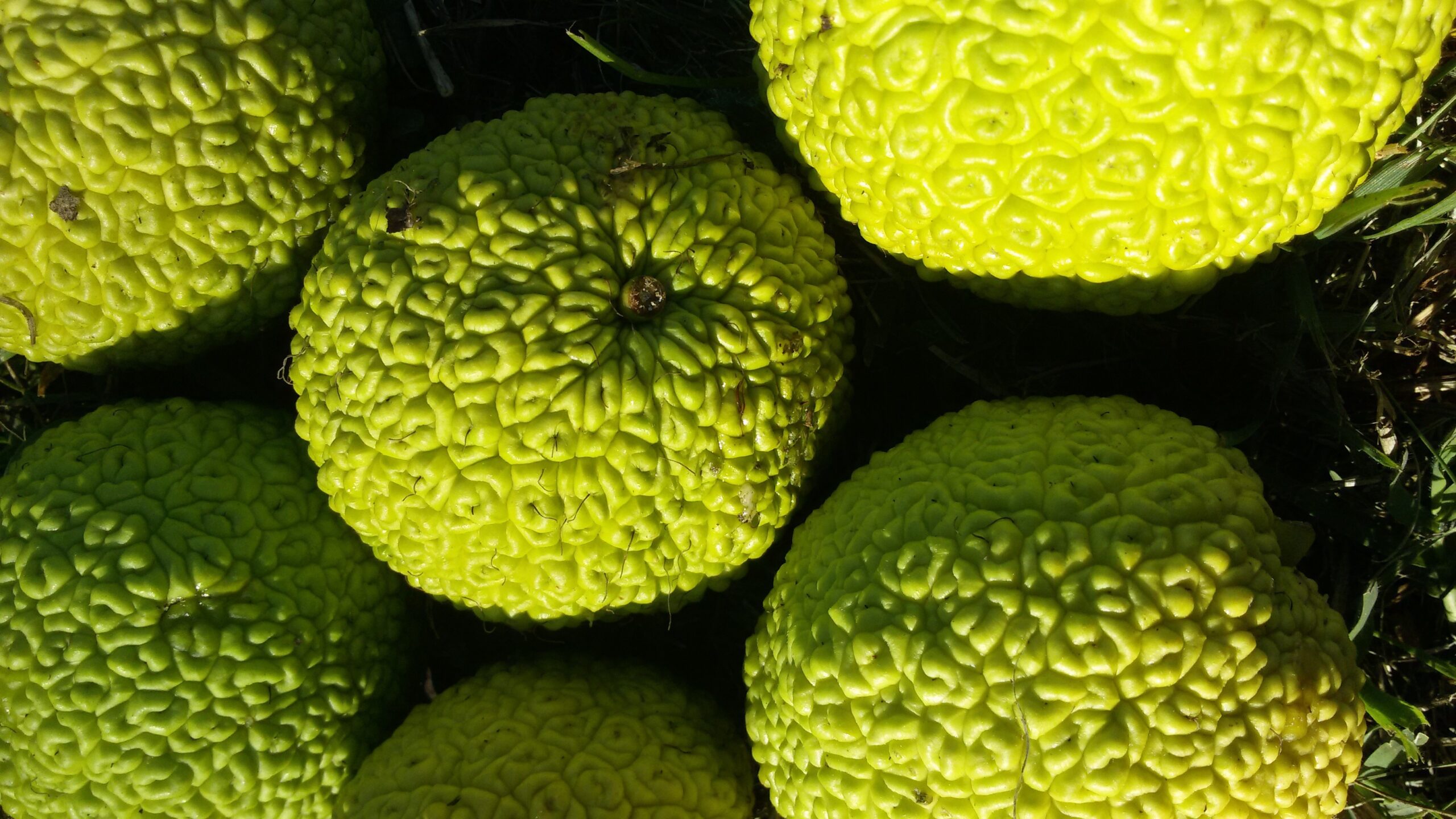
Here are some of the most interesting facts about Osage Orange (Maclura pomifera), along with how it’s used today and historically.
Fascinating facts
- Not an orange and not from Osage County
Its common name is misleading. The large, bumpy green fruit looks like a brain-shaped orange, but it’s actually in the mulberry family. It’s named after the Osage Native American tribe, who prized the wood. - The “hedge apple” myth
People still put the fruit in basements and garages believing it repels spiders and insects. Science says it doesn’t work — the fruit has almost no insect-repelling effect when whole. The chemicals that do have some effect are only released when the fruit is crushed or chemically extracted. - One of the hardest and densest woods in North America
It ranks among the very top in Janka hardness (around 2,040 lbf). It’s heavier than white oak or hickory and is extremely resistant to rot and insects. - Prehistoric horses and mammoths loved it
The huge fruit (up to 6″ diameter) is thought to have evolved to be eaten by giant Ice-Age mammals that are now extinct. Modern animals generally won’t eat it, which is why the fruit just piles up under the tree. - It bleeds latex and turns bright yellow
When freshly cut, the wood and fruit both exude a sticky white latex. The heartwood is a brilliant, glowing golden-yellow that darkens to a rich chocolate brown with age and UV exposure. - It was Thomas Jefferson’s favorite tree
Jefferson planted it at Monticello and promoted it widely.
Historical uses
- The ultimate bow wood
Before European contact, Osage Orange was the premier bow wood for many Plains tribes. A well-made Osage bow was so prized that it was worth a horse or even several horses in trade. Many experts still consider it the best bow wood native to North America — better than yew in many ways. - Living fences (the original barbed wire)
In the 1800s, before barbed wire was invented, farmers planted Osage Orange in tight rows and pruned it into an impenetrable, thorny hedge. These “living fences” were so effective that thousands of miles were planted across the Midwest. You can still find old Osage hedgerows on abandoned farmsteads today. - Dye wood
It produces a strong, light-fast yellow to gold dye that was used for wool and leather.
Modern woodworking uses
Because of its incredible density, stability, and striking color, Osage Orange is highly sought after by woodworkers:
- Tool handles – Axes, hammers, and mallets (extremely shock-resistant)
- Turning – Pens, bowls, knife handles, and bottle stoppers (turns beautifully and takes a high polish)
- Fine furniture – Especially accents, inlays, and small boxes
- Archery – Traditional self-bows and laminated bows
- Outdoor projects – Fence posts, decking, and any application where rot resistance is critical (it outlasts treated pine in ground contact)
Working tips for woodworkers:
- It is very hard — pre-drill everything.
- It can be brittle across the grain, so sharp tools and light cuts are essential.
- The dust can be irritating to some people.
- It finishes beautifully with oil (it “pops” the yellow dramatically) but can darken a lot with UV exposure.
Fun woodworking fact:
A freshly cut piece of Osage Orange can be so bright yellow that some people mistake it for Osage Orange “candy” when they first see it. Within a few months in sunlight it usually turns a deep, rich brown — giving you two completely different looks from the same board!


