Copenhagen’s last working shipyard has built its first public building, with Krohns Bådbyggeri applying the same timber slipway techniques once used to launch Royal Danish Navy ships to a 230-square-metre floating Douglas fir community space designed by Arcgency and MAST at the artificial island of Christiansholm.
That is according to Mads Møller, founder of Copenhagen studio Arcgency, who revealed that the project was designed to belong to the water. Bedding 1 is the first of three floating timber buildings planned for the canal-side development locally known as Papirøen, or Paper Island, with two further structures, a network of piers and a floating garden to follow under Cobe’s masterplan.
Anchored in the Arsenalgraven canal where the Royal Danish Naval Shipyard once stood, Bedding 1’s angular Douglas fir frame echoes the timber slipways once used to launch new ships from the site. Wood Central understands that Krohns Bådbyggeri remains the last active shipyard in central Copenhagen, carrying the construction work for Bedding 1 using techniques drawn from the same Danish shipbuilding tradition.
Angular Douglas fir supports flanking Bedding 1’s long sides, referencing the slipway scaffolding once used to ease new ships into the Arsenalgraven canal. (Photo Credit: Edith Sahlberg Gruvander)
“Bedding 1 was conceived as something that belongs to the water,” Møller said.
Organised across two storeys totalling 230 square metres, the upper deck is level with the quayside and houses a single flexible community space designed to host events and gatherings. A metal staircase from the quay descends to the lower level, where two apartments provide accommodation for guests of the island’s residents and open onto a covered timber terrace with mooring for boats and kayaks.
Bedding 1 moored beside the Paper Island redevelopment in the Arsenalgraven canal, Copenhagen — the angular Douglas fir frame on the long sides directly references the timber slipways once used to launch ships from the Royal Danish Naval Shipyard, parts of which formerly occupied the site. (Photo Credit: Edith Sahlberg Gruvander)
Framing the long sides of the structure, angular Douglas fir supports recall the slipway scaffolding historically used to ease ships into the water, with the cabin-like building pulled back behind them and clad in horizontal Douglas fir planks for privacy. White walls and pale timber carpentry fill the interior, with large windows framing views of the surrounding canal and the Paper Island development beyond.
Bedding 1’s upper deck holds a single flexible community space designed for events and gatherings, with windows framing views to Christiansholm and the wider Paper Island development. (Photo Credit: Edith Sahlberg Gruvander)
Cobe developed the masterplan for the Paper Island redevelopment, with Bedding 1 anchoring a wider canal-side scheme that will eventually include two further floating buildings, a network of piers and a floating garden. The Christiansholm work follows a wider Copenhagen push into timber neighbourhoods, with the Danish capital advancing all-timber housing and public space schemes as part of a citywide low-carbon construction agenda.
A covered Douglas fir walkway runs the length of Bedding 1’s lower level, where two guest apartments open onto a terrace with mooring for boats and kayaks. (Photo Credit: Edith Sahlberg Gruvander)
It comes as MAST’s floating residential masterplan for a disused Rotterdam dock advances through the Dutch planning system, with the Danish studio targeting 100 cross-laminated timber homes in the Spoorweghaven basin, which would become Europe’s largest floating housing district. The Copenhagen and Rotterdam projects mark a growing northern European turn toward timber as the material of choice for canal-side civic and residential architecture.
As some MAY remember, years ago, the house next to me got rented out to some not so great renters, and I became very security focused after things started walking away...
Well fast forward to this past month and my oldest brother gifted me his now orphaned Wyze Pan Cam V3s. He went with a camera setup that doesn't have a subscription even though the Wyze subscription is relatively inexpenisve...
So between the gifted Wyze Cam Pan v3 that has auto tracking / pan / tilt, I also set up my Wyze Cam V3 that had been previously watching my fence line in the side of the house, now replaced with a Wyze Cam Battery with solar panel (had problems sourcing power for the cams without solar...).
Mind you I live in a decent neighborhood, but that's the problem. Thieves etc... from out of the area tend to stalk neighborhoods like mine since the PD that recognizes them is 2 towns away.
I hate th contribute to a surveillance state, but I can limit the monitoring range to the edge of my property. So since I am the one monitoring IN and ON my property, we should be good to go.
I have a couple of Ring devices left. A Ring Spotlight Cam wired, a Ring Doorbell cam, and a Ring Floodlight cam. I am trying to get off of Ring as the lag between event and notification is huge, like 30 seconds... WIth the Wyze it is almost instantaneous...
I have the Wyze floodlight cam to replace the ring that is basically the motion activated floodlight fixture typically seen in backyards and driveways but with a camera.
So to protect the shop itself I have the following coverage.
1 cam in the rear of the shop pointing toward the roll up doors
1 cam in the front of the shop pointing to the man door from the house.
1 cam outside down the driveway between the roll up doors.
Door contact sensors at each door
85db siren
Security keypad.
It stinks when the behavior of others makes you have to take security steps like this...
An open-air mass timber theatre carrying 475 seats under a curved glulam grid shell has been completed in Garrison, New York for Hudson Valley Shakespeare, with Studio Gang’s Samuel H. Scripps Theater Center targeting LEED Platinum as a first for a purpose-built US theatre.
The 14,850 square foot (1,380 square metre) venue establishes Hudson Valley Shakespeare’s first permanent home, replacing 39 years of seasonal productions inside a tent at the nearby Boscobel House and Gardens after construction began on the new site in October 2024. Bringing actors, audiences and back-of-house together under one roof for the first time, the building also extends the company’s performance season beyond what the seasonal tent could accommodate.
The timber-framed grid shell, a single sweeping canopy supported on prefabricated A-frame timber columns, was engineered by Thornton Tomasetti with mass timber design assistance from Quebec-based fabricator Art Massif and built by construction manager Consigli, which has delivered more than 20 cross-laminated timber and glulam projects across the Northeast US. The concentric glulam geometry shelters the auditorium without enclosing it, with the proscenium arch beneath framing direct views across the Hudson River towards Storm King Mountain, Snake Hill and Breakneck Ridge.
Prefabricated A-frame timber columns carry the curved glulam grid shell over the auditorium, with the catwalks, rigging and lighting infrastructure suspended from the underside. (Photo Credit: Jason O’Rear)
Targeting LEED Platinum, the Samuel H. Scripps Theater Center will be the first purpose-built theatre in the United States to achieve the rating, with mass timber and material strategies cutting Global Warming Potential by 24 per cent and passive design and active systems reducing overall energy use by 50 per cent against the standard baseline. Rainwater reuse and efficient fixtures cut water consumption by 78 per cent, with rooftop photovoltaic panels supplying roughly 10 per cent of the building’s energy load.
Studio Gang’s environmental strategy delivers measurable reductions in global warming potential, energy use, and water consumption, with mass timber, photovoltaic panels, and rainwater reuse anchoring the LEED Platinum target. (Image: Studio Gang)
The wood structure replaced what the design team had originally explored as a tensile fabric tent, with Studio Gang rejecting that path on embodied-carbon grounds before iterating towards the timber frame that now defines the building. “We thought it could be a sort of tent,” Gang told Architectural Record.
Founded in 1987 and previously known as the Hudson Valley Shakespeare Festival, the theatre company relocated to the 98-acre Garrison site in 2022 on land conveyed by philanthropist and conservationist Christopher Davis. Support pavilions clad in yakisugi, a charred Japanese cedar, house the rehearsal studios, dressing rooms, offices and concessions that the company has never previously had under a permanent roof.
The landscape transition has been led by Nelson Byrd Woltz, whose Senior Principal, Thomas Woltz, has overseen the rewilding of the former golf course into native meadow and wetland habitat across nearly 14 acres of new planting and 250 native or adaptive trees. “Our design celebrates the natural beauty of this extraordinary site,” Woltz said.
The Samuel H. Scripps Theater Center sits on the rewilded 98-acre Garrison site, with Studio Gang’s curved mass timber roof rising above the yakisugi-clad support pavilions and the Hudson Highlands visible across the river. (Photo Credit: Jason O’Rear)
The opening season at the Samuel H. Scripps Theater Center runs from June to September 2026 with a production of King Lear, with Hudson Valley Shakespeare publicly committed to carbon neutrality by 2040 across the full 98-acre campus.
Six of Australia’s most awarded architectural practices have used American red oak, cherry and maple to design heirloom-quality furniture as a direct challenge to disposable design culture, with the resulting works unveiled today at Cult Design’s Abbotsford showroom for the opening of Melbourne Design Week. KEEP: Forever Objects Designed by Six Australian Architects runs at Cult until 8 June 2026, following the show’s 2025 Sydney launch.
The exhibition has been curated by former Vogue Living Australia editor-in-chief David Clark, and is presented by the American Hardwood Export Council (AHEC) in partnership with Melbourne furniture retailer Cult Design and Evostyle. Clark has commissioned new works from Edition Office, Kennedy Nolan, Lineburg Wang, Neil Durbach, Richards Stanisich with Meg Ashforth, and Virginia Kerridge — with each practice asked to translate its spatial thinking into the intimate scale of furniture, working only with red oak, cherry or maple.
The Melbourne run is the second Australian staging of KEEP after the show’s 2025 Sydney debut, and the latest move in a design-sector campaign AHEC has run across more than 50 international markets over three decades. The trade body represents thousands of American producers — from family-run sawmills to major flooring manufacturers — and has promoted more than 20 commercially available hardwood species to designers, architects and furniture makers worldwide.
KEEP pieces range from sculptural seating and tables to lighting and experimental objects — each translating an architect’s spatial thinking into the intimate scale of furniture. (Photo Credit: Graham Alderton, supplied by AHEC)
The resulting KEEP pieces range from sculptural seating and tables to lighting and experimental objects. Each work has been positioned as a direct challenge to throwaway furniture culture, asking what makes an object worth keeping.
“Historically, and in other places, it is more commonplace for architects to design furniture, for their own projects or for companies by commission,” Clark said. “In the nascent Australian furniture industry, it is less so.”
He said the exhibition is designed to test what Australia’s most accomplished practitioners might produce outside their usual spatial brief. “I thought it would be interesting to see what prominent and successful architects might design outside their usual focus, and perhaps, in the process and conversation, what they might bring to the texture and layers of the Australian design ecosystem,” Clark said.
Among the line-up is Brisbane practice Lineburg Wang, established by Michael Lineburg and Lynn Wang in 2018. The studio took out the AIA Queensland Architecture Medallion in 2023 and the Eleanor Cullis-Hill Award at the AIA National Awards in 2024 — placing it among the youngest practices in the show.
Each architect commissioned for KEEP has worked exclusively in American red oak, cherry or maple — translating spatial thinking into the intimate scale of furniture. (Photo Credit: Graham Alderton, supplied by AHEC)
The three timber species at the heart of KEEP — red oak, cherry and maple — were selected for their performance, expressive qualities and environmental credentials. According to U.S. Forest Service Forest Inventory and Analysis data published by AHEC, American red oak grows at 60.6 million cubic metres a year against a harvest of 31.9 million, lifting net standing volume by 28.7 million cubic metres annually.
Cherry adds 5.4 million cubic metres of net volume each year, and soft maple adds 20.4 million. Each of the three species featured in the show is part of a forest resource where annual growth significantly exceeds harvest — the sustainability framing that has anchored AHEC’s design-sector messaging in Australia and globally for more than a decade.
“KEEP is a reminder that the things we choose to live with can carry meaning and memory,” said Rod Wiles, Regional Director of the American Hardwood Export Council. “These works are made to endure, not just in use, but in the stories they can hold.”
Installed at Cult Design’s Abbotsford showroom at 16–28 Duke Street, KEEP invites Melbourne Design Week audiences to slow down and consider the value of the objects they choose to live with. The Design Week programme runs from today until 23 May, with the exhibition continuing for a further two weeks at Cult until 8 June 2026.
The show’s central premise — that an object’s worth lies in how long it can be kept — finds a thematic echo in the descriptor that Melbourne practice Kennedy Nolan uses for its own architectural work: creating enduring settings for life. For more on the exhibition and the species featured, visit americanhardwood.org or follow @ahec_anz.
A new 22-storey mass timber pod hotel could rise opposite Vancouver’s Law Courts, with local developer 1517856 B.C. Ltd. and Unison Architecture Ltd. filing a rezoning application for the 408-unit project at 948 Howe Street. That is according to the rezoning submission lodged with the City of Vancouver, which describes the proposal as a “high density lodging concept” combining “nano pods” and “nano rooms” on a 7.6-metre by 36.6-metre downtown site.
The development team is targeting budget-conscious urban travellers — specifically the 18- to 34-year-old demographic — who favour central location, digital connectivity and social experiences over conventional room size, although the submission stops short of disclosing potential room rates. Concrete, steel and mass timber make up the structural mix across the narrow Howe Street lot, with Unison Architecture targeting a late 2028 or early 2029 opening window.
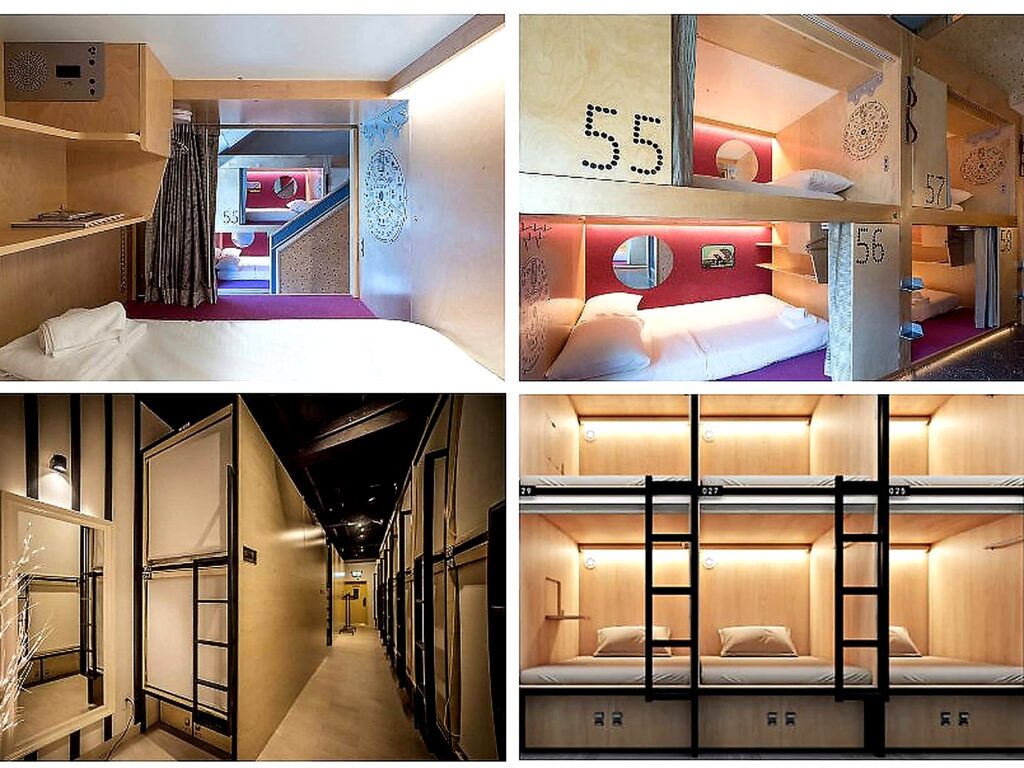
Each nano pod provides a private sleeping capsule of roughly 3 square metres, fitted with a standard door, integrated lighting and ventilation, a secure lock, a reclining bed, and under-bed luggage storage. Pod guests share washroom and shower facilities on each floor, whilst the fully enclosed nano rooms stretch to roughly 10 square metres of climate-controlled space, with sound isolation, secure storage and digital amenities.
Whistler and Richmond pod hotel interiors — the British Columbia precedents Unison Architecture has drawn on for the 408-unit Howe Street proposal, with the format already established across parts of Asia, Europe and the United States. (Photo Credit: Unison Architecture)
A sky reception area offering elevated city views sits alongside a sky bar open to the public, and guests will enter from Howe Street to complete app-based self-check-in and check-out. The design omits guest parking entirely, instead leaning on the Granville Entertainment District’s existing transit connections.
Royce Chwin, president and chief executive officer of Destination Vancouver, has written a letter of support for the application and urged faster approvals for additional pod hotels in the downtown core. “It aligns with broader goals to add new hotel capacity,” Chwin wrote, with the submission describing the development team’s intent as transforming an underutilised orphaned site through the nano-pod and nano-room format.
The application follows a May 2024 Vancouver City Council motion, moved by councillors Sarah Kirby-Yung and Lisa Dominato, encouraging the development of pod hotels as a response to the city’s hotel shortage. Council subsequently adopted a hotel policy in 2025 targeting approximately 10,000 new hotel rooms in Vancouver by 2050, with the broader goal of supporting the city’s tourism economy alongside its film, technology and life sciences sectors.
Whistler and Richmond already operate pod hotel concepts in British Columbia, drawing on a typology that has grown rapidly across Asia, Europe and parts of the United States. Destination Vancouver estimated in 2022 that the city needs an additional 10,000 hotel rooms between 2023 and 2050, and the development team argues the nano-pod and nano-room format addresses that gap on otherwise underutilised sites.
The public period on the 948 Howe Street rezoning application closes Tuesday, 19 May. A late 2028 or early 2029 opening hinges on Council approval of the 22-storey hybrid concrete, steel and mass timber pod tower.
Sweden’s White Arkitekter and the City of Lviv have signed a Memorandum of Understanding to deliver Ukraine’s first mass timber school, with the western Ukrainian project committed as a national demonstrator for sustainable reconstruction, regulatory testing and skills development — and the first built pilot under the Swedish-funded SustainTimber: Standards for Sustainable Transition initiative. That is according to Carl Bäckstrand, Deputy CEO and International Director at White Arkitekter, who confirmed the school will operate as a full-scale testbed for timber construction aligned with European standards and EU integration goals.
Funded by the Swedish Institute through the SI Ukraine Cooperation Programme, SustainTimber is led by White Arkitekter, with the Lviv-based practice Studio Zmist and the Swedish Institute for Standards (SIS), and is positioned within Ukraine’s National Recovery Plan as the country’s mass timber regulatory framework. Wood Central understands that the MoU carries the programme from the policy roadmap into its first built pilot, with the Lviv school selected to test materials, building methods, and regulatory frameworks ahead of nationwide replication.
In a statement, Bäckstrand said the Lviv pilot would demonstrate feasibility and support wider replication across Ukrainian cities, with the project shaped through months of dialogue with public authorities and industry stakeholders. “The collaboration marks an important step in translating shared knowledge into tangible initiatives,” Bäckstrand said.
Volodymyr Stasiv, Lead Specialist of the Department of Architecture and Spatial Development at the City of Lviv, said the school would give Ukrainian authorities a working model for modern timber construction whilst delivering high-quality social infrastructure for war-affected communities. “A valuable opportunity to implement modern timber construction technologies in Ukraine,” Stasiv said.
With more than 3,500 educational facilities damaged or destroyed across Ukraine since February 2022, Russian strikes have left nearly 400 schools completely destroyed and pushed 5.3 million children into disrupted learning, according to figures published by Ukraine’s Ministry of Education and UNICEF. Ukraine has lost one in every seven schools to drone, missile and artillery attack, with the impact falling hardest on regions east of the Dnipro and on cities under recurring aerial assault.
The MoU comes as Lviv has emerged as Ukraine’s mass timber civic testbed under Mayor Andriy Sadovyi, with the SustainTimber school joining Pritzker laureate Shigeru Ban’s cross-laminated timber extension to Ukraine’s largest hospital — announced by Sadovyi at the Lviv Urban Forum in June 2023 — as the city’s flagship international mass timber civic projects. Wood Central understands that the SustainTimber school is the first built pilot from the 2025 roadmap, delivered by White Arkitekter, Studio Zmist, and SIS, with Swedish and Ukrainian partners.
White Arkitekter — one of Scandinavia’s leading practices with around 500 staff across Sweden, the United Kingdom, Germany and Canada — has worked with Studio Zmist since 2022, when the Ukrainian firm sent a wide cooperation request to European architectural studios in the months after Russia’s full-scale invasion devastated Ukrainian cities. The Swedish practice is best known for the 30,000-square-metre Sara Cultural Centre in Skellefteå — a 75-metre, 20-storey CLT high-rise completed in 2021 and winner of MIPIM’s 2018 Best Future Project award.
Bäckstrand said the Lviv school would feed directly into White Arkitekter’s 2030 pledge for regenerative, climate-neutral architecture, with the SustainTimber roadmap identifying school-scale reference projects as the primary driver of EU-aligned mass timber rollout across Ukrainian municipalities — alignment Kyiv must complete ahead of the European Union Deforestation Regulation’s 30 December 2026 enforcement date for forest products entering the bloc.
A 350-cubic-metre glulam diagrid, lifted from a European production line to St Kilda Road, now crowns Anzac Station, the only platform-to-platform train-tram interchange on Melbourne’s Metro Tunnel, and an underground station forecast to move 14,500 passengers during peak. That is according to Tyson Infanti, Director of Business Development Australia and New Zealand within HASSLACHER group, who confirmed the German specialist, HESS TIMBER (a member of HASSLACHER group), supplied the entire curved-glulam, cross-laminated timber and structural connection package for the 84-metre canopy HASSELL has called a first for Melbourne and possibly Australia: a major rail station with its main entry on the tram platform.
HESS TIMBER, the Kleinheubach-based specialist timber construction company, supplied more than 350 cubic metres of curved and straight glulam beams alongside structural CLT soffit panels and the structural connection systems holding the diagrid above one of Melbourne’s busiest road and tram corridors. “We are pleased to have been able to work with CYP Design and Construction on this project,” HESS TIMBER said in its project release, with the diagrid designed by HASSELL, Weston Williamson + Partners and Rogers Stirk Harbour + Partners, structural engineering led by HESS TIMBER and Arup, and construction delivered by Cross Yarra Partnership for the Victorian Infrastructure Delivery Authority.
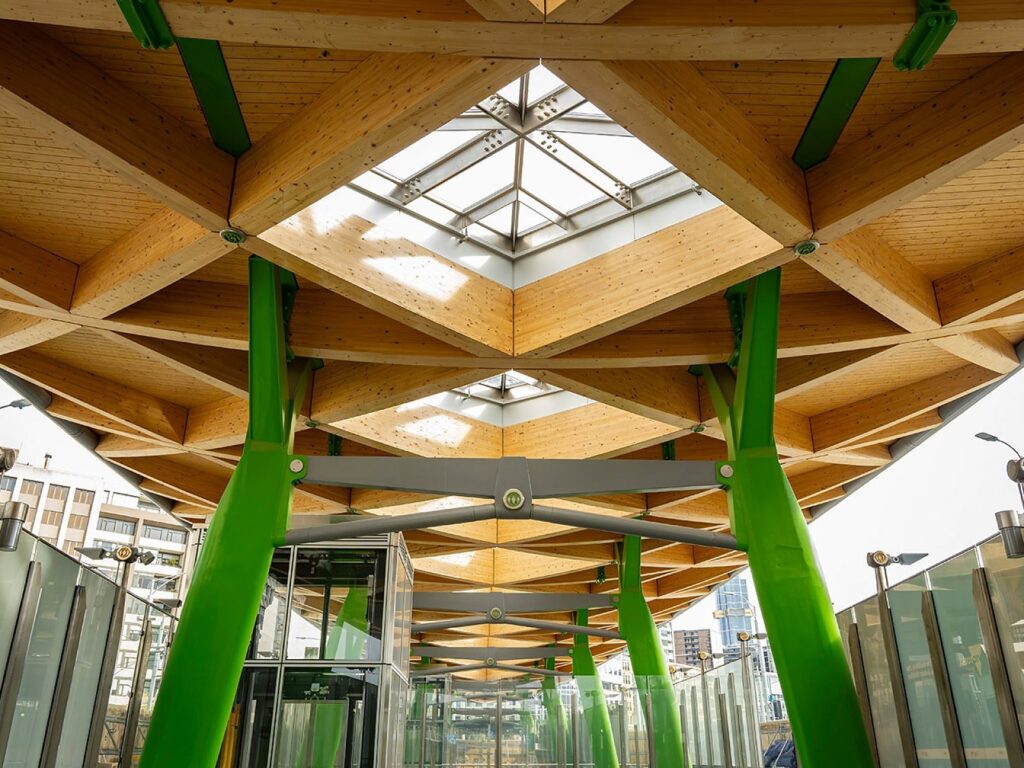
The 84-metre by 20-metre canopy, parametrically modelled in software package Rhinoceros, is built from 13 glulam cross beams, weighing up to 4,500 kilograms each. 164 diagonal glulam sections form the intersecting framework that gives the canopy its silhouette and 190 uniquely shaped CLT panels, produced at the group’s site at Stall im Mölltal, Austria (NORITEC Holzindustrie GmbH), lining the underside, with 12 skylights set along the central spine and the longest curved beams shipped as 20-metre segments.
The 84-metre by 20-metre canopy seen from below, with the diamond-pattern diagrid framing the central spine of 12 skylights set into 190 uniquely shaped CLT panels, and the green steel ring beam carrying the perimeter load above the underground concourse. (Photo Credit: HASSELL)
Wood Central understands that the diagrid geometry replaces conventional repetitive framing with a structurally efficient form that doubles as the station’s defining architectural gesture, allowing the timber roof to sit clear of the underground concourse on circular steel columns rising from within the station box itself. The hybrid arrangement uses steel for the supporting columns, main spine beams and perimeter ring beam, with mass timber for the lightweight, low-carbon roof, and the exposed timber panels softening what would otherwise read as conventional engineered transport infrastructure.
The green steel connection brackets bolted into the glulam end-grain are the structural connection systems HESS TIMBER supplied alongside the curved-glulam and CLT package, with the “Trams Towards Toorak Rd” tram platform signage confirming Melbourne’s first direct platform-to-platform interchange between rail and tram services. (Photo Credit: Wikimedia Commons / CC-BY-4.0)
A long road from Kleinheubach to St Kilda Road.
The HASSLACHER group’s European production base supplies some of Australia’s largest glulam timber sections. These massive beams are milled full-length at Kleinheubach, Germany (HASSLACHER Holzbauteile GmbH), or Hermagor, Austria (HASSLACHER Holzbausysteme GmbH), and shipped via special break-bulk cargo ships, known as RoRo vessels, before being delivered to the site on piloted truck transports. The Anzac Station’s timber canopy with curved glulam rafters, utilising this production and transportation capability, was craned over St Kilda Road from 2022 onwards and now rests on twelve green steel columns rising up to 16 metres above the underground concourse.
Anzac Station opened to passengers on 30 November 2025 alongside the wider Metro Tunnel, with more than 70,000 people moving through the network on opening day and around 13,000 passing through Anzac before full timetabled services launched on 1 February 2026 under the Big Switch branding. The station serves the Royal Botanic Gardens, the St Kilda Road office precinct and Melbourne Grammar School, with the Shrine of Remembrance directly opposite the canopy entrance, shaping the biophilic design behind the exposed timber soffit and 12-skylight central spine.
Visitors gather in the underground concourse on opening day, with green steel columns rising up to 16 metres from within the station box itself to meet the 350-cubic-metre glulam-and-CLT roof above — the hybrid steel-and-timber arrangement that lets the mass timber sit clear of the structural envelope. (Photo Credit: Wikimedia Commons / CC-BY-4.0)
It comes as Wood Central reported that the Anzac Station canopy joins HESS TIMBER’s deepening Australian project pipeline, with the Adelaide Aquatic Centre carrying Australia’s largest timber beams by weight and volume, Boola Katitjin at Murdoch University running on more than 1,800 pieces of glulam and Tasmania’s tallest mass timber building at St Luke’s in Launceston all flowing from the same European production lines of the HASSLACHER group.
Anzac Station is the first Melbourne rail station built with a direct platform-to-platform interchange between trains and trams, easing pressure on what Public Transport Victoria has identified as the busiest tram corridor in the world, with HESS TIMBER’s 350 cubic metres of glulam and CLT now carrying the architectural identity of an underground station forecast to serve 14,500 commuters every peak.
A decade after opening as a raw concrete shell once dismissed as a failed promise, the Cutaway at Barangaroo Reserve finally launched last Wednesday as a $100 million cultural venue anchored by 13 free-formed structural timber trees. Speaking at the unveiling, NSW Premier Chris Minns confirmed the venue will operate 24 hours a day, seven days a week, a new window secured only after Minister for Planning Paul Scully overrode opposition that had previously capped events at midnight.
The trees form the centrepiece of a fit-out delivered by Infrastructure NSW in partnership with FDC Construction & Fitout and architects fjcstudio, with First Nations designers Shannon Foster of Bangawarra and artist Jake Nash embedded in the design from its earliest stages. The Cutaway marks a second major Australian collaboration between HESS TIMBER and fjcstudio, following the free-form glulam canopy delivered at Bunjil Place in Narre Warren in 2017, completed under the practice’s former FJMT identity.
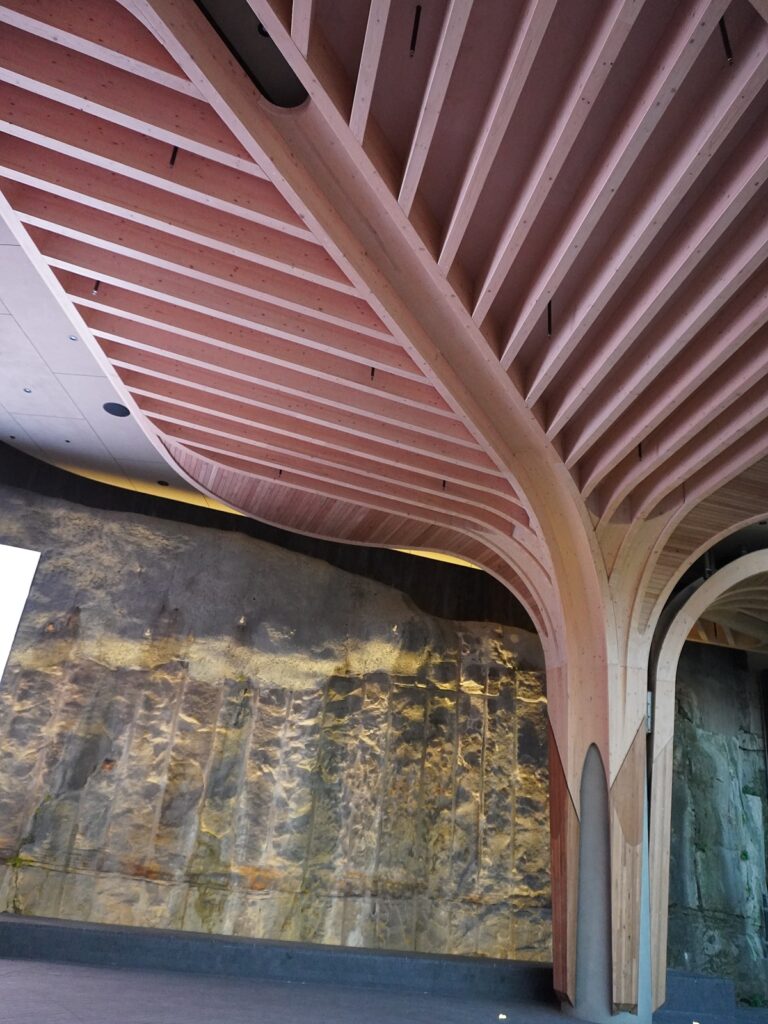
A 17-metre timber tree rises against the sandstone rock face, drawing on the giba-gunya (sandstone rock shelter) design reference. (Photo Credit: Kylan Low of the Timber Development Association, supplied to Wood Central / Central PR Group)
Wood Central understands that each tree is assembled from up to 115 precision-fabricated components supplied by HESS TIMBER, part of the HASSLACHER group, each weighing between 7 and 950 kilograms. The tallest tree stretches 17 metres from sandstone floor to vaulted canopy, its assembled form drawing on the curved geometry of the giba-gunya (sandstone rock shelter), a culturally significant natural reference woven into the architectural logic rather than applied as ornament.
“The design of the Cutaway maximises the potential of the space…transforming it into a globally attractive venue for arts and culture,” said Minister for the Arts John Graham.
More than 90 per cent of construction waste was diverted from landfill during the fit-out, whilst carbon emissions were more than 50 per cent below standard construction benchmarks, and all timber was sourced in compliance with Barangaroo Reserve’s sustainability principles.
Perforated plywood within each tree works in concert with two-layer glass enclosures over the venue’s open voids, an acoustic system rated for premium music and major events, whilst drawing natural light into the space.
Canopy detail of one of the 13 timber trees, with HESS TIMBER-fabricated components ranging from 7 to 950 kilograms. (Photo Credit: Kylan Low of the Timber Development Association, supplied to Wood Central / Central PR Group)
“The Cutaway will be the beating heart of Barangaroo…” said Minister for Jobs and Tourism Steve Kamper.
It comes as Sydney consolidates its standing as one of the world’s most active cities for large-scale timber architecture, with Atlassian Central having surpassed Milwaukee’s Ascent to become the world’s tallest plyscraper, a structural milestone Wood Central reported earlier this month. The Cutaway’s 3,000-person capacity spans a main event hall, pre-function spaces, gallery and exhibition rooms, a commercial kitchen, green rooms, dressing rooms and a dedicated First Nations education centre, with step-free access running directly from Barangaroo Metro Station through the basement carpark and into the hall.
The Cutaway’s glulam canopy frames the Sydney CBD skyline from Barangaroo Reserve’s harbourside precinct. (Photo Credit: Kylan Low of the Timber Development Association, supplied to Wood Central / Central PR Group)
Securing the 24/7 operating approval was not straightforward, with the Millers Point Community Resident Action Group mounting sustained objections over noise, crowd control and residential amenity before earlier planning decisions capped events at midnight, a restriction Scully’s direct intervention ultimately overturned.
“We’ve set the Cutaway up to be a must-visit destination for locals and visitors…” Scully said, adding that the venue would open its first event within weeks.
The Cutaway’s public realm entry, where step-free access runs from Barangaroo Metro Station to the 3,000-person main hall. (Photo Credit: Kylan Low of the Timber Development Association, supplied to Wood Central / Central PR Group)
The Cutaway opened to the public last weekend with a free programme of live music, gallery access and tours, before moving into a broader events programme.
“This extraordinary space is unlike anything else in Australia…” Minns said.
Please note: The photos for this story have been supplied exclusively to Wood Central by Kylan Low, the organiser of the Australian Timber Design Awards. To learn more about the awards, now in their 26th year, click here.
Canfor has named the conflict in Iran as the single biggest risk to its second quarter, warning that petroleum-driven supply chain disruption will drag on lumber demand and lift costs for US homebuilders just as the housing recovery looks for traction. That is according to the Q1 2026 financial results released to the Toronto Stock Exchange on May 6, with President and Chief Executive Officer Susan Yurkovich telling shareholders the conflict is reshaping the demand outlook even as a tighter supply backdrop dragged Q1 results sharply off the CAD $415.9 million Q4 blowout.
Canfor reported an operating loss of CAD $72.5 million and a shareholder net loss of CAD $72.1 million for the quarter — a result delivered just six weeks after the company moved to acquire the remaining issued shares of Canfor Pulp Products on March 17 and consolidated the pulp arm under full ownership. Lumber drove a CAD $43.7 million operating loss; pulp and paper added another CAD $16.2 million.
“The first quarter of 2026 continued to reflect challenging market conditions across our global operations,” Yurkovich said, adding that improved results were a function of higher production volumes and a North American lumber price recovery driven by tighter supply, with late-quarter weather disruption across British Columbia and the US South pinching the market further.
Full-year 2025 single-family housing starts fell 7 per cent to 943,000 units — the weakest annual result since the pandemic recovery — and NAHB Chair Buddy Hughes has previously appealed directly to US Trade Representative Jamieson Greer over the cumulative tariff impact on construction, with the body estimating combined tariffs and duties have added at least US$10,000 to the cost of a new dwelling. Section 232 lumber duties hold the effective burden at 34.83 per cent for most Canadian producers through August, with Canfor a mandatory respondent in that review, with a final determination due in August.
Mark Carney and Donald Trump face the August softwood determination with the Iran conflict now layering fresh petroleum-driven cost pressure onto a Canadian lumber sector already operating under Section 232’s 34.83 per cent effective burden. (Photo credit: Shawn Thew/UPI, UPI/Alamy Live News)
Total lumber shipments fell 6 per cent on the prior quarter to 1.26 billion board feet. Europe was off by 9 per cent due to cold-weather production impacts. North America fell 4 per cent due to British Columbia rail constraints and US South weather disruption. Production, however, lifted 2 per cent to 1.21 billion board feet as North American operating hours rebuilt following Q4’s seasonal holiday downtime.
Western SPF 2×4 #2&Btr averaged USD $463 per thousand board feet for the quarter, up 10 per cent on Q4 2025, whilst SYP East 2×4 #2 averaged USD $495 per thousand board feet — a 35 per cent jump. None of which made it through to Western SPF unit sales realisations, which were broadly flat: weaker offshore returns and a 2 per cent stronger Canadian dollar erased the benchmark lift before it hit the bottom line.
Whilst Asia was described as challenging, the China problem is structural. Official Chinese data shows real estate investment fell 11 per cent year on year across January and February 2026, with sales of newly built commercial housing by floor area down around 14 per cent over the same period. Japan softened too, on higher import volumes from Canada and Europe and a continued shift toward domestic wood use.
European demand stayed weak with slightly lower pricing quarter on quarter, though spruce showed late-quarter improvement after industry curtailments tightened supply. Elevated pine inventories continue to weigh on prices — particularly in the United Kingdom — with higher freight costs and the Iran conflict piling onto Canfor’s Vida sawmilling operations across southern Sweden.
Pulp and paper improved on the previous quarter, lifted by a modest US-dollar pricing uplift on global supply disruption and a 30 per cent rise in pulp shipments. Average NBSK list prices to China averaged USD $685 per tonne, up 2 per cent, while producer inventories closed February at 47 days of supply — the top end of Canfor’s stated balanced range.
Yurkovich said pulp headwinds had carried straight into the new quarter with producer inventories sitting well above trend. Canfor has scheduled a Q2 maintenance outage at its Intercontinental NBSK pulp mill, expected to strip around 20,000 tonnes of market pulp output, alongside a paper machine outage flagged to remove a further 5,000 tonnes.
For lumber, the company expects North American markets to soften later in Q2 as supply increases in response to recent price improvements, with macroeconomic uncertainty and heightened geopolitical risk continuing to constrain demand. The Iran conflict is flagged as a particular risk to new housing construction across the United States.
It comes as the wider North American sector continues to grind through what was a brutal 2025, with Canfor permanently closing its Estill and Darlington mills in South Carolina last year and stripping 350 million board feet of annual capacity from the market. West Fraser, Domtar, and Interfor have all curtailed, with capacity being released from the system faster than weak demand can absorb.
As of March 31, Canfor reported CAD $60.2 million in cash and equivalents on a consolidated basis, including Vida, against CAD $440.8 million drawn on operating loans, CAD $53.0 million reserved for standby letters of credit, and CAD $906.5 million in undrawn operating loan facilities. Canfor’s next test arrives in early August, with Q2 results due alongside the US Commerce Department’s final softwood determination and the conclusion of scheduled NBSK and paper machine outages that will strip 25,000 tonnes from the market.
Cardboard Cathedral architect Shigeru Ban will next month be awarded the 2026 American Institute of Architects (AIA) Gold Medal at the AIA Conference on Architecture and Design in San Diego, capping more than four decades of work that has proven paper tubes, timber and bamboo can carry permanent civic, cultural and humanitarian architecture.
Ban, already a Pritzker Prize-winning architect, is the first non-American to be awarded the Gold Medal since the late Richard Rogers received it in 2019, and is the first Japanese architect to receive it since Fumihiko Maki in 2011. The award places Ban alongside recent recipients, including Deborah Berke, Carol Ross Barney and Lake Flato co-founders David Lake and Ted Flato, a roster reserved for individuals whose careers have left a lasting influence on theory and practice.
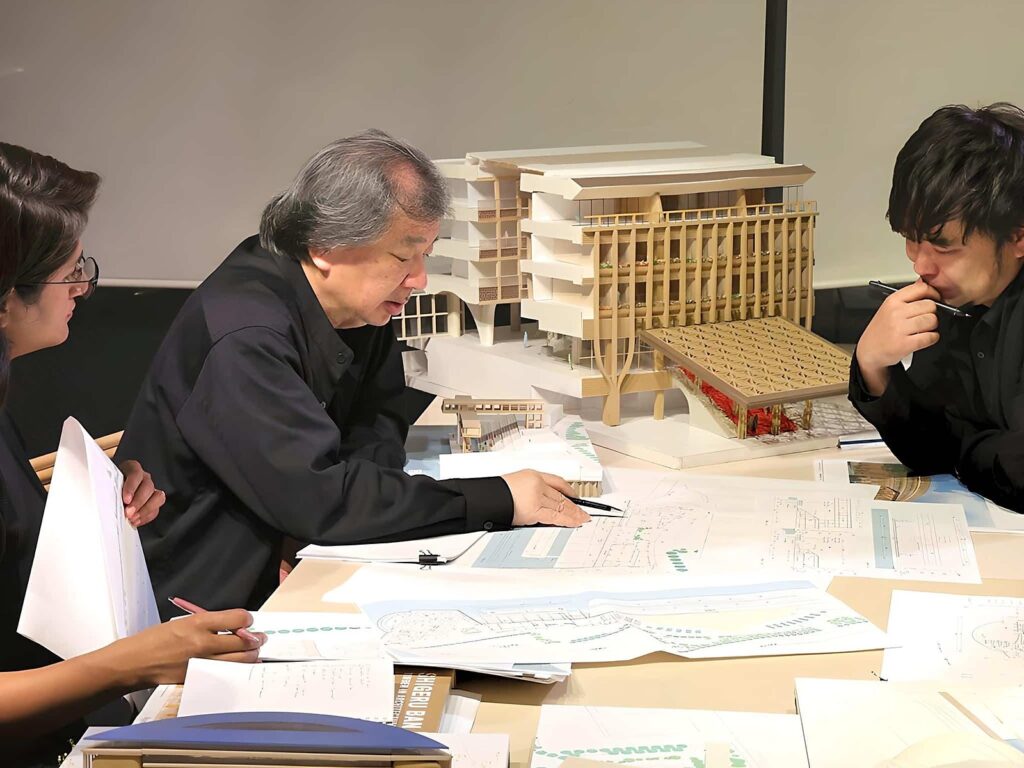
Tokyo-based architect Shigeru Ban (centre) reviews plans with practice colleagues at Shigeru Ban Architects, alongside a layered timber-and-masonry study model. The 2026 Gold Medal jury, chaired by Angela Brooks of Brooks + Scarpa Architects, said Ban’s career masterfully blends structural innovation, ecological sensitivity and profound humanitarianism. (Photo Credit: Shigeru Ban Architects)
Citing what it called Ban’s pioneering use of humble, renewable materials, the AIA said his career “masterfully blends structural innovation, ecological sensitivity, and profound humanitarianism,” with the 2026 jury chaired by Angela Brooks of Brooks + Scarpa Architects. The Gold Medal was first awarded in 1907 and has been presented to more than 80 architects since 1947, including Frank Lloyd Wright, I.M. Pei and Renzo Piano.
Born in Tokyo in 1957, Ban opened his Tokyo practice in 1985, after training at the Southern California Institute of Architecture (SCI-Arc) and New York’s Cooper Union, where he studied under Ricardo Scofidio, Bernard Tschumi and John Hejduk. The paper tube began as an exhibition solution while Ban was working as a curator at Tokyo’s Axis Gallery in the mid-1980s, with the lightweight cardboard cylinders supporting his Alvar Aalto retrospective before he scaled them up into permanent civic structures.
After the 1995 Kobe earthquake killed more than 6,000 people, Ban founded the Voluntary Architects’ Network (VAN), the not-for-profit body that has since completed over 50 disaster-relief projects across 23 countries using paper, timber and bamboo. The most recognised work from this body of practice is the Cardboard Cathedral in Christchurch, New Zealand, assembled from 98 cardboard tubes, timber and polycarbonate panels for 700 worshippers after the 2011 earthquake destroyed the city’s Anglican cathedral.
An interior render of Shigeru Ban Architects’ proposed 250-seat all-timber concert hall, inserted within Switzerland’s protected 19th-century Zeughaus armoury in Altdorf for cultural platform Zauberklang. Wood Central reported on the CHF 45 million commission in April 2026, with Italian glulam beams and Swiss connection-design specialists carrying the egg-shaped auditorium volume above a public foyer at ground level. (Image Credit: Mograph Studio / Shigeru Ban Architects)
Ban’s commercial and cultural portfolio also includes the Centre Pompidou-Metz in France, completed in 2010 with a timber gridshell roof inspired by a woven Chinese hat, and the Swatch Omega Campus in Biel, Switzerland, the largest mass timber building in the world at 240 metres of Swiss-sourced wood. Tod Williams, FAIA, co-founder of Tod Williams Billie Tsien Architects, said: “Shigeru is an extraordinary person and of great energy, conviction, and kindness.”
Ban previously won the Pritzker Architecture Prize in 2014 and Japan’s Praemium Imperiale for Architecture in 2024, with the Japanese government naming him a Person of Cultural Merit earlier this year. For over 30 years, the Tokyo architect has taught at Harvard, Cornell, and Columbia, often involving students directly in VAN humanitarian deployments through workshops that link academic studio work to refugee camps and disaster zones.
Milan’s mass timber Olympic Village is converting from athletes’ accommodation into Italy’s largest publicly supported student housing complex as part of a four-month works programme, with the Skidmore, Owings and Merrill (SOM) design now offering future Olympic hosts a working template for purpose-built post-Games renewal. That is according to Marco Scalvini, director of fund and asset management at Italian real estate developer COIMA, who confirmed at a 7 April Community Value Urban Regeneration roundtable hosted by The European House of Ambrosetti (TEHA Group) that 65 per cent of the 1,700 beds across the six new mass timber residential blocks have been assigned through university agreements and direct web bookings.
Wood Central understands the Porta Romana scheme is the only one of the six athlete villages used during the Milano Cortina 2026 Winter Games designed from the outset as a permanent urban neighbourhood, with the same buildings that hosted more than 1,000 athletes from over 40 delegations during the February event now converting under a brief that Italian trade press cites as significantly faster than the multi-year conversion timelines that have characterised most past Olympic athlete villages. “We expect it to open in August 2026 with a total of 1,700 beds,” Scalvini said.
Exposed glulam timber roof trusses inside one of Milan’s Porta Romana restored heritage structures, with the former Squadra Rialzo locomotive workshop and Basilico warehouse converting to communal student space under COIMA’s four-month brief. (Photo Credit: Donato Di Bello / courtesy COIMA)
IOC President Kirsty Coventry tours the SOM-designed Milan Olympic Village at Porta Romana on 18 September 2025 ahead of its February 2026 Games handover, with the delegation viewing the restored heritage interior now converting to communal student space under COIMA’s four-month brief. (Photo Credit: Independent Photo Agency / Alamy Live News)
The complex achieved NearlyZero Energy Building (NZEB) standards and holds both Leadership in Energy and Environmental Design (LEED) Gold and WiredScore Platinum certifications, with heat pumps, a one megawatt photovoltaic system, stormwater reuse and electric vehicle charging built in across the six new mass timber blocks and the restored Squadra Rialzo locomotive workshop and Basilico warehouse. Mass timber construction and prefabricated facade panels cut embodied carbon during the €140 million build, with COIMA pre-installing final student-configuration furniture during the Games under a July 2025 agreement with Fondazione Milano Cortina 2026 — a design-for-conversion brief that skips the gut-and-rebuild cycle stretching most past Olympic conversions into multi-year timelines.
It comes as Wood Central reported on the broader mass timber programme across the Milano Cortina 2026 venue network, with Italian fabricator Rubner Holzbau supplying engineered timber across vertical extensions in Milan and PEFC-certified timber retrofits at the Fabio Canal Cross-Country Ski Stadium. “Purpose-built for one usage, and that then will transform for another permanent purpose,” SOM partner Colin Koop said.
The Scalo Romana masterplan will eventually add 320 affordable housing units across the wider 19-hectare former rail yard, with COIMA pricing the student rents to deliver long-term investors a five per cent return only marginally above the ten-year BTP yield. Olympic host cities have a long history of venues sitting idle after the Games close — with Milan’s mass timber renewal answering 6 per cent of the city’s 30,000-bed student housing gap on a four-month works programme, against an Italian national shortage of 500,000 beds and a purpose-built student accommodation market that has grown 186 per cent in five years.
Browne Park reopened in Rockhampton last Saturday 2 May as Aurizon Stadium, with a 90-metre glulam roof comprising twelve 20-metre beams cantilevering 12 metres over the western grandstand, delivering Australia’s longest cantilevered timber structure and one of the first timber-roofed stadiums in Queensland ahead of the Brisbane 2032 Olympic and Paralympic Games.
That is according to Stantec, the structural engineering firm behind the timber roof, working alongside Italian glulam fabricator Theca/Rubner Holzbau, architects Cox Architecture and Italian connection-design specialist Ergodomus Timber Engineering on the Queensland Government-backed scheme. Wood Central understands the glulam elements were sized to fit within shipping containers for transport from the European Union and assembled on-site under a 100 per cent Building Information Modelling workflow, with Stantec leading work across fourteen engineering disciplines.
It comes as Sport, Racing and Olympic and Paralympic Games Minister Tim Mander, who refereed the 2004 and 2005 NRL Grand Finals, confirmed the final $3.5 million tranche of the $63 million Queensland Government commitment in September 2025, adding broadcast-standard lighting, a video replay scoreboard and upgraded field drainage to bring the venue to NRL hosting standard. “Browne Park has been the spiritual home of rugby league in Central Queensland,” Mander said.
Member for Keppel Nigel Hutton published this Browne Park preview two weeks ahead of the venue’s reopening. The redeveloped stadium carries Australia’s longest cantilevered timber roof, delivered through the $63 million Queensland Government commitment confirmed by Sport, Racing and Olympic and Paralympic Games Minister Tim Mander. (Video Credit: Nigel Hutton / YouTube)
Stantec’s analysis of timber and steel solutions found timber carried a marginally higher capital cost but delivered a 400-tonne net CO2 saving against the steel-equivalent design, the annual equivalent of removing 40 cars from the road, with the local municipality and designers commissioning an in-scale wind tunnel analysis after Cyclone Marcia hit Rockhampton in 2015. “In Rockhampton, winds can be extraordinarily strong, posing significant challenges to structural integrity,” Ergodomus said in its project description.
Backed by the Queensland Government with naming rights from rail freight operator Aurizon, the redevelopment delivered a three-level grandstand with 3,253 seats, up from the previous 564, alongside upgraded lighting, an enhanced playing surface, expanded media and broadcast facilities, four universally designed change rooms, a large video screen and additional spectator amenities. “Rockhampton is incredibly important to Aurizon,” Aurizon Managing Director and CEO Andrew Harding said.
Browne Park Inc Chairman Paul Hoolihan said the redevelopment opened a new chapter for the venue, which has hosted rugby football in Central Queensland since 1890 and was renamed Browne Park in 1958 to honour the late Rockhampton Rugby League president Jack Browne. “Aurizon has been part of the Central Queensland story for generations,” Hoolihan said.
The Central Queensland Capras returned to the redeveloped venue on Saturday with a Round 8 victory over defending Hostplus Cup champions the Burleigh Bears, ending two seasons in exile. The venue is booked to host up to 16 Queensland Rugby League fixtures each season, alongside local finals and community events, with broadcast infrastructure now in place for higher-profile fixtures, including potential NRL premiership matches.
EDITOR’S NOTE: This article has been retracted by Wood Central. It contained factually incorrect information about the materials used in Browne Park’s western grandstand roof. We apologise to readers and to the project team. For current information about the redevelopment, please refer to the Browne Park or Stantec project pages directly. Published: 6 May 2026 Retracted: 6 May 2026
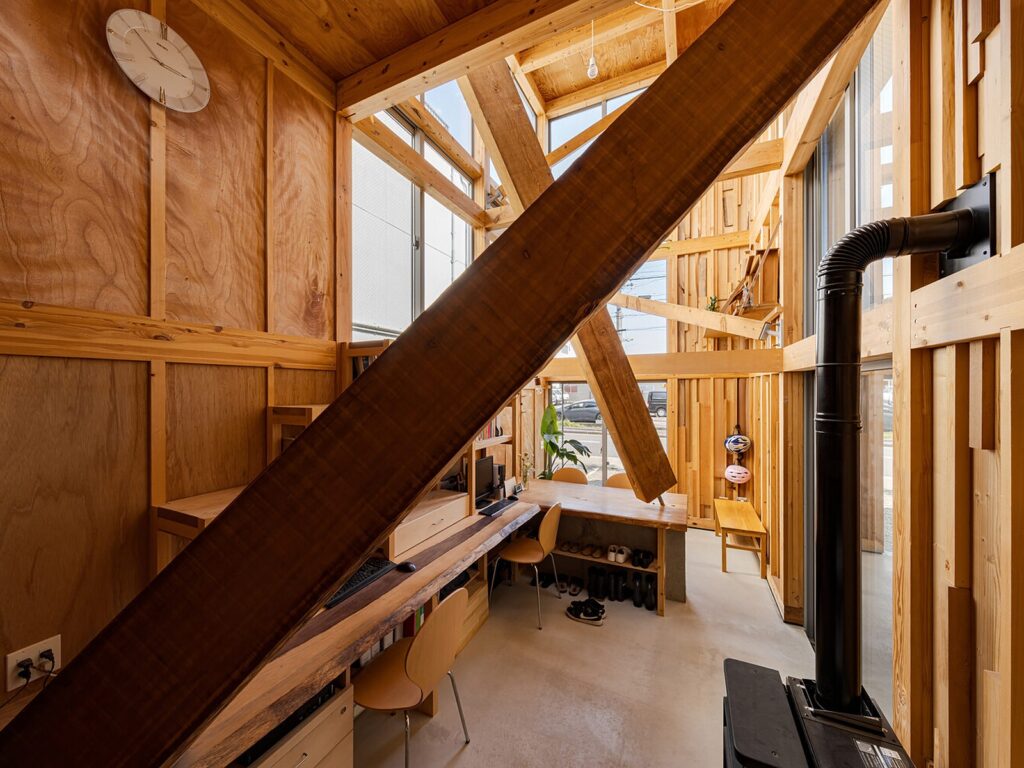
A 50-year-old Nagoya construction firm has reused decades of timber stockpiled across two of its own warehouses as the primary structure for a combined office and residence, with the available beam and brace lengths driving the building’s floor heights and plan dimensions rather than the other way around. The project, House & Office SH, was designed by Isuki Kamiya and Yui Goto of 1-1 Architects.
Wood Central understands the timber accumulated across the two warehouses over generations, with much of the stock drawn from bulk orders placed by the firm’s previous-generation founder — a working carpenter — as well as salvaged sections collected during demolition. The pieces varied in species, size and condition, leaving the stockpile difficult to standardise into conventional construction lengths.
1-1 Architects positioned the build as a response to a broader Japanese phenomenon, with construction companies and lumberyards across the country holding similar dormant timber stockpiles that are often cut only into finishing materials rather than reused as structural members. The studio approached the surplus “much like extracting rare metals from discarded electronic devices,” treating warehouse stock as an unused urban resource awaiting structural reactivation.
Rather than cutting the sections down to uniform members, Kamiya and Goto worked the existing dimensions directly into the structural model, with floor heights and plan dimensions adjusted as variables against the timber’s fixed lengths. Large diagonal members cut across rooms at unexpected angles, with the structural geometry shaped by the timber’s existing dimensions.
A reused diagonal beam cuts across the two-storey volume at House & Office SH, with the timber’s original length and angle dictating the building’s geometry rather than in reverse. (Image Credit: Takashi Uemura / 1-1 Architects)
The diagonal bracing replaces opaque shear walls along the building’s short axis, allowing the interior to remain visible from the street while defining the boundary between commercial and residential zones. Each connection demanded a bespoke response, with custom metal fittings fabricated from the irregular pieces’ three-dimensional coordinates and final adjustments made on site to account for warping and decades-old material deviations.
A diagonal brace meets the custom 3D-measured steel fitting connecting it to the workdesk slab — each junction across the building required its own bespoke fitting fabricated from the timber’s coordinates. (Image Credit: Takashi Uemura / 1-1 Architects)
The ground floor is held open and visible to the surrounding low-rise neighbourhood, where many of the small shopfronts and workshops that once activated the streetscape have closed in recent decades as customer traffic shifted to large shopping malls. House & Office SH is structured to reactivate that edge by distributing work, commerce and living functions across levels rather than separating them into discrete vertical zones.
Domestic life is arranged within the structural frame, with shelves built into the framing and stairs passing through beams that double as spatial markers. (Image Credit: Takashi Uemura / 1-1 Architects)
It comes as Wood Central reported on University College London’s Circular Economy Lab and UK CLT demonstrating a CascadeUp modular CLT prototype built entirely from recycled demolition timber, with the Nagoya project applying the same reuse principle in traditional Japanese post-and-beam carpentry rather than engineered panels.
Komatsu Structural Design engineered the connections, with Hirata Construction, now in its 50th year, building the project to Kamiya and Goto’s design in Nagoya from timber its previous-generation founder had ordered as a carpenter and stockpiled across two of the firm’s warehouses.
‘The Hale,’ a curved-gable mass timber civic pavilion built from cross-laminated timber and glulam, elevated above the tide line and clad with rainscreen façades and protected steel connections for sea-level rise, storm surges and salt exposure, has been pitched for Honolulu’s Kakaʻako Ma kai shoreline at the 2026 International Mass Timber Conference (IMTC) in Portland, Oregon.
Wood Central understands that ‘Hale’ is inspired by the traditional Hawaiian ‘place of shelter’ as a contemporary civic gathering space, with the design adding marine-grade coatings and cross-ventilation across the cladding to round out the tropical marine durability package. In addition, the design team also explored locally harvested softwoods to strengthen regional supply chains and cut transport-related carbon emissions across the timber value chain.
The studio brief asked how Pacific Island design traditions could inform modern public spaces in Honolulu, a question that ran through the team’s material specifications as much as its spatial planning across the Kakaʻako site.
From left, Dylan Martos, Jayden Uowolo and Edwin Sun with their design boards for ‘The Hale,’ the curved-gable mass timber civic pavilion the team developed through a first-semester graduate design studio at the University of Hawaiʻi at Mānoa School of Architecture and pitched at the 2026 International Mass Timber Conference in Portland. (Image Credit: UH Mānoa School of Architecture)
Uowolo, who travelled to Portland with Sun and Martos to deliver the presentation, said the conference had pushed his thinking on how Pacific Island traditions could feed contemporary mass timber design.
“Traditional Pacific Island ideas can shape contemporary design,” Uowolo said.
An interior rendering of ‘The Hale,’ showing the multi-storey library atrium where cross-laminated timber structure and timber shelving frame a civic learning space at the heart of the curved-gable pavilion. The CLT and glulam systems are specified for long-term performance in tropical marine environments, with rainscreen façades and protected steel connections managing salt exposure across the Honolulu shoreline site. (Image Credit: UH Mānoa School of Architecture)
Parker, who guided the studio with fellow professor Ho Kyung Lee, said industry-facing events of IMTC’s scale gave architecture students early career exposure that fed back into the school and the wider profession.
“They give them early exposure to the critical topics professional architects are discussing,” Parker said.
Work has now started on the Port of Portland’s redevelopment of its 40-acre former Terminal 2 marine site on the Willamette River, with the new mass timber campus projected to support more than 360 jobs and up to $115 million in regional GDP at full operational scale.
ZAUGG Timber Solutions, the Swiss-based mass timber manufacturer, has set up shop on the site as one of the first Phase 1 tenants and is currently awaiting final permits before its Terminal 2 operation can move into full-scale production.
Wood Central understands the campus is the first US site of its kind dedicated to mass timber housing manufacture and research at scale, designed to compress the path from product development to occupied dwelling and give Oregon a domestic answer to a housing shortage that has become the state’s dominant policy challenge.
Rachel Thieme, Economic Development Manager at the Port of Portland, said the redevelopment had been designed to activate a stretch of waterfront that had drifted out of productive industrial use and put the full mass timber supply chain inside one operational footprint. “We’ll have manufacturers, builders, start-ups all in one place,” Thieme said.
ZAUGG is one of the first Phase 1 tenants but unlikely to be the last, with the Port continuing to court additional manufacturers, builders and start-ups across the mass timber and housing innovation supply chain.
Marcus Kaufmann, who works with the Oregon Department of Forestry and helps run the Oregon Mass Timber Coalition, said Oregon was now in a position to become the United States’ domestic leader in mass timber, with European companies arriving as a direct result of investment already on the ground. “That’s a huge win for the state. That’s a huge win for everyone,” Kaufmann said.
A rendering of the University of Oregon’s Oregon Acoustic Research Laboratory and Energy Studies in Buildings Lab, designed by LEVER Architecture for the Port of Portland’s Mass Timber and Housing Innovation Campus at Terminal 2. The facility is the first of its kind in North America for high-throughput acoustic testing of mass timber floor-ceiling assemblies. (Image Credit: LEVER Architecture for the University of Oregon)
It comes as Wood Central reported Oregon’s new acoustic lab is structured to close a critical gap in mass timber testing, with multi-storey housing in particular dependent on certified sound-transmission data for building-code approvals at the state and municipal level. The campus’s wider context is the Port’s mass timber roof at Portland International Airport’s redeveloped main terminal, which Wood Central reported opened in 2024 as the largest mass timber project in the United States, with the visibility of the airport build accelerating the push to move mass timber from commercial product into residential housing.
With ZAUGG awaiting final permits, the University of Oregon’s acoustics and energy lab in development, and additional Phase 1 tenants still to be confirmed, the next 24 months will determine whether the 40-acre campus can deliver the 360 jobs and up to $115 million in regional GDP the Port of Portland has promised Oregon.
London-based RISE Design Studio has secured planning approval to redevelop Sutton Churches Tennis Club with a hybrid mass timber pavilion targeting AECB CarbonLite New Build certification, in a scheme the practice intends as a replicable model for ageing community sports facilities across the UK.
That is according to RISE Design Studio, with the London Borough of Sutton granting consent on the strength of full council support and works on site expected to commence in early 2027.
Wood Central understands the existing clubhouse has been judged dilapidated and no longer viable, with the approved scheme delivering a single-storey pavilion that includes an enlarged clubroom, upgraded changing facilities, accessible WCs and integrated storage. The new building has been designed to grow with the club and serve its community for decades to come.
Structurally, the pavilion uses cross-laminated timber walls and glulam roof elements as a hybrid mass timber system, with off-site fabrication, trimming embodied carbon and compressing the on-site programme. The factory-finished wall and roof modules will be lifted into place over a tight community-club programme, where labour cost on a long stick-build would have eaten the budget.
Imran Jahn, Design Director at RISE Design Studio, said the typology was designed to restore architectural quality to grassroots sports infrastructure that has historically been built to a price. “Beautiful architecture should be accessible to all, not reserved for a select few,” Jahn said.
The pavilion will run on mechanical ventilation with heat recovery, air-source heat pumps, and rooftop photovoltaic panels, with airtightness across the envelope and the Passivhaus-informed AECB CarbonLite New Build certification target, covering both embodied and operational carbon. RISE said the certification is critical for community-led organisations working on limited budgets, with running costs decisive in their business cases.
Accessibility has been embedded from the outset rather than added as a downstream compliance fix, with the ground floor lowered to align with the surrounding landscape, making the entire pavilion step-free. The approach is designed to make the facility welcoming to players, families and visitors with mobility needs without bolting on ramps after the fact.
The site has been organised through a linear zoning strategy that runs from a western recreational landscape, through a central social hub, to an eastern service block at the boundary. The clubroom sits at the heart of the plan, oriented northwards to frame views across the tennis courts and maintain a strong visual connection to the sport.
RISE Design Studio’s Sutton Churches Tennis Club pavilion folds a cross-laminated timber wall structure under a glulam roof and zinc-clad red eave that references the tiled roofs of the surrounding south London housing stock. (Image Credit: RISE Design Studio)
A restrained palette of timber, metal and glass sets the building lightly within its setting, with vertical timber cladding softening its mass and a standing seam metal roof providing shelter and shading through a generous overhang. A vibrant red roof finish references the tiled roofs of the surrounding homes, and a central linear rooflight reduces the building’s reliance on artificial lighting.
Jose Dengra, Senior Architect at RISE Design Studio, said early-stage coordination had been the single largest determinant of the scheme’s deliverability against the AECB benchmark. The pavilion “meets high environmental and accessibility standards while responding carefully to its context,” Dengra said.
To the east, the ancillary block has been designed as a discreet acoustic buffer for neighbouring residents, with high-level windows maintaining privacy without compromising daylight inside. The arrangement is one of several touches RISE argues should be designed in from the start in community sports facilities.
Jackie Halls, of the New Clubhouse Committee at Sutton Churches Tennis Club, said the existing facility had become an active drag on participation and inclusion. “Our old clubhouse has become a real barrier and is holding the club back,” Halls said.
Works at Sutton Churches Tennis Club are expected to commence in early 2027, with the scheme set to stand as RISE Design Studio’s first piece of community sporting infrastructure and, the practice argues, an exemplar for what a modern community-focused clubhouse can be.
A curved 230-square-metre pedestrian bridge in Shanghai’s Pudong New Area has been fabricated and installed in approximately 80 days on a hybrid glulam and steel structure, with a glazed timber crossing arching above the residential estate’s sunken garden. That is according to GREEN ARCHITECTS and gad, the joint design team behind the Yitaiyipin Garden bridge, which sits at the second-floor level inside the residential estate and faces an urban green space.
The architects said the lower structure became “a key design consideration in this project” because the sunken courtyard beneath the cantilever was intended to accommodate frequent pedestrian traffic between the urban green corridor and the garden’s central axis. The semi-circular plan responds to opposing conditions of “closure” facing the inner garden and “opening” facing the city.
The arched lower structure rests on two Y-shaped steel columns, with an inclined single-curved steel pipe forming the bottom chord and spindle-shaped timber rods serving as the web members, locked together by crossed steel cables to form a three-dimensional spatial truss. The truss profile is lowered at both ends and elevated at the centre, presenting a curved silhouette readable from every angle around the semi-circular plan and delivering what GREEN ARCHITECTS and gad described as “a light, open appearance with visual impact.”
The three-dimensional spatial truss combines an inclined steel-pipe bottom chord with spindle-shaped timber web members, which are locked together by crossed steel cables. (Photo Credit: Cao Liang)
The enclosed upper level sits on a “7”-shaped glulam structure supplemented by slender steel columns, with the timber columns positioned along the inner curve backing onto the sunken courtyard, whilst the glazed facade extends outwards towards the urban lawn. The arrangement creates a material contrast between robust glulam columns on the inside and the transparent glass envelope on the outside.
The enclosed upper level sits on a “7”-shaped glulam structure supplemented by slender steel columns, with the timber columns running along the inner curve. (Photo Credit: Cao Liang)
Construction was carried out using factory-fabricated components assembled on site, with the full programme from off-site fabrication through to final installation completed in approximately 80 days. The architects said the prefabricated approach “fully demonstrated the efficiency advantage of prefabricated timber structures.”
The cantilevered span reads from the koi pond at the base of the residential estate’s sunken garden, with the curved glazed crossing arching above. (Photo Credit: Cao Liang)
The project comes as Wood Central reported on LUO Studio’s arched Gulou Bridge Waterfront in Jiangmen, the 166-metre PEFC-shortlisted timber crossing carrying fishing boats and tourists across the OCT Alliance’s eco-cultural resort, and on the 9-metre glulam Onetai Bridge in New Zealand’s Coromandel, the country’s first state highway timber bridge in five decades. The Yitaiyipin span sits in the same prefab logic — engineered timber and steel cooperating across structural roles rather than competing for them.
A three-storey commercial building in Whakatū, Nelson, has cut 500,000 kilograms of CO2-equivalent emissions compared with a concrete-and-steel building on a tight urban site where fire codes typically rule structural timber out. That is according to Jeremy Smith and Andrew Irving of Irving Smith Architects, the firm behind the WallÉ-X typology and its 2022 predecessor, the Forsyth Barr building.
Wood Central understands that WallÉ-X carries nearly 2,000 square metres of commercial floor area, saving around 250 kilograms of CO2-equivalent per square metre, with LVL posts and beams sitting alongside CLT floors and stairs, inside fire-resistant pre-cast concrete sidewalls, and a concrete ground-floor slab.
Inside the second-floor tenancy at WallÉ-X, the LVL posts and beams sit alongside CLT floors and plywood vertical screening through the open-plan office. The structure is inserted into fire-resistant pre-cast concrete sidewalls and a concrete ground-floor slab. (Photo Credit: Irving Smith Architects via Architecture New Zealand)
A single diagonal K-brace runs through the building from the ground up, changing material as it rises. At ground level outside the Wakatu Lane entry, the brace is solid steel. On the first floor, it becomes a steel plate sandwiched between two LVL timber boards. By the second floor, it is pure LVL with no steel at all — the heaviest material at the bottom, where lateral forces are largest, the lightest at the top, where they are smallest.
The architectural sections through WallÉ-X show the three-tenancy stack between Bridge Street and Wakatu Lane, the K-brace lateral system running from solid steel at ground level to pure LVL timber at the top floor, and the 1.2-metre top-floor setback that satisfies fire-code maintenance access requirements for the cladding. (Image Credit: Irving Smith Architects via Architecture New Zealand)
Smith said the design question throughout had been where timber could replace concrete and steel on the site. “We’re trying to make a timber building. We just have to use concrete in some places so we can build on the site,” Smith said.
What makes the typology unusual is the top-floor wall set back about 1.2 metres from the concrete balustrades on each side boundary. The setback satisfies fire-code maintenance access requirements for the top-floor cladding, allows construction in timber, and doubles as outdoor space for the top-floor tenancy.
The Wakatu Lane elevation of WallÉ-X shows the recessed top-floor wall set back about 1.2 metres from the concrete side-boundary balustrades, with the diamond-patterned bronze screen across the first and second floors and the extended “shark’s mouth” eave above. The setback meets fire-code maintenance access requirements for the top-floor cladding and also serves as an outdoor space for the top-floor tenancy. (Photo Credit: Irving Smith Architects via Architecture New Zealand)
Irving said the geometry handled the fire-code requirement without reading as a compliance move. “This doesn’t look like we’re cheating the fire code. It just looks like a deck, and there’s a lot to be said for putting less building on the north-west corner,” Irving said.
The recessed top-floor verandah in the north-western corner of WallÉ-X is sheltered by the 1.2-metre setback from the concrete side-boundary balustrades and accessed through sliding doors past the timber K-brace — pure LVL by the second floor, with all the steel left behind below. The setback satisfies fire-code maintenance access requirements for the top-floor cladding. (Photo Credit: Irving Smith Architects via Architecture New Zealand)
Smith and Irving argue that fire ratings are the central reason structural timber tends to cluster on larger, campus-style sites. Internal ratings affect timber sizing through char rating, connections, and finishes, whilst external ratings, designed to prevent fire spread between properties, force timber buildings into separations that tight sites cannot afford.
Smith said the city’s question was whether architecture had to abandon fine grain to use timber. “Most cities are made up of small tenancies. So, does that mean the small fine grain of smaller cities has to be merged together to make big sites so we can build in timber?” Smith said.
WallÉ-X’s saving of 250 kilograms of CO2-equivalent per square metre is more than three times that of its 2022 predecessor, the Forsyth Barr building, which saved around 70 kilograms per square metre. The first WallÉ trimmed about 50,000 kilograms of CO2-equivalent across its floor area, whilst WallÉ-X has trimmed around 500,000 kilograms across nearly 2,000 square metres.
It comes as Wood Central reported a global wave of mass timber commercial construction through 2025 and 2026, from Denmark’s TRÆ tower to a series of CLT projects across London. Each of those buildings sits on larger sites with the fire-code separations WallÉ-X has been designed to do without.
A diamond-patterned bronze screen, perforated to filter light, covers the first floor and about half the second-floor façade. The second floor carries an extended “shark’s mouth” eave and a recessed verandah in the north-western corner, both sheltered by the top-floor setback above.
About six tonnes of steel fixings sit above the second floor, connecting the timber truss roof to the pre-cast concrete sidewalls. “There’s about six tonnes of steel above us, grabbing hold of the concrete walls,” Irving said.
The top-floor breakroom and kitchen in the WallÉ-X tenancy show the LVL beam running overhead and the plywood island bench. Roughly six tonnes of steel fixings sit above this floor connecting the timber truss roof to the pre-cast concrete sidewalls, anchoring the timber structure to its concrete fire-rated edges. (Photo Credit: Irving Smith Architects via Architecture New Zealand)
The ground floor sits about a metre above street level to anticipate a one-in-100-year flood event, with the level change handled by recessed stairs and a ramp running the width of the building. The floor overhang shelters both the ramp and the entry stairs.
Smith said the practice intended to scale the typology across the urban grain rather than amalgamate sites to make timber stack up. “We’re not going to amalgamate sites to build in timber. We’re saying we are going to come up with a typology that allows us to build in timber but use concrete and steel to facilitate location,” Smith said.
Brazil has cut Amazon deforestation by between 60 and 80 per cent over two decades, but four of the country’s flagship supply chain policies have failed to halt forest degradation, the slower and less visible assault now hollowing the canopy from beneath. That is according to lead author Federico Cammelli at the University of Cambridge’s Department of Geography and Conservation Research Institute, whose findings, published in the Proceedings of the National Academy of Sciences, warn that the European Union’s Deforestation Regulation defines degradation too narrowly to capture the fire damage, illegal logging and fragmentation tied to soybean and beef production across the basin.
Wood Central understands the four policies tested, including the Amazon Soy Moratorium and the G4 cattle agreement signed by Brazil’s four largest meat packers, were assessed against degradation indicators across three Brazilian states, with the research team finding none had measurably reduced the fires, illegal logging and habitat fragmentation now driving the canopy collapse from underneath. Earlier work cited in the PNAS paper found net carbon emissions from forest degradation in the Brazilian Amazon between 2001 and 2018 ran comparable to, or higher than, those from outright deforestation.
The European Union Deforestation Regulation polices commodity flows into EU markets, but its narrow definition of degradation overlooks the fires and fragmentation tied to soybean and beef production, leaving operators able to comply while sourcing from Brazilian Amazon forests already hollowed out beneath the canopy, Cambridge researchers warn. (Photo Credit: Getty Images)
The first phase of Brazil’s Plan for Prevention and Control of Deforestation in the Amazon, launched in the mid-2000s, drove a 60-to-80-per-cent reduction in tree clearing, with private-sector commitments including the soy moratorium and the G4 cattle commitment from Brazil’s largest meat packers contributing to the regional success. Despite those gains, the Cambridge-led team found no conclusive evidence that supply chain policies had tackled the fire damage and illegal logging that drive anthropogenic degradation across the Amazon basin.
The Cambridge team described degraded landscapes now extending across millions of hectares of Brazilian Amazon, where low-intensity fires creep under the canopy until the trees die standing: “There’s still a forest there, but it’s so damaged that the carbon it once stored starts leaking, the animals have disappeared, and new grass species colonize the forest edges,” Cammelli said.
“Flames often go undetected under the canopy, but after one or two years, trees die while standing, and the forest transforms into a cemetery of dead standing trees.”
The G4 cattle agreement, signed by Brazil’s four biggest meatpackers, appeared to be linked to an increase in Amazon timber extraction, possibly because tighter regulation of cattle ranching pushed some operators into the less-regulated logging sector. The Cambridge team described the displacement effect as a clear illustration of how single-commodity policies can shift environmental pressure between sectors of the rural economy rather than removing it from the landscape.
Workers process tropical hardwood at a Brazilian Amazon sawmill, of the kind Cambridge researchers identified as the less-regulated sector the G4 cattle agreement appeared to push operators into, as the supply chain policy that tightened cattle ranching across the basin coincided with an increase in Amazon timber extraction over the same period. (Photo Credit: Alamy Stock Images)
“Avoiding deforestation and degradation is so much more important for climate and nature than restoring what’s already gone,” said senior author Professor Rachael Garrett of Cambridge’s Department of Geography and Conservation Research Institute. “There are certain things you can’t get back.”
The Cambridge team is urging Brussels to broaden the EUDR’s definition of degradation, which the researchers argue currently overlooks the fire damage and fragmentation tied to soybean and beef production, leaving operators able to comply with the regulation while sourcing from forests still hollowed out by fire and illegal logging [INSERT BACKLINK to Wood Central EUDR explainer or A-EU FTA coverage]. Despite Brazil’s 2023 environmental policy update, which introduced degradation into its enforcement criteria for municipalities with poor records, the Cambridge team found no publicly documented examples of companies operating in the Brazilian Amazon that had set concrete corporate targets specifically addressing degradation.
On the ground in the Chico Mendes Extractive Reserve, firefighter Antonio, who has worked the Amazon fire lines since 2019, said 2024 marked the most extreme fire year of his career, with the dry season lengthening each year and the rains arriving with sudden violence when they finally came. “I had never seen anything like it. The forest burned like dry pasture—it was frightening for those of us who risk our lives to protect it,” Antonio said.
By 2050, on the Cambridge team’s projection, forest degradation could span the entirety of the Brazilian Amazon — leaving Brazil’s flagship soy moratorium and G4 cattle pact short of the fires and illegal logging now hollowing the canopy beneath them.
For more information: F. Cammelli, R. Garrett et al., Deforestation-focused policies do not reduce degradation in the Brazilian Amazon, Proceedings of the National Academy of Sciences (2026). DOI: 10.1073/pnas2507793123
AFL football has returned to Tasmania, with UTAS Stadium hosting its first home fixture of the 2026 season on ANZAC Day yesterday, next to a live Fairbrother construction site, the new glulam-and-concrete Centre West Stand at the heart of a $130 million total redevelopment due for completion in October next year.
The $130 million redevelopment, whose timber-concrete engineering was first reported by Wood Central last April, has temporarily reduced capacity at the historic York Park ground to roughly 9,000 seats across the 2026 AFL season, less than half its pre-construction footprint of 19,500. The cap is set to lift to about 17,000 once new seating areas come online in 2027, with the venue running at full Australian Tier 2 standard from the 2028 season.
The redevelopment, designed by Populous and Philp Lighton Architects, will carry mass timber glulam columns and beams across the new Centre West Stand façade and concrete and mass timber plates across the inside of the redeveloped Eastern Stand roof and concourse seating, with off-site prefabrication of the glulam frame chosen to cut on-site construction time and lower the building’s embodied carbon.
Engineers are now driving 20-metre steel piles through layers of soft mud and 19th-century buried fill into bedrock to stabilise the site, where the water table sits just 200 millimetres below the surface across what was originally swampland and Launceston’s mid-1800s landfill before becoming the city’s showgrounds.
A 19,000-square-metre field reconstruction is also underway to prevent flooding across the playing surface, with the existing ground remaining open for AFL, AFLW, VFL and Big Bash League fixtures throughout the construction phase.
The Centre West Stand site was fenced off and stripped to bare ground earlier this year, with 20-metre steel piles being driven through layers of soft mud and 19th-century buried fill to reach bedrock beneath the former swampland. (Photo Credit: Duo Projects)
The radiata pine has been sourced from Australian plantations, with the timber chosen over a steel alternative on grounds of construction speed and carbon emissions.
Tasmanian builder Fairbrother (also the contractor behind St Luke’s, the tallest mass timber building in the state) is rolling out the works in phased completions, with the Western Stand Infill Seating due September 2026, the redeveloped Eastern Stand carrying 3,629 new seats due by March 2027, and the new Centre West Stand scheduled for October 2027.
The redeveloped UTAS Stadium, with the new Eastern Stand and Plaza shown in dotted outline against the existing oval-shaped ground. The new Eastern Stand will carry covered stadium seating, hospitality, food and beverage, and amenities across 3,629 new seats due by March 2027. (Image: ABC News / Stadiums Tasmania)
The redeveloped venue, jointly funded with $65 million each from the Australian and Tasmanian Governments, sits on an oval-shaped ground that already hosts Hobart Hurricanes Big Bash League fixtures, AFLW, VFL, and North Launceston Football Club matches, alongside Hawthorn’s four AFL home games each year.
The new Centre West Stand at UTAS Stadium is illuminated for night-time fixtures, with the curved mass-timber roof and glulam-clad façade rising above the new plaza level, which is set to handle pedestrian traffic into the redeveloped venue. (Render: Populous / Stadiums Tasmania)
“Launceston already has a great sporting legacy, and this project will ensure that continues for generations to come,” Jess Teesdale, the Federal Member for Bass, said at the September 2025 works launch, where she also pointed to the significantly increased crowd capacity expected once the new stands come online.
Federal Infrastructure, Transport, Regional Development and Local Government Minister Catherine King welcomed the works at the same launch, saying she could not wait to see her beloved Richmond Tigers play the Tasmania Devils at the upgraded venue once the new club enters the AFL.
It comes as Tasmania Devils CEO Brendon Gale confirmed earlier this month that the AFL’s 19th team remained locked in for a Round 1, 2028 entry, with Hobart’s Macquarie Point Stadium pushed back to early-to-mid 2030 and the Devils’ first match at the new Hobart venue likely to fall in Round 1, 2031.
Until Macquarie Point opens, Gale told SEN’s Dwayne’s World, the Devils will split home games between Hobart’s Ninja Stadium and the redeveloped UTAS Stadium, leaving Launceston’s glulam-and-concrete venue to carry the bulk of the club’s northern fixture list across the first three AFL seasons.
The Centre West Stand, the new Eastern Stand and the Western Stand Infill Seating will combine to deliver an AFL Tier 2 venue at full capacity for the start of the 2028 AFL season, when the Tassie Devils run out for their first home fixture in Launceston.
 Login
Login