Smurfit Westrock will invest about €600 million in its French operations over the next three to five years, funding a modernisation and decarbonisation programme spanning the 50 sites where the packaging group employs about 6,000 people. The group timed the announcement ahead of this year’s Choose France summit, the annual showcase the French government stages to draw foreign capital into domestic industry.
Saverio Mayer, CEO Europe, MEA and APAC at Smurfit WestRock, said the spending builds on more than €500 million invested in French plants over the past five years to modernise operations and expand capacity, with the company now in its fifth decade in the country. He added that the group’s “commitment to innovation, quality, and decarbonisation efforts is clear.”
Because the group already runs four net zero plants in France alongside an almost fully decarbonised paper mill, the new spending deepens an emissions-cutting effort already well underway. Andrew Coffey, chief executive of Smurfit Westrock France, said hitting net zero at those sites had given the company a platform to go further, arguing that “sites creating sustainable packaging are sustainable in their own right.”
Smurfit Westrock has earmarked €40 million for an expansion and modernisation of the Épernay facility in the Marne and €20 million for the advanced corrugated plant at Vernon. More than €100 million will go to the Facture paper mill in south-western France, where the works include a new evaporation plant.
Coffey said the targeted spending would strengthen the company’s capabilities whilst cutting its environmental impact across a French operation that sits within a global network of about 97,000 people in 40 countries.
A century ago, the hardwood forests of the eastern United States were little more than stumps and ashes, and next week the American Hardwood Export Council will rebuild a piece of that comeback inside a Copenhagen exhibition hall. Wood for the Trees, the immersive walk-through it has staged for 3daysofdesign, retraces a hardwood’s path from standing tree to finished product entirely in donated US timber.
Step inside and the room becomes an abstract arboreal setting, with materials raised on rotating trunks, seating hewn into the shape of fallen logs, and graphics suspended overhead like the boughs of a forest canopy. Audio-visual displays, environmental data and narrative panels thread between the objects, turning the documentary that inspired the show into a space the visitor walks through rather than watches.
The journey moves through five stages — growth, stewardship, selection, resilience and timber — each opening a door onto the realities of responsible forest management. The early rooms trace how trees regenerate and even clone themselves across generations, the day-to-day and century-spanning labour of tending a forest, and the careful judgement of which trees to fell and which to leave standing.
And later, the focus turns to resilience and how a forest shrugs off climate shifts, pests and disease, before the final stage follows the grain to the point where the forest meets the human world. Drawn from AHEC’s recent documentary Forested Future, which followed the communities whose livelihoods rest on forests, the show widens a Copenhagen platform the council has used in recent years for designer collaborations and sculptural one-offs.
Watch the trailer for Forested Future, AHEC’s documentary on the Appalachian forest communities whose stewardship inspired Wood for the Trees. (Video: AHEC)
Mitre & Mondays, the London studio of Josef Shanley-Jackson, Freya Bolton and Finn Thomson, builds objects and spaces around reuse, repair and regenerative materials. Benchmark, the Berkshire furniture-maker founded by Terence Conran and Sean Sutcliffe in 1984, built the show from those donated boards, drawing on four decades of working with natural, non-toxic timber.
The Mitre & Mondays trio behind the exhibition, from left, Josef Shanley-Jackson, Freya Bolton and Finn Thomson, at Benchmark’s workshop. (Photo Credit: Mitre & Mondays, Supplied to Wood Central by AHEC)
Behind the spectacle sits a recovery the council returns to often, with the eastern United States hardwood forests rebounding from those stumps and ashes to more than 40 million acres today. They are now growing at twice the rate they are harvested, a ratio AHEC uses to argue that a diversified timber market gives landowners a reason to keep forests standing rather than clear them.
Every plank in the installation was donated by the family-owned sawmills Bingaman & Son Lumber, MacDonald & Owen, Northland Forest Products and Rossi Lumber. Four species carry the room, with American red oak, yellow birch, hard maple and cherry, each chosen to show the range a diversified market can draw on.
Thailand and Sweden have committed to building a sustainable timber industry that spans the entire value chain, from plantation forestry to engineered wood products and modern timber construction, following a Bangkok forum that brought together foresters, researchers, industry executives, and government officials from both nations. The Wood Solution Thailand Forum 2026, held at the Eastin Grand Hotel Sathorn on 2 June, marked the latest step in a partnership that began in 2022 and now spans forestry, academia, finance and government.
That is according to Arunrung Phothong Humphreys, Ambassador of Thailand to Sweden, who opened proceedings by pressing the question that has anchored the initiative from the outset before answering it herself. Sweden offered a strong forestry sector, an advanced wood-processing industry and decades of experience balancing economic growth with environmental stewardship, the ambassador said, asking simply, “Why Sweden?”
Arunrung Phothong Humphreys, Ambassador of Thailand to Sweden, opens the forum and asks why the kingdom should look to Stockholm as its model. (Photo Credit: ScandAsia.com)
Because the relationship has been strengthened by the Strategic Partnership Agreement signed between the two countries, the ambassador described the project as a new model linking grassroots communities with emerging green industries. The initiative traces back to 2022 cooperation between the Thailand-Nordic Countries Innovation Unit under the Royal Thai Embassy in Stockholm, the Eco-Innovation Foundation, the Stockholm Environment Institute and Sida.
Speaking after the ambassador, Emanuel Lundin, First Secretary at the Embassy of Sweden in Bangkok, characterised the project as a shared effort to draw long-term value from Thailand’s largely underutilised forestry resources. He told the forum the journey mattered as much as the eventual outcome.
Marie Jürisoo, Director of SEI Asia, who led the three-month engagement phase ahead of the forum, said the process had been designed to accelerate momentum, deepen stakeholder participation and identify practical next steps. The morning session turned to the findings of several collaborative studies examining Thailand’s potential to expand sustainable forestry and timber-based construction.
The central question, according to Aaron Kaplan, Director of the Eco-Innovation Foundation, was what the initiative would deliver for Thailand and whether it could evolve beyond research into a genuine development movement. Researchers and industry representatives stressed that success would demand cooperation across forestry, education, construction, finance and government.
Running through the discussion was a recurring argument that the initiative amounts to more than timber construction alone, with speakers repeatedly returning to the need to build an ecosystem connecting forest owners, processors, manufacturers, investors, architects, and policymakers. Drawing on Swedish experience, representatives highlighted the role smallholders can play, describing how family-owned forests have become part of a long-term value chain supported by institutions that ensure fair pricing, certification, and market access.
A substantial part of the programme showcased projects already underway in Thailand, ranging from economic plantations and engineered wood products to construction applications. The Phrae Sustainable Wood City initiative featured prominently, reflecting the northern province’s long association with the country’s teak industry and its emergence as a potential model for wider development.
Ambassador Arunrung Phothong Humphreys inspects a Thai pioneer exhibit, one of several projects promoting bamboo and underutilised commercial species. (Photo Credit: ScandAsia.com)
Outside the conference hall, a small exhibition signalled how far the initiative has spread beyond forestry, with one programme promoting bamboo as an underutilised commercial resource and another highlighting Casuarina, a pine-like species researchers believe could stabilise coastal areas threatened by erosion. Education featured strongly, with an academic programme in Phrae now training around 150 postgraduate students as future forestry resource and environmental managers.
Further along, displays set out forest product certification systems developed by the Department of Forest Industry Technology, alongside plans by the Hydro-Informatics Institute to expand its Water Management School into a broader Water and Forestry Management School. Several projects addressed how farmers can earn income during the years it takes for trees to mature, among them the production of lac, an insect-derived resin later processed into shellac and other commercial products.
Moving from Thai pioneers working on engineered wood products and bamboo development to international experience, the afternoon programme heard Swedish and other organisations share examples from countries where sustainable forestry and timber construction have become established industries. Kaplan closed the forum by describing the movement as a work in progress that still needs many more stakeholders to come on board, telling participants, “Today is a small preview of what is yet to come.”
A draft roadmap unveiled at the forum charts a phased path to 2037, carrying Thailand from foundation-building and pilot projects through industrial scale-up to eventual regional leadership in engineered wood products and timber construction, a horizon Kaplan said the partnership had only begun to lay the foundations for.
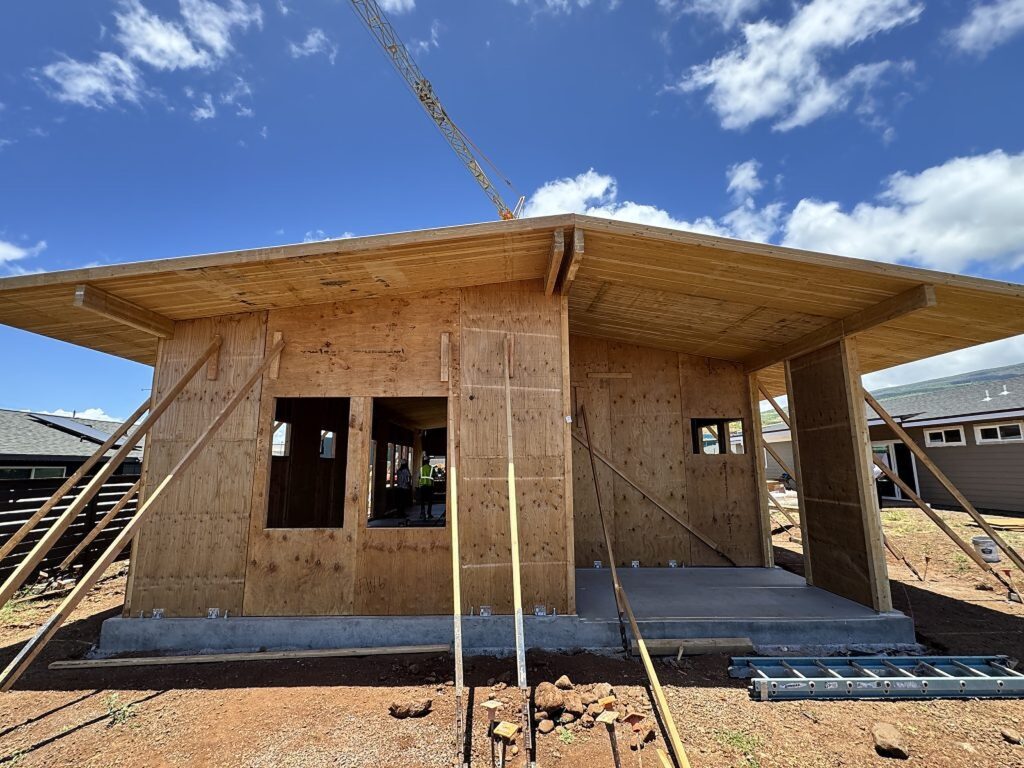
Designed by HIOG principal David Sellers, who also sits on Habitat for Humanity Maui’s board of directors, the Bunkhouse uses veneer-laminated timber walls and glue-laminated timber roof panels dimensioned around a four-foot module. That module allows termite treatment before installation, efficient shipping across the Pacific and rapid assembly once the panels reach the site.
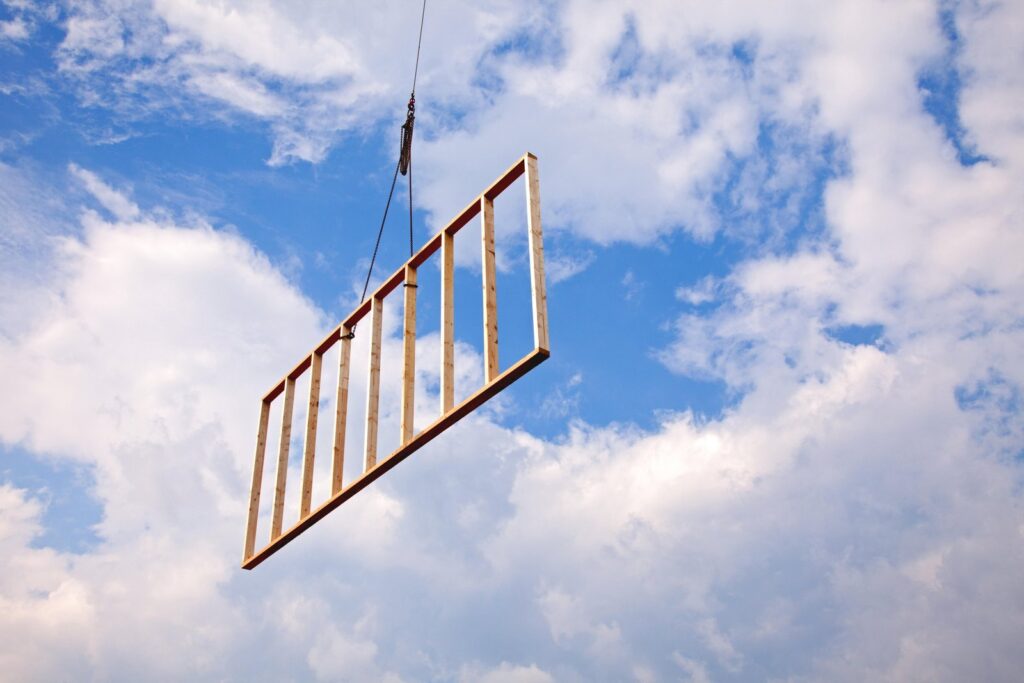
The bunkhouse’s veneer laminated timber walls and craned roof panels rise on the cleared Lahaina lot. (Photo Credit: Hawaiʻi Off Grid)
Sellers, who led the design with support from WoodWorks, said two decades of underbuilding had left the islands unable to rebuild Lahaina at the speed residents deserve, and the bunkhouse answers that with a system that can be prefabricated and deployed after future disasters. “Recovery doesn’t have to mean rebuilding the same way,” he said.
The flat-pack logic is the point for HIOG, which conceived the dwelling as a proof of concept for prefabricated mass timber as a route to affordable, resilient housing at a lower cost and faster pace. Maui’s largest architecture and engineering firm, HIOG, commits 30 per cent of its work to community projects and partnered on disaster relief after the 2023 fires.
Project leaders mark the start of construction at the Lahaina mass timber bunkhouse blessing. (Photo Credit: Hawaiʻi Off Grid)
According to Jennifer Cove, president and chief executive of WoodWorks, the partnership advances education, workforce development and design work for new mass timber housing prototypes whilst honouring local architectural character. “This project demonstrates how mass timber can strengthen post-disaster rebuilding,” she said.
Meanwhile, Matt Bachman, the executive director of Habitat for Humanity Maui, said the bunkhouse will expand the charity’s volunteer capacity in Lahaina, where each additional worker moves another family closer to a permanent home. “Volunteers have always been at the heart of Habitat for Humanity’s work,” Bachman said.
HIOG expects the Bunkhouse to be completed within four months, with August 2026 the target — three years after the August 2023 fires razed the lot and much of historic Lahaina.
The US Justice Department has rallied harvest, processing, and consumer nations behind a drive to strip illegal timber from global supply chains, leading the first multilateral workshop to seat the entire timber trade at one table in Libreville from 18 to 22 May. That is according to Principal Deputy Assistant Attorney General Adam Gustafson of the Department’s Environment and Natural Resources Division, who said that illegal wood that breaches the Lacey Act undercuts American producers.
Pressing the commercial stake at the heart of the talks, Gustafson said the United States holds a strong interest in clearing illegal timber from global supply chains and keeping unlawful wood off the US market. “Illegally imported wood undercuts our domestic producers,” he said, adding that cooperation with foreign trading partners sharpens the collective ability to interdict illegal timber whilst supporting legitimate commerce.
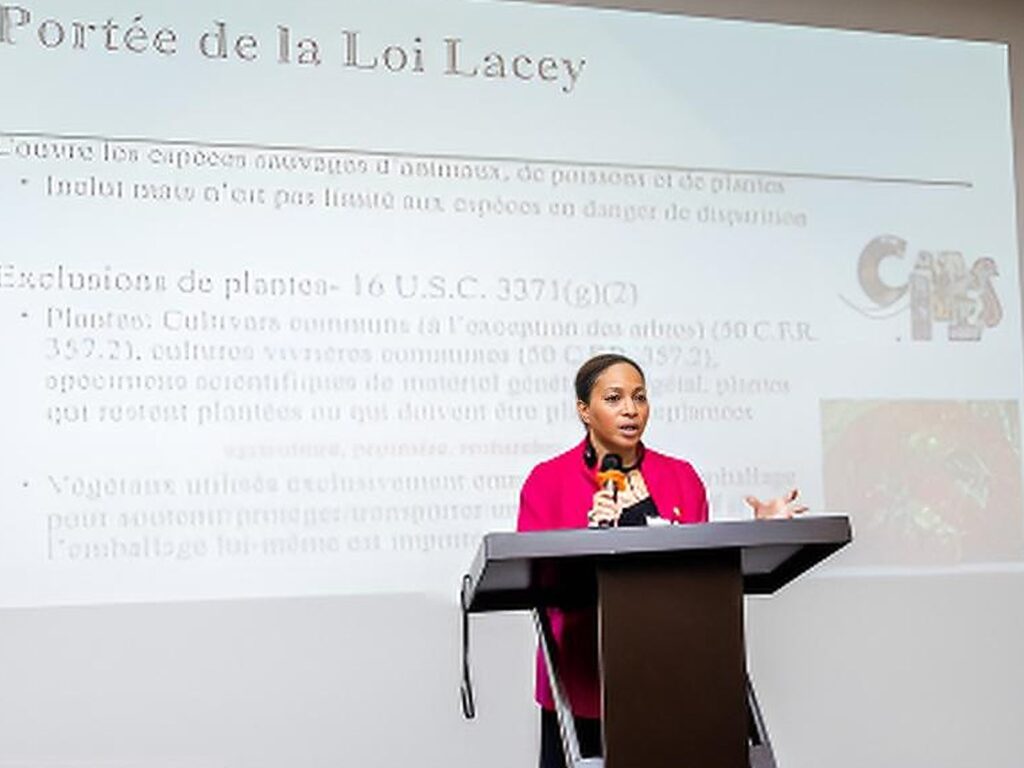
An ENRD presentation on the scope of the Lacey Act during the Libreville workshop. (Photo: ENRD)
Drawing more than 100 officials to the Gabonese capital, the workshop brought together industry, key harvesting nations, a leading processing and re-export hub and major consumer markets in the first session to span a timber supply chain from harvest through to customs. Cameroon and Vietnam joined the United States and Gabon, with the European Union, the United Kingdom, non-governmental organisations and international bodies also represented.
A timber processing line of the kind the workshop examined in mapping the trade from harvest through to customs. (Photo: ENRD)
Backed by more than half a dozen US agencies spanning the DOJ Trade Fraud Task Force, Customs and Border Protection and Homeland Security Investigations, the workshop also drew on the State Department, the Office of the US Trade Representative and US embassies in Libreville, Hanoi and Yaoundé. Participants toured sites tied to Gabon’s timber supply chain, including the Gabon Special Economic Zone.
Illegal logging ranks as the third most lucrative form of transnational organised crime behind counterfeiting and drug trafficking, according to anti-corruption group Global Financial Integrity, stripping lawful producers and forest owners of billions of dollars in revenue each year. The session also reinforced bilateral counter-trafficking work already under way between the United States, Gabon, Cameroon and Vietnam.
Gabon and Cameroon each trade actively in timber with both the United States and Vietnam, with Vietnam now negotiating memoranda of understanding with both countries to formalise trade-data exchange and joint investigations. More than 100 delegates attended across the five days, the Environment and Natural Resources Division said, marking the first time a complete timber supply chain — from harvest to customs — has been seated in a single room.
Institutional capital backing US structural lumber has steadily moved away from the Pacific Northwest and towards the fast-growing pine forests of the American South, unwinding a supply map that ran through Douglas Fir country for more than a century. That is according to Mexico Business News, whose international business director, Felipe Martinez, wrote that land constraints, tighter regulation, and recurring wildfires have pushed both mills and money towards Southern Yellow Pine.
Douglas Fir built its reputation on a strong strength-to-weight ratio and dimensional stability, qualities that made it a default for architectural framing and early cross-laminated timber. The Pacific Northwest that supplies it has drifted from high-volume commodity production towards a narrower, more specialised niche as harvestable log supply tightens.
Whilst the West Coast works through those bottlenecks, the Southeast draws on millions of acres of managed plantation, where decades of replanting have left a mature fibre basket feeding steady mill throughput. The region’s pine now underwrites a widening share of the engineered-wood sector well beyond the forest edge.
Canfor put hard numbers behind that shift in late 2024, opening a US$210 million sawmill at Axis, near Mobile in southern Alabama, engineered for 250 million board feet of annual capacity. The complex runs next-generation processing, automation and a biomass-fuelled drying system, replacing older Mobile-area operations the company has since wound down.
Canfor Southern Pine president Tony Sheffield cast the investment as a multi-decade commitment, calling Axis “a modern facility that will operate for generations to come.”
Capital has followed the fibre, with fresh mill investment spread across South Carolina, Georgia, Alabama, Mississippi and Louisiana, much of it routed through private landowners, family offices and timber real estate investment trusts. Those managed estates supply the precision-milled pine that glulam and other engineered-wood producers draw on nationwide.
The geographic pull mirrors broader Sunbelt migration, as population and commercial development shift south and developers seek supply closer to expanding markets. Shorter freight runs also give builders a buffer when long-haul shipping falters, helping steady project timelines wherever construction is underway.
The split now leaves two timber baskets serving different ends of the same market, with Douglas Fir holding the architectural and specialty grades whilst Southern Yellow Pine carries the volume. Canfor’s Axis mill alone adds 250 million board feet a year to that Southern supply, and Mexico Business News expects the region’s modernisation drive to keep drawing structured, long-horizon investors.
A government-backed mapping project will chart every commercial forest in New Zealand down to a single hectare, sorting plantations by species and age in a database built for the country’s small woodlot owners. That is according to Te Uru Rakau, the government forestry agency, which earlier this year signed a contract with a consortium to produce the spatial database.
The contract comes as foresters and processors look beyond pine for species that fetch higher returns, even where scattered smallholdings make the critical mass those species need hard to reach. Districts have lacked the data to match growers to a common crop, a shortfall the new database is meant to close.
Graham West, a Rotorua farm forester and past president of the New Zealand Farm Forestry Association, said the satellite-based system would far surpass earlier efforts to gauge crop type and exact area. Large estates already lodge their planting figures with the national survey, but “we do not have an accurate picture of what they are growing,” West said of smaller growers.
Last year’s national exotic forest survey showed that much of the plantation estate is in smallholdings, with almost a quarter of a million hectares held in titles of less than 40 hectares. That share trails only the 1.1 million hectares held in estates of 10,000 hectares or more, out of 1.8 million hectares of exotic forest nationally.
The Central North Island holds the largest concentration of those small woodlots, at 58,000 hectares, much of it beyond the reach of the big firms that feed the national count. West has drawn on forest grower levy funds to develop Treefarmer, a support programme for smaller-scale growers, with an early build already folding in Hawke’s Bay.
For an owner weighing an alternative to pine, West said, a clear view of what already grows nearby lets a grower pick species around what the district has already planted. Knowledge of species and stand age could also let neighbouring woodlot owners share felling costs when their crops mature together.
Motueka farm forester Roger May told Farmers Weekly the tool was vital if New Zealand were to move past low-value raw pine exports and grow its higher-value timbers. “We had $2.8 billion of forestry imports last year,” May said.
Those imports ran at close to half the value of the country’s forestry exports, May said, with roughly $150 million of the total made up of special-purpose timber. Pinpointing where high-value species already grow, he argued, was central to expanding the planted area and sharpening the sector’s efficiency.
Russian lumber production edged up 3 per cent in April, even as sales deteriorated and exports fell, driving inventories higher as weak household purchasing power limits the domestic market’s capacity to absorb the surplus. That is according to the monthly Russian Lumber Industry Insights report, which found producers holding output steady whilst warehouse stocks climb on softening demand.
Companies are working to maintain production volumes, the report said, but stocks keep building because domestic demand is weakening. The economy ministry cut its growth outlook sharply in May, revising its GDP growth forecast to 0.4 per cent this year and 1.4 per cent in 2027, after the economy contracted by 0.3 per cent in the first quarter.
The fiscal backdrop has darkened alongside it, with the January–April budget deficit reaching 5.9 trillion roubles, equivalent to 2.5 per cent of GDP and roughly 1.5 times the government’s full-year plan. Construction has followed the wider slowdown, the completed building area falling 21 per cent in April from March to 6.5 million square metres and running 4 per cent lower year-on-year.
Housing commissioning told the same story, with completions across the first four months down 24 per cent year on year. The pressure has intensified abroad, where the crisis in China’s construction sector has cut import demand and sharpened price competition.
Chinese softwood lumber imports fell 33 per cent year-on-year in April to 967,000 cubic metres, with Russian shipments into China down 34 per cent over the month. Canadian volumes moved in the opposite direction and rose 4 per cent, whilst Belarusian exports to China fell 40 per cent and Finnish supply dropped 59 per cent.
Buyers have gravitated to the cheapest offers, and lower-priced Canadian lumber is gradually displacing costlier Russian and Belarusian product. Logistics costs for Russian suppliers have continued to climb, the report said, eroding the profitability of the shipments that remain.
The export squeeze comes as the Australian Forest Products Association warns that as much as 100,000 cubic metres of Russian-origin wood a year still reaches local homes, rerouted through China. The figure is enough to sit behind the plasterboard of up to 15,000 new builds each year, all of it escaping the 35 per cent conflict-timber tariff that was meant to shut Russian material out.
The Seoul Metropolitan Government will build Korea’s first large-scale hybrid timber international arena on the Han River waterfront, a 199.9 billion won ($145 million) venue near Gwangnaru Station designed for elite combat sports and year-round public use. That is according to the city government, which on Monday named the winning entry in an international design competition for the Gwangjang-dong Multipurpose Sports Complex.
A joint entry by Gawa Architects & Associates, Iséak Architects and DD Architects won the commission ahead of 27 rival submissions, with a circular arena built around a hybrid timber frame. Such a structure remains a rarity among large-scale public buildings in Korea, where mass timber has been slow to move into civic infrastructure.
The judging panel praised the winning design for balancing public accessibility with professional arena functionality, citing its separation of athlete and spectator circulation and its fit with the surrounding district. The panel reached that view despite complex underground conditions on the site, which lies above a subway line and waste treatment infrastructure.
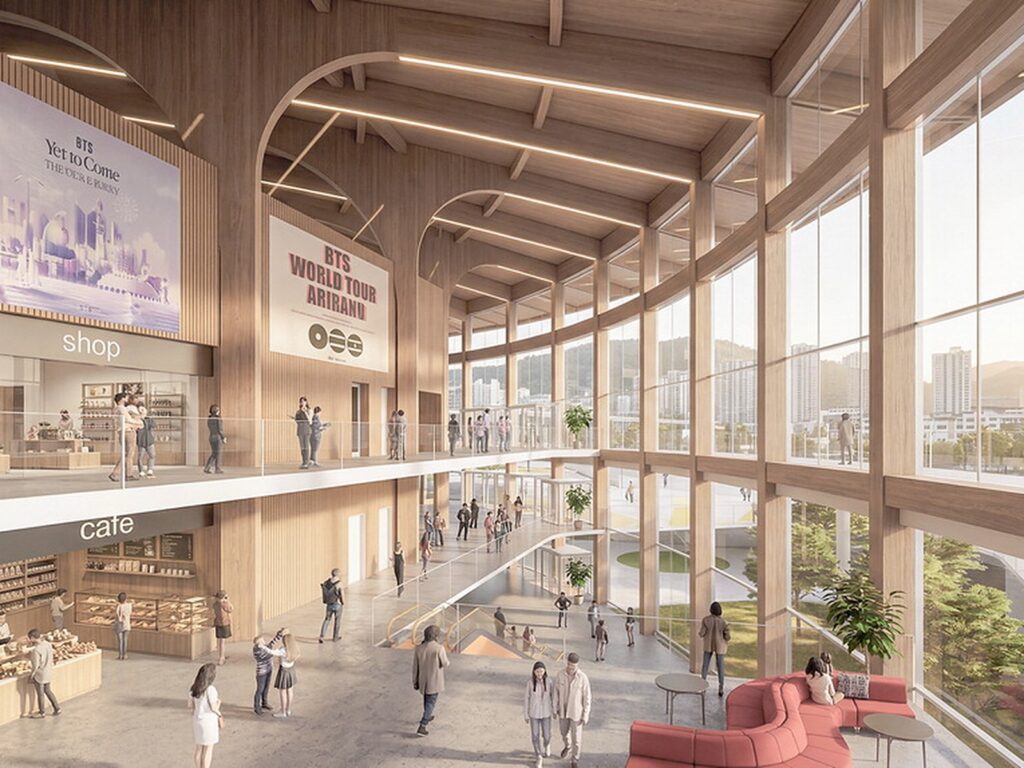
Inside the arena, the design pairs an exposed timber frame with a public concourse of shops and cafés, doubling as a cultural venue on non-competition days. (Render courtesy of the Seoul Metropolitan Government)
Designated for urban sports facilities in 1978, the 50,916-square-metre site languished for decades before administrative clearances and central investment reviews were secured in 2025. The master plan will connect the arena with existing local hubs, including the Gwangjin-gu Citizens’ Sports Center, the Seoul Gwangjin Youth Center and the YES24 Live Hall.
Engineered to meet rigorous international regulatory standards, the venue will host premium training camps and global tournaments in combat sports such as taekwondo, judo and wrestling. On non-competition days, it will open to amateur sport, cultural events and public concerts.
The master plan threads continuous green space between the arena and the Han River, integrating the venue with the Gwangjin-gu Citizens’ Sports Center and YES24 Live Hall. (Render courtesy of the Seoul Metropolitan Government)
Continuous green space will run between the arena and the river at ground level, whilst a public car park below will absorb parking demand around Gwangnaru Station. The design leans on the site’s position as a gateway to Seoul along the Han River, aiming to read as a new urban landmark.
The complex is intended to serve as an open public space where residents’ daily lives coexist with international sport, rather than as a conventional sports venue. That is the stated aim of Kim Yong-hak, the city’s director general for future space planning, who said Seoul would keep delivering public architecture through open, professional design competitions.
The city will finalise the contract with the winning consortium this month, ahead of an 18-month detailed design phase. Construction is scheduled to break ground in April 2028, with the arena due to open in August 2031.
China’s factory activity stalled at the 50.0 mark that divides expansion from contraction in May, even as broader business output stayed positive on stronger services demand. That is according to the National Bureau of Statistics of China, whose latest survey put the official manufacturing purchasing managers index at 50.0, down 0.3 points from April, with the non-manufacturing business activity index at 50.1 and the composite PMI output index up 0.4 points to 50.5.
Manufacturing production held in positive territory at 51.2 as new orders contracted to 49.9, leaving factories busier than their order books. The lift came from pharmaceuticals, railway, ship and aerospace equipment and computer and electronic gear, all above 53.0, while heavier sectors such as fuel processing, chemical fibres and non-metallic minerals dragged below the threshold.
The split between firm output and soft demand drew notice beyond Beijing, and Morgan Stanley Chief China Economist Robin Xing put the recovery’s weight on its best-performing corners. “Domestic demand is lagging, but high-end manufacturing and exports are holding the line,” Xing wrote.
The new-economy lines kept climbing: high-technology manufacturing rose 0.7 points to 52.9, its sixteenth straight month in expansion, and equipment manufacturing added 0.3 to 52.1. Consumer goods slipped the other way to 49.7, down a full point, and energy-intensive industries fell harder, off 0.8 points to 47.1.
Big factories pulled ahead with a PMI of 51.1, up 0.9 points, whilst medium and small firms trailed at 48.6 and 48.5, both stuck in contraction. Input costs ran hot again: the major raw-material purchase price index reached 60.5 and the factory-gate price index 51.9, each down 3.2 points on April but still expanding for a fifth month.
The price strength ran deepest in textiles, chemical fibres, rubber and plastics and ferrous metal smelting, where both gauges stayed above 55.0 for a third month running. Services were the brighter note, with the activity index up 0.7 points to 50.3; railway transport, telecoms, broadcasting and satellite services and insurance all topped 55.0, and the sector’s expectation index reached 55.4.
Construction stayed under the line at 48.8, yet it gained 0.8 points, and its expectation index rose a full point to 51.5. The timber trade reads that gauge closely, since Chinese building demand pulls through to log and sawnwood flows.
The softer reading also comes amid the Iran war and renewed strain on demand, which Morgan Stanley counts alongside oil prices and uncertain global supply among the swing factors for China’s year.
Beijing has set 2026 growth at between 4.5 and 5 per cent, its lowest target since 1991, and Morgan Stanley still expects China to reach it even with the manufacturing gauge sitting exactly on the line.
Russian timber is slipping into Australian homes hidden behind plasterboard and flooring after being laundered through China and other third countries, evading the tariffs imposed after Moscow’s invasion of Ukraine. That is according to Mark Corrigan, a chemical engineer who has tracked Russian-origin imports and reported in Nine Media mastheads today. With birch plywood and Siberian larch entering under the cover of paperwork that masks their provenance, Corrigan said the trade was both invisible to home builders and difficult to police.
Kateryna Argyrou, chair of the Australian Federation of Ukrainian Organisations, said laundered timber and refined Russian crude alike entered the country under clean documentation, leaving the Kremlin free to keep collecting its cut. “It all arrives here legally, with a clean bill of origin,” Argyrou said.
The Australian Forest Products Association (AFPA) estimates up to 100,000 cubic metres of annual imports could carry Russian-origin wood, in a submission to a Senate inquiry into the effectiveness of sanctions on Russia. As reported by the Sydney Morning Herald, acting chief executive Richard Hyett warns that as many as 15,000 new homes built each year could contain it.
In their submission to the Senate Foreign Affairs, Defence and Trade References Committee, Hyett pressed the federal government to close what has been described as Russia’s shadow trade through Chinese and Southeast Asian supply chains. AFPA’s submission points to clear evidence that large volumes of Russian timber are being transferred and transformed through China, sidestepping the 35 per cent tariff Australia placed on Russian goods in 2022. Domestic producers were losing ground to cheap imports, the association said, warning that “Russian timber is coming into Australia rerouted through third-party countries.”
Before the war, Russia held more than a fifth of the world’s forests and supplied up to half the local market for laminated veneer lumber, a share that collapsed once the tariff took hold and Chinese shipments surged. The submission follows mounting pressure on Canberra, which has been pressed to close Russia’s conflict-timber loophole amid accelerating third-country rerouting.
Russian President Vladimir Putin meets Alexey Mordashov, whose business empire controls Sveza, one of the world’s largest plywood producers. (Photo Credit: Wikimedia Commons, CC BY 4.0)
The campaign extends an earlier push by the federation, which pressed Albanese on Russia’s shadow timber trade and demanded sanctions reach all products derived from Russian materials wherever they are processed.
The European Union warned last year that plywood purchases posed a major risk of breaching its ban on wood originating in Russia or Belarus, whilst the United Kingdom has prohibited any direct or indirect purchase of Russian timber products. Australia has taken no equivalent step, the association noted, leaving it a growing destination for rerouted exports.
A Department of Agriculture report released under freedom-of-information laws last year found the provenance of more than half of all sampled timber products could not be accurately verified. The assessment, prepared by verification firm Source Certain, warned that the risk of sourcing conflict timber could be managed only through due diligence.
Timber NSW said in its submission that it believed huge volumes of imported timber may have originated in Russia, urging the government to add both directly and indirectly sourced Russian products to the national sanctions list. The state body wants country-of-origin testing tightened alongside any extension of the tariff regime.
A Department of Foreign Affairs and Trade spokesperson said Australia remained steadfast in supporting Ukraine and that its 35 per cent tariff applied to timber of Russian origin, adding that importers were expected to conduct due diligence on their supply chains.
Juken New Zealand managing director Hisayuki Tsuboi is weighing employee and union feedback against bids from potential buyers, with the formal consultation period for the Kaitāia mills closed since 22 May and a decision on whether to sell or shut down both sites now weeks away. About 100 Far North residents packed Te Ahu Hall in Kaitāia on Saturday, with long-serving Juken workers, Workers First Union representatives, iwi, and politicians united behind the message that the Northland Mill and Triboard plant could survive under the right ownership, provided a credible buyer surfaces before the company makes its call.
“This is a deliberate process and no decisions have been made at this stage,” Tsuboi told the NZ Herald, with JNL set to spend several weeks assessing worker feedback and incoming bids before testing whether a viable pathway exists for continued mill operations.
Workers First union organiser Marcus Coverdale, who hosted the Saturday meeting, said losing the two mills would have a “devastating effect” on the Far North town, with the 200 direct jobs feeding dozens of contractors and the small-business economy across Kaitāia. The two-month sale and consultation process closed at 4pm NZST on 22 May, covering both the formal worker consultation and the buyer-interest window.
One delegate with 27 years at the mill, and a survivor of five rounds of redundancies, warned that an extended closure risked the permanent loss of decades of technical knowledge built up around Triboard — a world-class engineered wood panel that adds significant export value above raw log shipments. The worker argued that closing the operation would reduce New Zealand to exporting raw logs for value to be added offshore, a low-margin position any timber-producing country can occupy.
“This product is world-class,” the delegate said, with the meeting hearing that the financial gap between exporting raw radiata pine logs and exporting finished engineered panels was the single most consequential variable for the Kaitāia operation.
Several speakers expressed optimism that the Government would intervene if no commercial buyer materialised, building on Northland MP Grant McCallum’s earlier confirmation that a consortium of New Zealand-based investors was already in discussions with Juken. Auckland Mayor Wayne Brown also confirmed interest in a private bid in the days before the tender closed.
The meeting also surfaced the structural costs, including the mills’ use of around a third of Kaitāia’s town water supply alongside some of the country’s highest electricity prices, that shaped JNL’s earlier conclusion that the operation could not be made sustainable under existing ownership.
The Kaitāia mills opened 37 years ago and have been Japanese-owned since, manufacturing sawn timber at the Northland Mill and engineered wood panels at the adjacent Triboard plant for residential and commercial construction across New Zealand. Coverdale told the meeting that Aotearoa had already lost six major wood processing sites in the past two years, including Kinleith’s paper machine, Eves Valley, Karioi, and Tangiwai, and could not afford to lose two more.
Tsuboi has not set a public deadline for a final decision, with the future of one of the Far North’s largest private workforces — 200 timber jobs across 37 years of Triboard and sawn-timber manufacturing — now resting on the offers received before the 22 May close, while JNL’s third New Zealand operation in the Wairarapa continues unaffected.
Sarawak will gradually reduce its timber exports while encouraging downstream industries built on planted forests, as the Malaysian state pushes to accelerate its transition towards a green economy. That is according to Sarawak Premier Abang Johari Tun Openg, who set out the policy in his Gawai Dayak 2026 message as part of the state’s broader green economy strategy.
Delivered ahead of the 1 June Gawai Dayak harvest festival, the address cast the export cut as a commitment to environmental sustainability rather than a single policy instrument, with the Premier telling Sarawakians that “there will be a reduction in the export of timber” as the state emphasised its green economic transition.
The cut would draw down an export base that has already softened, with Sarawak’s timber export earnings falling to about RM2.84 billion in 2024, down from RM3.14 billion a year earlier, as plywood receipts slipped to roughly RM1.36 billion, even as export volume edged up to 627,389 cubic metres.
That softer 2024 result gave way to steadier trade through the following year, when the state’s timber exports reached RM1.87 billion across the first three quarters of 2025, with log shipments contributing RM310 million, wood pellet exports climbing 60 per cent to RM97 million, and Japan holding its place as the dominant buyer at RM1.17 billion ahead of India on RM299 million.
Rather than abandoning the forestry sector, the government is encouraging downstream industries based on planted forests to serve a dual purpose, producing biomass whilst functioning as carbon sinks that feed the state’s renewable energy and low-carbon agenda.
The remarks come as Sarawak pursues a wider slate of green initiatives — spanning renewable energy, hydrogen technology, low-carbon industries and sustainable resource management — under its Post-Covid-19 Development Strategy (PCDS) 2030 framework. With the transition agenda aimed at long-term environmental sustainability and growth, Abang Johari said the state was working towards becoming a regional green economy hub for future generations.
Most of British Columbia’s value-added wood manufacturers operate well below best-practice efficiency levels, and the sector’s productivity has lagged behind that of the province’s sawmills and panel makers since before the 2007–2009 financial crisis. That is according to a new study by Lili Sun, Rico Chan and Bryan Bogdanski of Natural Resources Canada’s Pacific Forestry Centre, published in Forest Policy and Economics, which measures firm-level efficiency alongside a long-run productivity index.
Of the 143 British Columbia firms in the sample, only 17 per cent are fully efficient on the study’s aggregate measure, and the technical-efficiency scores suggest most could cut their use of wood and labour by anywhere from 14 to 49 per cent without producing any less, a gap that points to slack across the sector rather than a handful of laggards.
The finding cuts against a long-running policy bet, because secondary manufacturing has been promoted for decades as the way to diversify British Columbia’s forest economy away from declining commodity lumber, a case that has sharpened as US import duties and shrinking timber supply force mill closures across the province. The study effectively tests whether the value-added sector that policymakers have relied on is itself operating efficiently and finds that it largely is not.
The study defines secondary manufacturing as the further processing of lumber into intermediate and finished goods, spanning Cabinets, Engineered Wood Products, Furniture, Millwork, Other Wood Products, Pallets and Containers, Remanufactured Products, and Shakes and Shingles, whilst excluding veneer and panels. A Canada-wide survey cited in the paper estimates the broader sector at $19 billion in sales and 92,000 jobs, whilst British Columbia alone accounts for 680 firms, an estimated 16,888 full-time equivalent workers, and $4.46 billion in sales in 2016.
Drawing on the 2016/2017 survey, the researchers run Data Envelopment Analysis that treats labour and wood use as inputs and sales as the single output, a reasonable lens given that wood purchases and labour together account for 79 per cent of sector costs.
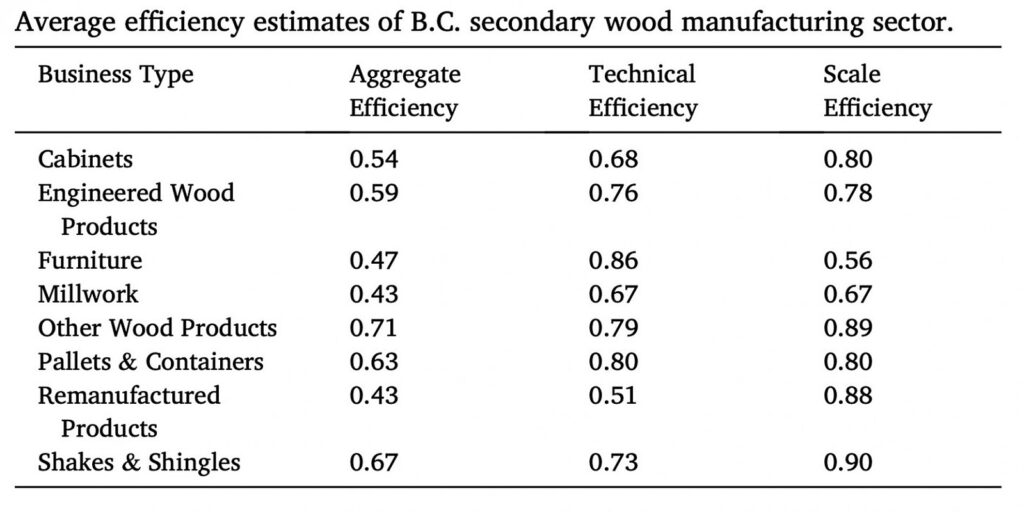
Average aggregate, technical and scale efficiency estimates by business type in the BC secondary wood manufacturing sector. (Source: Sun, Chan and Bogdanski / Forest Policy and Economics)
The inefficiency varies sharply by business type, with Furniture firms posting the strongest technical efficiency and Remanufactured Products the weakest, whilst Other Wood Products leads on aggregate efficiency at 55 per cent of firms fully efficient, compared with just 6 to 7 per cent in Millwork and Cabinets.
Firm counts, average roundwood-equivalent wood use, full-time-equivalent workers and gross revenue for the 143 BC firms in the DEA study. (Source: Sun, Chan and Bogdanski / Forest Policy and Economics)
To connect firm-level efficiency with long-run performance, the authors build a chained Malmquist productivity index from Statistics Canada data running through 2024, which shows sawmills and panel products pulling steadily ahead of secondary manufacturing, with the gap widening after the 2007–2009 financial crisis.
Malmquist total factor productivity, technical change and efficiency change for BC forest manufacturing sectors, 1991-2024. (Source: Sun, Chan and Bogdanski / Forest Policy and Economics)
The authors caution that the long-run series is an imperfect proxy, since Furniture and Cabinets drop out of the industry data and engineered wood producers cannot be cleanly separated, meaning the productivity gap is indicative rather than exact.
The combined picture points to a sector with room to raise output from the wood and labour it already uses, and on the study’s logic the larger prize lies in closing the technical-efficiency gap, improving how firms turn inputs into product, rather than chasing scale, which most categories already manage reasonably well.
For more information: Sun, L., Chan, R., & Bogdanski, B. (2026). Efficiency and productivity analysis of the secondary wood manufacturing sectors in British Columbia. Forest Policy and Economics, [volume], [article no.]. https://www.sciencedirect.com/science/article/pii/S1389934126001176
New Zealand exporters are giving ground on the premiums they have long held on furniture-grade logs, as weak furniture and construction demand across China has eased CFR prices in recent weeks. That is according to PF Olsen, the New Zealand-based forest management and log marketing firm, whose latest wood market report tracks softening retail activity feeding back through the export log supply chain.
Down 10.4 per cent on the same month last year, retail furniture sales totalled CNY 13.4 billion in April, whilst retail sales of construction and decoration materials reached CNY 10.1 billion, a fall of 13.8 per cent year-on-year. The monthly figures extend a slide already visible across the opening months of 2026.
Reporting weak demand and elevated inventory levels, manufacturers continue to put pressure on premiums for furniture-grade logs such as pruned and A40 grades. Across January to April, retail furniture sales were down 1.4 per cent year-on-year, whilst retail sales of construction and decoration materials declined 7.1 per cent over the same period.
Softwood log inventories across China have held within a 2.4 to 2.7 million cubic metre range, with daily offtake steady at about 55,000 to 60,000 cubic metres. (Photo Credit: Stock Image)
Sitting at NZ $126 to NZ $127 per JASm3 for the larger exporters, CFR prices for A-grade logs from New Zealand have edged lower in recent weeks. Most exporters have accepted reductions of about NZ$ 2 per JASm3, underlining how tight the room has become to defend furniture-grade premiums against weak downstream demand.
Held relatively stable within a 2.4 to 2.7 million cubic metre range, softwood log inventories across China have absorbed higher arrivals through April without building further. Softwood log imports totalled 2.204 million cubic metres for the month, up 0.9 per cent on March.
Combined hardwood and softwood log imports tell a similar story, reaching 2.98 million cubic metres in April. That marked a 7.9 per cent month-on-month rise, running 1.7 per cent ahead of the same month last year as buyers replenished at softer prices.
Steady at about 55,000 to 60,000 cubic metres, the daily log offtake across China has held firm even as the lumber trade weakened. Softwood lumber imports fell 32.8 per cent year-on-year in April to 967,000 cubic metres, with cumulative annual imports down 12.5 per cent. Anchored to soft retail demand and steady offtake, the market leaves New Zealand exporters defending furniture-grade premiums whilst lumber imports continue their year-on-year retreat.
Timber and forest products companies would gain a direct route to compete for federal construction, renovation and military building contracts under bipartisan legislation introduced in the United States House of Representatives, where mass timber would carry a two-tier contracting preference. That is according to Glenn “GT” Thompson, the Pennsylvania Republican who introduced the Mass Timber Federal Buildings Act alongside Oregon Democrat Andrea Salinas.
Structured across two tiers, the bill puts mass timber made in the United States and responsibly sourced from state, federal, private and Tribal forestlands first in line for federal work. An optional second tier extends to products drawn from restoration practices, fire mitigation projects and forest owners, while a whole-building lifecycle assessment requirement would gather evidence on the environmental performance of wood in federal buildings.
For Thompson, whose district includes the Allegheny National Forest, the measure aims to expand markets for the timber that Pennsylvania’s foresters and mills are already ready to supply. “Timber and forest products have long been an important economic engine,” Thompson said.
Tying the bill to Oregon’s mass timber industry and to construction costs, Salinas argued that federal demand would expand the sector, support jobs and help bring down building costs amid the housing crisis. “Our wood products are sustainable and cost-effective building materials,” Salinas said.
The United States has emerged as one of the fastest-growing markets for mass timber, with thousands of multi-family, commercial and institutional projects completed or under way nationwide. (Photo Credit: Alamy Stock Images)
The push comes as US softwood demand remains weak, with imports across the largest markets falling almost 2 million cubic metres in the first quarter under steep duties on Canadian supply and a weak homebuilding market. National Alliance of Forest Owners president and chief executive Dave Tenny welcomed the bill as a lever for rural communities and domestic manufacturing.
“Strong markets for innovative wood products like mass timber help sustain rural communities,” Tenny said. The American Forest Resource Council and the Forest Landowners Association also endorsed the measure, alongside Pennsylvania’s Allegheny Hardwood Utilization Group and the Pennsylvania Forest Products Association.
On the Senate side, Oregon Democrat Jeff Merkley and Idaho Republican James Risch lead a companion bill, giving the legislation a path in both chambers. Mass timber — the engineered material made by bonding wood panels, beams and columns into structural components — can carry mid- to high-rise buildings.
For now, Thompson and Salinas are advancing a measure that puts American-made, responsibly sourced mass timber first in line for federal construction, renovation and military building work.
A new national testing standard for mechanical fasteners and connectors holding timber buildings together gives manufacturers, laboratories, and engineers a single, repeatable method for measuring how those joints carry load. That is according to FWPA Standard T01, the FWPA-funded Industry Standard developed by the ARC Advance Timber Hub at the University of Queensland in collaboration with the Engineered Wood Products Association of Australasia.
Aimed at manufacturers, testing laboratories, universities, engineers and certifiers, the standard sets out consistent methods for measuring strength, stiffness, ductility and slip behaviour across both sawn timber and engineered wood products, including glue-laminated timber, laminated veneer lumber, cross-laminated timber and plywood. It covers lateral and axial loading, along with testing of individual fasteners and full connection assemblies, generating characteristic design values suitable for structural design under AS 1720.1.
Rather than replacing existing Australian Standards, T01 is built to sit alongside them, offering an alternative route to the characteristic capacities of commonly used timber connection types until AS 1649, revised in 2025, undergoes a further comprehensive overhaul. The standard fills a working gap, providing usable test data to the sector for modern timber systems, whilst the formal benchmark catches up.
For Forest and Wood Products Australia, the value lies in comparability, with a single shared method enabling laboratories, researchers and manufacturers to measure the same connection consistently. “Improves transparency and comparability of test results,” FWPA said.
Released as a 2026 first edition covering Category A and B fasteners, T01 marks the opening part of the series, and Forest and Wood Products Australia has built it to run alongside the Australian Standards until AS 1649 clears its next full revision.
Public comment has opened on the first amendment to the standard governing certified sustainable forests across Australia and New Zealand, with the revision drafted to bring the scheme into line with the European Union’s deforestation regulation. That is according to Responsible Wood, the standards development organisation behind AS/NZS 4708 and the body that administers PEFC-endorsed certification across both countries.
The standard sets out the requirements forest managers must satisfy to certify their operations as sustainable, anchoring the Responsible Wood Certification Scheme in Australia whilst forming the basis of the PEFC-recognised scheme in New Zealand. Reviewed every five years and last updated in 2021, the document governs certification across 17 million hectares of Australian forest and a further 600,000 hectares across the Tasman, and has been redrafted by the organisation’s Standards Reference Committee.
Responsible Wood CEO Simon Dorries said the review kept the standard aligned with evolving industry practice, scientific knowledge and stakeholder expectations across the sector: “Sustainable forest management impacts a wide range of people and sectors,” Dorries said.
Responsible Wood chief executive Simon Dorries said the five-yearly review keeps AS/NZS 4708 aligned with evolving industry practice, scientific knowledge and stakeholder expectations as the standard moves into line with the EU deforestation regulation. (Photo Credit: Wood Central / Central PR Group supplied by Weathertex as part of Wood You Like to Know)
The amendment responds to changes in the PEFC International benchmark PEFC ST 1003:2024, rewritten to align the global certification system with the European Union Deforestation Regulation, alongside feedback gathered since the last revision. The consultation follows Responsible Wood’s move last year to begin redrafting the standard to meet the incoming EU rules.
Drawn from forest managers, researchers, auditors, government, environmental groups, Indigenous stakeholders, industry and unions across both countries, the committee prepared the draft under Standards Australia procedures, with Responsible Wood accredited as a standards development organisation in both markets.
Dorries said the consultation gave forest managers, manufacturers, builders, designers, retailers, environmental groups and communities a direct hand in shaping responsible forest management on both sides of the Tasman.
Responsible Wood has set 7 August as the deadline for submissions, with the draft standard and submission form available ahead of the committee finalising the revision under the PEFC system, which it describes as the world’s largest.
Softwood lumber imports across the world’s 10 largest markets by volume contracted sharply between January and March, led by a 1.94 million cubic metre fall in the United States, a 1.19 million cubic metre fall in Germany, and a 775,000 cubic metre fall in China. Combined imports into those markets dropped 3.9 million cubic metres to 12.6 million cubic metres over the quarter, according to new data aggregated by Lesprom Analytics.
The US is the epicentre.
In the United States, the decline came as steep import duties on Canadian softwood restrained shipments and a soft homebuilding market — where new home sales remain weak, and prices stay elevated — kept demand subdued. Canada posted the single largest supplier fall of the quarter at 1.52 million cubic metres, a squeeze felt acutely after Canfor booked a CAD $72.5 million Q1 loss under an effective duty burden near 35 per cent.
“The first quarter of 2026 continued to reflect challenging market conditions across our global operations,” Canfor President and Chief Executive Susan Yurkovich told shareholders. Russia logged the second-largest supplier fall of the period at 743,000 cubic metres, with Austria third at 680,000 cubic metres.
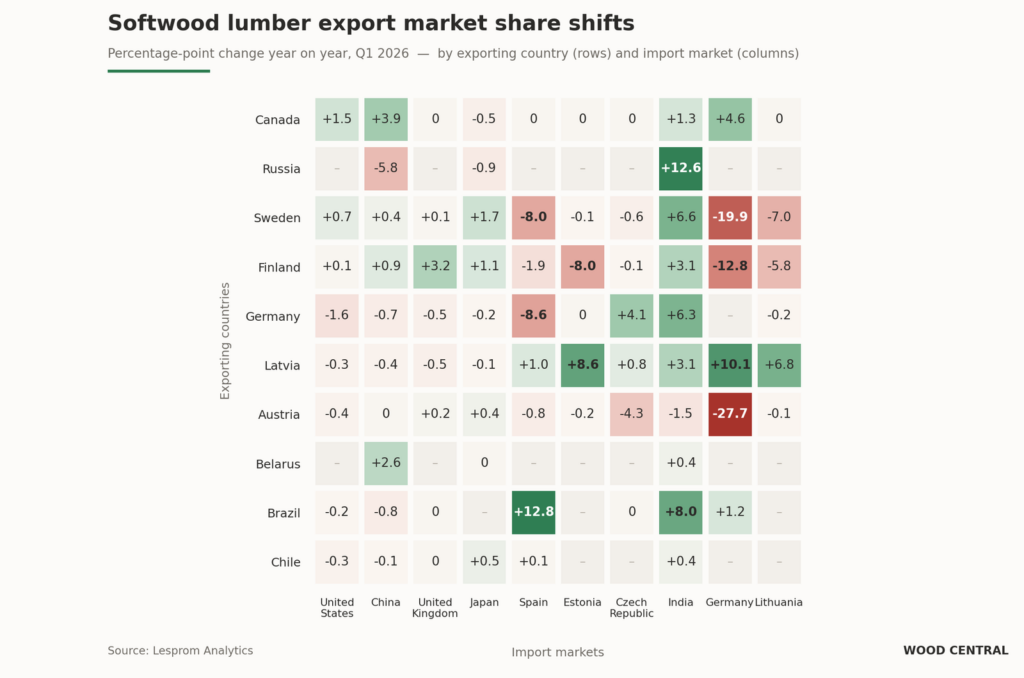
Softwood lumber export market share shifts across the 10 largest import markets, Q1 2026 — year-on-year change in percentage points, with Austria shedding 27.7 points in Germany and Latvia gaining 10.1. (Chart: Wood Central; data: Lesprom Analytics)
In Germany, the deck is reshuffling.
As construction activity stayed weak, Germany recorded the second-largest market contraction, with imports down 1.19 million cubic metres. Inside that shrinking market, the supplier order turned over hard, with Austria shedding 27.7 percentage points of share, Sweden 19.9 percentage points, and Finland 12.8 percentage points.
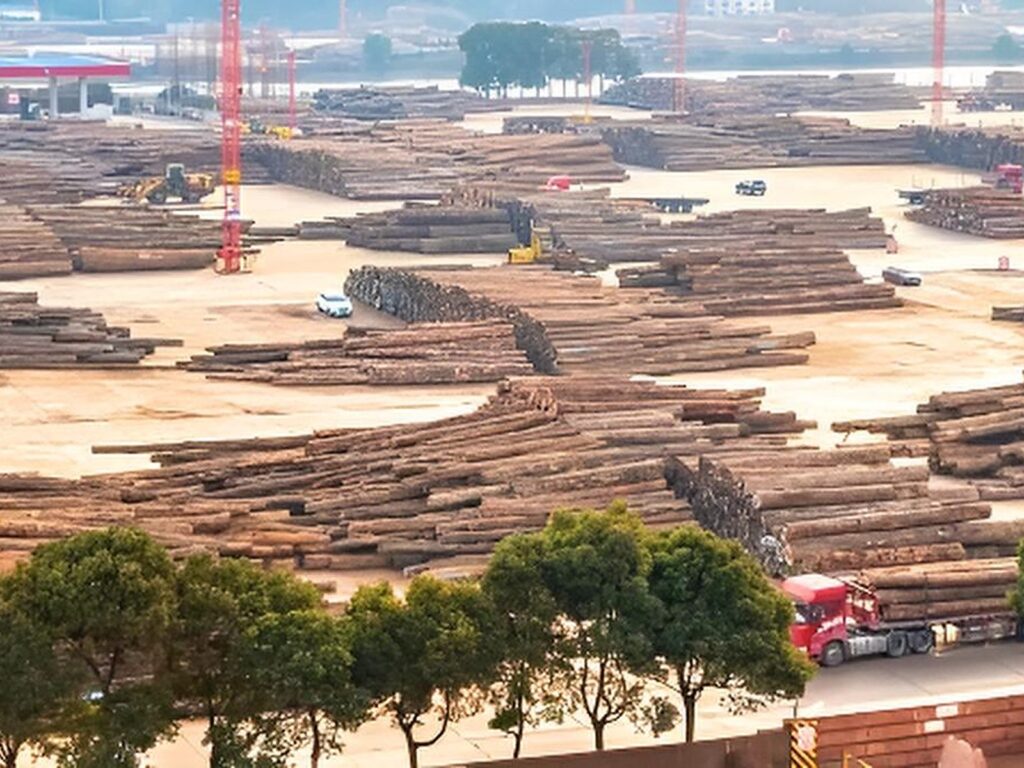
Sawlogs feed the infeed deck of a European sawmill — Germany’s softwood lumber imports fell 1.19 million cubic metres in the first quarter of 2026, the second-largest drop among the 10 largest markets. (Photo: Stock Photo)
Filling the gap, Latvia gained 10.1 percentage points, Canada 4.6 percentage points, and Brazil 1.2 percentage points as buyers rebalanced toward lower-cost and closer supply. China rounded out the three largest market declines, with construction demand staying weak across the quarter.
With the United States, Germany and China together driving the bulk of the 3.9 million cubic metre slide, and Belarus the only notable mover the other way at 15,700 cubic metres, the quarter sets a soft baseline for the major buyers heading into the northern building season.
Billionaire developer Jeff Greene has put forward a 25-story, 399-apartment tower for a downtown West Palm Beach block that, if built in the prefabricated timber described by its design team, would stand as the tallest wood-framed building in Florida. That is according to the South Florida Business Journal, which first detailed the proposal for 120 South Dixie Highway under the state’s Live Local Act.
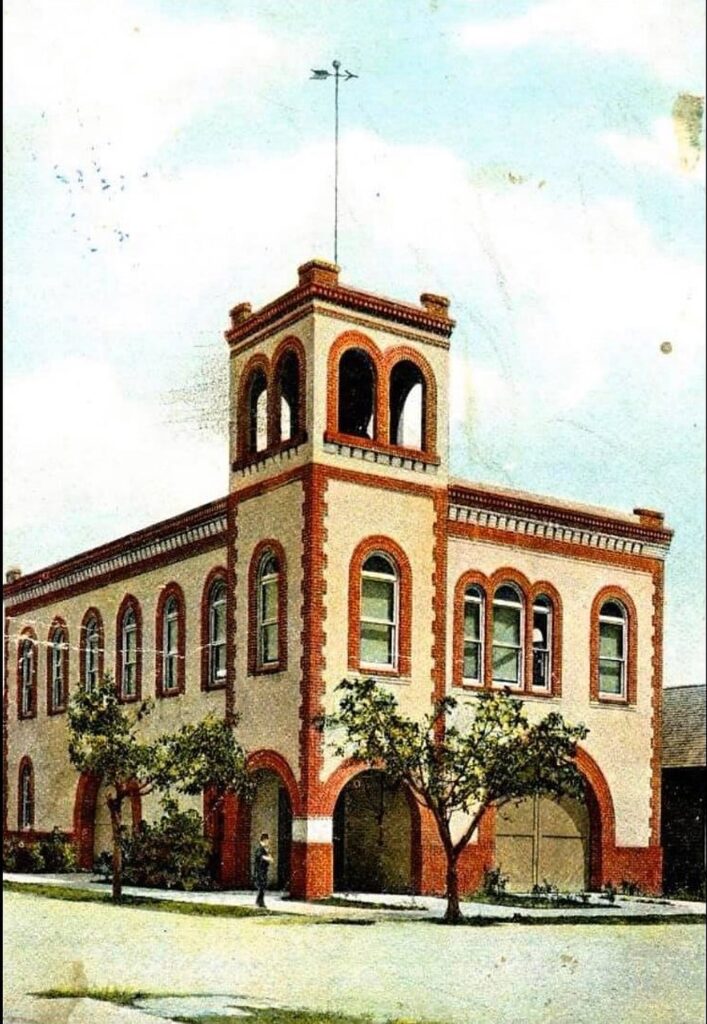
The tower is the work of Carlo Ratti Associati, the Turin and New York practice whose founder curated the 2025 Venice Architecture Biennale, with a tapering faceted facade rising above a brick podium. Its design would fold a turn-of-the-century firehouse on the site into the building’s frontage, keeping the masonry landmark within a modern high-rise.
The high-rise would incorporate part of this turn-of-the-century firehouse into its facade. (Image from Facebook)
Carlo Ratti Associati and development partner Nexus Systems intend to build the tower from prefabricated timber modules, a method the team says would speed construction and keep costs down. The developers argue that off-site timber fabrication and the material’s lower embodied carbon would deliver a faster, cleaner build than a conventional concrete frame.
Carlo Ratti Associati’s design tapers to a faceted timber peak above a brick podium. (Image: Carlo Ratti Associati)
The Live Local Act lets qualifying projects bypass some local zoning limits and pursue administrative approval in return for long-term workforce housing. About 160 of the 399 apartments, roughly 40 per cent, would be reserved for households earning at or below 120 per cent of the area median income, which Palm Beach County sets at $104,000.
Plans describe studios through three-bedroom units of 505 to 1,320 square feet, with workforce homes set on floors two to four and six to 11 and market-rate apartments above. The scheme also carries about 7,550 square feet of retail and 236 parking spaces, alongside shared amenities including a pool and gym on the fifth floor.
The West Palm Beach Plans and Plats Review Committee reviewed the proposal on 14 May and returned it for changes the developer must make before construction can begin. That early municipal scrutiny sits at the front of a Live Local approval path that can otherwise move administratively once a filing meets the statutory checklist.
Tall-wood towers have won global support for faster assembly and lower carbon, yet they continue to raise engineering, fire-safety and insurance questions, particularly in hurricane-exposed markets such as South Florida. Whether a 25-story timber building can meet Florida’s wind codes and insurers’ requirements remains the central technical test for the design.
The 25-story Ascent tower in Milwaukee, completed in 2022 as the world’s tallest mass-timber building at the time, is routinely cited as proof that high-rise timber is achievable. Its example also shows how approval processes and insurance standards shift sharply from one jurisdiction to the next.
Greene is pressing ahead with the twin-tower One West Palm development downtown and holds extensive land across the city, a portfolio that has repeatedly drawn him into disputes with West Palm Beach over height and zoning. The new timber proposal arrives as those tensions continue, with the developer and the city already at odds over a separate Currie Park scheme.
For now the proposal rests with the West Palm Beach Plans and Plats Review Committee, which will decide whether a 25-story timber tower holding 160 affordable apartments clears the changes it has demanded before construction.
 Login
Login