The Seoul Metropolitan Government will build Korea’s first large-scale hybrid timber international arena on the Han River waterfront, a 199.9 billion won ($145 million) venue near Gwangnaru Station designed for elite combat sports and year-round public use. That is according to the city government, which on Monday named the winning entry in an international design competition for the Gwangjang-dong Multipurpose Sports Complex.
A joint entry by Gawa Architects & Associates, Iséak Architects and DD Architects won the commission ahead of 27 rival submissions, with a circular arena built around a hybrid timber frame. Such a structure remains a rarity among large-scale public buildings in Korea, where mass timber has been slow to move into civic infrastructure.
The judging panel praised the winning design for balancing public accessibility with professional arena functionality, citing its separation of athlete and spectator circulation and its fit with the surrounding district. The panel reached that view despite complex underground conditions on the site, which lies above a subway line and waste treatment infrastructure.
Inside the arena, the design pairs an exposed timber frame with a public concourse of shops and cafés, doubling as a cultural venue on non-competition days. (Render courtesy of the Seoul Metropolitan Government)
Designated for urban sports facilities in 1978, the 50,916-square-metre site languished for decades before administrative clearances and central investment reviews were secured in 2025. The master plan will connect the arena with existing local hubs, including the Gwangjin-gu Citizens’ Sports Center, the Seoul Gwangjin Youth Center and the YES24 Live Hall.
Engineered to meet rigorous international regulatory standards, the venue will host premium training camps and global tournaments in combat sports such as taekwondo, judo and wrestling. On non-competition days, it will open to amateur sport, cultural events and public concerts.
The master plan threads continuous green space between the arena and the Han River, integrating the venue with the Gwangjin-gu Citizens’ Sports Center and YES24 Live Hall. (Render courtesy of the Seoul Metropolitan Government)
Continuous green space will run between the arena and the river at ground level, whilst a public car park below will absorb parking demand around Gwangnaru Station. The design leans on the site’s position as a gateway to Seoul along the Han River, aiming to read as a new urban landmark.
The complex is intended to serve as an open public space where residents’ daily lives coexist with international sport, rather than as a conventional sports venue. That is the stated aim of Kim Yong-hak, the city’s director general for future space planning, who said Seoul would keep delivering public architecture through open, professional design competitions.
The city will finalise the contract with the winning consortium this month, ahead of an 18-month detailed design phase. Construction is scheduled to break ground in April 2028, with the arena due to open in August 2031.
Softwood lumber imports across the world’s 10 largest markets by volume contracted sharply between January and March, led by a 1.94 million cubic metre fall in the United States, a 1.19 million cubic metre fall in Germany, and a 775,000 cubic metre fall in China. Combined imports into those markets dropped 3.9 million cubic metres to 12.6 million cubic metres over the quarter, according to new data aggregated by Lesprom Analytics.
The US is the epicentre.
In the United States, the decline came as steep import duties on Canadian softwood restrained shipments and a soft homebuilding market — where new home sales remain weak, and prices stay elevated — kept demand subdued. Canada posted the single largest supplier fall of the quarter at 1.52 million cubic metres, a squeeze felt acutely after Canfor booked a CAD $72.5 million Q1 loss under an effective duty burden near 35 per cent.
“The first quarter of 2026 continued to reflect challenging market conditions across our global operations,” Canfor President and Chief Executive Susan Yurkovich told shareholders. Russia logged the second-largest supplier fall of the period at 743,000 cubic metres, with Austria third at 680,000 cubic metres.
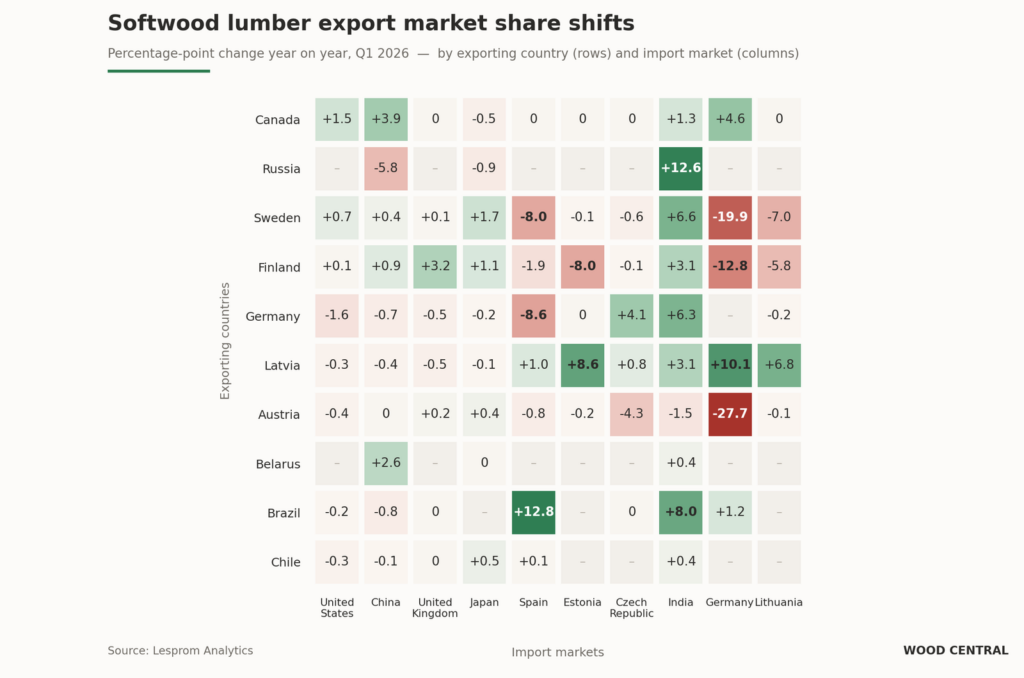
Softwood lumber export market share shifts across the 10 largest import markets, Q1 2026 — year-on-year change in percentage points, with Austria shedding 27.7 points in Germany and Latvia gaining 10.1. (Chart: Wood Central; data: Lesprom Analytics)
In Germany, the deck is reshuffling.
As construction activity stayed weak, Germany recorded the second-largest market contraction, with imports down 1.19 million cubic metres. Inside that shrinking market, the supplier order turned over hard, with Austria shedding 27.7 percentage points of share, Sweden 19.9 percentage points, and Finland 12.8 percentage points.
Sawlogs feed the infeed deck of a European sawmill — Germany’s softwood lumber imports fell 1.19 million cubic metres in the first quarter of 2026, the second-largest drop among the 10 largest markets. (Photo: Stock Photo)
Filling the gap, Latvia gained 10.1 percentage points, Canada 4.6 percentage points, and Brazil 1.2 percentage points as buyers rebalanced toward lower-cost and closer supply. China rounded out the three largest market declines, with construction demand staying weak across the quarter.
With the United States, Germany and China together driving the bulk of the 3.9 million cubic metre slide, and Belarus the only notable mover the other way at 15,700 cubic metres, the quarter sets a soft baseline for the major buyers heading into the northern building season.
Forest fires have NOW caused more than UAH 1 trillion in damage across Ukraine since Russia’s full-scale invasion began, with the destruction of timber stands accounting for the bulk of the country’s mounting environmental losses. That is according to the State Enterprise Forests of Ukraine, the government body responsible for managing the nation’s forest fund.
Environmental inspectors estimate that damage rose by a further UAH 36.7 billion between 15 and 22 May 2026 alone, with more than UAH 36.3 billion of that total tied directly to forest fires and the loss of other plantations. The weekly increase points to a war that continues to consume forest assets at a pace no peacetime disturbance has matched.
Official figures from Ukraine’s State Environmental Inspectorate put total war-driven environmental damage at roughly UAH 6.9 trillion between 24 February 2022 and 22 May 2026, with forest fires accounting for UAH 1 trillion across 165,000 hectares. (Image Credit: State Environmental Inspectorate of Ukraine)
Roughly 165,000 hectares of forest have burned since the war began, a figure that has climbed steadily across more than four years of conflict. Most of the fires trace back to Russian shelling and combat operations concentrated in the frontline and border regions.
Firefighting machinery moves through dense smoke to contain a blaze in a Ukrainian pine stand.
The highest concentration of fires last week struck the Kharkiv and Chernihiv regions, where foresters and emergency rescuers fought blazes that combat conditions made far harder to reach. In the frontline, crews extinguished several large fires covering more than 20 hectares whilst working amid live mine danger.
“Extinguishing was complicated by the presence of explosive objects,” Forests of Ukraine said.
A fire crew works a burnt clearing where felled timber continues to smoulder, as foresters and rescuers respond to blazes across frontline regions. (Photo Credit: Forests of Ukraine)
Foresters extinguished 22 separate fires totalling 28.6 hectares over the most recent week, 14 of them caused directly by Russian strikes and a further seven sparked by enemy drone attacks in the Chernihiv region. The remaining ignitions were blamed on residents’ careless handling of fire across the Rivne, Volyn, Kharkiv and Sumy regions.
Scorched trunks stand in heavy smoke as the forest floor continues to smoulder. (Photo Credit: Forests of Ukraine)
New ignitions have since broken out across the Chernihiv region, particularly in the Pereliub forestry, where a fire covering 5,800 hectares raged only weeks earlier. The enterprise has separately distanced itself from a blaze on the slopes of Mount Pikuy in the Carpathians, noting the fire began outside its forest fund on land managed by the Boykivshchyna National Nature Park.
A fire truck works a smouldering site at dusk, embers still glowing across the forest floor. (Photo Credit: Forests of Ukraine)
The losses fall on a forest estate already under severe pressure, with logging volumes down sharply since the invasion and Ukraine exporting more than US$2 billion in wood and wood products as recently as 2021. Kyiv has since extended a zero-quota licensing regime barring exports of unprocessed timber and fuelwood through the end of 2026, a measure designed to steer scarce raw material toward domestic processors and rural heating supply.
Wood Central understands that recovery will demand years of demining, replanting and restoration before scorched stands return to productive use, even as Ukraine works to expand domestic logging and timber processing and prepares to align with the EU Deforestation Regulation. Sustained investment on that scale will be hard to summon whilst the war shows no sign of easing.
An electric drone has felled a tree and flown it clear of a working forest without a single ground machine, completing every step of the harvest on its own. That is according to Norrsken Evolve general partner Alex Bakir, whose firm backs AirForestry, the Uppsala-based green technology company developing the airborne thinning system, and who confirmed the result at the weekend.
Bakir, who has watched the drone move from prototype to a working stand, did not understate the moment, calling the autonomous harvest the first of its kind anywhere. AirForestry says its drone felled trees in a working production forest and, separately, completed an end-to-end harvest without human control — each a first for the airborne thinning method it has built since 2020.
Conventional thinning relies on machines weighing 20 tonnes or more, driven deep into the stand to fell trees that themselves weigh as little as 80 kilograms. AirForestry estimates that more than 20 per cent of the forest floor is damaged simply to move that machinery into position, with forest owners worldwide spending around €14 billion a year on the operation.
Built to avoid all of it, the company’s drone flies above the canopy on an electric powertrain that leaves no wheel tracks, no soil compaction and no root damage. Its 6.2-metre carbon-fibre airframe carries a purpose-built harvesting tool that grips a tree from the top, delimbs it on the way down, cuts it close to the ground and carries the trunk out to the nearest road.
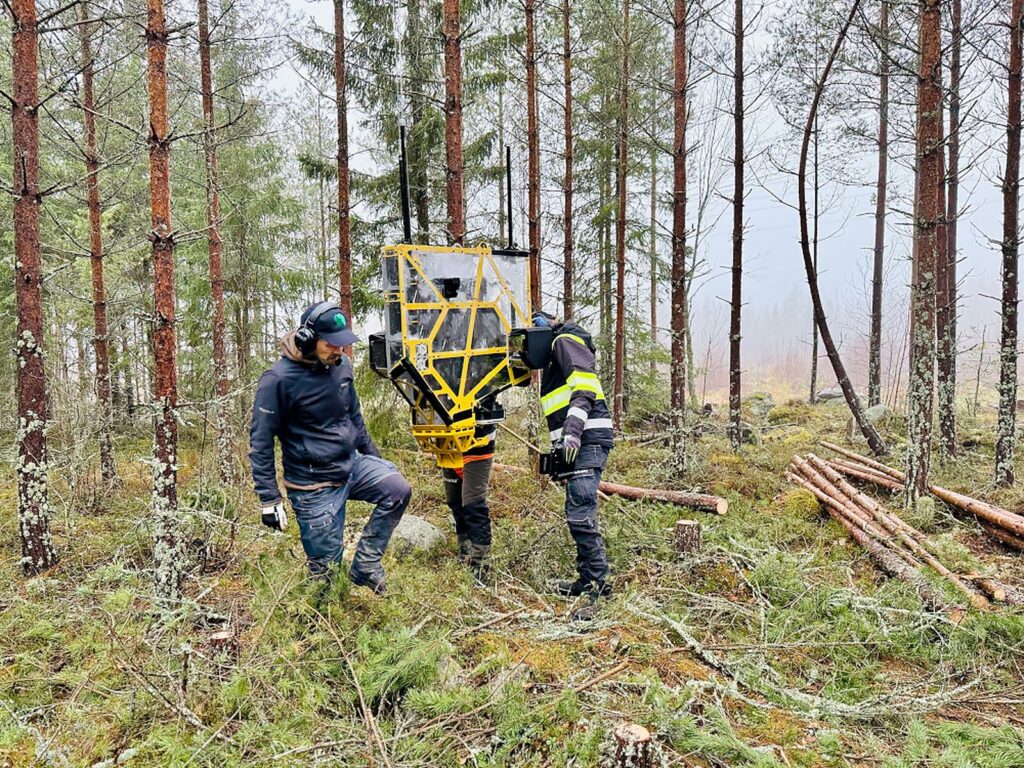
AirForestry technicians set the harvesting tool in a thinned stand, with felled stems stacked at right. (Photo Credit: AirForestry)
The system is designed to work in temperatures as low as minus 20 degrees, through rain and snow and in wind gusts of 13 metres a second, the conditions that define a Nordic thinning season. The drone can carry 200 kilograms, comfortably above the 40-140 kilogram range of the thinning-grade trees it is designed to remove.
AirForestry’s drone runs a full-cycle harvest, gripping a tree from the top, delimbing and felling it, then carrying the trunk clear of the stand. (Video Credit: AirForestry)
AirForestry puts hard figures behind the method. It estimates that the approach yields around 8 per cent more timber across a full harvest cycle, and that removing ground machinery from Swedish thinning alone would keep 23 million tonnes of carbon dioxide stored in standing trees. For Bakir, whose firm has followed the drone from a one-metre prototype in 2020 to a working production stand, the result marks a structural break rather than a one-off test. “The forest floor is no longer where forestry happens,” Bakir said.
Founded in 2020 by Olle Gelin, Mauritz Andersson, Markus Romar and Caroline Walerud, the company has since drawn backing from several of Europe’s largest forest owners. Walerud, who became chief executive in December 2025, has moved AirForestry into a scale-up phase after a €10.3 million seed round led by Northzone late in 2024.
Walerud has set the company an unusually large target, arguing that drone thinning can take a substantial share out of forestry’s carbon emissions against what she describes as almost unlimited customer demand. “I believe that AirForestry could become one of the world’s most important companies,” Walerud said.
The AirForestry team with a drone-felled trunk and the harvesting drone behind, at the company’s base outside Uppsala. (Photo Credit: AirForestry)
The production-forest result also follows AirForestry’s first move beyond Sweden, a project opened in January with the Norwegian state forestry body Statskog in terrain near Trondheim. Statskog manages close to one-fifth of Norway’s forest area, and the trial is testing whether drone thinning can work on the steeper, more rugged terrain that conventional machinery struggles with.
Co-founder Olle Gelin, who led the company through that expansion, says the Norwegian project points to demand well beyond AirForestry’s home market. “This collaboration with Statskog is a significant step in that direction,”Gelin said.
Six aircraft thinning a single stand at once, each flying autonomously, is the operation AirForestry is now building toward. The company has said that fleet configuration is the point at which the cost of airborne thinning matches the ground-based machinery it intends to replace, and it forms the basis for the commercial rollout it is now preparing.
A saddle-shaped timber canopy nicknamed “the Pringle” has been craned into position at a film studio campus outside Atlanta, Georgia, forming North America’s longest bending-active timber gridshell. That is according to StructureCraft, the Vancouver-based timber engineer and design-builder behind the superstructure, which set the doubly curved grid in place earlier this week, ahead of a grand opening early next month in time for the FIFA World Cup.
Wood Central understands the 370-square-metre Assembly Studios Bandshell rests on two precast concrete plinths at the edge of a new public greenspace, its elastically bent timber laths arching up from a near-flat lattice into a doubly curved span of close to 25 metres. Stainless-steel shingles will clad the finished shell, shaped to catch the Georgia sun from almost any angle.
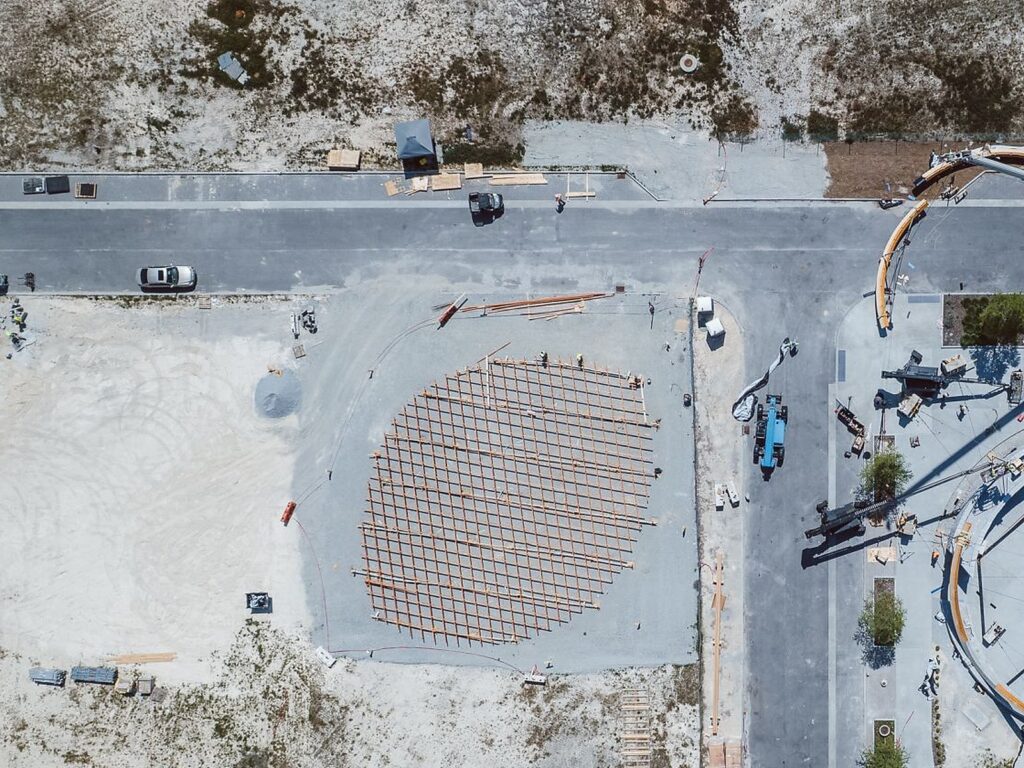
An aerial view shows the timber gridshell in its near-flat lattice state, the circular grid of laths later elastically bent into a doubly curved canopy spanning close to 25 metres. The structure rises beside a new public greenspace at the Assembly Studios campus in Doraville, Georgia. (Photo credit: StructureCraft)
Bending-active gridshells of this kind trace back to the experimental lath roofs of the 1970s, before the structural type fell out of use worldwide, held back by the engineering nerve and the fused design-and-build approach it demands. StructureCraft head of engineering Lucas Epp said no comparable timber gridshell had been attempted at this scale anywhere in North America.
“It’s going to be an eye-catcher for sure,”Epp said.
The $10 million budget covers site works, civil engineering, landscaping, and building services, with the bandshell opening the long-delayed second phase of Assembly Atlanta, the 49-hectare Grey Media production campus in Doraville. Apple TV’s forthcoming remake of Cape Fear is among the productions recently shot at the studios.
Curved glulam arches are tensioned into position over the amphitheatre stage at the Assembly Studios Bandshell, the second timber element of a venue anchored by the saddle-shaped gridshell canopy. StructureCraft fabricated the arches offsite to the same millimetre tolerances before crews craned each rib into the ring. (Photo credit: StructureCraft)
Fabrication ran entirely offsite, with the timber members shaped in Canada and trucked to Georgia before Bailey Construction hoisted the completed shell onto its supports and fixed it at six points. Gipson Company president Jay Gipson said the curved geometry forced every surrounding platform, wall and stage element to be built to a tolerance of around five millimetres.
“These woods have turns, they have twists,” Gipson said.
Crews were scheduled to fix the plywood diaphragm in the week after the grid was set, followed by the roofing and secondary components that finish the canopy.
The canopy is not the only timber structure on the site, with a ring of curved glulam arches rising over the bandshell’s concrete amphitheatre stage, each rib craned in and tensioned against the others to hold the sweeping form. Smith Dalia Architects, the Atlanta practice behind the bandshell, drew the arches and the saddle shell as a single composition, a timber set piece for a park built to host open-air screenings and full-scale concerts.
Mid-rise has overtaken detached housing as the building typology driving Australia’s housing growth, with established frame and truss supply chains now ceding ground in a market they have historically dominated. That is according to IndustryEdge Managing Director and AFWI Precinct Project Manager Tim Woods, who today addressed FTMA’s National Conference — At the Crossroads, Reframing the Growth — at Twin Waters on the Sunshine Coast.
Speaking to a room packed with frame and truss manufacturers, Woods said mid-rise approvals jumped more than 70 per cent in 2025 to add 7,800 dwellings to the national pipeline — the same volume uplift as freestanding houses and townhouses combined, with the latter two formats rising just 1.9 per cent and 20.5 per cent respectively. The segment was on track to entrench itself across the coming decade, Woods said, with mid-rise unlikely to retreat below current levels as Australia chases the 225,000 dwellings per year needed by 2034 to clear a preexisting national housing shortfall.
Australia’s freestanding house approvals have not delivered the volume needed in 30 years, with the highest-ever total of 132,000 reached in 1994 and peak completions of 124,500 dwellings recorded the following year. With the past decade averaging just 175,000 total completions annually — well below the 180,000 base demand line and the 225,000 catch-up rate identified in FWPA-funded research released in February 2025 — Woods said the maths no longer permitted the sector to lean on the detached format.
The stronger signal came from the 2025 trade data, which showed structural timber consumption declined 1.1 per cent across the calendar year despite a rising market in approvals. “That is an inflection point,” Woods told delegates, with LVL imports climbing 26 per cent to a probable record, prefabricated dwelling imports up 53 per cent and light gauge steel taking some share in mid-rise and high-rise construction.
Mid-rise is on track to carry the bulk of Australia’s housing growth as the country chases 225,000 dwellings per year through to 2034. (Photo Credit: Stock Image)
Woods argued the steel sector’s gains came from solving builder and developer problems, which he said the timber industry has the products to address, but has yet to deliver as an integrated solution. Engineered wood products carry the embodied-carbon advantage, the material-flexibility advantage, and the quality-of-life advantage that light gauge steel lacks, yet still lose share because the sector has not pulled supply, design, manufacture, and installation into a single offer developers now demand across detached, townhouse, and mid-rise construction.
Woods urged the timber-frame sector to evolve its building systems to compete in mid-rise as the immediate priority, with high-rise a more cautious horizon. The next ten years would either secure timber’s place across the formats that will deliver Australia’s housing or shut it out of them, Woods said, with the slipping share no longer a theoretical risk worth observing.
The presentation ran alongside a panel discussion on the Forest and Wood Products Australia (FWPA) and Australian Forest and Wood Innovations (AFWI)-backed Future Frame Initiative, featuring Louise Wallis of the University of Tasmania, Australian Timber Development Association CEO Andrew Dunn, AFWI Deputy Director Patrick Mitchell and FWPA Head of Built Environment and Head of the WoodSolutions Programme Kevin Peachey. The AFWI side of the partnership is supported by a $200 million combined research pool, with $100 million in federal funding matched dollar-for-dollar by co-investment partners.
Pressed by delegates on the federal budget’s capital gains and negative gearing changes, Woods said the package would free up marginal dwellings sustained only by tax advantage, with apartment and flat stock flowing into the market over the coming year. The tax changes were not the principal driver of the housing market, Woods said, attributing the next leg of activity to underlying demand rather than fiscal settings.
Woods closed by telling delegates Australia would fall 1.02 million dwellings behind demand by 2034 if completions held at the past decade’s 175,000-per-year average — a shortfall equivalent to roughly 380,000 families on a 2.3-person household basis.
Please note: Wood Central will have additional coverage from the FTMA National Conference in the coming days.
CSIRO will close its North Ryde Fire Technology Laboratory in December, with industry sources warning the closure could strip up to 50 per cent of Australia’s fire-testing capacity at a moment when demand for testing has never been higher. That is according to internal documentation obtained by Wood Central, which confirms the closure forms part of an Infrastructure Technologies property review tied to financial constraints and organisational priorities.
In correspondence sent to industry stakeholders last night, CSIRO confirmed the decision not to renew the lease and acknowledged the importance of the North Ryde capability to industry, regulators and the broader community. The agency said it had commenced early engagement with staff under a major change process while engaging customers, regulators and partners to manage the transition.
Wood Central understands the closure will hit the building products value chain hardest, particularly timber windows, doors, floors and plasterboard. Bushfire-zone housing built to BAL ratings, low-rise apartments, townhouses and façade assemblies tested under AS 5113 all depend on the North Ryde laboratory.
“Fire safety gets to the core of why we have a CSIRO,” a fire-safety industry source told Wood Central, “and they are closing it down.”
Wood Central understands that Jensen Hughes, which operates a NATA-accredited fire testing laboratory in Melbourne offering a comprehensive range of fire-resistance and reaction-to-fire testing, will remain the only major commercial provider in the Australian market once North Ryde closes. “In effect, we will soon go from operating in a duopoly to a monopoly,” the source said. “We need more providers to help reduce bottlenecks in testing, not fewer.”
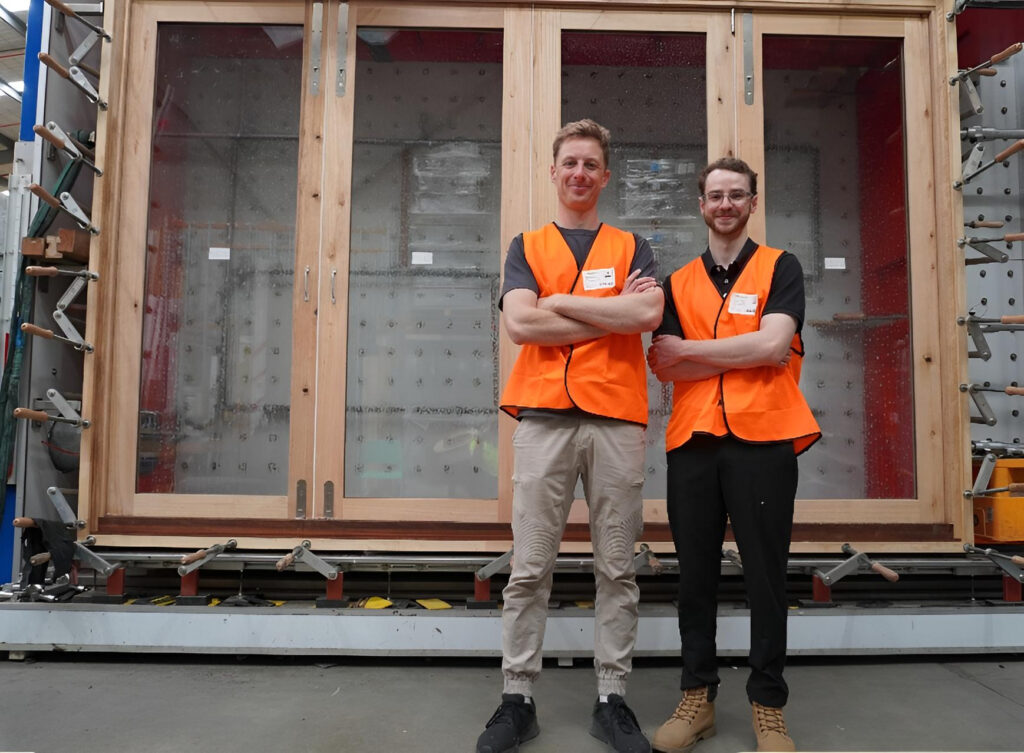
Earlier this year, Wood Central reported on AFWI research conducted by Kylan Low, Structural Engineer at the Timber Development Association, and Jesse Ross, Engineer with the Australian Glass and Window Association, who used the North Ryde facility to test the next-generation timber window systems. (Photo Credit: Images provided to the Central PR Group / Wood Central library by the Timber Development Association)
Manufacturers reliant on the North Ryde bench may need to source alternative accredited providers for future fire-resistance and reaction-to-fire work. Offshore providers have been flagged in the CSIRO correspondence as a possible pathway, with the impact set to fall hardest on plasterboard systems, façade assemblies and bushfire-zone building products tied to Australian test reports.
Compliance assessments currently run at around 2 years, with the queue already long before the North Ryde decision. That baseline now faces a major blow-out as up to half the country’s NATA-accredited fire-testing capacity comes offline.
“Assessments could take up to three, four or even five years,” the source said. “And this could have major implications for project sunset clauses and liquidated damages, which are tied up in these tests.”
The source has also raised concerns the closure will concentrate demand on a single major private provider, lifting prices as the National Construction Code tightens fire-safety performance requirements. Existing test report modifications must be carried out by a NATA-registered entity, narrowing the accredited pathway available to building-product manufacturers nationwide.
It comes as CSIRO has confirmed it will honour all currently contracted projects before any operational changes take effect. The agency’s broader Infrastructure Technologies capability will continue at other CSIRO locations, with the closure targeted at the North Ryde fire-technology bench rather than the wider research function.
Please note: Industry stakeholders have been invited to provide written submissions on dependencies, potential impacts and considerations through a formal Feedback Form launched alongside the announcement.
Saving wasted time, working safely and having fun are probably my 3 main goals in woodworking. I love to figure out little short cuts of woodworking and evidently, so do many other people and often there are multitudes of people who submit near identical ideas. I love them all.
Here are a few that I use, some submitted and some I learned myself through trial and error ....
The submission, signed by Timber NSW Chief Executive Maree McCaskill, calls on the federal government to amend the Autonomous Sanctions (Import Sanctioned Goods – Russia) Designation 2022 with a new Item 17 clause covering all timber and timber products directly or indirectly sourced from Russia. The mechanism would match the European Union’s tightened sanctions adopted under EU Council Regulation 2026/506 on 23 April 2026, which closed similar third-country routing loopholes across the bloc.
Arguing that tariffs alone cannot close the loophole because they rely on country-of-origin declarations, McCaskill said Australian Customs Notice 2022/21 — which applied a 35 per cent additional duty to Russian and Belarusian goods from 25 April 2022 — has failed to stem indirect imports. “A policy outcome through any tariff increase will be ineffective,” McCaskill said.
The EU banned Russian timber imports under its fifth sanctions package in April 2022, and FSC and PEFC both suspended Russian certificates from their global certification schemes the same year, sealing Russian fibre out of every major Western market. (Image Credit: Stock Illustration ID: 719426440)
Referred by the Senate on 5 November 2025, the inquiry will accept public submissions until 12 June, with a final report due back by 20 August. At least 26 submissions are already on the public register, including from Australian National University legal scholar Anton Moiseienko, financial integrity firm KordaMentha, the Minderoo Foundation, Transparency International Australia and the Department of Foreign Affairs and Trade.
Most of the submissions so far on the public register focus on the “blood oil” loophole, with Australia identified as the single biggest buyer of petroleum products refined from Russian crude in third countries. The energy sector and Ukrainian community submitters include the Centre for Research on Energy and Clean Air, the Australian Institute of Petroleum, Senator Fatima Payman, the Australia-Ukraine Chamber of Commerce, B4Ukraine and the Australian Federation of Ukrainian Organisations.
Wood Central understands that a number of additional peak bodies across the Australian timber supply chain are preparing submissions to the inquiry in the coming days. The Albanese government is under growing pressure to align Australia’s regime with those of the European Union and other Western nations, with Russian timber among the Kremlin’s highest-value transborder trades.
A Chinese log port stacked with imported softwood logs, gantry cranes operating under signage for Zhonglin Xinminzhou Port — one of the entry points feeding the Chinese mills that produce more than 70 per cent of the world’s plywood. China imported more than 11.2 million cubic metres of Russian timber in 2024, with Russian softwood lumber supplying 63 per cent of total Chinese softwood imports. (Photo Credit: Supplied)
Chinese-controlled mills now produce more than 70 per cent of the world’s plywood through operations across Vietnam, Indonesia and Malaysia, with Russian softwood lumber supplying 63 per cent of Chinese softwood imports. China imported more than 11.2 million cubic metres of Russian timber in 2024.
Australian importers were major end-users of these products before the 2022 invasion, with Russian-origin LVL formwork and engineered beams accounting for 40 to 50 per cent of the local market — a flow Wood Central has tracked through fresh Australian Bureau of Statistics data, raising new concerns about Chinese LVL dumping into the Australian market. The submission cites US Forces in Europe commander General Alexus Grynkewich’s March 2026 congressional testimony as evidence that current sanctions are failing to constrain Moscow’s military spending, even as Russian timber still accounts for 1 to 1.3 per cent of GDP and 2.4 per cent of export revenue.
Lord Nelson’s HMS Victory has been named as one of two early-2026 pilot sites for the PEFC Project Sourcing standard, with the world’s oldest commissioned warship serving as a test bed for a new global framework that traces low-carbon timber through complex construction supply chains.
That is according to PEFC’s 2025 Annual Review, published overnight, which names the £45 million Royal Navy restoration alongside London’s Elephant Park H11B development as the first sites trialling the revised standard’s traceability requirements ahead of approval later this month.
As Wood Central reported in October 2024, the £45 million conservation programme is being supplied by Hewins Oak, WL West & Sons, and Border Hardwoods, with timber potentially sourced from PEFC-certified French forests after the National Museum of the Royal Navy turned to Britain’s historical adversary for shipbuilding-grade oak. At the time, project manager Simon Williams said France’s centuries of forest management had yielded “superiorly managed forests to the UK,” with scale and quality unavailable in local forests.
J M W Turner’s The Battle of Trafalgar, 21 October 1805, depicts HMS Victory at the height of the engagement that secured British naval supremacy and cost Lord Nelson his life. More than two centuries on, the same flagship will trial PEFC’s world-first Project Sourcing standard for sustainable timber. (Photo Credit: IanDagnall Computing / Alamy Stock Photo, National Maritime Museum, Greenwich, London)
Whilst the new Project Sourcing framework builds on more than 15 years of PEFC Project Certification experience, the revised standard sets a 70 per cent certified-content threshold at both the project and component levels — with component-level certification accepted from PEFC or any other recognised scheme. The framework strengthens the link between reporting and traceability and major green building rating schemes, including LEED and BREEAM, and is calibrated for project-based procurement where chain-of-custody systems do not fully accommodate the responsibility split between principal contractors and independent subcontractors.
Built in 1759 and launched in 1765, HMS Victory remains the world’s oldest commissioned warship, with approximately 6,000 trees used in her original construction and 26 miles of rope required to rig her masts. The current conservation programme began in May 2022, after the National Museum of the Royal Navy erected scaffolding around the vessel to let her dry out, and Victory is now drier than at any point in her history.
The £45 million Victory: The Big Repair conservation programme at Portsmouth Historic Dockyard, where HMS Victory has been drying out under scaffolding since May 2022, and which will now trial PEFC’s world-first Project Sourcing timber standard ahead of May 2026 approval. (Photo Credit: The Royal Navy)
Whilst the ship’s surface appeared sound at the start of the 2022 survey, shipwrights soon discovered that a thin skin of paint and filler masked planking that was entirely rotten on the starboard side. The vessel’s outer sound layer concealed “material that no longer resembled timber and was much closer to potting compost,” said then-project director Andrew Baines.
The decision to source French oak follows the French Crown’s 17th-century commitment to dedicate large areas of land to shipbuilding plantings, with Napoleon himself instructing further tree planting in the same period that Victory was making her name. The choice carries a significant historical irony, with Lord Nelson having branded the Forest of Dean’s state as “deplorable” in a report following his 1802 visit, demanding the Crown plant more oaks for shipbuilding.
The Victory restoration aims to be finalised by 2035, with the Royal Navy hopeful that the conservation work will extend the ship’s life by another 50 years. PEFC’s Project Sourcing standard, informed by results from the Victory and Elephant Park H11B pilots, is targeted for approval later this month.
A Hanseatic-era cog buried beneath Tallinn’s Lootsi Street since the 1360s has been dated through tree-ring analysis to oak forests across northern Poland and the Tallinn hinterland, with one cluster of hull planks matching timber still hanging in the door of the city’s medieval Bremen Tower. That is according to a new study published in the Journal of Cultural Heritage, which confirmed the vessel as one of the largest medieval shipwrecks recovered in Europe.
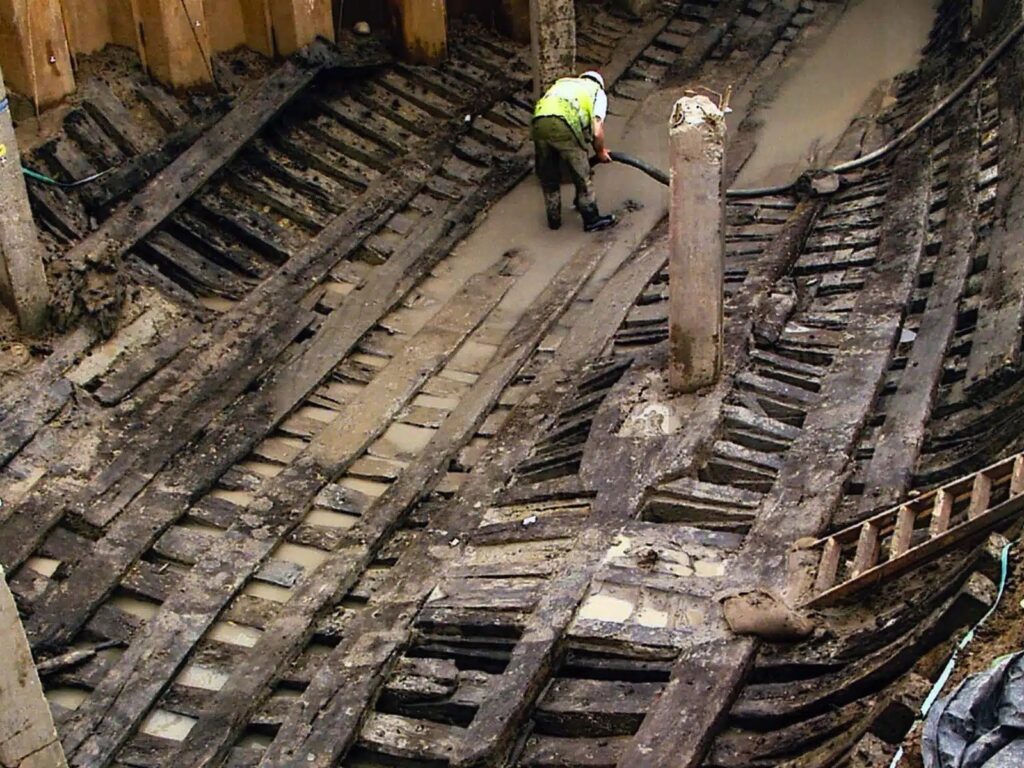
Construction crews working on the foundations for a new office building struck wood roughly 1.5 metres below ground on 31 March 2022, exposing the timber hull of a 14th-century merchant vessel measuring 24.5 metres long, 9 metres wide, and 4 metres tall. Engineers later cut the hull into four sections to clear the development site, requiring 3 months of preparation and 13 hours of transport to relocate the wreck for conservation.
The 24.5-metre Lootsi cog exposed within sheet piling on Tallinn’s Lootsi Street, with the keel curve of the 14th-century merchant vessel visible across the development pit before engineers cut the hull into four sections for relocation. (Photo Credit: Estonian Maritime Museum)
Tree-ring analysis across multiple plank groups from the hull showed that most of the oak matched timber sources in northern Poland — the standard supply chain for Hanseatic shipbuilding in the era. One cluster of planks did not fit that pattern, with growth rings matching a sequence found in a door still hanging in Tallinn’s medieval city wall, wood previously linked to the Tallinn hinterland or western Lithuania.
The matched timber sequence has prompted researchers to ask whether the cog was assembled in western Lithuania and completed for its first voyage from Tallinn before sinking near the harbour, with the study stopping short of a firm conclusion. Sourcing hulls from multiple regions was standard practice for large Baltic shipbuilding of the period, with the Hanseatic League’s commercial reach pulling oak across thousands of kilometres of coastline into yards from Lübeck to Riga.
Several structural features have resisted the cog classification since the excavation began, with the hull sealed in pitch-covered animal fur alongside the moss caulking standard for cogs of the period. Certain plank configurations had been believed to appear in shipbuilding only a century later, prompting Estonian Maritime Museum archaeology researcher Priit Lätti to consult specialists abroad without finding a comparable wreck.
The state of the ship’s interior pointed to a sudden sinking rather than a planned abandonment, with tools, weapons, and worn leather shoes scattered through the hold and two well-preserved ship rats recovered from the wreck. “People had to get off the ship in a hurry,” Lätti said, with the inventory ruling out a controlled scuttling.
A worn pointed-toe leather shoe recovered from the wreck — one of several scattered through the hold alongside tools and weapons — points to a sudden sinking rather than a planned abandonment of the 14th-century merchant vessel. (Photo Credit: Estonian Maritime Museum)
Among the most striking artefacts recovered from the wreck is a dry compass reported by Estonian public broadcaster ERR as the oldest surviving example of its kind in Europe, with the magnetised needle still pivoting freely after more than six centuries underwater. It comes as Wood Central reported on the discovery of 1,200-year-old ship timber from the Frankish empire’s Dorestad trading port in March 2026, where Carolingian-era oak surfaced during sewer works in Wijk bij Duurstede.
The dry compass recovered from the wreck, reported by Estonian public broadcaster ERR as the oldest surviving example of its kind in Europe, with the magnetised needle still pivoting freely after more than six centuries underwater. (Photo Credit: Estonian Maritime Museum)
An even older wreck sits buried nearby and has not been touched, with Lätti confirming the ground has preserved the timber for centuries, and that better excavation methods may eventually allow a more complete recovery. The Lootsi cog is scheduled for permanent public display at the Estonian Maritime Museum once Finnish conservators and the museum team complete moisture-controlled stabilisation of the four-section hull.
For more information: Daly, A., Sohar, K., Läänelaid, A., Lätti, P., & Reinvars, L. (2026). Timber for a medieval Cog – Wood studies of the Lootsi 8 wreck, Tallinn. Dendrochronologia, 97, Article 126519. https://doi.org/10.1016/j.dendro.2026.126519
Italian sawmills are running at near-zero or negative margins as Gulf container freight has jumped from US$500 per container to as much as US$4,000, whilst log prices across the DACH region of Germany, Austria and Switzerland remain at €148 per cubic metre. That is according to the latest Conlegno Study Centre report published on Tuesday, May 5, which warns that the conflict in Iran that closed the Strait of Hormuz, elevated roundwood prices and rising energy costs are eroding profitability across more than 2,000 member companies.
The perfect storm is hitting the sector,” the report finds.
And whilst weak European demand and oversupply would normally drag raw material prices lower, log values have instead remained historically high across the corridor, leaving Italian sawmills caught between elevated input costs and thin downstream pricing power. Conlegno describes the dynamic as a divergent binary effect, where soft demand fails to feed through to lower roundwood costs, squeezing the cash margin out of every cubic metre milled.
As it stands, Italy needs around four million cubic metres of softwood a year — the framing lumber, pallet wood and panel feedstock that supplies its construction and packaging sectors. Italian forests cover only about 20 per cent, with the rest shipped from Germany, Austria and the Czech Republic. That import exposure worsened sharply after Storm Vaia and the bark beetle infestation cut Trentino’s annual log supply from 500,000 cubic metres to as low as 250,000 cubic metres, with 2025 production projected at 450,000 cubic metres — well short of Trentino’s 1.25 million cubic metre post-Vaia milling capacity.
The Strait of Hormuz — the chokepoint carrying roughly a quarter of the world’s seaborne oil — has shifted global fuel markets onto a volatile footing, with industrial diesel up 140 per cent across Asia and container surcharges up to US$5,000 baked into Gulf-transit trade lanes. (Image Credit: Supplied)
It traces back to Hormuz.
Following the Iranian Revolutionary Guard action that closed the Strait of Hormuz on 28 February, industrial diesel prices across Asia have climbed 140 per cent and ocean freight surcharges of up to US$5,000 per container have been baked into trade lanes that depend on Gulf transit. Maersk has separately applied to US regulators for an emergency bunker surcharge of US$200 per TEU on head-haul routes and US$100 per TEU on backhaul, with Drewry’s World Container Index holding at US$2,287 per 40-foot container as of 2 April.
“The timber-chain consequences are being severely underestimated,”Royal Dekker warned late last week.
Robbert Jan Dekker, director of Dutch tropical hardwood importer Royal Dekker, warned that the timber-chain consequences of the 28 February Strait of Hormuz closure are being severely underestimated as the freight shock reaches European softwood mills. (Photo Credit: Royal Dekker)
It comes as Wood Central reported that the Hormuz crisis has driven Asian panel prices up by 15 per cent, with Indian wood panel makers raising prices by five to 15 per cent, and a Federation of Malaysian Manufacturers survey finding that nine in ten firms are either already affected or expect an impact within four weeks. The International Tropical Timber Organisation charts an industry-wide repricing from Kuala Lumpur to Bangalore to Ho Chi Minh City, with Italian panel prices rising by five to ten per cent — roughly half the Asian rate.
On the panel side, the European Commission’s 14 April 2026 decision to finalise definitive anti-dumping duties of 5.4 per cent on Brazilian softwood plywood — applied across an EU softwood plywood market valued at €600 million per year, of which €216 million was previously imported from Brazil — has trimmed one source of low-cost competition for Italian and wider European panel makers. But that relief has been overrun by a sharper rise in log, energy and glue costs, with OSB up around ten per cent since the start of the year and particleboard and pine plywood also climbing across European mills.
Whilst Italian sawmills have modernised through Industry 4.0 investments and improved processing flexibility over the past 15 years, the wider continental sector continues to operate under structural pressure on raw material costs, with the European Organisation of the Sawmill Industry warning at the International Softwood Conference in Oslo last October that rising input prices are denting earnings across the continent. “Raw material prices have increased across Europe, denting profitability in the industry,” Tommi Sneck, president of the European Organisation of the Sawmill Industry, told delegates.
The oak burial chamber at the centre of a 65-metre-diameter mound near Riedlingen in southern Germany has been dated to 584 BC by dendrochronology, with waterlogged groundwater preserving the timber chamber for 2,610 years despite an ancient looting raid that punched through the roof. That is according to the State Office for Cultural Heritage Baden-Württemberg (LAD), with state archaeologist Prof. Dr Dirk Krausse leading the project alongside Dr Roberto Tarpini, the officer responsible for the Heuneburg monument.
The chamber sits seven kilometres northeast of Heuneburg, the hilltop centre that archaeologists now regard as the oldest city north of the Alps, and the felling year places the Riedlingen burial just two years before the Bettelbühl princess grave, dated to 583 BC. Thick oak layers in the roof, possibly built to deter intruders, were nonetheless breached by a southeastern shaft cut down to a 40-by-45-centimetre opening, with the looters carrying off the metal grave goods and abandoning the chamber timbers.
The robbers’ tunnel itself became a second archive, because their backfill sealed wood, textile and fur fragments in wet oxygen-poor soil that would normally rot them within decades. “That was a stroke of luck for archaeology, because finds survived that would otherwise have vanished without a trace,” Krausse told reporters.
The body was that of a young man aged 17 to 19, and brown bear toe bones recovered from the chamber point to a bearskin wrap dragged out during the theft. Wagon components recovered from the shaft confirm a four-wheeled vehicle of the kind reserved for high-status early Celtic burials, alongside a thin strip of birch bark carved with a stylised stallion, one of the rare early Celtic images preserved on perishable material.
The robbers themselves left material that has since become evidence, because radiocarbon dating placed one of two large wicker baskets recovered from the shaft at least 200 years younger than the chamber, with a birchwood torch and a resin-rich splinter used for lighting. “All of the wood from the burial chamber will be carefully recovered, conserved, and restored,” said Dr Claus Wolf, president of the LAD, with the State Office now committed to a multi-year programme to recover every surviving timber from the mound.
It comes as a separate later burial recovered near the mound’s edge yielded a man aged 25 to 35, with two bronze garment clasps and a small rock crystal amulet, alongside two pottery vessels containing cremated remains placed at the site around 600 BC. The mound itself, originally over six metres tall and now reduced to roughly two metres, received further burials for generations after the first robbery.
With dendrochronology fixing the felling year to 584 BC and the LAD now committed to a multi-year recovery programme that will lift every surviving timber from the 65-metre mound, the Riedlingen oak chamber dates to 583 BC, two years before the Bettelbühl princess grave, with both burials contemporary with Heuneburg’s unique Iron Age mud-brick architecture.
Environment Commissioner Jessika Roswall has delivered the EUDR simplification review today, locking medium and large operators into a hard 30 December 2026 compliance start. That is according to a Commission statement issued today, which tabled the package four days past the 30 April deadline as a report to the European Parliament and Council, revised guidance and FAQs, changes to the IT system and a draft delegated act amending the list of products covered.
Wood Central understands that the package keeps all seven EUDR commodities within the regulation and fully retains wood and its pulp and paper derivatives within Annex I, leaving leather hide removal and soluble coffee inclusion as the Commission’s only proposed category-level scope changes in today’s review. Both changes sit inside a draft delegated act amending Annex I, first floated for public consultation in April 2025 and now reissued with the leather and coffee proposals folded in.
The delegated act adds the prefix “ex” to certain HS codes to confirm that only products derived from a relevant commodity fall within the EUDR’s scope, with all other goods sharing the same customs code excluded. Waste material, used and second-hand wood and paper products, samples of negligible value, and packing materials used to support, protect, or carry another product are also exempted from regulation under the same act.
Environment Commissioner Jessika Roswall delivered the EUDR simplification review on Monday 4 May, four days past the 30 April deadline, with the package keeping the regulation’s core text untouched and leather hides the only category-level removal proposed. (Photo Credit: European Union — Council of the EU)
Ms Roswall said today’s package keeps the EUDR’s deforestation objectives intact whilst incorporating the simplifications already agreed by co-legislators in December 2025. The Commissioner had previously confirmed that Brussels would “not place unnecessary burdens on companies and trading partners,” and the law’s core legal text is now formally untouched after the third deadline cycle.
WWF European Policy Office, the global conservation NGO’s Brussels-based EU advocacy arm, said today’s review ends months of regulatory uncertainty and confirms the EUDR will move into operational compliance from December 2026. Anke Schulmeister-Oldenhove, the office’s Forests Manager, said “now the EU must hold the line” on enforcement, with WWF research estimating each year of delayed implementation costs around 50 million trees and 16.8 million tonnes of carbon emissions.
The European Commission last week confirmed Brussels would not reopen the EUDR’s primary legal text in the lead-up to today’s simplification review, with the Commission instead moving on targeted Annex I amendments and updated guidance. (Footage: European Commission Audiovisual Service via YouTube)
Miki Ng, EU policy researcher and campaigner at London-based environmental NGO Earthsight, said the decision keeps forest-product compliance on the same track operators have been preparing for, with the proposed leather hide exemption the only category-level commodity removal in the package. “The proposal to remove leather from the law is about politics, not evidence,” Ms Ng said, warning that beef from cattle raised on deforested land would be kept out of the EU market whilst hides from the same animal would circulate freely.
The leather proposal does not affect the wood, pulp or paper provisions, with forest-product operators continuing under the same Annex I scope they were preparing for ahead of the original December 2025 deadline. The Confederation of European Paper Industries (Cepi), the trade body for European pulp and paper producers, has previously welcomed the December 2025 postponement and called for further FAQ and Guidance work to clarify persisting ambiguities in the regulation.
It comes as Wood Central reported that Brussels missed its 30 April EUDR deadline before delivering Monday’s package, with US Ambassador Andrew Puzder pressing Ms Roswall for a “negligible risk” classification for US producers ahead of the cut-off and the European Organisation of the Sawmill Industry (EOS) joining a multi-sector association call for further legislative simplification before the December 2026 start date.
The Commission’s package will now be transmitted to the European Parliament and Council for two months of scrutiny under the standard EU procedure, with large and medium forest-product operators facing a hard 30 December 2026 start, micro and small operators in scope until 30 June 2027 and the regulation’s seven covered commodities all retained inside Annex I — three years after the law took effect in June 2023.
A 23-metre circular timber platform built more than 5,000 years ago has been uncovered beneath what was long taken for a stone-built artificial island in a Scottish loch, with radiocarbon dates from the Loch Bhorgastail crannog and other Outer Hebrides sites aligning to between 3500 and 3300 BC. That is according to a paper published this week in the journal Advances in Archaeological Practice by Dr Stephanie Blankshein and Professor Fraser Sturt of the University of Southampton, working with Dr Duncan Garrow at the University of Reading and Angela Gannon at Historic Environment Scotland under the AHRC-funded Islands of Stone project.
Wood Central understands the academic work was triggered by Lewis resident and local archaeologist Chris Murray, who in 2012 recovered extraordinarily well-preserved Early and Middle Neolithic pots from a loch bed, and who later worked with Mark Elliot of Museum nan Eilean to identify similar collections at five further crannog sites across the island.
The Bhorgastail platform was first established as a circular timber base 23 metres across, topped with brushwood, with later layers of brushwood and stone added during the Middle Bronze Age and further activity recorded during the Iron Age. Hundreds of pieces of Neolithic pottery were recovered from the loch bed surrounding the crannog, with a now-submerged stone causeway leading from the shore to the island.
Dr Blankshein said the excavation overturned earlier readings of the site, with the wood proving to be the load-bearing element rather than fill beneath a stone cairn. “The timber itself was the basis of the structure,” Dr Blankshein said.
Professor Sturt had described the crannogs in his 2019 commentary on the project’s first dating paper as a “monumental effort… to build mini-islands by piling up many tons of rocks on the loch bed,” with the 2021 excavation and the new photogrammetry method now confirming timber, not stone, as the load-bearing layer.
A diver from the University of Southampton works inside a measurement frame above the exposed timber substructure at Loch Bhorgastail, with brushwood and worked timbers visible beneath the stone cap that disguised the crannog as a stone island for 5,000 years until the team’s 2021 excavation. (Photo Credit: University of Southampton/PA)
The team developed a shallow-water photogrammetry technique to map the crannog above and below the waterline as a single continuous structure, using two waterproof low-light cameras mounted on a frame and manoeuvred by a diver to centimetre-level positioning, a technique the researchers say matches that of an aerial drone.
“This problem is a well-known frustration for archaeologists,” Professor Sturt said, citing fine sediments, choppy conditions, floating vegetation and reflected light as the conditions that hinder imaging at depths under one metre.
Crannogs sit at the boundary where shallow water of 3 to 4 metres meets depths of up to 20 metres, with over 550 examples recorded across Scotland and 170 known sites in the Outer Hebrides alone, although only 10 per cent have been radiocarbon dated and just 20 per cent dated at all.
Substantial quantities of Neolithic ceramic vessels were recovered, largely intact, from the lochs around the crannog and other Outer Hebrides sites, suggesting systematic, possibly ritualised, deposition from the islets rather than incidental loss. Of an estimated 170 crannogs across the Outer Hebrides, only one in five has been dated by any method, with the new shallow-water imaging technique now positioned to extend the AHRC-funded Islands of Stone survey across the remaining 136 sites.
Saw horses are of those little thought about items that you don't seem to miss until you need one. I have an old pair of the "A" frame type sitting in my stoop for almost 20 years now, I didn't make them but they sure come in handy from time to time, despite all the room they take up, because they don't "stack".
They are well worn, paint splattered, wobbly and not all that well made, but they have lasted a long time despite all that, but time to upgrade them ...
The European Union Deforestation Regulation (EUDR) is functioning not as a compliance burden but as a globally funded data infrastructure programme, with geolocation maps now being quietly forced onto export supply chains, quietly producing the high-resolution dataset across global production landscapes that restoration finance has long lacked.
Today, Wood Central spoke exclusively to Rudolf van Rensburg, a director of Margules Groome Consulting, who said the regulation’s reach across global supply chains had quietly produced a spatial dataset of a kind the sector had never previously had at scale. “For the first time, supply chains feeding the European market are being mapped at a resolution and consistency the forest sector has never seen before. Compliance is paying for that mapping, whether or not operators ever intend to use it beyond market access.”
Rudolf van Rensburg, Director of Margules Groome Consulting, who told Wood Central the EUDR is “in effect, a global data infrastructure programme” with the potential to determine whether restoration finance scales beyond isolated projects. (Photo Credit: Margules Groome Consulting)
Wood Central understands the analysis comes as the bloc’s seven covered commodities prepare to be backed by geolocation-linked due diligence statements before they can enter the European market, with the rule reaching across cattle, cocoa, coffee, oil palm, rubber, soya, and wood and covering both raw materials and the wide spread of finished products manufactured from them.
Restoration finance has long been constrained not by a lack of capital but by a lack of confidence, with investors consistently pointing to unclear land boundaries, weak baselines, and inconsistent monitoring as the issues that make most projects commercially unviable, and Margules Groome argues that structural data gap closes the moment EUDR forces companies seeking European market access to fund creation of the spatial layer themselves, regardless of whether they ever intend to use it beyond compliance.
Once the polygon dataset exists, the firm argues, its role expands well beyond the regulation that produced it, with the same boundary capable of defining a carbon project under methodologies administered by Verra and Gold Standard, and supporting biodiversity metrics relevant to disclosure regimes such as the Taskforce on Nature-related Financial Disclosures (TNFD). What changes is not the existence of those markets but the cost of entering them, with the marginal effort required to layer additional value falling sharply once the underlying dataset is in place.
For large vertically integrated plantation owners and fibre processors exporting from Southern Africa, Latin America, and Southeast Asia, the shift opens what Margules Groome calls in-setting, with companies able to invest within their own supply base rather than rely solely on external carbon markets and environmental performance tied directly to the land that supplies the business.
Wood Central also spoke to Shaun Henderson, a consultant at Margules Groome Consulting, who said the precision the regulation now demands has implications well beyond European market access, into the credibility questions that have long held back carbon investors. “Spatial uncertainty has always been a real source of risk in carbon project baselines. EUDR does not make a project carbon-ready on its own, but the geolocation precision it requires gives investors a far stronger starting point than the sector has historically been able to offer.”
Shaun Henderson, consultant at Margules Groome, who said EUDR’s geolocation precision “gives investors a far stronger starting point than the sector has historically been able to offer” on carbon project baselines. (Photo Credit: Margules Groome Consulting)
The EUDR also requires a level of geolocation precision materially higher than what has historically been used in many supply chains. Whilst that precision is driven by regulatory needs, it has direct implications for finance because spatial uncertainty is a known source of risk in carbon market baselines and leakage assessments.
The implications are particularly significant for smallholder systems, which manage a large share of agricultural land globally yet have historically been excluded from restoration finance because the transaction costs of mapping fragmented holdings made the economics unworkable. In regions associated with initiatives such as the Great Green Wall across the Sahel, and within fragmented ecosystems like Brazil’s Atlantic Forest, EUDR compliance is mapping farms and clarifying boundaries for the first time, with the constraint shifting from whether the data exists to whether the systems are in place to use it.
“Smallholders have been locked out of restoration finance for one practical reason — the cost of mapping fragmented holdings made the economics unworkable. EUDR shifts who pays for that mapping, and the moment it shifts, the conversation about smallholder restoration finance changes completely,” Henderson said.
Margules Groome is clear about the limits of that thesis, noting EUDR does not guarantee data quality, does not create monitoring systems, does not resolve questions around additionality where compliance itself is already shaping land-use behaviour, and does not determine how value is shared across supply chains.
Van Rensburg told Wood Central that the firm’s bottom line is that the regulation may determine whether restoration finance scales at all. “EUDR is, in effect, a global data infrastructure programme. Whether restoration finance scales beyond isolated projects into something systemic will depend in large part on whether the sector treats this dataset as a compliance file or as the foundation it actually is.”
Tropical primary rainforest loss fell 36 per cent in 2025 to 4.3 million hectares, down from a record 6.7 million hectares the year before, but the world is still losing primary forest at a rate equivalent to 11 football fields a minute as climate-driven fires emerge as the largest single threat to the gains. That is according to the World Resources Institute (WRI) and the University of Maryland’s Global Land Analysis and Discovery (GLAD) Lab, which released the annual tree cover loss data on Wednesday through WRI’s Global Forest Watch platform.
Wood Central understands the 4.3-million-hectare figure is roughly the size of Denmark and remains 46 per cent above the level recorded a decade ago, with global forest loss still running 70 per cent above the trajectory required to meet the 2030 goal of halting and reversing forest loss. The gap puts pressure on the European Union Deforestation Regulation (EUDR) and the Tropical Forest Forever Facility (TFFF), the two instruments WRI has flagged as central to keeping the Glasgow Leaders’ Declaration commitment alive.
Measured against a humid tropical primary forest baseline fixed at 30-metre satellite pixel resolution in 2001, the 36 per cent fall excludes plantation harvest cycles, tree crops and young secondary forest from the headline number. WRI’s tree cover loss category is broader than deforestation, taking in wildfire, storm damage, and managed harvest, in addition to permanent conversion to other land use. Fire-driven loss is classified separately by a machine-learning model that filters out mechanical clearing followed by burning.
Much of the global reduction was driven by Brazil, home to the world’s largest rainforest, where non-fire primary forest loss fell 41 per cent in 2025 to its lowest level on record. The decline coincides with stronger environmental policies and enforcement under President Luiz Inácio Lula da Silva, including the relaunch of the PPCDAm federal anti-deforestation plan and increased penalties for environmental crimes.
Mirela Sandrini, Executive Director of WRI Brasil, said the Brazilian numbers showed what could be done when forest protection became a national priority. “Brazil’s progress shows what’s possible when forest protection is treated as a national priority,” Sandrini said.
An Ibama Fiscalização enforcement officer watches a seized aircraft burn on a remote airstrip during a federal operation against illegal activity in the Brazilian Amazon, captured in the second-place winner of the 2024 Ibama em Ação photo contest. The relaunch of the PPCDAm federal anti-deforestation plan and increased penalties for environmental crimes under President Luiz Inácio Lula da Silva drove non-fire primary forest loss in Brazil to its lowest level on record in 2025. (Photo Credit: Ibamagov / Wikimedia Commons, CC BY-SA 2.0)
Elizabeth Goldman, Co-Director of WRI’s Global Forest Watch, said the scale of the drop was encouraging but flagged that part of the decline reflected a pause after an extreme fire year. “A drop of this scale in a single year is encouraging,” Goldman said, adding that climate-driven fires were now amplifying each other’s effects and that El Niño returning in 2026 would raise the stakes for prevention and response investment.
Agricultural expansion remained the leading driver of total tree cover loss, but fires accounted for 42 per cent of the 25.5 million hectares lost worldwide in 2025, a 14 per cent fall on 2024 across an area still slightly larger than the United Kingdom. Canadian wildfires alone burned through 5.3 million hectares to make 2025 the country’s second-worst fire year on record.
A Prefeito/Ibama brigadista holds a fire hose at the edge of a flame front during the 2024 Brazilian fire season. Climate-driven fires now account for 42 per cent of the 25.5 million hectares of tree cover lost worldwide, with Canadian wildfires alone burning through 5.3 million hectares in 2025, making it the country’s second-worst fire year on record. (Photo Credit: Ibamagov / Wikimedia Commons, CC BY-SA 2.0)
Matthew Hansen, GLAD Lab Director and Professor at the University of Maryland, said the climate signal had pushed forest fires beyond their seasonal rhythm, closer to a permanent state of emergency. “Climate change and land clearing have shortened the fuse on global forest fires,” Hansen said.
Indonesia and Malaysia recorded primary forest loss at relatively low rates, while Colombia reversed a 2024 spike with a 17 per cent fall to its second-lowest level since 2016, on the back of Indigenous land-rights recognition and stronger enforcement. Forest loss remained high in the Democratic Republic of the Congo, Peru, Laos and Madagascar, where DRC non-fire loss hit a record high in 2025, driven by small-scale farming, charcoal production, conflict displacement and mining pressure.
WRI’s 2025 figures incorporate the DIST-ALERT land disturbance dataset added to the GLAD Lab pipeline in 2023, which captures late-season tree cover loss that earlier algorithms missed because of cloud cover and limited satellite passes. From 2026, the data will feed into Global Nature Watch, an AI-powered WRI platform backed by the Bezos Earth Fund that draws on peer-reviewed Global Forest Watch and Land & Carbon Lab research in a chat-style interface.
WRI Global Director of Forests Rod Taylor said sustained political will across the next 12 months would determine whether the 2025 gains held, given national elections due in several forest countries and El Niño’s expected lift of fire risk through the 2026 dry season. “The progress we’re seeing in countries like Brazil and Colombia is heartening,” Taylor said.
Stasiek Czaplicki Cabezas, a Bolivian researcher and data journalist for Revista Nómadas, said forest loss in Bolivia and across the broader region was structurally tied to the use of fire to clear land for agricultural expansion. “In Bolivia, as in many other countries, forest loss is closely tied to agricultural expansion,” Cabezas said.
Bolivia recorded its second-highest level of primary forest loss on record in 2025 and has now surpassed the Democratic Republic of the Congo in tropical primary forest loss, despite holding 60 per cent less primary forest than the DRC.
For more information, including last year’s assessment that found wildfires overtaking agriculture as the leading driver of tropical primary forest loss for the first time on record, see Wood Central’s special feature on the 2024 WRI report. The same coverage cycle includes earlier reporting on the deforestation pace at the 2024 peak, when ten football pitches a minute were being lost, and the investigation into illegal gold miners razing at-risk tropical forests to the point of no return — pressure that the latest WRI data continues to flag across the Amazon basin and the Congo basin.
Cartels capture comisariados, the elected committees that govern Indigenous ejidos, then route fraudulent extraction permits through state forestry centres known as Centros de Atención, Wood Central understands. PROFEPA, Mexico’s environmental enforcement agency, opened 176 illegal-logging investigations across 28 states and seized 11,094 cubic metres of timber between January 2024 and February 2026, with a single Chihuahua yard accounting for more than 500 cubic metres alone.
Chihuahua’s Sierra Tarahumara holds two-thirds of Mexico’s standing timber, with deforestation running to 35,900 hectares between 2017 and August 2024, according to GI-TOC’s analysis of Global Forest Watch data. (Image Credit: GI-TOC, Frontiers of Plunder, January 2026)
The head of CONAFOR‘s Chihuahua office told GI-TOC investigators that “there is definitely more illegal logging than legal” in the state, where wood production worth MX $3.3 billion (US $172 million) a year accounts for one-third of Mexico’s national total.
GI-TOC investigators documented that Los Salgueiro extracted MX $3 million (US $153,523) from a single Baborigame ejido through forced timber concessions, with 15 trucks daily hauling around 7,000 board feet apiece. The illicit trade now costs Chihuahua’s state government around US$125 million a year, with Bocoyna, Guachochi, Guadalupe y Calvo and Balleza identified as the municipalities running the highest tree-cover loss.
A truck hauls logs near Guadalupe y Calvo, one of four Chihuahua municipalities GI-TOC names as a cartel-logging hotspot, where the Sinaloa Cartel-aligned Los Salgueiro faction extracts forced concessions from Indigenous ejidos. (Image Credit: GI-TOC, Frontiers of Plunder, January 2026)
PROFEPA chief Mariana Boy Tamborrell said “impunity for those who destroy forest ecosystems is over” in announcing a February 2026 multi-state operation that closed 25 illegal sawmills and seized 394.95 cubic metres of timber.
Mexican federal records show just 19 arrests and two convictions for illegal logging in Chihuahua across the eleven months to November 2024 — an enforcement record GI-TOC investigators say has not slowed the laundering.
Oak, elm and hazel forests thrived on Doggerland, the now-submerged landmass between Britain and mainland Europe, more than 16,000 years ago — thousands of years before any pollen record from the British and European uplands had registered temperate forest cover. That is according to a sedimentary ancient DNA study published in Proceedings of the National Academy of Sciences, led by Professor Robin Allaby of the University of Warwick.
Professor Allaby’s team analysed sedaDNA from 252 sediment samples collected from 41 marine cores along the Southern River, a prehistoric watercourse selected for its well-preserved sediments. The researchers traced the region’s ecological history from approximately 16,000 years ago through to its final submergence beneath the southern North Sea.
Wood Central understands that the work was funded by the European Research Council under the Horizon 2020 LOST FRONTIERS project, and that the discovery represents the largest sedimentary ancient DNA reconstruction of the submerged landscape conducted to date. Sedimentary DNA accumulates in fine alluvial sediments but degrades through repeated reworking, the inverse of pollen, which preserves well in peat bogs and persists across sediment turnover.
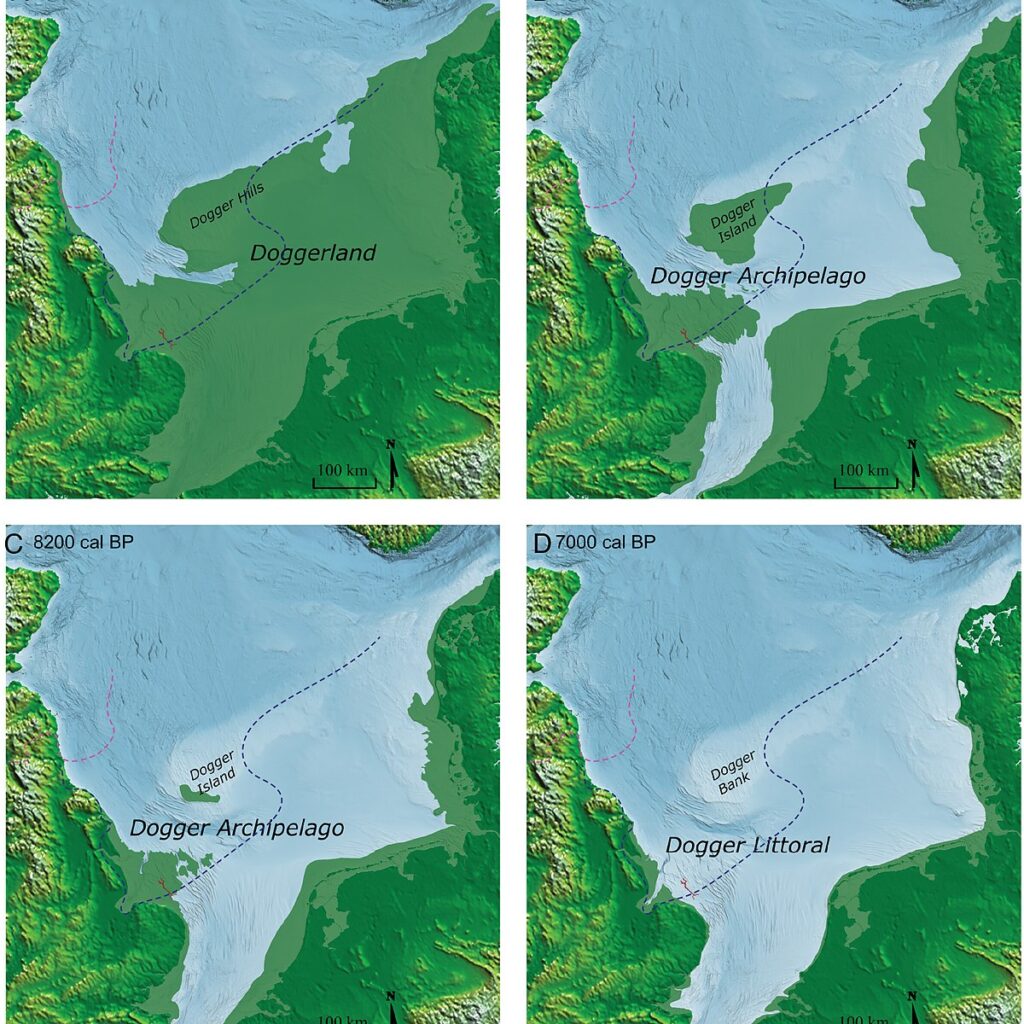
Doggerland was a vast landmass connecting Britain to mainland Europe that supported thriving Mesolithic communities before rising seas submerged it 10,000 and 7,000 years ago. University of Warwick researchers discovered ancient forest DNA evidence from this lost world beneath the North Sea.
The Warwick team paired the genetic record with sedimentological analysis of every core, separating samples derived from a local source from those carrying material reworked or transported from elsewhere. Within the secure cores, oak, elm and hazel were identified in deposits laid down before the Allerød, the warm interstadial roughly 13,900 years ago that marks the close of the last glaciation.
Lime, a warmth-loving species, appeared around 2,000 years before its earliest known existence on the British mainland. This suggests parts of southern Doggerland functioned as a northern refuge whilst the surrounding European uplands remained too cold for broadleaf trees.
“We unexpectedly found trees thousands of years earlier than anyone expected,” Professor Allaby said. The team also recovered evidence the North Sea fully formed later than previously documented, undercutting decades of pollen-based reconstructions that had placed widespread temperate forest cover in the region towards the end of the last glaciation, not well before it.
The team also detected DNA from Pterocarya, a walnut relative thought to have vanished from northwestern Europe in the Hoxnian interglacial around 400,000 years ago. The signal was recovered from two secure cores, ELF19 and ELF45, with DNA degradation patterns at 30 per cent, indistinguishable from oak, hazel, willow, alder and elm in the same Late Pleniglacial layers.
On that basis, the Warwick team concluded the Pterocarya signal represents a relic population that survived in northwestern Europe well into the last glaciation rather than reworked ancient material. This pushes the regional extinction date for the genus forward by hundreds of thousands of years.
The persistence of these temperate species across the last glaciation supports the theory of microrefugia, small climatically-buffered pockets that allowed cold-sensitive trees to survive in higher latitudes than the surrounding climate would otherwise support. The presence of such refugia is the leading explanation for Reid’s Paradox, the long-standing puzzle in palaeobotany over how European forests recolonised cleared ground at rates far faster than seed and pollen dispersal can account for.
Doggerland’s submergence timeline from 10,000 to 7,000 years ago, showing the progressive flooding that buried the ancient forests discovered through University of Warwick DNA analysis. The maps illustrate how the landmass transformed from a connected continent to scattered islands before complete submergence beneath the North Sea. (Image: University of Warwick/PNAS)
The findings add to a growing body of archaeological evidence reshaping understanding of European forest heritage, as Wood Central has reported in coverage of heritage forest protection debates across Europe and Australia. Co-author Professor Vincent Gaffney of the University of Bradford said the findings overturn the long-held view of Doggerland as a mere transit corridor between Britain and continental Europe.
“Doggerland was not only a heartland of early human settlement,” Professor Gaffney said, describing the landmass as a fulcrum for how prehistoric communities resettled northern Europe across millennia. The sedaDNA record also traces the gradual flooding of the landscape, with seagrass appearing in the upper core layers as marine waters advanced.
The team identified woodland habitats capable of supporting wild boar and other game species, resources critical to early Mesolithic communities long before the Maglemosian culture emerged on the British mainland around 10,300 years ago. The PNAS paper draws on 252 sediment samples across 41 marine cores along the prehistoric Southern River, with parts of southern Doggerland remaining above sea level until approximately 7,000 years ago — 1,150 years after the Storegga Slide tsunami struck the North Sea, Professor Allaby said.
For more information: R.G. Allaby, R. Ware, R. Cribdon, T.A. Hansford, T. Kinnaird, D. Hamilton, L. Kistler, P. Murgatroyd, R. Bates, S. Fitch & V. Gaffney, Early colonization before inundation consistent with northern glacial refugia in Southern Doggerland revealed by sedimentary ancient DNA, Proc. Natl. Acad. Sci. U.S.A. 123 (11) e2508402123, https://doi.org/10.1073/pnas.2508402123 (2026).
 Login
Login