Australian members of the Forest Stewardship Council have cleared the way for a single trans-Tasman governance structure, voting through a constitutional overhaul that redraws who counts as a member and how the board is built across both countries. That is according to FSC Australia and New Zealand, which passed three special resolutions at its annual general meeting on 28 May, though the new model cannot take full effect until New Zealand’s own members vote on it.
Written into the constitution, the changes set formal definitions for Australian and New Zealand members, carved membership into new National and International classes with their own eligibility tests, and rebuilt the board composition to guarantee representation from both countries across the council’s social, environmental, and economic chambers. The Australian vote settles one half of the arrangement and leaves the rest resting on a separate New Zealand ballot.
The same meeting handed a seat back to one of FSC’s earliest hands, appointing Patrick Anderson as a director more than thirty years after he represented Greenpeace International at the organisation’s founding meeting in 1994. Anderson brings three decades of experience in forest governance, human rights and environmental advocacy to a board that also returned Nicky Moffat to the Environmental Chamber.
His appointment closes a chapter for Rachael Cavanagh, who stepped down from the board earlier this year and was thanked for her service to FSC ANZ. The new line-up takes its place as the council pushes a busy reform agenda across the region.
Beyond the boardroom, the revised Australian Forest Stewardship Standard drew attention as it entered a second and final round of public consultation, now open until 29 June. A year of engagement filled out the rest of the agenda, from FSC Forest Walk events held on both sides of the Tasman to continued growth in the promotional licence holder programme.
Three guest presentations rounded out the day, with Value Australia founder Rayne van den Berg outlining next steps for the Global Forestry Natural Capital Project and FSC Asia Pacific deputy regional director Michelle Wong updating members on the FSC Traceability System. First Nations Committee representative Tolita Davis-Angeles spoke about the committee’s work and where it is headed next.
A century ago, the hardwood forests of the eastern United States were little more than stumps and ashes, and next week the American Hardwood Export Council will rebuild a piece of that comeback inside a Copenhagen exhibition hall. Wood for the Trees, the immersive walk-through it has staged for 3daysofdesign, retraces a hardwood’s path from standing tree to finished product entirely in donated US timber.
Step inside and the room becomes an abstract arboreal setting, with materials raised on rotating trunks, seating hewn into the shape of fallen logs, and graphics suspended overhead like the boughs of a forest canopy. Audio-visual displays, environmental data and narrative panels thread between the objects, turning the documentary that inspired the show into a space the visitor walks through rather than watches.
The journey moves through five stages — growth, stewardship, selection, resilience and timber — each opening a door onto the realities of responsible forest management. The early rooms trace how trees regenerate and even clone themselves across generations, the day-to-day and century-spanning labour of tending a forest, and the careful judgement of which trees to fell and which to leave standing.
And later, the focus turns to resilience and how a forest shrugs off climate shifts, pests and disease, before the final stage follows the grain to the point where the forest meets the human world. Drawn from AHEC’s recent documentary Forested Future, which followed the communities whose livelihoods rest on forests, the show widens a Copenhagen platform the council has used in recent years for designer collaborations and sculptural one-offs.
Watch the trailer for Forested Future, AHEC’s documentary on the Appalachian forest communities whose stewardship inspired Wood for the Trees. (Video: AHEC)
Mitre & Mondays, the London studio of Josef Shanley-Jackson, Freya Bolton and Finn Thomson, builds objects and spaces around reuse, repair and regenerative materials. Benchmark, the Berkshire furniture-maker founded by Terence Conran and Sean Sutcliffe in 1984, built the show from those donated boards, drawing on four decades of working with natural, non-toxic timber.
The Mitre & Mondays trio behind the exhibition, from left, Josef Shanley-Jackson, Freya Bolton and Finn Thomson, at Benchmark’s workshop. (Photo Credit: Mitre & Mondays, Supplied to Wood Central by AHEC)
Behind the spectacle sits a recovery the council returns to often, with the eastern United States hardwood forests rebounding from those stumps and ashes to more than 40 million acres today. They are now growing at twice the rate they are harvested, a ratio AHEC uses to argue that a diversified timber market gives landowners a reason to keep forests standing rather than clear them.
Every plank in the installation was donated by the family-owned sawmills Bingaman & Son Lumber, MacDonald & Owen, Northland Forest Products and Rossi Lumber. Four species carry the room, with American red oak, yellow birch, hard maple and cherry, each chosen to show the range a diversified market can draw on.
The peak advocacy body for Australia’s forest communities has seized on a major peer-reviewed review of native forestry, arguing it strips the scientific cover from the harvesting bans imposed in Victoria and Western Australia and the campaign to extend them. That is according to Steve Dobbyns, chair and director of Forest and Wood Communities Australia, who said the findings should force a reset in how governments weigh forestry policy.
The review, published in the journal Australian Forestry by former CSIRO scientists John Raison, Sadanandan Nambiar and Glen Kile with University of Melbourne hydrologist Lindsay Bren, concluded that sustainable native forestry does not cause deforestation, threaten biodiversity at a landscape scale, worsen wildfire risk or generate the large carbon emissions claimed by its opponents. The release of the FWCA’s response follows Wood Central’s coverage of the review, which found the case for a nationwide ban unsupported by the published evidence.
Dobbyns said public debate had been distorted for years by the way the case against forestry was made, arguing it had been “dominated by misinformation, emotion and ideology rather than facts.” The closures in Victoria and Western Australia had been built largely on claims the paper directly challenges, he said, with the consequences falling hardest on the regional towns that depend on the industry — hollowing out those communities whilst deepening Australia’s reliance on imported timber and stripping out the workforce and machinery that underpin bushfire response in forested country.
Because the review also dismantles the assumption that plantations can quickly absorb the loss of native forests, the FWCA used its response to press the point on imports, noting the authors’ finding that Australia already runs a widening timber deficit. The demand does not vanish when domestic production stops, Dobbyns said, but is pushed offshore to suppliers that may operate under weaker environmental rules than those governing Australian forests.
Turning to the policy stakes, Dobbyns said the review ought to be required reading for any minister weighing fresh restrictions, given the bearing of forestry decisions on regional jobs, housing supply, renewable materials and long-term forest health. He argued that the authors had shown that blanket harvesting bans rest on no sound scientific foundation, declaring that “Australia deserves evidence-based forestry policy” and calling on federal and state governments to ground future decisions in peer-reviewed science and practical management experience rather than campaign pressure.
The FWCA describes itself as the national peak body for forestry businesses, timber communities, and the workers associated with them, advocating for Regional Forest Agreement reform and sovereign timber supply. On the authors’ own figures, native forest harvesting affects only a tiny share of the estate each year, with every harvested area regenerated under regulatory requirements, the review judged among the most rigorous in the world.
For further information: Raison, R. J., Nambiar, E. K. S., Kile, G. A., & Bren, L. J. (2026). Australia’s native forests can be sustainably managed for wood production together with other important forest values. Australian Forestry.https://doi.org/10.1080/00049158.2026.2663997
Ukraine’s ambassador to Australia has warned that Russian-origin timber rerouted through third nations and built into Australian homes is helping fund Moscow’s war, and has thrown his weight behind the industry’s push to close the gap. That is according to Vasyl Myroshnychenko, who said Australian houses should not help bankroll Russia’s invasion.
Pointing to a Nine investigation published in the Sydney Morning Herald and The Age that set out the scale of the trade, the ambassador said significant volumes of Russian timber were still reaching Australia after being routed through third countries and processed offshore. The practice, he argued, was sidestepping what the sanctions were meant to do rather than breaking any specific rule.
Australian homes should not be helping to fund Russia’s war against Ukraine.
A disturbing investigation by @KnottMatthew in @smh@theage reveals that significant volumes of Russian timber may still be entering Australia after being routed through third countries and processed… pic.twitter.com/nf36KC3ri2
With the forestry industry estimating up to 15,000 new homes built each year could contain Russian-origin timber, the ambassador warned the wood was hidden in the fabric of finished houses, behind walls, floors and roofs. The products “may be generating revenue for a regime,” Myroshnychenko said, tying the trade to the deaths of tens of thousands of Ukrainians and the destruction of entire cities.
Whilst praising Australia’s record of standing with Kyiv, the ambassador backed the call to close the gap, casting it as a test of the sanctions regime’s ability to hold. Loopholes that allow Russian commodities to enter through third countries erode both the force of the measures and the principle behind them, he said, and the concern extends well beyond a single product.
The ambassador’s support adds diplomatic weight to a case the timber industry has put to a Senate inquiry, with the Australian Forest Products Association pressing for stronger action to protect local manufacturers and the integrity of the domestic market. AFPA acting chief executive Richard Hyett said the latest evidence pointed to Russian timber still reaching Australia in volume despite the measures in place.
AFPA estimates that as many as 15,000 new homes a year could contain Russian timber laundered through China to dodge Australia’s 35 per cent tariff. (Photo Credit: Dreamstime)
Australia had been left exposed because it had done less than its partners to curb rerouting, Hyett argued, pointing to the European Union and the United States as having gone further. “Australia has become a target for Russian products,” Hyett said.
AFPA ties that warning to as much as 100,000 cubic metres of imported timber a year that could carry Russian material. Its submission seeks to extend the 35 per cent tariff to all products containing it, regardless of stated origin. It also presses for country-of-origin labelling and tighter border checks, so rerouted shipments are caught before they clear customs and reach the market. Those steps would bring Australia closer to the controls already operating across the European Union and in the United States.
Cement Australia will retrofit its century-old Railton kiln in north-west Tasmania to burn wood waste and used tyres along with coal, part of a $108 million upgrade the company casts as central to cutting its carbon emissions. That is according to Cement Australia, which has paused production at the site for an estimated 45 days and expects alternative fuels to supply half the plant’s energy once the works are finished.
Whilst the manufacturer presents the switch as a decarbonisation measure, conservationists question whether the wood waste will be sourced from plantations or native forests, warning that native-sourced biomass could erode the climate benefit. The Railton plant produces 1.4 million tonnes of finished cement each year and has used alternative fuels since 2008, though those fuels still account for only 15 per cent of its energy.
Chief executive Rob Davies said in 2024 that alternative fuels would make up 35 per cent of the plant’s energy, with wood chips supplying 30 per cent and used tyres a further 5 per cent, and the company has since set a longer-term target of 50 per cent. The kiln, which opened in 1922 and employs about 130 people, shuts every two years for maintenance, and Cement Australia expects to be operating on the new fuel mix by the third quarter of 2026.
Speaking alongside Energy Minister Chris Bowen in 2024, Davies said the kiln had been built for coal and needed reworking, with new fans and larger equipment to handle the heavier load of alternative fuels. The redesign was meant to let the kiln take in the fuels more readily, “so that effectively it breathes easier,” he said.
Tasmania’s Environment Protection Authority cleared the project last month, subject to strict conditions covering air pollutant emissions, site noise and vehicle movements, after finding the proposal would cut overall greenhouse gas emissions and dust at the site. The authority said further action was nonetheless required on existing nitrogen dioxide emissions, and the planning application was approved by all Kentish councillors at a special meeting on 4 May.
The retrofit draws on $53 million in federal funding announced in 2024 under the $330 million Powering the Regions Fund, a package meant to help nine major heavy-industry manufacturers decarbonise. Cement Australia expects the change to cut its coal use by 111,000 tonnes a year and lower carbon dioxide by 105,000 tonnes over the same period.
Opposition has built since the funding was announced, with Greens senator Nick McKim calling for the grant to be rescinded and the Bob Brown Foundation staging a protest outside the plant. McKim said the project would entrench high-emissions activity and warned of “the ongoing destruction of Tasmania’s precious native forests,” he said.
Cement Australia declined to say where the wood would be sourced, though in its notice of intent to the regulator it stated the demand would not drive an increase in forestry harvesting. The residue would instead come from a mix of certified sustainably managed forests, the company said, including plantation and regrowth eucalypts, with Tasmania’s logging generating between one and two million tonnes of biomass each year.
Kentish Council mayor Kate Haberle welcomed the investment, saying the existing rail line and surrounding infrastructure made the site well-suited to the upgrade and that the works secured the plant’s future. Cement Australia expects the new fuels to be running by the third quarter of 2026, taking alternative fuels from 15 per cent of the kiln’s energy towards its stated target of 50 per cent.
Russian timber is slipping into Australian homes hidden behind plasterboard and flooring after being laundered through China and other third countries, evading the tariffs imposed after Moscow’s invasion of Ukraine. That is according to Mark Corrigan, a chemical engineer who has tracked Russian-origin imports and reported in Nine Media mastheads today. With birch plywood and Siberian larch entering under the cover of paperwork that masks their provenance, Corrigan said the trade was both invisible to home builders and difficult to police.
Kateryna Argyrou, chair of the Australian Federation of Ukrainian Organisations, said laundered timber and refined Russian crude alike entered the country under clean documentation, leaving the Kremlin free to keep collecting its cut. “It all arrives here legally, with a clean bill of origin,” Argyrou said.
The Australian Forest Products Association (AFPA) estimates up to 100,000 cubic metres of annual imports could carry Russian-origin wood, in a submission to a Senate inquiry into the effectiveness of sanctions on Russia. As reported by the Sydney Morning Herald, acting chief executive Richard Hyett warns that as many as 15,000 new homes built each year could contain it.
In their submission to the Senate Foreign Affairs, Defence and Trade References Committee, Hyett pressed the federal government to close what has been described as Russia’s shadow trade through Chinese and Southeast Asian supply chains. AFPA’s submission points to clear evidence that large volumes of Russian timber are being transferred and transformed through China, sidestepping the 35 per cent tariff Australia placed on Russian goods in 2022. Domestic producers were losing ground to cheap imports, the association said, warning that “Russian timber is coming into Australia rerouted through third-party countries.”
Before the war, Russia held more than a fifth of the world’s forests and supplied up to half the local market for laminated veneer lumber, a share that collapsed once the tariff took hold and Chinese shipments surged. The submission follows mounting pressure on Canberra, which has been pressed to close Russia’s conflict-timber loophole amid accelerating third-country rerouting.
Russian President Vladimir Putin meets Alexey Mordashov, whose business empire controls Sveza, one of the world’s largest plywood producers. (Photo Credit: Wikimedia Commons, CC BY 4.0)
The campaign extends an earlier push by the federation, which pressed Albanese on Russia’s shadow timber trade and demanded sanctions reach all products derived from Russian materials wherever they are processed.
The European Union warned last year that plywood purchases posed a major risk of breaching its ban on wood originating in Russia or Belarus, whilst the United Kingdom has prohibited any direct or indirect purchase of Russian timber products. Australia has taken no equivalent step, the association noted, leaving it a growing destination for rerouted exports.
A Department of Agriculture report released under freedom-of-information laws last year found the provenance of more than half of all sampled timber products could not be accurately verified. The assessment, prepared by verification firm Source Certain, warned that the risk of sourcing conflict timber could be managed only through due diligence.
Timber NSW said in its submission that it believed huge volumes of imported timber may have originated in Russia, urging the government to add both directly and indirectly sourced Russian products to the national sanctions list. The state body wants country-of-origin testing tightened alongside any extension of the tariff regime.
A Department of Foreign Affairs and Trade spokesperson said Australia remained steadfast in supporting Ukraine and that its 35 per cent tariff applied to timber of Russian origin, adding that importers were expected to conduct due diligence on their supply chains.
The bans that have closed native forestry in Victoria and Western Australia, along with the campaign to extend them across NSW and Tasmania, rest on misinformation and a flawed promotion of science that cannot be squared with the published evidence. That is according to lead author John Raison, a former Chief Research Scientist at the CSIRO with nearly five decades studying native forest ecology, writing in the journal Australian Forestry alongside fellow former CSIRO scientists Sadanandan Nambiar and Glen Kile and University of Melbourne hydrologist Leon Bren, who together have more than 200 years’ experience in the field.
As it stands, just 0.05 per cent of Australia’s 132 million hectares of native forest is harvested in any year, the authors point out, a figure equal to about 1.5 per cent of the net harvestable area and one that sits awkwardly beside anti-forestry campaigners’ claims of wholesale destruction. The harvested coupes are scattered and non-contiguous, and the law requires each to be regenerated and monitored.
The review puts the case against native forestry down to misinformation, a flawed use of science, and the exaggeration of occasional management failures, and finds no basis for the campaign’s central demand. “There is no scientific basis for imposing a total ban on harvesting,” Raison told Wood Central.
Rather than back the closures, Raison and his fellow scientists argue the opposite — that there is a case for reversing bans in some jurisdictions and modestly increasing the harvestable area elsewhere, as a warming climate and a deepening domestic wood shortage raise the cost of leaving productive forest locked up. The six adverse claims against native forestry that they evaluated, ranging from deforestation to threats to water yield and quality, are each found wanting when the evidence is weighed at the landscape scale.
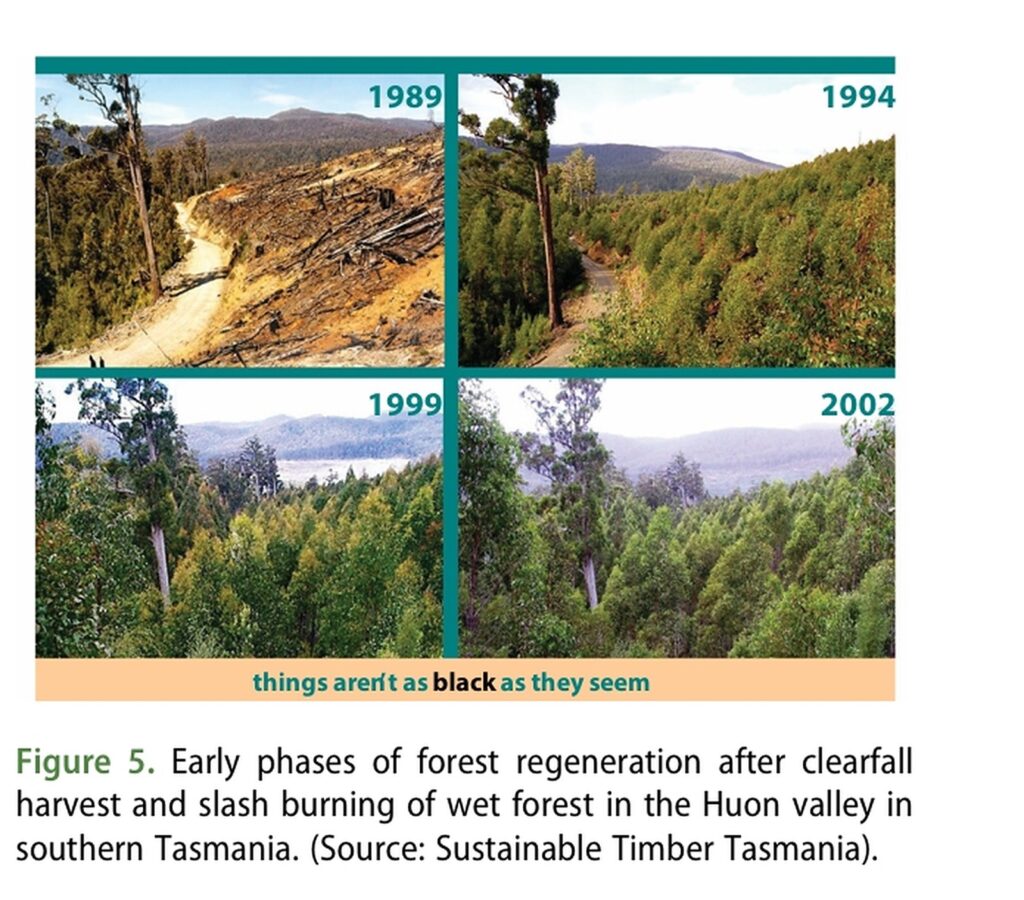
Early phases of forest regeneration after clearfall harvest and slash burning of wet forest in the Huon valley, southern Tasmania, photographed between 1989 and 2002. (Source: Sustainable Timber Tasmania)
[IN-TEXT IMAGE 1 — Huon valley regrowth sequence 1989–2002] Caption: Early phases of regeneration after clearfall harvest and slash burning of wet forest in the Huon valley, southern Tasmania, between 1989 and 2002. (Source: Sustainable Timber Tasmania)
The charge that harvesting equals deforestation draws a firm rebuttal, on the grounds that almost all harvested stands are regrowth, regenerated and monitored under legislated codes of practice rather than cleared for other land uses. A sequence of images from the Huon Valley in southern Tasmania, taken across thirteen years from 1989, shows a clear-felled and slash-burnt coupe replaced by dense young forest.
At the landscape scale, accounting for the dynamics of growth and the harvest-and-regrowth cycle, the authors say that sustainable harvesting leads neither to forest degradation nor to deforestation. The same evidence, they argue, undercuts the broader claim that managed native forests are being run down.
Carbon has become a major rallying point for activists, and it is here that the review is at its bluntest, dismissing the idea that ending harvesting would generate saleable carbon credits. The Australian Climate and Biodiversity Foundation has put that abatement at more than one million tonnes of CO₂-e a year for NSW, worth roughly $100 million, yet the authors calculate that all logs harvested nationally carry only about 2.5 million tonnes of CO₂-e — 0.6 per cent of Australia’s total net emissions — with a full life-cycle analysis showing sustainable harvesting aids mitigation rather than driving emissions.
Areas prescribed burnt and burnt by wildfire in south-west Western Australia from 1960 to 2023, showing bushfire extent rising as the prescribed-burn area declined. (Source: updated from Sneeuwjagt 2011 by Brad Barr)
That conclusion presses directly on the NSW government’s proposed Great Koala National Park, which the review says rests on contested science. Recent CSIRO survey work suggests national koala numbers may be up to 10 times higher than earlier estimates, with NSW data putting the state’s population near 274,000, and drone and acoustic surveys finding densities broadly similar within national parks and in adjacent harvested forests.
Harvesting in dispersed coupes has little bearing on the extent or severity of wildfire at the landscape scale, the review finds, whilst well-planned fuel-reduction burning cuts the area burnt by one hectare for every three treated. The long record from south-west Western Australia makes the case plainly: as the area treated by prescribed burning fell away from the 1960s, the area lost to bushfire climbed.
Melbourne’s water supply is another recurring alarm, and the authors are equally firm that fears of a logging-driven shortage in the city’s catchments rest on falsehood and misinformation. A long-used catchment model, they note, has for years overstated how much water regrowing forest actually uses.
Total volume of logs harvested from softwood plantations by category over twelve years to 2022–23, showing a static supply that cannot quickly absorb lost native forest production. (Source: adapted by Steve Read from ABARES)
A blanket ban on harvesting would only deepen a supply problem the country already faces, with wood-product imports reaching $6.5 billion in 2023–24, compared with $2.7 billion in exports and an estimated 2.5 million new homes needed by 2034. Plantations are no quick substitute, the authors argue, given a softwood estate static at about 1.2 million hectares for two decades and a first-year bill of roughly $1.5 billion to close Victoria’s native forest industry.
Native forests where harvesting previously occurred formed a net carbon sink of 35.7 million tonnes of CO₂-e in 2021, on the authors’ figures, equal to 8 per cent of Australia’s total emissions that year. The authors say regrowth forests make a significant contribution to meeting Australia’s emissions-reduction targets, and warn that propaganda built on the flawed use of science is undermining the case for managing native forests for community benefit. “There is a strong case for walking back from this,” the authors conclude.
For more information: Raison, R. J., Nambiar, E. K. S., Kile, G. A., & Bren, L. J. (2026). Australia’s native forests can be sustainably managed for wood production together with other important forest values. Australian Forestry.https://doi.org/10.1080/00049158.2026.2663997
Researchers at RMIT University have converted eucalyptus bark — a forestry by-product routinely discarded as low-value waste — into a highly porous carbon designed for carbon capture and the trapping of pollutants from both air and water, opening a cheaper route to environmental cleanup. That is according to a study led by RMIT PhD researcher Pallavi Saini, published in the journal Biomass and Bioenergy, which outlines how a single activation step converts bark into a functional material.
Built on a one-step activation process rather than the multi-stage methods common across industry, the technique converts a forestry residue into the microscopic pore structure that filtration and purification systems rely on to trap unwanted molecules as air or water passes through. The researchers describe the result as a circular-economy use for biomass that the sector has largely ignored.
Saini said the bark’s performance in adsorption testing was unexpected, given how routinely the material is written off on the mill floor. “Overlooked biomass can be transformed into something useful,” she said.
Because eucalyptus bark is abundant and renewable across the Australian landscape, RMIT researcher Deshetti Jampaiah said it suited local production without the complex processing required by other feedstocks. “This makes it highly relevant for real-world environmental applications,” Jampaiah said.
With more than 900 eucalypt species growing across the country, the team says future work could draw on Indigenous knowledge holders to identify which are best suited to advanced environmental materials. That breadth gives Australian developers a deep, largely untapped feedstock to screen.
Distinguished Professor Suresh Bhargava, who leads the RMIT laboratory behind the work, said the bark demonstrated how discarded materials could help address pollution and carbon emissions simultaneously. The published study points to carbon dioxide capture, water purification, air filtration and industrial gas treatment as candidate uses, with the carbon “support[ing] cleaner water, cleaner air and carbon capture,” Bhargava said.
Whilst the early results are promising, the team cautions that durability testing and scale-up remain to be completed before the carbon can be deployed in working systems, leaving commercial carbon capture some way off. For now, the work adds to a fast-growing body of global research into biomass-derived carbons, particularly in timber-producing countries where bark and other residues pile up unused.
For more information: Saini, P., Sharma, S., Periasamy, S., Jampaiah, D., & Bhargava, S. K. (2026). Sustainable valorisation of eucalyptus bark waste into microporous carbon materials for efficient CO₂ capture. Biomass and Bioenergy, 212, Article 109242. https://doi.org/10.1016/j.biombioe.2026.109242
A new national testing standard for mechanical fasteners and connectors holding timber buildings together gives manufacturers, laboratories, and engineers a single, repeatable method for measuring how those joints carry load. That is according to FWPA Standard T01, the FWPA-funded Industry Standard developed by the ARC Advance Timber Hub at the University of Queensland in collaboration with the Engineered Wood Products Association of Australasia.
Aimed at manufacturers, testing laboratories, universities, engineers and certifiers, the standard sets out consistent methods for measuring strength, stiffness, ductility and slip behaviour across both sawn timber and engineered wood products, including glue-laminated timber, laminated veneer lumber, cross-laminated timber and plywood. It covers lateral and axial loading, along with testing of individual fasteners and full connection assemblies, generating characteristic design values suitable for structural design under AS 1720.1.
Rather than replacing existing Australian Standards, T01 is built to sit alongside them, offering an alternative route to the characteristic capacities of commonly used timber connection types until AS 1649, revised in 2025, undergoes a further comprehensive overhaul. The standard fills a working gap, providing usable test data to the sector for modern timber systems, whilst the formal benchmark catches up.
For Forest and Wood Products Australia, the value lies in comparability, with a single shared method enabling laboratories, researchers and manufacturers to measure the same connection consistently. “Improves transparency and comparability of test results,” FWPA said.
Released as a 2026 first edition covering Category A and B fasteners, T01 marks the opening part of the series, and Forest and Wood Products Australia has built it to run alongside the Australian Standards until AS 1649 clears its next full revision.
Public comment has opened on the first amendment to the standard governing certified sustainable forests across Australia and New Zealand, with the revision drafted to bring the scheme into line with the European Union’s deforestation regulation. That is according to Responsible Wood, the standards development organisation behind AS/NZS 4708 and the body that administers PEFC-endorsed certification across both countries.
The standard sets out the requirements forest managers must satisfy to certify their operations as sustainable, anchoring the Responsible Wood Certification Scheme in Australia whilst forming the basis of the PEFC-recognised scheme in New Zealand. Reviewed every five years and last updated in 2021, the document governs certification across 17 million hectares of Australian forest and a further 600,000 hectares across the Tasman, and has been redrafted by the organisation’s Standards Reference Committee.
Responsible Wood CEO Simon Dorries said the review kept the standard aligned with evolving industry practice, scientific knowledge and stakeholder expectations across the sector: “Sustainable forest management impacts a wide range of people and sectors,” Dorries said.
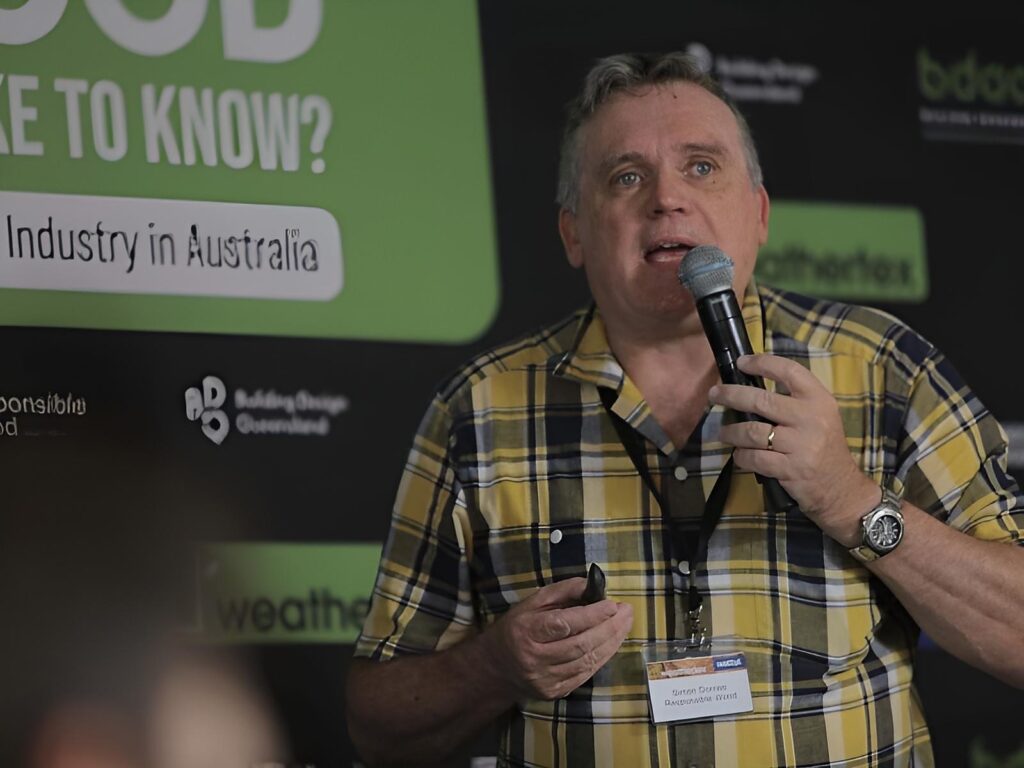
Responsible Wood chief executive Simon Dorries said the five-yearly review keeps AS/NZS 4708 aligned with evolving industry practice, scientific knowledge and stakeholder expectations as the standard moves into line with the EU deforestation regulation. (Photo Credit: Wood Central / Central PR Group supplied by Weathertex as part of Wood You Like to Know)
The amendment responds to changes in the PEFC International benchmark PEFC ST 1003:2024, rewritten to align the global certification system with the European Union Deforestation Regulation, alongside feedback gathered since the last revision. The consultation follows Responsible Wood’s move last year to begin redrafting the standard to meet the incoming EU rules.
Drawn from forest managers, researchers, auditors, government, environmental groups, Indigenous stakeholders, industry and unions across both countries, the committee prepared the draft under Standards Australia procedures, with Responsible Wood accredited as a standards development organisation in both markets.
Dorries said the consultation gave forest managers, manufacturers, builders, designers, retailers, environmental groups and communities a direct hand in shaping responsible forest management on both sides of the Tasman.
Responsible Wood has set 7 August as the deadline for submissions, with the draft standard and submission form available ahead of the committee finalising the revision under the PEFC system, which it describes as the world’s largest.
A leading forest-communities advocate has cautioned that the new link between koala deaths and a 27-degree Celsius heat threshold risks confusing correlation with causation, pointing to the spring breeding season as an overlooked explanation for the surge in admissions. That is according to Steve Dobbyns, executive officer of Forest and Wood Communities Australia, in comments to Wood Central on the study of 11,862 koala rescue records across New South Wales.
The study, released this week, matched each admission to local weather records spanning 2000 to 2022 and found the odds of a koala being admitted or dying increased by 1.5 to 3.5 times once seven-day temperatures exceeded 30 °C. Its lead author, University of Sydney behavioural ecologist Valentina Mella, has called the work the most comprehensive link yet drawn between rising temperatures and koala mortality.
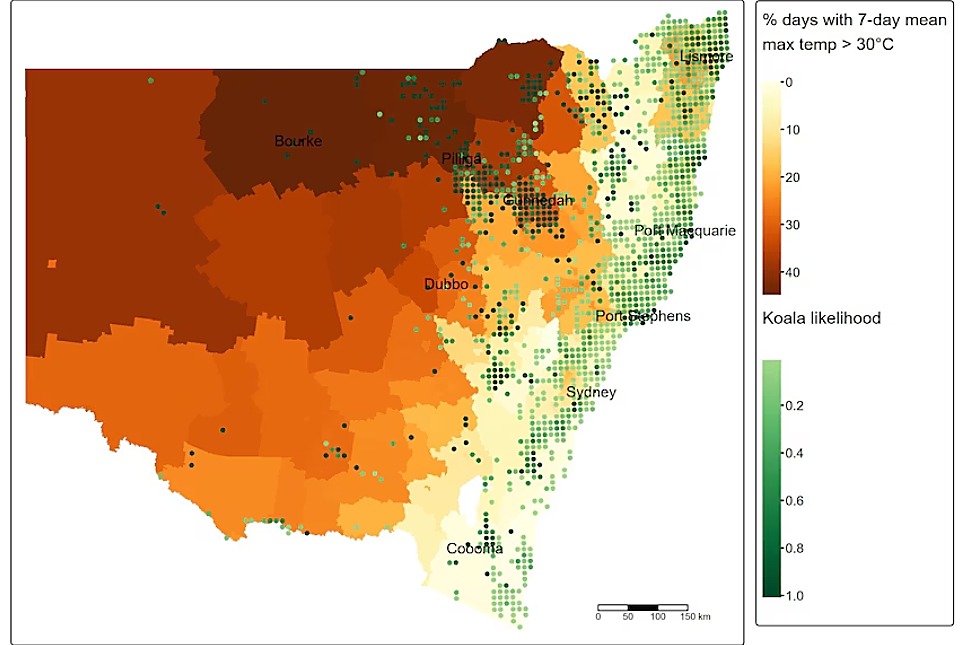
The study mapped koala likelihood across NSW against heat exposure, with the darkest inland districts recording the most weeks above 30 °C and the steepest modelled risk of hospitalisation or death. (Biology Letters: University of Sydney, CC BY 4.0)
Dobbyns welcomed the research as a worthwhile contribution but said a statistical association of that kind could not, on its own, establish what was killing the animals. “Correlation doesn’t necessarily prove causation,” he said.
His central objection turns on timing, because the spring and summer breeding season coincides with the hot, dry months singled out by the study as most dangerous. Koalas cover far greater distances in that window as they search for mates and territory, he said, which leaves open the possibility that heat marks the calendar rather than the cause.
That heightened movement carries its own toll, with roaming animals running into cars, dogs and other hazards far more often than settled koalas. The breeding surge, he said, “coincides with hotter months and drought conditions,” so higher temperatures “may simply overlap with periods of elevated movement and stress rather than being the sole driver of mortality.”
A second caution concerns the data itself: rescue admissions count only the koalas people find and deliver into care, rather than total deaths across the landscape. Dobbyns said animals moving more often near roads, towns and farms were “more likely to be detected and admitted to care,” which could overstate the apparent toll in settled districts.
He was careful not to play down the heat risk, acknowledging that hot weather and drought clearly affect koala health and survival. Pinning rising deaths on a single number, he said, oversimplifies a picture that involves “a much more complex interaction between breeding behaviour, seasonal movement, habitat condition, disease, predation and human interaction.”
For Dobbyns, the threshold makes a compelling headline but will carry weight once researchers can separate heat from the breeding-season movement that peaks across the very same weeks — a distinction he says the current admissions data cannot draw on its own.
The Albanese government has committed $39.3 million to a trial of System 600, an open-source prefabricated housing platform that standardises components such as wall panels, bathroom pods and facades, enabling them to be manufactured off-site and assembled on-site at speed. It comes as Housing Minister Clare O’Neil pushes modern methods of construction to the centre of the Commonwealth’s housing agenda, drawing on a Swedish model where prefabrication is already standard.
O’Neil used her National Press Club address to argue Australia has been too slow to adopt techniques common overseas, telling delegates she is a committed believer in housing innovation. The funding will flow to states and territories for pilot projects, technical development, training and supply-chain expansion.
“We have to get faster and more efficient,” O’Neil said.
The minister pointed to Scandinavia, telling the Press Club that 80 per cent of homes built in Sweden use some aspect of modern methods of construction, “compared to just 5 per cent in Australia.” She said she would happily live in a home built that way, pushing back on what she cast as lingering Australian scepticism toward prefabrication.
“We do need to change that,” O’Neil said of the gap.
Housing Minister Clare O’Neil told the National Press Club that lifting home building means adopting modern methods of construction at far greater scale. (Video Credit: ABC News via YouTube)
System 600 was developed jointly by Homes NSW and the Building 4.0 Cooperative Research Centre, and its open-source design lets different manufacturers produce compatible parts under common standards rather than locking projects into a single proprietary supplier. The platform breaks a building into repeatable subsystems covering structure, external envelope, services and interior finishes, applying manufacturing logic to construction while preserving design flexibility.
“We have standard parts, not standard designs,” Building 4.0 CRC Director Mathew Aitchison said.
The program starts with medium-density buildings of four to six storeys, using a standardised kit of parts manufactured off-site — bathrooms, kitchens and balconies among them — that is then assembled on-site through systems built to meet tenant needs, speed delivery and drive down cost. The system takes its name from a 600 by 600 millimetre grid that coordinates component size and connection, with roughly 80 per cent of each building standardised and the remaining 20 per cent tailored to its site.
Homes NSW and the CRC put the approach on show last year with a fully built two-bedroom demonstration apartment at a Mascot showcase that drew more than 1,000 attendees across its run. Because the platform is open-source and supplier-agnostic, any manufacturer that builds to the shared rules can supply parts to any project, with the first deployment running through the Homes NSW social-housing program.
That program has been underway since May 2024, with $2 million each from Homes NSW and the CRC, targets a 20 per cent cut in construction time and cost, and underpins a NSW commitment of $6.6 billion toward 8,400 new homes and 30,000 repairs. Professor Daryl Patterson, who leads the platform’s technical development, said the distributed model was a deliberate answer to the risks of highly centralised modular manufacturing.
“There’s a lot of intelligence in the supply chain,” Patterson said.
The timing matters because productivity is moving in the wrong direction, with Productivity Commission findings showing that Australia builds roughly half as many homes per hour worked as it did in 1995, and residential construction timelines nearly doubled over the past decade. New dwelling prices rose an average of 4.7 per cent in the year to April on Bureau of Statistics figures released on Wednesday, and the Commonwealth Bank expects home-building costs to peak at 8 per cent by September.
National Shelter chief executive Jackson Hills said the funding would help clear one of the most stubborn barriers to the delivery of modern construction methods at scale. The government also wants more social housing built from prefabricated parts, and O’Neil told the Press Club the $40 million kit-of-parts investment could not be better spent, given the wear and tear on ageing public housing stock.
“There is simply no pathway to meeting our future housing needs without the adoption of new and innovative housing,” Hills said.
A walk-through of the two-bedroom demonstrator apartment, Homes NSW, and the Building 4.0 CRC, built to show the System 600 kit-of-parts approach at the Mascot showcase. (Video Credit: Building 4.0 CRC via YouTube)
This is the precise problem the Future Framing Initiative is testing, with University of Tasmania research lead Professor Louise Wallis confirming the team is identifying where the roadblocks sit and building the evidence to clear them. The work tests the framing system responsible for more than 80 per cent of the country’s current housing stock against a mid-rise future.
“Literally it’s up to 15 metres,” Wallis said of the system’s tested upper bound — roughly four to five storeys.
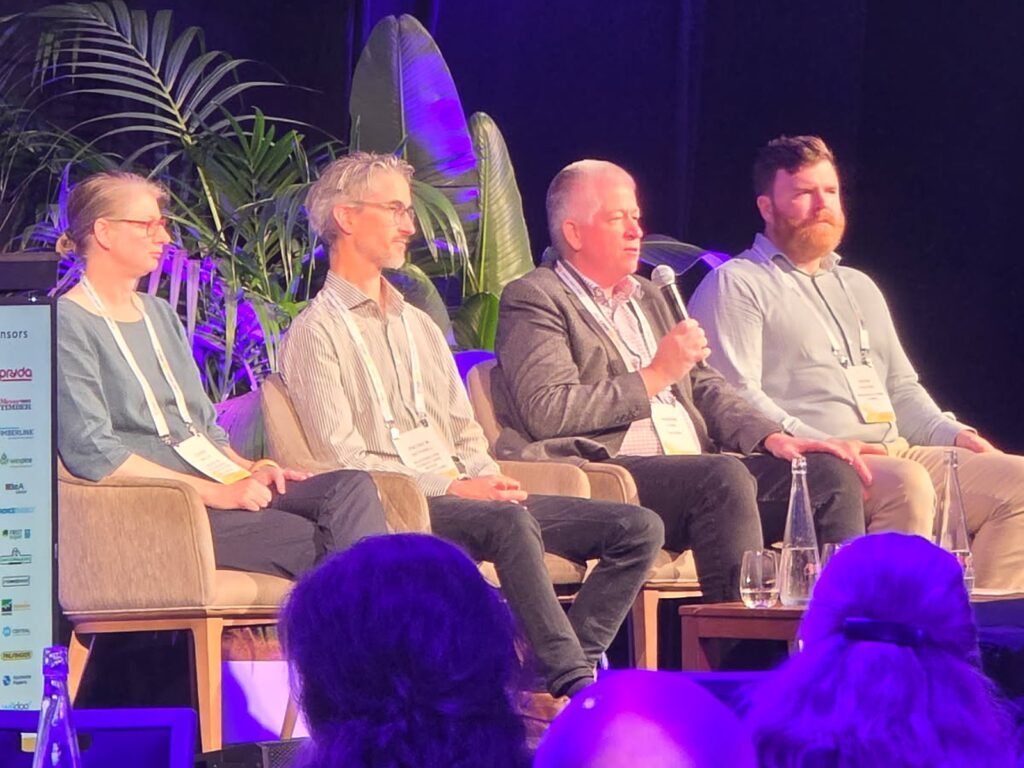
The Future Framing Initiative panel at FTMA’s National Conference at Twin Waters on the Sunshine Coast, with University of Tasmania research lead Professor Louise Wallis, AFWI Deputy Director Professor Patrick Mitchell, Australian Timber Development Association CEO Andrew Dunn and FWPA Head of Built Environment and Head of the WoodSolutions Programme Kevin Peachey on stage. (Photo Credit: Supplied by FTMA to Wood Central / Central PR Group)
The Initiative is backed by FWPA alongside major timber framing suppliers, including Timberlink, and is working to build trust in timber and strengthen its role in affordable, efficient housing. Australian Timber Development Association chief executive Andrew Dunn has said the Initiative will publish its mid-rise lightweight-framing standard as an FWPA Industry Standard rather than route it through Standards Australia, a means to deliver outcomes to the market in the shortest possible time.
“This is a generational opportunity to fix roadblocks and modernise timber framing,” Dunn said.
Colourful Queensland timber legend Chris Hall passed away in Toowoomba last week, aged 83, after settling permanently in the Darling Downs Garden City 18 years ago.
Many of his successful endeavours have included, in his early years, working as a jackaroo in western Queensland before moving into the timber business in a big way as a wholesale merchant and importer and running a wood stripping and drying facility for top-end clients, this while keeping an eye on a herd of Murray Grey cattle growing fat on improved pastures at the family’s 120-hectare Boonah property in the Fassifern Valley.
In 1968, he joined Brett’s in the Brisbane company’s timber importing division, working under the expert tutelage of Bertie George.
A close friend, Bill Philip, recalls: “The boom in the industry turned to bust by mid-1974 with floods, politics and crumbling credit providers forcing many building developers to the wall.”
“Only top traders like Chris Hall survived in these difficult times. Chris never took his eye off the ball and made many friends … and Christopher Lindsay Hall never lost a friend. The family always remained intact and flourished.”
“Chris liked to describe himself as a ‘simple country boy’ but he was much, much more than this. He was a good man always around for the fun, the hard times and the great times.”
“Forest Products Marketing then ‘dominated’ the world of wood in Queensland but not Chris who left FPM after a comparatively short time to take up a sizeable selection at Millbong-Munbilla Road at Roadvale in the Fassifern Valley.”
The hilltop elevated site had a constant breeze, and Chris proudly proclaimed he could strip and air-dry one-inch hoop pine on his elevated property faster than anybody else.
Christopher Hall is survived by his wife Colleen, four daughters Sarah, Vanessa, Lucie and Georgina, their husbands and eight grandchildren.
A private family service for Chris Hall was held in Toowoomba.
A timber “cathedral” of NSW hardwood columns, rising into a tiered canopy above rows of log benches, is the signature space of the world’s first wild koala breeding centre. Guulabaa, or Place of Koala in the Gathang language of the Biripi people, was built almost entirely from local hardwood and raised in a working state forest as a direct answer to the Black Summer bushfires.
The 25-hectare site breeds koalas for release into the wild, as part of a recovery programme led by Koala Conservation Australia. Its elevated timber decks link a cafe and gallery run by the Bunyah Local Aboriginal Land Council to the rest of the visitor experience.
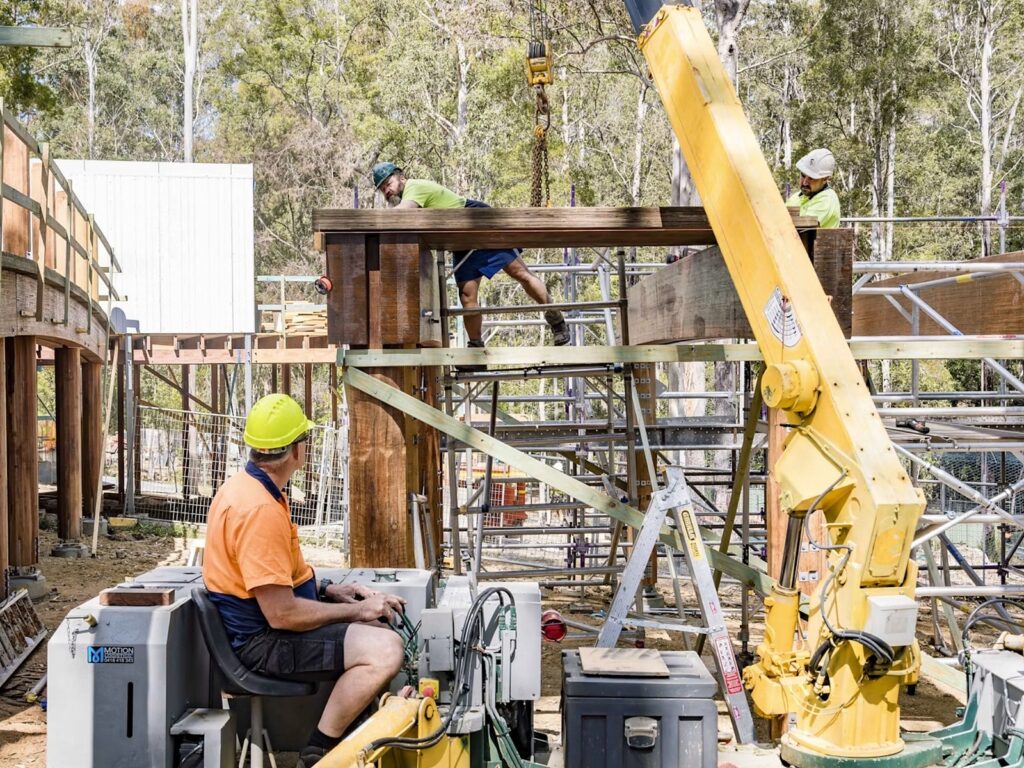
Crews position a mass timber deck during construction of the Guulabaa hub, prefabricated off-site and craned into the working forest. (Photo Credit: Supplied by Forestry Corporation of NSW to the Timber Design Awards as part of the submission)
The hub is a 90 per cent timber structure, with four main decks of mass timber supported on a braced pole system, and traditional framing retained for the stairs, gallery and roofs. Bridge-ply LVL decking spans pairs of large LVL and Stringybark beams, while unseasoned hardwood poles, bolted to concrete foundations with steel brackets, carry the decks clear of the ground.
Each deck was prefabricated off-site under a Design for Manufacturing and Assembly process, then craned into position to limit disturbance to the working forest around it. Even the steel bracing between the poles was set, the award’s entry notes, “to minimise climbing hazards” and keep the ground beneath the decks clear.
A prefabricated LVL panel is craned into place at Guulabaa, with stacked bridge-ply decking waiting on the forest floor. (Photo Credit: Supplied by Forestry Corporation of NSW to the Timber Design Awards as part of the submission)
The timber came from eight local hardwood businesses — Ironwood, Coffs Harbour Hardwoods, Hurford Hardwood, Pentarch Forestry, Machins Sawmilling, Hayden Timbers, Weathertex and Big River Group — a local supply chain that, the entry says, “helped revitalise the regional industry.” Weathertex also supplied the cladding, described in the entry as a carbon-positive board made from sawmill waste.
Central to the design was fire-resistant Tallowwood, a native hardwood that, the awards entry argues, proved viable where “sustainable native timber construction was previously considered impossible”. Traditional First Nations cool-burning practices were written into the site’s fire management, drawing on Indigenous knowledge held by the Bunyah Local Aboriginal Land Council.
The completed Guulabaa hub steps through the canopy on unseasoned hardwood poles, a 90 per cent timber structure. (Photo Credit: Supplied by Forestry Corporation of NSW to the Timber Design Awards as part of the submission)
The cathedral also serves as the site for cultural awareness training, integrating First Nations culture into the visitor experience. Its awards entry argues that Guulabaa has set “a new precedent for safe, climate-adaptive architecture in bushfire-prone regions”.
Designed by global architecture firm Gensler, with structural engineering by TTW and construction by F & SJ Maione, the hub was shaped in collaboration with Forestry Corporation NSW and the Bunyah Local Aboriginal Land Council. “Guulabaa challenged us to rethink what regenerative architecture should be,” said Ken McBryde, then Design Director at Gensler Australia.
Speaking to the media last year, McBryde said the project was less about a bold architectural statement than about designing with care and respect for Country, crediting the result to long-term thinking shared across the project team and First Nations knowledge holders. It was TTW that entered Guulabaa in the Public Building category of last year’s Australian Timber Design Awards, and projects of its kind help explain a change in this year’s programme.
For the first time, architects, engineers and builders are encouraged to identify the source of their timber, tracing it to the forest region and, in many cases, the sawmill. That is according to awards organiser Kylan Low, who said more than 4,000 Australian projects have entered the awards since 2000. The programme is run by the Timber Development Association and supported by Forest and Wood Products Australia and WoodSolutions.
Kylan Low, organiser of the Australian Timber Design Awards. (Photo Credit: Supplied)
“For the first time in its 27-year history, the Australian Timber Design Awards is tracking timber back to its forest region of origin, and in many cases, the sawmill,” Low said. “It’s a milestone for the programme and a powerful statement about the transparency and traceability our industry can offer.”
Koalas die at sharply higher rates once the seven-day average maximum temperature tops 27 degrees Celsius, a threshold well short of the heat extremes long assumed to put the species in danger. That is according to a study published in the journal Biology Letters, which matched 11,862 koala rescue admissions across New South Wales against weather records spanning 2000 to 2022.
The work, led by University of Sydney behavioural ecologist Valentina Mella, found the odds of a koala being admitted to care or dying increased by 1.5 to 3.5 times in weeks when average maximum temperatures exceeded 30 °C, relative to a 25 °C baseline. Populations across inland north-west NSW carried the heaviest exposure, because those ranges run hotter than the coastal forests to the east.
Mella, who has run several koala studies in the state’s north-west, told ABC Science that prolonged drought and more frequent heat were now compounding habitat fragmentation and disease, with some local extinctions already beyond reversal. “These are the first populations that are going to go,” she said.
Valentina Mella has carried out several koala studies across north-west NSW, the inland region, the new analysis identifies as most exposed to heat-related admissions and deaths. (Photo Credit: University of Sydney)
The koala population in Gunnedah, once promoted as the koala capital of the world, is now functionally extinct, with the remaining animals infertile and no replacements to take their place once they die.
The study mapped every admission against local weather records, producing a statewide gradient that runs from the heat-prone inland districts of the Pilliga and Liverpool Plains to the cooler, koala-dense forests of the Mid North Coast. That coastal belt takes in the 176,000 hectares of state forest earmarked for the proposed Great Koala National Park, which the NSW government has committed to legislating late in 2026, as Wood Central reported.
The study overlaid koala likelihood across NSW on a map of heat exposure, with the darkest inland districts recording the most weeks above 30 °C and the steepest risk of hospitalisation or death. (Biology Letters: University of Sydney, CC BY 4.0)
The finding carries direct weight for land managers and private native forestry, because koala survival rests not only on the eucalypts the animals feed on, but also on the shade trees they shelter in during the hottest hours. University of Queensland ecologist Bill Ellis, who took no part in the study, said non-food trees mattered as much to koala survival as the eucalypts the animals browse.
Ellis has urged landowners to keep patches of bush on private property, particularly along creek lines, arguing those cooler pockets are exactly where koalas retreat when heat builds. “They can’t survive without the shady trees that they sit in during the day,” he said.
Separate research at the Australian National University is testing whether eucalypts can be bred to have higher protein and lower toxin levels, an effort aimed at building what its scientists describe as nutritional refugia in a warming climate. ANU landscape and nutritional ecologist Kara Youngentob, who was not involved in the Biology Letters study, said koalas lost their appetite in the heat and held almost no fat reserves to draw on.
Youngentob said the margin was far thinner for koalas than for most mammals, because the animals must eat every night and keep nothing in reserve. “Koalas can only last a few days; they basically have no fat reserves,” she said.
Koalas draw most of their water from the eucalyptus leaves they eat, yet trees pull moisture back from their foliage during dry spells, leaving the animals chewing what Mella likened to dry cardboard. The loss matters because panting is the main cooling mechanism koalas have, and every pant spends water that a drought-stressed animal cannot easily recover.
University of Melbourne ecologist Natalie Briscoe, who had no role in the research, said using care admissions in this way was a clever way to capture an association that is otherwise hard to measure in wild animals. The result, she said, lined up with what is already known about koala physiology and behaviour under sustained heat.
Briscoe said the outlook was bleak, particularly for koalas in the northern and inland parts of the range where heat is building fastest. “Things are likely only going to get worse for koalas under climate change,” she said.
Mella has called for water stations and built shade structures across the hottest regions, the same provision long made for livestock. The koala is listed as endangered in NSW, Queensland and the ACT, and the study sets the point at which deaths begin to climb at 27C — a mark inland ranges now cross for weeks at a stretch each summer.
Cheap Russian timber is still reaching Australian building sites three years after Canberra hit it with a 35 per cent tariff, rerouted and relabelled through third countries to dodge the duty. That is according to a submission filed with the Senate Foreign Affairs, Defence and Trade References Committee yesterday by Australian Forest Products Association Acting Chief Executive Richard Hyett, who has urged the federal government to extend that tariff to every product carrying Russian material, no matter which country it ships from.
At the centre of the submission sits a blunt verdict on a policy now three years old, namely that the sanctions introduced in the weeks after Russia invaded Ukraine have not done the job. Wood Central understands the submission states the sanctions “appear to have been inadequate,” with Russian products “rerouted in both raw and processed form through third countries to avoid Australian sanctions.”
The complaint turns on two engineered products above all: laminated veneer lumber and plywood, in which Chinese manufacturers convert cheap Russian timber into finished goods that clear the substantial transformation test and so escape the duty altogether. Hyett describes the result as a shadow trade running through Chinese supply chains, a pattern that has also seen Russian birch processed in Vietnamese and Indonesian mills before shipping on to Western markets.
The submission documents what it calls a commensurate shift, with imports from China and Lithuania rising as Russian volumes fell away after the April 2022 tariff. AFPA says the pattern has raised serious concerns about the authenticity of the origin claims from those countries.
The shift has only hardened over the past year, with declared LVL imports reaching 205,343 cubic metres in the 12 months to October 2025, a 63 per cent jump on the year before. China supplied 69 per cent of that total, and the price of Chinese products fell by 63.2 per cent over the same period.
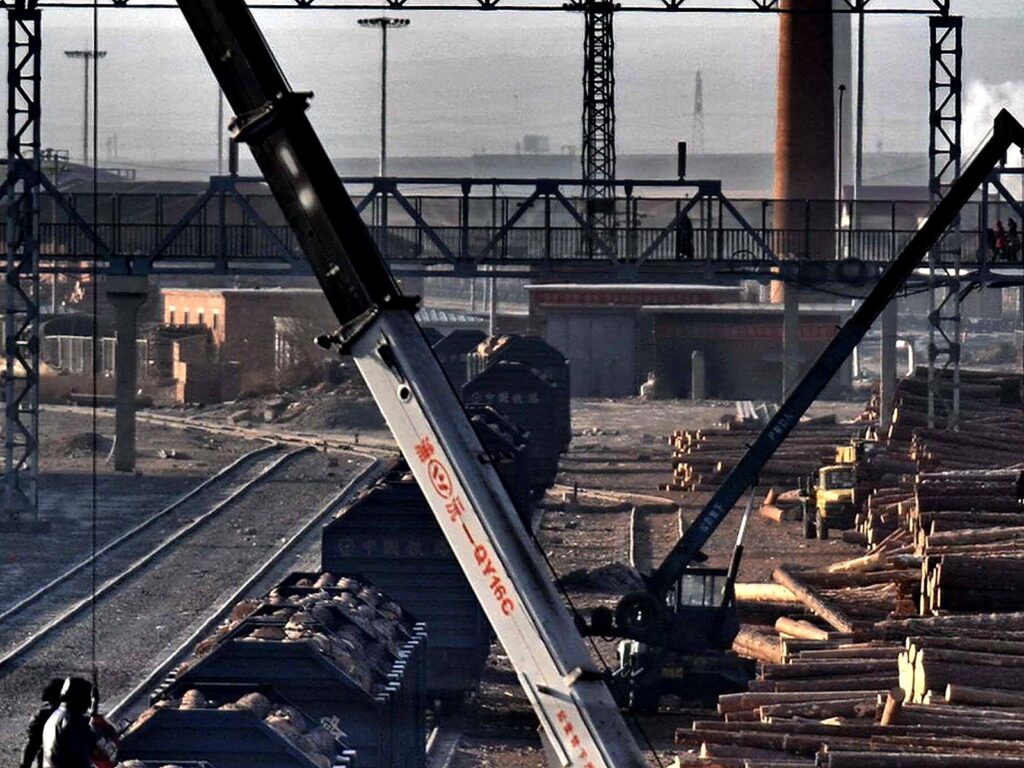
Logs are loaded for rail freight at a timber yard. China shipped 69 per cent of Australia’s laminated veneer lumber in the year to October 2025, a trade AFPA says is carrying rerouted Russian material that escapes the 35 per cent tariff once milled across the border. (Photo Credit: Supplied)
A price collapse on that scale cannot be explained by ordinary market softness, the submission argues, and points instead to dumping or to relabelled Russian stock working its way down the chain. That argument is backed by a timber testing report commissioned by the Department of Agriculture, Forestry and Fisheries, which found that Chinese LVL contained Russian wood and that half of the samples examined could not have their origin verified.
Those findings raise hard questions about FSC certification issued in China, given that the scheme banned Russian and Belarusian material after the invasion, yet apparently certified products keep turning up on Australian shelves. Australia, the submission notes, operates no independent origin-testing programme of its own and relies almost entirely on certification for assurance, even though Source ID technology is already capable of confirming where a log was cut.
For Australian mills, the toll is already visible: yards backed up with unsold stock, shifts trimmed, and demand for locally grown timber draining away as cheap imports take up shelf space. The submission states that the impact on domestic producers “has been and continues to be devastating.”
AFPA has presented three remedies to the committee, none of which is modest. Hyett wants the 35 per cent tariff extended to all products containing Russian materials, anti-dumping action opened against those products, and proactive border compliance checks to catch rerouted stock before it clears customs.
The submission holds up the European Union and the United States as the template Australia has so far declined to follow. From November 2025, every Chinese hardwood plywood shipment into the EU has carried an 86.8 per cent duty — bar a single cooperating exporter on 43.2 per cent — while Brussels has issued a sanctions alert flagging birch plywood routed through China with trade links to Russia or Belarus.
Australia, by contrast, has taken none of those steps, and AFPA argues that the inaction has quietly turned the country into a preferred destination for the trade the West is now shutting out.
The AFPA submission is one of 29 already lodged through the committee’s portal, an inquiry the Senate referred on 5 November 2025. Public submissions close on 12 June, and a final report is due back by 20 August, with at least 26 entries already on the public register, among them Australian National University legal scholar Anton Moiseienko, financial integrity firm KordaMentha, the Minderoo Foundation, Transparency International Australia and the Department of Foreign Affairs and Trade.
Most of the submissions so far on the public register focus on the so-called “blood oil” loophole, with Australia named as the single biggest buyer of petroleum products refined from Russian crude in third countries. The energy and Ukrainian-community submitters include the Centre for Research on Energy and Clean Air, the Australian Institute of Petroleum, Senator Fatima Payman, the Australia-Ukraine Chamber of Commerce, B4Ukraine and the Australian Federation of Ukrainian Organisations.
Russian President Vladimir Putin meets Alexey Mordashov, whose Severgroup controls plywood giant Sveza. INTERPOL ranks illegal logging as the third most lucrative transnational crime, and AFPA argues funds from sanctioned Russian timber are still reaching Moscow through third-country sales. (Photo Credit: Wiki Commons, under Creative Commons)
Wood Central understands the timber supply chain is among the sectors now active before the inquiry, with further submissions expected in the days ahead, and the Albanese government is under mounting pressure to bring Australia’s regime into line with the European Union and other Western nations. Russian timber sits among the Kremlin’s highest-value transborder trades, and INTERPOL ranks illegal logging as the third most lucrative transnational crime on earth — behind only counterfeiting and drug trafficking.
A public school in south-west Sydney has been delivered in less than nine months, its classrooms, commons and envelope built almost entirely from exposed laminated veneer lumber that doubles as both structure and finished surface. That is according to the project’s entry in the 25th Australian Timber Design Awards, lodged by head contractor Lipman in the Public Building category, which sets out how Oran Park Public School uses engineered timber and high pre-manufactured value to meet School Infrastructure NSW’s push for faster school delivery.
A lower-level classroom at Oran Park Public School: its exposed NelsonPine LVL ceiling cassette serves as a structural element, finished lining, and fire protection for the level above. (Photo Credit: Mike Chorley, provided to Wood Central by the Australian Timber Design Awards)
Exposed LVL runs through the primary columns and beams, the closed floor cassettes and the closed ceiling cassettes, accounting for around 70 per cent of the structure. The floor cassettes were built from a NelsonPine LVL panel that serves as finished ceiling lining, a structural element, and fire protection for the level above.
Meanwhile, Roof cassettes, comprised of NelsonPine LVL billets, serve as the structure and finished ceiling in a single component, with MeySPAN LVL and MeyJOIST engineered I-joists completing the modules. Timber Building Systems fabricated and installed the timber scope, working with NelsonPine to machine LVL columns to exact dimensions for a visually seamless match with the ceilings.
The exterior of Building O at Oran Park Public School at dusk, with exposed LVL soffits lining the upper walkway and pre-cast concrete stairs and circulation kept clear of the timber structure. (Photo Credit: Mike Chorley, provided to Wood Central by the Australian Timber Design Awards)
The building achieves a 5 Star Green Star as-built rating, with exposed timber soffits delivered in a Class 9B building of Type B construction under the National Construction Code. The awards entry states that the exposed LVL solution “featured prominently in the sustainability strategy” for the school, supported by heat-exchange energy recovery systems serving every teaching space.
Bennett and Trimble led the architecture, with Bligh Tanner as the structural and facade engineer, and Lipman as the early contractor involvement partner and head contractor. Lipman’s submission states engineered timber was specified for its alignment with “modern methods of construction, accelerated delivery and low-carbon buildings.”
Inside Oran Park Public School — a multi-purpose space opening through operable walls to the LVL-framed learning commons, a general learning area beneath the exposed timber ceiling and an aerial of the school’s two engineered timber buildings in south-west Sydney. (Photo Credit: Mike Chorley, provided to Wood Central by the Australian Timber Design Awards)
Oran Park Public School was entered in the Public Building category of the 25th Australian Timber Design Awards, the 2024 edition of a program that recognised 15 projects. The awards have run for 27 consecutive years, a roll call that takes in World Buildings of the Year, Olympic venues, embassies near the White House and, in 2025, Archer Office’s reuse of a condemned 1892 boot factory in Bondi Junction.
Building O at Oran Park Public School is lit at dusk, a homebase entry marked by a red acoustic panel and patterned glazing, and a classroom drawing daylight through a full-height window wall beneath its exposed LVL ceiling. (Photo Credit: Mike Chorley, provided to Wood Central by the Australian Timber Design Awards)
Entries for the 27th Australian Timber Design Awards are now open, with organiser Kylan Low revealing that the program is the industry’s way of championing its best work, with every winning project carrying a supply chain story that runs from the forest through sawmills and engineers to builders. “Behind every winning project is a supply chain story that begins in the forest,” Low said.
Primex Field Days has wrapped up in Lismore, closing a three-day run that drew students, landholders and the general public into the timber industry for the agricultural showcase’s first staging in the Northern Rivers. A wide forestry programme drove much of that traffic, run across 21 to 23 May by the North East NSW Regional Forestry Hub.
Securing the annual event was a coup for Lismore, which hosted Primex for the first time in 2026 after years in which the showcase had built its name elsewhere on the North Coast. Primex owner Bruce Wright set out the preparations for the Lismore staging in an interview with Talking Lismore ahead of the gates opening.
The hub’s programme ran the breadth of the sector across the three days, moving from valuing the forest on a private landholding and the workings of carbon credits through to high-value hardwood furniture and the restoration of degraded landscapes. Crowds of students moved through the forestry exhibits and pressed speakers with challenging questions throughout the event.
Students moved through the forestry exhibits and speaking sessions across the three days of the Primex Field Days in Lismore, with the North East NSW Regional Forestry Hub programme drawing strong interest from schools. (Photos: Supplied exclusively to Wood Central / Central PR Group by the North East NSW Forestry Hub)
Hub manager Nick Cameron said the response from younger visitors had been the standout of the three days, with secondary students drawn to forestry careers and primary-aged children captivated by the working machinery: “The primary students loved watching the equipment demonstrations,” Cameron said.
Last month, the hub published a series of videos produced by Central PR Group / Wood Central. One of them covered Designer Woodworks founder Garan Hale, following the Kyogle fine woodworker through the salvage, milling, drying, and benchwork behind 30 years of Northern Rivers hardwood furniture. (Video Credit: Supplied by the North East NSW Forestry Hub)
Andrew Hurford, chair of Timber NSW and chief executive of the Hurford Group, said the reaction from students and the general public pointed to a high level of social licence for the forestry sector. Exhibitors ranged from plantation growers SuperForest Plantations and Hurford Forests through to Koppers, whose timber utility poles carry much of the Australian electricity network, alongside sawmillers producing flooring and decking.
The North East NSW Regional Forestry Hub forestry programme drew hundreds of landholders, students and industry to sessions spanning farm forestry, property water management, carbon credits and value-added timber. (Photos: Supplied exclusively to Wood Central / Central PR Group by the North East NSW Forestry Hub)
Organisers expect the forestry presence to return when Primex next runs, with the hub reading the Lismore turnout as a measure of public appetite for the industry’s story. Three days of full exhibits and a steady stream of students have given the sector a strong case for a permanent fixture on the Primex floor.
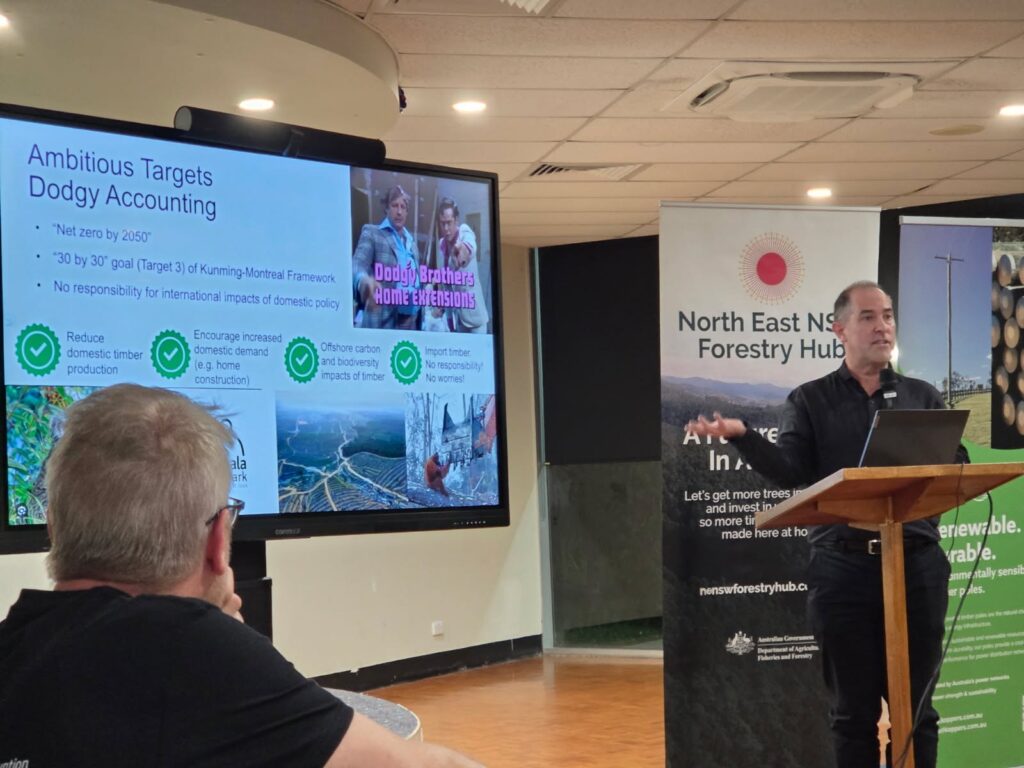
Reduced harvesting in Australia’s native forests is driving timber demand offshore to countries with a high risk of illegal logging and deforestation, a pattern that has pushed the nation’s overseas harvest footprint far beyond the domestic one it is meant to replace. That is according to Dr Tyron Venn, one of the country’s preeminent forest economists, who delivered the keynote address at this year’s Primex Forest Industries Dinner in Lismore, NSW, last night.
Dr Venn delivers the keynote address at the Primex Forest Industries Dinner, arguing that national carbon accounting fails to account for the offshore impacts of cutting timber production at home. (Photo Credit: Supplied to Wood Central / Central PR Group by the North East NSW Forestry Hub)
According to Dr Venn, the volume of timber cut in Australia’s native forests has fallen by 75 per cent over the past three decades, with local hardwoods used for floors, windows and joinery displaced by a surge of tropical timber from countries with high risks of deforestation, degradation and timber trafficking. “Imports make up 46 per cent of timber traded in Australia,” Dr Venn told the dinner, a rise from just 24 per cent in 1996.
And of those imports, Dr Venn revealed that about half originate in countries rated as high-risk for illegal harvesting, deforestation, and forest degradation, with large volumes routed through China and traced back to PNG, the Solomon Islands, Russia, South and Central America, and Southeast Asia.
Logs are handled at Zhonglin Xinminzhou Port, a China Forestry Group terminal — China accounts for close to a third of Australia’s solid wood imports, much of it traced to high-risk forests. (Photo Credit: Supplied)
Dr Venn’s past research, which he said will soon be released in an upcoming journal, showed that Australia’s native forest policy has cut 36,000 hectares of certified native forest from harvesting each year, a figure displaced by more than 46,000 hectares of cutting in high-risk tropical forests. “Australian forest policy is unintentionally threatening global efforts to conserve biodiversity and mitigate climate risk,” he told last year’s symposium.
Industry figures, politicians and growers gather at the Primex Forest Industries Dinner in Lismore, which drew nearly 100 guests in a show of forestry’s standing across the Northern Rivers. (Photo Credit: Exclusively supplied to Wood Central / Central PR Group)
Dr Venn’s keynote was the headline of a broad speaking programme run across the three days by the North East NSW Regional Forestry Hub, covering everything from valuing the forest on a private landholding through to carbon credits, high-value hardwood furniture and the restoration of degraded landscapes. Crowds of students moved through the forestry exhibits and pressed speakers with challenging questions across the event.
United front: Andrew Hurford, Chair of Timber NSW, and Mick Stephens, CEO of Timber Queensland, welcome attendees to the Primex Forest Industries Dinner in Lismore. (Photo Credit: Supplied to Wood Central / Central PR Group by the North East NSW Forestry Hub)
According to Nick Cameron, the North East NSW Regional Forestry Hub manager, the response from younger visitors had been striking, with secondary students drawn to forestry careers and primary-aged children captivated by the machinery at work. “The primary students loved watching the equipment demonstrations,” Cameron said.
The North East NSW Regional Forestry Hub ran a three-day forestry programme at Primex Field Days in Lismore, drawing landholders, students and industry to sessions spanning farm forestry, property water management, carbon credits and value-added timber. (Photos: Supplied exclusively to Wood Central / Central PR Group by the North East NSW Forestry Hub)
Meanwhile, Andrew Hurford, chair of Timber NSW and chief executive of the Hurford Group, said the reaction from students and the general public pointed to a high level of social licence for the forestry sector. Exhibitors ranged from plantation growers SuperForest Plantations and Hurford Forests through to Koppers, whose timber utility poles carry much of the Australian electricity network, alongside sawmillers producing flooring and decking.
Federal taxpayers could be hit with compensation claims running into the hundreds of millions of dollars if Canberra’s overhaul of national environment laws cuts across state-run native forest logging, with Tasmania now signalling it will press the Albanese government to cover the cost. That is according to new information obtained by Matthew Denholm of The Australian, who has seen correspondence from Tasmanian Resources Minister Felix Ellis warning that his state will expect federal compensation for any logging impacts arising from the reforms.
The changes, struck under a deal between the federal government and the Greens, will end forestry’s long-standing exemption from the Environment Protection and Biodiversity Conservation Act from July 2027. The Greens described the move at the time as “a spanner in the works of the native forest logging industry”, whilst the sector warned it could make logging close to impossible in the two states where it continues.
Environment Minister Murray Watt has sought to settle those fears by floating new agreements under which the states would assess their own compliance against national environmental standards. Significant uncertainty remains, however, and state forestry ministers have held talks with Watt in Canberra in recent weeks as they press for firmer guarantees.
Environment Minister Murray Watt has floated new agreements under which the states would assess their own compliance against national environmental standards. (Photo Credit: Supplied by Australian Forest Products Association, Flickr 4.0)
The correspondence obtained by The Australian shows Ellis wrote to The Wilderness Society on 17 March, arguing that Canberra should carry the cost where its decisions stop Tasmanian timber businesses producing the wood and fibre the nation needs. Ellis has separately rejected calls to suspend the signing of new long-term wood supply agreements until the reforms take effect, saying the state must give its processors the certainty to invest.
“No Tasmanian forestry business will be worse off,” Ellis told The Australian.
Federal Forestry Minister Julie Collins has dismissed the case for compensation, pointing to roughly $600 million in Commonwealth funding already provided or promised to the forestry industry and a further $28 million to help states implement the changes.
“It is a significant federal investment in a sustainable industry,” Collins told The Australian.
Legal advice commissioned by The Wilderness Society points in the opposite direction, suggesting any liability is more likely to rest with state rather than federal taxpayers. The society’s Tasmanian campaigns manager, Alice Hardinge, said modelling put the potential claims at between $155 million and $300 million — the same exposure flagged in two reports released earlier this month.
“An industry with no social licence and with declining market demand,” Hardinge said.
Any compensation push by Tasmania could be joined by NSW, the only other state where native forest logging continues under a Regional Forest Agreement. Tasmania’s native forest industry has drawn more than $1 billion in payouts and subsidies since the early 2000s, including the protections locked in under the 2012 forest peace deal.
 Login
Login