WoodCentral

Normal view

Greenpeace Delegate From FSC’s Birth Joins Australian Board

3 June 2026 at 11:47

Australian members of the Forest Stewardship Council have cleared the way for a single trans-Tasman governance structure, voting through a constitutional overhaul that redraws who counts as a member and how the board is built across both countries. That is according to FSC Australia and New Zealand, which passed three special resolutions at its annual general meeting on 28 May, though the new model cannot take full effect until New Zealand’s own members vote on it.

Written into the constitution, the changes set formal definitions for Australian and New Zealand members, carved membership into new National and International classes with their own eligibility tests, and rebuilt the board composition to guarantee representation from both countries across the council’s social, environmental, and economic chambers. The Australian vote settles one half of the arrangement and leaves the rest resting on a separate New Zealand ballot.

The same meeting handed a seat back to one of FSC’s earliest hands, appointing Patrick Anderson as a director more than thirty years after he represented Greenpeace International at the organisation’s founding meeting in 1994. Anderson brings three decades of experience in forest governance, human rights and environmental advocacy to a board that also returned Nicky Moffat to the Environmental Chamber.

His appointment closes a chapter for Rachael Cavanagh, who stepped down from the board earlier this year and was thanked for her service to FSC ANZ. The new line-up takes its place as the council pushes a busy reform agenda across the region.

Beyond the boardroom, the revised Australian Forest Stewardship Standard drew attention as it entered a second and final round of public consultation, now open until 29 June. A year of engagement filled out the rest of the agenda, from FSC Forest Walk events held on both sides of the Tasman to continued growth in the promotional licence holder programme.

Three guest presentations rounded out the day, with Value Australia founder Rayne van den Berg outlining next steps for the Global Forestry Natural Capital Project and FSC Asia Pacific deputy regional director Michelle Wong updating members on the FSC Traceability System. First Nations Committee representative Tolita Davis-Angeles spoke about the committee’s work and where it is headed next.

The post Greenpeace Delegate From FSC’s Birth Joins Australian Board appeared first on Wood Central.

  •  

Cement Australia Turns to Forestry Waste to Cut Coal Use at Railton Kiln

2 June 2026 at 06:27

Cement Australia will retrofit its century-old Railton kiln in north-west Tasmania to burn wood waste and used tyres along with coal, part of a $108 million upgrade the company casts as central to cutting its carbon emissions. That is according to Cement Australia, which has paused production at the site for an estimated 45 days and expects alternative fuels to supply half the plant’s energy once the works are finished.

Whilst the manufacturer presents the switch as a decarbonisation measure, conservationists question whether the wood waste will be sourced from plantations or native forests, warning that native-sourced biomass could erode the climate benefit. The Railton plant produces 1.4 million tonnes of finished cement each year and has used alternative fuels since 2008, though those fuels still account for only 15 per cent of its energy.

Chief executive Rob Davies said in 2024 that alternative fuels would make up 35 per cent of the plant’s energy, with wood chips supplying 30 per cent and used tyres a further 5 per cent, and the company has since set a longer-term target of 50 per cent. The kiln, which opened in 1922 and employs about 130 people, shuts every two years for maintenance, and Cement Australia expects to be operating on the new fuel mix by the third quarter of 2026.

Speaking alongside Energy Minister Chris Bowen in 2024, Davies said the kiln had been built for coal and needed reworking, with new fans and larger equipment to handle the heavier load of alternative fuels. The redesign was meant to let the kiln take in the fuels more readily, “so that effectively it breathes easier,” he said.

Tasmania’s Environment Protection Authority cleared the project last month, subject to strict conditions covering air pollutant emissions, site noise and vehicle movements, after finding the proposal would cut overall greenhouse gas emissions and dust at the site. The authority said further action was nonetheless required on existing nitrogen dioxide emissions, and the planning application was approved by all Kentish councillors at a special meeting on 4 May.

The retrofit draws on $53 million in federal funding announced in 2024 under the $330 million Powering the Regions Fund, a package meant to help nine major heavy-industry manufacturers decarbonise. Cement Australia expects the change to cut its coal use by 111,000 tonnes a year and lower carbon dioxide by 105,000 tonnes over the same period.

Opposition has built since the funding was announced, with Greens senator Nick McKim calling for the grant to be rescinded and the Bob Brown Foundation staging a protest outside the plant. McKim said the project would entrench high-emissions activity and warned of “the ongoing destruction of Tasmania’s precious native forests,” he said.

Cement Australia declined to say where the wood would be sourced, though in its notice of intent to the regulator it stated the demand would not drive an increase in forestry harvesting. The residue would instead come from a mix of certified sustainably managed forests, the company said, including plantation and regrowth eucalypts, with Tasmania’s logging generating between one and two million tonnes of biomass each year.

Kentish Council mayor Kate Haberle welcomed the investment, saying the existing rail line and surrounding infrastructure made the site well-suited to the upgrade and that the works secured the plant’s future. Cement Australia expects the new fuels to be running by the third quarter of 2026, taking alternative fuels from 15 per cent of the kiln’s energy towards its stated target of 50 per cent.

The post Cement Australia Turns to Forestry Waste to Cut Coal Use at Railton Kiln appeared first on Wood Central.

  •  

The Russian Timber Hiding Behind Australia’s Plasterboard

1 June 2026 at 09:15

Russian timber is slipping into Australian homes hidden behind plasterboard and flooring after being laundered through China and other third countries, evading the tariffs imposed after Moscow’s invasion of Ukraine. That is according to Mark Corrigan, a chemical engineer who has tracked Russian-origin imports and reported in Nine Media mastheads today. With birch plywood and Siberian larch entering under the cover of paperwork that masks their provenance, Corrigan said the trade was both invisible to home builders and difficult to police.

Kateryna Argyrou, chair of the Australian Federation of Ukrainian Organisations, said laundered timber and refined Russian crude alike entered the country under clean documentation, leaving the Kremlin free to keep collecting its cut. “It all arrives here legally, with a clean bill of origin,” Argyrou said.

The Australian Forest Products Association (AFPA) estimates up to 100,000 cubic metres of annual imports could carry Russian-origin wood, in a submission to a Senate inquiry into the effectiveness of sanctions on Russia. As reported by the Sydney Morning Herald, acting chief executive Richard Hyett warns that as many as 15,000 new homes built each year could contain it.

In their submission to the Senate Foreign Affairs, Defence and Trade References Committee, Hyett pressed the federal government to close what has been described as Russia’s shadow trade through Chinese and Southeast Asian supply chains. AFPA’s submission points to clear evidence that large volumes of Russian timber are being transferred and transformed through China, sidestepping the 35 per cent tariff Australia placed on Russian goods in 2022. Domestic producers were losing ground to cheap imports, the association said, warning that “Russian timber is coming into Australia rerouted through third-party countries.”

Before the war, Russia held more than a fifth of the world’s forests and supplied up to half the local market for laminated veneer lumber, a share that collapsed once the tariff took hold and Chinese shipments surged. The submission follows mounting pressure on Canberra, which has been pressed to close Russia’s conflict-timber loophole amid accelerating third-country rerouting.

Russian President Vladimir Putin meets businessman Alexey Mordashov at the Kremlin
Russian President Vladimir Putin meets Alexey Mordashov, whose business empire controls Sveza, one of the world’s largest plywood producers. (Photo Credit: Wikimedia Commons, CC BY 4.0)

The campaign extends an earlier push by the federation, which pressed Albanese on Russia’s shadow timber trade and demanded sanctions reach all products derived from Russian materials wherever they are processed.

The European Union warned last year that plywood purchases posed a major risk of breaching its ban on wood originating in Russia or Belarus, whilst the United Kingdom has prohibited any direct or indirect purchase of Russian timber products. Australia has taken no equivalent step, the association noted, leaving it a growing destination for rerouted exports.

A Department of Agriculture report released under freedom-of-information laws last year found the provenance of more than half of all sampled timber products could not be accurately verified. The assessment, prepared by verification firm Source Certain, warned that the risk of sourcing conflict timber could be managed only through due diligence.

Timber NSW said in its submission that it believed huge volumes of imported timber may have originated in Russia, urging the government to add both directly and indirectly sourced Russian products to the national sanctions list. The state body wants country-of-origin testing tightened alongside any extension of the tariff regime.

A Department of Foreign Affairs and Trade spokesperson said Australia remained steadfast in supporting Ukraine and that its 35 per cent tariff applied to timber of Russian origin, adding that importers were expected to conduct due diligence on their supply chains.

The post The Russian Timber Hiding Behind Australia’s Plasterboard appeared first on Wood Central.

  •  

Ex-CSIRO Top Scientists Reject the Science Behind the Native Forest Ban

1 June 2026 at 06:56

The bans that have closed native forestry in Victoria and Western Australia, along with the campaign to extend them across NSW and Tasmania, rest on misinformation and a flawed promotion of science that cannot be squared with the published evidence. That is according to lead author John Raison, a former Chief Research Scientist at the CSIRO with nearly five decades studying native forest ecology, writing in the journal Australian Forestry alongside fellow former CSIRO scientists Sadanandan Nambiar and Glen Kile and University of Melbourne hydrologist Leon Bren, who together have more than 200 years’ experience in the field.

As it stands, just 0.05 per cent of Australia’s 132 million hectares of native forest is harvested in any year, the authors point out, a figure equal to about 1.5 per cent of the net harvestable area and one that sits awkwardly beside anti-forestry campaigners’ claims of wholesale destruction. The harvested coupes are scattered and non-contiguous, and the law requires each to be regenerated and monitored.

The review puts the case against native forestry down to misinformation, a flawed use of science, and the exaggeration of occasional management failures, and finds no basis for the campaign’s central demand. “There is no scientific basis for imposing a total ban on harvesting,” Raison told Wood Central.

Rather than back the closures, Raison and his fellow scientists argue the opposite — that there is a case for reversing bans in some jurisdictions and modestly increasing the harvestable area elsewhere, as a warming climate and a deepening domestic wood shortage raise the cost of leaving productive forest locked up. The six adverse claims against native forestry that they evaluated, ranging from deforestation to threats to water yield and quality, are each found wanting when the evidence is weighed at the landscape scale.

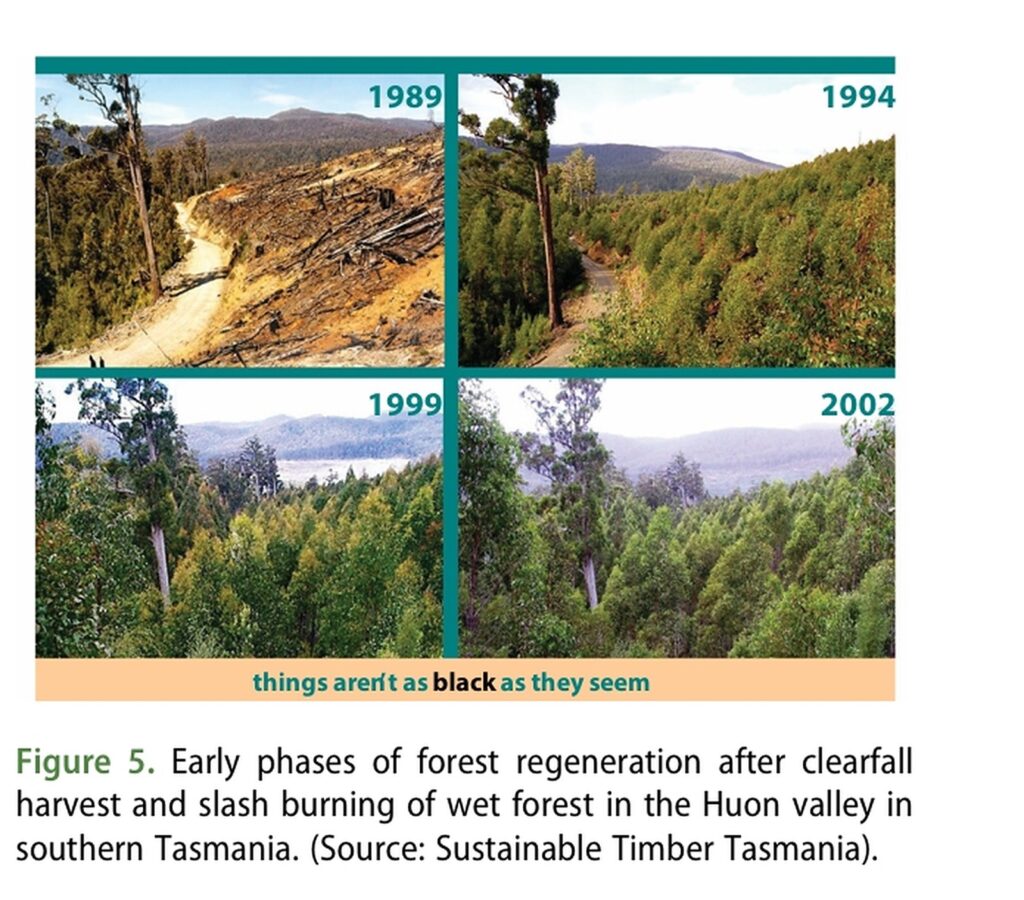
Four-panel sequence showing a clearfelled Huon valley coupe in 1989 regenerating into dense young forest by 2002.
Early phases of forest regeneration after clearfall harvest and slash burning of wet forest in the Huon valley, southern Tasmania, photographed between 1989 and 2002. (Source: Sustainable Timber Tasmania)

[IN-TEXT IMAGE 1 — Huon valley regrowth sequence 1989–2002] Caption: Early phases of regeneration after clearfall harvest and slash burning of wet forest in the Huon valley, southern Tasmania, between 1989 and 2002. (Source: Sustainable Timber Tasmania)

The charge that harvesting equals deforestation draws a firm rebuttal, on the grounds that almost all harvested stands are regrowth, regenerated and monitored under legislated codes of practice rather than cleared for other land uses. A sequence of images from the Huon Valley in southern Tasmania, taken across thirteen years from 1989, shows a clear-felled and slash-burnt coupe replaced by dense young forest.

At the landscape scale, accounting for the dynamics of growth and the harvest-and-regrowth cycle, the authors say that sustainable harvesting leads neither to forest degradation nor to deforestation. The same evidence, they argue, undercuts the broader claim that managed native forests are being run down.

Carbon has become a major rallying point for activists, and it is here that the review is at its bluntest, dismissing the idea that ending harvesting would generate saleable carbon credits. The Australian Climate and Biodiversity Foundation has put that abatement at more than one million tonnes of CO₂-e a year for NSW, worth roughly $100 million, yet the authors calculate that all logs harvested nationally carry only about 2.5 million tonnes of CO₂-e — 0.6 per cent of Australia’s total net emissions — with a full life-cycle analysis showing sustainable harvesting aids mitigation rather than driving emissions.

Bar and trend chart of south-west WA showing bushfire area climbing as annual prescribed-burning area falls from the 1960s.
Areas prescribed burnt and burnt by wildfire in south-west Western Australia from 1960 to 2023, showing bushfire extent rising as the prescribed-burn area declined. (Source: updated from Sneeuwjagt 2011 by Brad Barr)

That conclusion presses directly on the NSW government’s proposed Great Koala National Park, which the review says rests on contested science. Recent CSIRO survey work suggests national koala numbers may be up to 10 times higher than earlier estimates, with NSW data putting the state’s population near 274,000, and drone and acoustic surveys finding densities broadly similar within national parks and in adjacent harvested forests.

Harvesting in dispersed coupes has little bearing on the extent or severity of wildfire at the landscape scale, the review finds, whilst well-planned fuel-reduction burning cuts the area burnt by one hectare for every three treated. The long record from south-west Western Australia makes the case plainly: as the area treated by prescribed burning fell away from the 1960s, the area lost to bushfire climbed.

Melbourne’s water supply is another recurring alarm, and the authors are equally firm that fears of a logging-driven shortage in the city’s catchments rest on falsehood and misinformation. A long-used catchment model, they note, has for years overstated how much water regrowing forest actually uses.

Bar chart of Australian softwood plantation log volumes by category, 2011–12 to 2022–23, holding broadly flat around 8–11 million cubic metres.
Total volume of logs harvested from softwood plantations by category over twelve years to 2022–23, showing a static supply that cannot quickly absorb lost native forest production. (Source: adapted by Steve Read from ABARES)

A blanket ban on harvesting would only deepen a supply problem the country already faces, with wood-product imports reaching $6.5 billion in 2023–24, compared with $2.7 billion in exports and an estimated 2.5 million new homes needed by 2034. Plantations are no quick substitute, the authors argue, given a softwood estate static at about 1.2 million hectares for two decades and a first-year bill of roughly $1.5 billion to close Victoria’s native forest industry.

Native forests where harvesting previously occurred formed a net carbon sink of 35.7 million tonnes of CO₂-e in 2021, on the authors’ figures, equal to 8 per cent of Australia’s total emissions that year. The authors say regrowth forests make a significant contribution to meeting Australia’s emissions-reduction targets, and warn that propaganda built on the flawed use of science is undermining the case for managing native forests for community benefit. “There is a strong case for walking back from this,” the authors conclude.

For more information: Raison, R. J., Nambiar, E. K. S., Kile, G. A., & Bren, L. J. (2026). Australia’s native forests can be sustainably managed for wood production together with other important forest values. Australian Forestry. https://doi.org/10.1080/00049158.2026.2663997

The post Ex-CSIRO Top Scientists Reject the Science Behind the Native Forest Ban appeared first on Wood Central.

  •  

Tasmania Demands Canberra Pay Logging Compensation over EPBC Reforms

22 May 2026 at 13:30

Federal taxpayers could be hit with compensation claims running into the hundreds of millions of dollars if Canberra’s overhaul of national environment laws cuts across state-run native forest logging, with Tasmania now signalling it will press the Albanese government to cover the cost. That is according to new information obtained by Matthew Denholm of The Australian, who has seen correspondence from Tasmanian Resources Minister Felix Ellis warning that his state will expect federal compensation for any logging impacts arising from the reforms.

The changes, struck under a deal between the federal government and the Greens, will end forestry’s long-standing exemption from the Environment Protection and Biodiversity Conservation Act from July 2027. The Greens described the move at the time as “a spanner in the works of the native forest logging industry”, whilst the sector warned it could make logging close to impossible in the two states where it continues.

Environment Minister Murray Watt has sought to settle those fears by floating new agreements under which the states would assess their own compliance against national environmental standards. Significant uncertainty remains, however, and state forestry ministers have held talks with Watt in Canberra in recent weeks as they press for firmer guarantees.

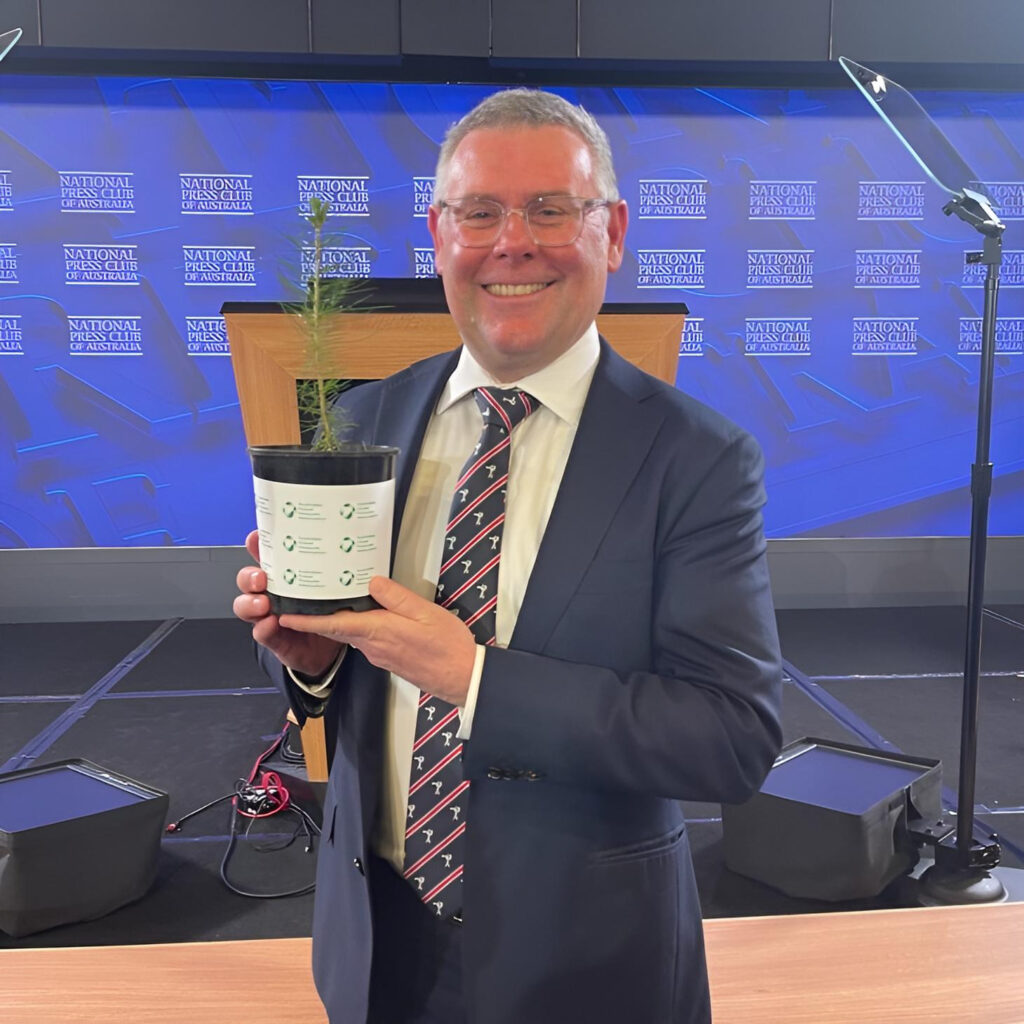
Federal Environment Minister Murray Watt holding a tree seedling at the National Press Club of Australia.
Environment Minister Murray Watt has floated new agreements under which the states would assess their own compliance against national environmental standards. (Photo Credit: Supplied by Australian Forest Products Association, Flickr 4.0)

The correspondence obtained by The Australian shows Ellis wrote to The Wilderness Society on 17 March, arguing that Canberra should carry the cost where its decisions stop Tasmanian timber businesses producing the wood and fibre the nation needs. Ellis has separately rejected calls to suspend the signing of new long-term wood supply agreements until the reforms take effect, saying the state must give its processors the certainty to invest.

“No Tasmanian forestry business will be worse off,” Ellis told The Australian.

Federal Forestry Minister Julie Collins has dismissed the case for compensation, pointing to roughly $600 million in Commonwealth funding already provided or promised to the forestry industry and a further $28 million to help states implement the changes.

“It is a significant federal investment in a sustainable industry,” Collins told The Australian.

Legal advice commissioned by The Wilderness Society points in the opposite direction, suggesting any liability is more likely to rest with state rather than federal taxpayers. The society’s Tasmanian campaigns manager, Alice Hardinge, said modelling put the potential claims at between $155 million and $300 million — the same exposure flagged in two reports released earlier this month.

“An industry with no social licence and with declining market demand,” Hardinge said.

Any compensation push by Tasmania could be joined by NSW, the only other state where native forest logging continues under a Regional Forest Agreement. Tasmania’s native forest industry has drawn more than $1 billion in payouts and subsidies since the early 2000s, including the protections locked in under the 2012 forest peace deal.

The post Tasmania Demands Canberra Pay Logging Compensation over EPBC Reforms appeared first on Wood Central.

  •  

Tasmania Risks Up to $300m in Native Logging Payouts as EPBC Reforms Loom

18 May 2026 at 13:47

The Tasmanian government has been urged to pause new native forest logging contracts, with two different reports commissioned by the Wilderness Society warning the state could face payouts of between $155 million and $300 million if it cannot meet contracted supply ahead of federal environment law reforms taking effect from mid-2027. The push, backed by the Greens and three independent members of the Tasmanian Parliament, is calling on Premier Jeremy Rockliff to defer fresh contract signatures until the EPBC Act overhaul is finalised and remaining native saw log volumes are confirmed.

Speaking to the Mercury today, Optimal Economics chief economist Stephen Walters said the federal legislative changes would come alongside difficult market conditions for timber producers, including falling demand, persistently low prices, rising costs, and more intense overseas competition. “The report warns that forestry-related risks add pressure to Tasmania’s already deteriorating fiscal position,” Walters said, pointing to rising debt and persistent budget deficits as constraints on the state’s capacity to absorb more liabilities.

The Wilderness Society’s modelling puts the lower-bound exposure at $155 million and the upper-bound at $300 million, with the variance driven by the volume of contracted native saw logs the state cannot deliver from a forest estate facing reduced approvals under the reformed Commonwealth regime.

Wilderness Society campaigner Hughie Nicklason called on Rockliff to halt negotiations until federal reforms are finalised and supply is confirmed, warning that Tasmania’s budget could not absorb a fresh wave of contract payouts on top of existing pressure. “The state is already in a very dire economic situation,” Nicklason said.

The Wilderness Society was joined at the Hobart launch by Greens Leader Rosalie Woodruff, Greens members Vica Bayley, Cecily Rosol and Tabatha Badger, and independent members Peter George, Helen Burnett and Kristie Johnston, who called on Rockliff and Resources Minister Felix Ellis to publicly defer contract signatures until volumes are confirmed. The push followed a delegation visit to Canberra last week, where Ellis sought “a clear guarantee” that the Tasmanian timber industry would not be worse off under the Albanese Government’s changes.

Environment Minister Murray Watt says Australia’s national laws are “fundamentally broken,” with new reforms set to modernise the 26-year-old EPBC Act and establish a federal EPA. Watt, a former Agriculture, Forestry and Fisheries Minister, is leading the overhaul. (Photo Credit: Australian Forest Products Association, shared via Flickr under a Creative Commons 4.0 Licence)
Environment Minister Murray Watt is leading the overhaul of the 26-year-old EPBC Act that the Wilderness Society’s commissioned modelling identifies as the trigger for Tasmania’s $155 million to $300 million payout exposure from mid-2027, with Watt describing Australia’s national environment laws as ‘fundamentally broken’ ahead of the reforms that will also establish a federal EPA. (Photo Credit: Australian Forest Products Association, shared via Flickr under a Creative Commons 4.0 Licence)

Ellis told supporters via Facebook that the Canberra delegation had travelled “to support the future of our forest industry” and reaffirmed the state had no intention of closing the native forest sector. “These changes will not end the industry,” Ellis said, adding the priority was now to lock in long-term supply contracts that would give Tasmanian timber processors the confidence to invest while Commonwealth law changes were navigated.

The pressure on Tasmania’s contract decisions comes against the 2022 Sustainable Timbers Tasmania assessment of high-quality eucalypt saw log supply, which projected total production of high-grade logs would remain at 137,000 cubic metres a year from 2027, even as the share coming directly from native forests dropped to 58,000 cubic metres. The 79,000-cubic-metre gap is at the centre of the Wilderness Society’s argument that long-term contracts written against an unconfirmed native resource will trigger payout liabilities once supply cannot be delivered.

Optimal Economics has put that exposure at between $155 million and $300 million, with the Tasmanian government continuing to signal it intends to sign new long-term supply contracts before the EPBC reforms take effect from mid-2027.

The post Tasmania Risks Up to $300m in Native Logging Payouts as EPBC Reforms Loom appeared first on Wood Central.

  •  

Single Oil Dump Costs Sustainable Timber Tasmania Nearly $30,000

17 May 2026 at 08:48

Sustainable Timber Tasmania has spent nearly $30,000 cleaning up a single illegal oil-dumping incident in the state’s north-west, as hazardous waste is increasingly abandoned on permanent timber production zone land across Tasmania. That is according to Suzette Weeding, general manager of conservation and land management at Sustainable Timber Tasmania, who confirmed the single recent incident accounted for almost the agency’s entire average annual clean-up bill across the past three financial years.

Petrochemicals, asbestos, tyres, vehicles and clinical waste are among the materials being dumped across the state’s permanent timber production zone, with the recent oil incident triggering a major containment operation in Tasmania’s north-west. Operational crews used absorbent materials to halt the spill spreading into soils, vegetation and drainage lines.

Illegal dumping has cost the agency an average of $39,000 a year to inspect, manage and remove across the past three financial years, with the recent oil dump accounting for almost $30,000 of that bill on its own. The single north-west incident leaves only a narrow gap between one event and an entire year’s typical caseload.

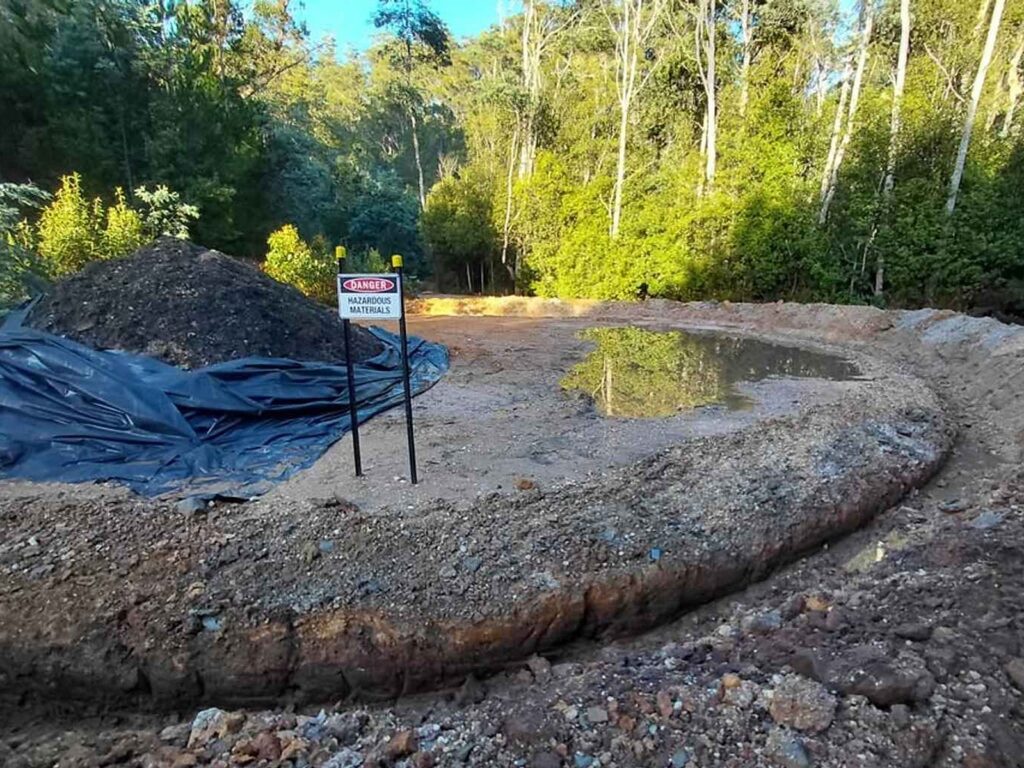
Danger Hazardous Materials sign at the Sustainable Timber Tasmania oil-dumping containment site
A “Danger — Hazardous Materials” sign marks the containment site built by Sustainable Timber Tasmania to stop the oil from spreading from reaching surrounding soils and drainage lines. (Photo Credit: Supplied by Sustainable Timber Tasmania)

Weeding said the financial cost was only part of the picture, with crews diverted from regeneration and biodiversity work to deal with hazardous material on public land. “These incidents pose a serious risk to forest ecosystems, waterways and wildlife,” Weeding said.

Wood Central understands the agency manages around 800,000 hectares of permanent timber production zone land across Tasmania, under a framework set by the Forest Management Act 2013 and the Tasmanian Regional Forest Agreement. The cost of unlawful waste disposal currently falls on the public forest budget rather than on the offenders responsible.

Abandoned vehicles, tyres and household waste dumped on Sustainable Timber Tasmania production-forest land
Abandoned vehicles, tyres, cardboard and household waste were tipped down a gully in a Sustainable Timber Tasmania-managed forest, one of multiple waste streams now turning up across the estate. (Photo Credit: Supplied by Sustainable Timber Tasmania)

Sustainable Timber Tasmania is working with Tasmania Police, the Environmental Protection Authority and other agencies to investigate the recent incident and deter further offending. The agency said each cleanup required specialist contractors and additional staff hours that were not built into routine operational planning.

It comes as Sustainable Timber Tasmania moves through Dean Kearney’s first full year as chief executive, with the 25-year forestry veteran inheriting a brief that covers the modernisation of public-forest management alongside a rising illegal-dumping caseload across the 800,000-hectare estate.

Pile of dumped car tyres beside a Sustainable Timber Tasmania production-forest road in a Tasmanian eucalypt stand
A pile of used car tyres dumped at the edge of a Sustainable Timber Tasmania production-forest road, one of the waste streams now drawing on the agency’s $39,000 annual clean-up budget. (Photo Credit: Supplied by Sustainable Timber Tasmania)

Weeding said the $39,000 annual average reflected a steady operational burden across Sustainable Timber Tasmania’s three-year clean-up record, with the recent oil incident in Tasmania’s north-west materially raising that figure inside a single event in a single corner of the state.

The post Single Oil Dump Costs Sustainable Timber Tasmania Nearly $30,000 appeared first on Wood Central.

  •  

Sugar Gliders, Not Logging, Drive the Swift Parrot to Extinction

6 May 2026 at 07:52

A new peer-reviewed study has questioned the popular view that logging forests has led to the swift parrot’s collapse, finding that introduced sugar gliders, not native forest harvesting, are the main driver of Tasmania’s most endangered bird toward functional extinction by 2030. That is according to independent researcher Simon Grove, whose paper in Australian Forestry warns that activist campaigns against native forestry are detracting from the only conservation strategy that could save the species.

The swift parrot is native to Tasmania, with no known breeding population on the mainland or elsewhere, leaving an estimated 300 to 500 mature birds uniquely vulnerable to local pressures within a single state. Grove’s paper sets out two opposing accounts of the decline: the forest habitat narrative, which holds that native forest harvesting is the critical mechanism of population loss; and the predation narrative, which attributes the collapse to the killing of nesting females and their broods by sugar gliders, an introduced species absent from Tasmania for most of the parrot’s evolutionary history.

Neither the straightforward forest habitat hypothesis nor a more nuanced version linking sugar glider predation to forest disturbance is well supported by the evidence reviewed in the paper. The predation hypothesis, by contrast, is grounded in empirical observation of nest failures and supported by statistical modelling of breeding-season mortality, with the paper concluding that habitat-focused strategies would do little more than ensure the remaining birds continue to be predated when nesting.

Grove has been blunt about the conservation consequences, arguing that activist efforts directed at native forestry are not merely ineffective but contribute to the very extinction they aim to prevent. “Directing outrage towards the highly regulated forestry sector does nothing,” Grove said.

It comes as Wood Central reported in April that Tasmania’s Forest Practices Authority dismissed Bob Brown Foundation claims of swift parrot nesting within harvest coupe WT003E, with FPA Chief Forest Practices Officer Anne Chuter confirming after an independent ecologist survey on 10 February 2026 that no breeding birds had been observed and that potential habitat had been managed in accordance with the agreed Threatened Species Adviser approach. The Grove paper now provides the peer-reviewed scientific basis for the FPA’s regulatory approach, which the activist campaign against Bunnings supplier Porta has spent six months attempting to discredit.

The implications for Australia’s national conservation effort are direct, with Grove arguing that a strategy focused solely on protecting existing breeding habitat would make a material difference to the species’ fate in the short term and that all-out predation mitigation is the only strategy carrying any prospect of avoiding swift parrot extinction. The Federal Government has pledged $500 million under its Threatened Species Action Plan and committed to preventing further extinctions, but the existing recovery framework concentrates on the breeding range protections Grove’s paper now concludes are inadequate.

The campaign’s focus on forestry has propelled the issue to international attention since Leonardo DiCaprio’s 2024 Instagram intervention, with the Hollywood actor citing 750 remaining birds and calling on Australian governments to halt logging near nesting sites, and the Bob Brown Foundation securing a Tasmanian Supreme Court injunction in the Huon Valley. The Wilderness Society’s parallel campaign pressuring Bunnings to drop NSW and Tasmanian native hardwoods has run on the same swift parrot habitat argument, citing 68 summer-period acoustic recordings from the Wielangta forest and tying Tasmanian timber supplier Porta to alleged critical swift parrot habitat in coupe WT003E.

Grove’s paper warns that the forestry focus is not merely ineffective but actively detracts from the practical glider-control work the critically endangered species needs to survive, with as few as 300 mature swift parrots remaining across the bird’s sole breeding range in Tasmania.

For more information: Grove, S. J. (2026). What is driving the continued decline of critically endangered swift parrots? A re-examination of the research papers. Australian Forestry, 1–34. DOI: 10.1080/00049158.2026.2634414

The post Sugar Gliders, Not Logging, Drive the Swift Parrot to Extinction appeared first on Wood Central.

  •  

AFL Returns to UTAS Mid-Build as Work Starts on Timber-Concrete Grandstand

26 April 2026 at 04:39

AFL football has returned to Tasmania, with UTAS Stadium hosting its first home fixture of the 2026 season on ANZAC Day yesterday, next to a live Fairbrother construction site, the new glulam-and-concrete Centre West Stand at the heart of a $130 million total redevelopment due for completion in October next year.

The $130 million redevelopment, whose timber-concrete engineering was first reported by Wood Central last April, has temporarily reduced capacity at the historic York Park ground to roughly 9,000 seats across the 2026 AFL season, less than half its pre-construction footprint of 19,500. The cap is set to lift to about 17,000 once new seating areas come online in 2027, with the venue running at full Australian Tier 2 standard from the 2028 season.

The redevelopment, designed by Populous and Philp Lighton Architects, will carry mass timber glulam columns and beams across the new Centre West Stand façade and concrete and mass timber plates across the inside of the redeveloped Eastern Stand roof and concourse seating, with off-site prefabrication of the glulam frame chosen to cut on-site construction time and lower the building’s embodied carbon.

Engineers are now driving 20-metre steel piles through layers of soft mud and 19th-century buried fill into bedrock to stabilise the site, where the water table sits just 200 millimetres below the surface across what was originally swampland and Launceston’s mid-1800s landfill before becoming the city’s showgrounds.

A 19,000-square-metre field reconstruction is also underway to prevent flooding across the playing surface, with the existing ground remaining open for AFL, AFLW, VFL and Big Bash League fixtures throughout the construction phase.

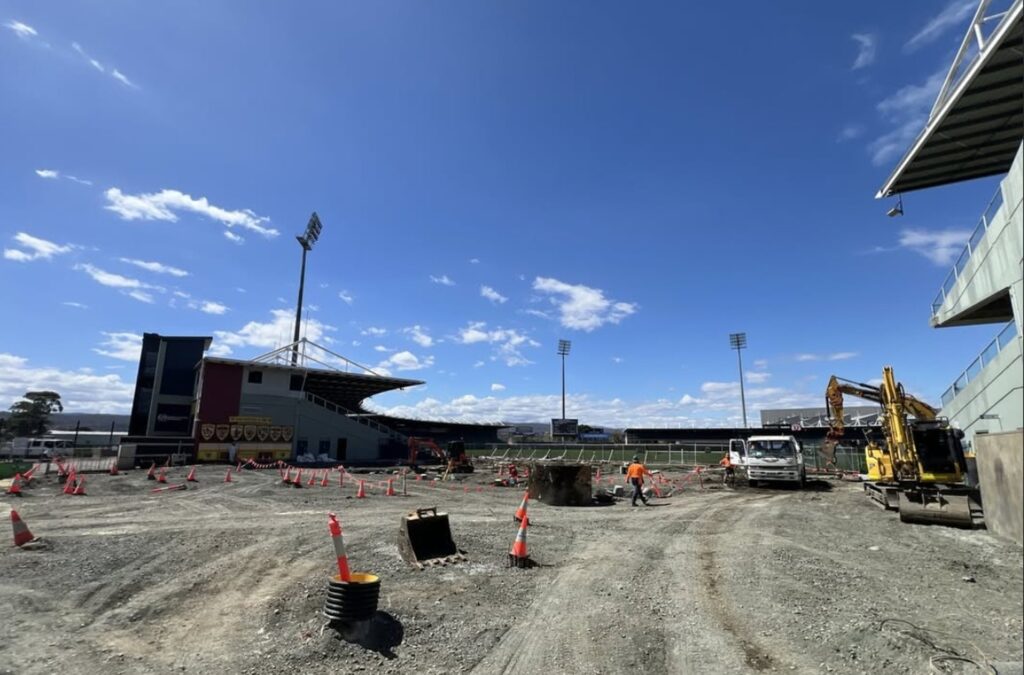
UTAS Stadium Centre West Stand site stripped to bare ground with traffic cones, excavators and steel piles being driven through soft mud and buried fill into bedrock.
The Centre West Stand site was fenced off and stripped to bare ground earlier this year, with 20-metre steel piles being driven through layers of soft mud and 19th-century buried fill to reach bedrock beneath the former swampland. (Photo Credit: Duo Projects)

The radiata pine has been sourced from Australian plantations, with the timber chosen over a steel alternative on grounds of construction speed and carbon emissions.

Tasmanian builder Fairbrother (also the contractor behind St Luke’s, the tallest mass timber building in the state) is rolling out the works in phased completions, with the Western Stand Infill Seating due September 2026, the redeveloped Eastern Stand carrying 3,629 new seats due by March 2027, and the new Centre West Stand scheduled for October 2027.

Annotated aerial render of UTAS Stadium showing the new Eastern Stand and Plaza in dotted outline against the existing oval-shaped Launceston ground.
The redeveloped UTAS Stadium, with the new Eastern Stand and Plaza shown in dotted outline against the existing oval-shaped ground. The new Eastern Stand will carry covered stadium seating, hospitality, food and beverage, and amenities across 3,629 new seats due by March 2027. (Image: ABC News / Stadiums Tasmania)

The redeveloped venue, jointly funded with $65 million each from the Australian and Tasmanian Governments, sits on an oval-shaped ground that already hosts Hobart Hurricanes Big Bash League fixtures, AFLW, VFL, and North Launceston Football Club matches, alongside Hawthorn’s four AFL home games each year.

Populous render of UTAS Stadium's new Centre West Stand at night, with mass timber glulam roof and façade illuminated above the new plaza level.
The new Centre West Stand at UTAS Stadium is illuminated for night-time fixtures, with the curved mass-timber roof and glulam-clad façade rising above the new plaza level, which is set to handle pedestrian traffic into the redeveloped venue. (Render: Populous / Stadiums Tasmania)

“Launceston already has a great sporting legacy, and this project will ensure that continues for generations to come,” Jess Teesdale, the Federal Member for Bass, said at the September 2025 works launch, where she also pointed to the significantly increased crowd capacity expected once the new stands come online.

Federal Infrastructure, Transport, Regional Development and Local Government Minister Catherine King welcomed the works at the same launch, saying she could not wait to see her beloved Richmond Tigers play the Tasmania Devils at the upgraded venue once the new club enters the AFL.

It comes as Tasmania Devils CEO Brendon Gale confirmed earlier this month that the AFL’s 19th team remained locked in for a Round 1, 2028 entry, with Hobart’s Macquarie Point Stadium pushed back to early-to-mid 2030 and the Devils’ first match at the new Hobart venue likely to fall in Round 1, 2031.

Until Macquarie Point opens, Gale told SEN’s Dwayne’s World, the Devils will split home games between Hobart’s Ninja Stadium and the redeveloped UTAS Stadium, leaving Launceston’s glulam-and-concrete venue to carry the bulk of the club’s northern fixture list across the first three AFL seasons.

The Centre West Stand, the new Eastern Stand and the Western Stand Infill Seating will combine to deliver an AFL Tier 2 venue at full capacity for the start of the 2028 AFL season, when the Tassie Devils run out for their first home fixture in Launceston.

The post AFL Returns to UTAS Mid-Build as Work Starts on Timber-Concrete Grandstand appeared first on Wood Central.

  •  

Australian Structural Timber Prices Hold Firm Despite Diesel Crisis

24 April 2026 at 04:36

Australia’s diesel crisis might have pushed the country’s largest harvest-and-haulage operators to the brink, but it has yet to materially lift prices for the treated and untreated structural timbers used to build houses nationwide. That is according to new data from Forest and Wood Products Australia, which revealed that structural timber prices fell across the March quarter, even as wholesale diesel nearly doubled in the wake of the Iran crisis.

The data were drawn from the Australian Institute of Petroleum’s pricing data to trace the diesel surge from late February into late March, a five-week run that stoked concern across manufacturing, logistics, and transport. Yet its data showed that both treated and untreated structural timber prices, which dominate Australian house framing, fell against the final three months of last year.

Carpenters raising timber frame on a predominantly timber-framed two-storey Australian home under construction, illustrating the timber-maximised residential category in the Wood Beca Building a Low-Carbon Future report
New data shows that prices for treated and untreated structural timber, the lines that dominate domestic house framing, both fell against the final three months of 2025, even as wholesale diesel nearly doubled, and residential construction remained directly exposed to rising energy costs. (Photo Credit: Alamy Stock Images)

“Most businesses are unlikely to pass these higher costs fully on to consumers,” the FWPA report said, with firms absorbing part of the impact through margin compression whilst closely monitoring market conditions. A sustained run of elevated fuel prices over the next 6 to 12 months would force a more gradual adjustment, the report said, with partial cost pass-through running alongside operational efficiencies.

Anthony Dorney fuels a wheel loader at SA Relf's on-site bulk tank in Bulahdelah — a log-laden truck visible behind him carrying the hardwood that feeds building sites across the eastern seaboard. "It cost me $2.90 per litre, which is obscene," he told Wood Central. (Photo Credit: Wood Central / Central PR Group, shared for exclusive use by the Dorney family)
Anthony Dorney, one of the country’s largest harvest and haulage contractors and the fourth generation of his family to move structural timber on the NSW Mid North Coast, was forced to sell the family’s herd of cattle last month to cover a monthly fuel bill that has blown from $220,000 to more than $400,000 since the Iran crisis pushed diesel prices to $4 a litre. (Photo: Supplied to Wood Central / Central PR Group by the Dorney family)

It comes after the federal Government moved on the supply side before the quarter closed, halving the fuel excise and reducing the heavy vehicle road user charge to zero for three months to relieve the squeeze on haulage operators. The data for January to March, therefore, captured a window that largely predates the point at which the fuel-cost pressure would feed through freight, treatment, and distribution contracts.

That matters for the national debate over housing affordability, where timber has repeatedly been cited as a driver of rising construction costs. The FWPA quarterly does not support that claim — “price data indicate that timber prices have not been a primary driver of cost increases,” the report said, with structural timber falling across the March quarter since the fuel crisis began.

Please note: This is part of a special series covering the fuel crisis in regional Australia. For more information, click here for Wood Central’s exclusive coverage.

The post Australian Structural Timber Prices Hold Firm Despite Diesel Crisis appeared first on Wood Central.

  •  

Regulator Dismisses Bob Brown’s Swift Parrot Claims on Bunnings Timber

22 April 2026 at 03:11

The Forest Practices Authority has cleared the Tasmanian logging coupe at the centre of a Bob Brown Foundation and Wilderness Society campaign against Bunnings timber supplier Porta, confirming no swift parrots were observed breeding within the harvest area during an independent ecologist survey. That is according to correspondance obtained by Wood Central, in which Anne Chuter, the Chief Forest Practices Officer, responded to Jenny Weber, Campaign Manager for the Bob Brown Foundation, concerning coupe WT003E in southern Tasmania.

Under the Swift Parrot Sightings Response Protocol, the FPA was notified on February 6 of new audible records from an acoustic recorder within WT003E and promptly advised against harvesting any potential habitat within 500 metres of the records until an FPA ecologist could undertake a site survey.

That survey took place on 10 February 2026, with the regulator confirming that no swift parrots were observed breeding within the harvest area and that potential habitat had been managed strictly in line with the agreed management approach set out in the Threatened Species Adviser.

The Wilderness Society has been running a campaign against NSW and Tasmanian timbers being sold in Bunnings stores, using “dodgy certification standards”, underpinned by concerns for the Swift Parrot, Southern Gliders and Koalas.

Writing on behalf of the FPA, Chuter noted that “potential swift parrot habitat has been managed in accordance with the agreed management approach set out in the Threatened Species Adviser,” pointing parties to the regulator’s Compliance unit for any further review of the operation.

It comes as the Wilderness Society has petitioned Bunnings to drop Porta as a supplier, alleging that logs transported from WT003E to Porta’s mill carry “critical swift parrot habitat” into the hardware chain under its PEFC and Responsible Wood certification. The Wilderness Society campaign cited 68 summer-period swift parrot recordings from the Wielangta forest and ties the Porta supply link to donation-driven petitions urging consumers to email the retailer directly.

Steve Dobbyns, Executive Chair of Forest and Wood Communities Australia, however, rejected the activist position, saying “the Wilderness Society and the Bob Brown Foundation are campaigning against Bunnings and soliciting donations using misleading and false claims of ‘logging in critically endangered swift parrot habitat’, which have been dismissed by Tasmania’s independent regulator, the Forest Practices Authority.”

Steve Dobbyns, Executive Chair of Forest and Wood Communities Australia, surveys a regional hardwood forest — as diesel prices top $3.39/litre and FWCA warns the supply chain moving timber, food pallets and mine timbers to Australia's cities is running out of room to absorb the cost. (Photo: Supplied to Wood Central / Central PR Group by FWCA)
Steve Dobbyns, Executive Chair of Forest and Wood Communities Australia, who rejected the Bob Brown Foundation and Wilderness Society campaign against Bunnings timber supplier Porta, as built on “misleading and false claims” dismissed by Tasmania’s independent Forest Practices Authority. (Photo Credit: Supplied to Wood Central / Central PR Group by Forest and Wood Communities Australia)

It comes after new research, published in Australian Forestry, raised new questions about why the endangered swift parrots’ habitat is in decline. Published by ecologist Dr S.J. Grove, it revealed that birds’ collapse, which could be functionally extinct by the end of the decade, is driven by predation of nesting females and their broods by the introduced sugar glider, but crucially, not by native forest harvesting.

Grove tests what he calls the ‘forest habitat narrative’ against what he terms the ‘predation narrative’, finding neither the straightforward habitat-loss hypothesis nor its more nuanced disturbance-linked variant well-supported by the evidence, in contrast to the predation hypothesis, which he describes as grounded in empiricism and supported by robust statistical modelling. The review concludes that “an all-out focus on predation mitigation remains the only strategy with at least the potential to avoid species extinction.”

Academy Award-winning actor and United Nations Messenger of Peace on climate Leonardo DiCaprio smiling in a dark blazer and open-collar shirt against an orange backdrop at an In Conversation event at London's BFI Southbank on 19 November 2025.
Leonardo DiCaprio, United Nations Messenger of Peace on climate since 2014, photographed at an In Conversation session at London’s BFI Southbank on 19 November 2025, whose 2024 Instagram intervention pressed Australian governments to halt native forest harvesting near swift parrot nesting sites and became the international face of a campaign that Tasmania’s Forest Practices Authority has now formally dismissed over coupe WT003E. (Photo Credit: Raph_PH, CC BY 4.0, via Wikimedia Commons)

The swift parrot campaign has drawn international attention for more than two years, with Wood Central in 2024 reporting that Leonardo DiCaprio used his 62 million Instagram followers to demand Australian governments halt harvesting near nesting sites, citing the 750 remaining birds in Tasmania’s breeding range.

  • For more information: Grove, S. J. (2026). What is driving the continued decline of critically endangered swift parrots? a re-examination of the research papers. Australian Forestry, 1–34. https://doi.org/10.1080/00049158.2026.2634414

The post Regulator Dismisses Bob Brown’s Swift Parrot Claims on Bunnings Timber appeared first on Wood Central.

  •  

Beijing Builder in Final Two for Hobart’s $1.13B Timber Stadium

20 April 2026 at 01:57

A subsidiary of China’s largest state-owned construction firm is one of two finalists shortlisted to build Hobart’s $1.13 billion Macquarie Point stadium, the 23,000-seat arena set to carry the world’s largest timber roof. That is according to the Tasmanian government, which this week confirmed Constructure Joint Venture and BESIX Watpac had cleared the expression-of-interest phase for the preliminary tender.

Led by Italian infrastructure major Webuild, the Constructure Joint Venture includes China Construction Oceania, a wholly-owned subsidiary of China State Construction Engineering Corporation. BESIX Watpac, the Australian arm of Belgian group BESIX, rounds out the two-way race for a construction contract the government aims to award by the end of 2026.

Pressed on the Chinese state-owned bidder’s inclusion, Macquarie Point Development Corporation CEO Anne Beach said tier-one construction firms operating in Australia are generally internationally owned, pointing to the Webuild-led consortium as having the scale needed to deliver. “It gives us the benefit of a balance sheet, the capacity, the risk management and the expertise,” Beach said.

Tasmanian Business, Industry and Resources Minister Eric Abetz said his concern was not the composition of the bidders but whether Tasmania’s project could hold tier-one attention against Queensland’s accelerating Olympic pipeline. “It is concerning, however, that Tasmania’s stadium build might be overlooked as the best major construction players in the nation vie to be a part of the Brisbane Olympics project, which is progressing much faster than Macquarie Point,” Abetz said.

victoria park olympic stadium brisbane 2032 interior render (2)
An early design render of the interior of the proposed Brisbane Stadium at Victoria Park, featuring a cantilevered roof, shaded seating tiers, and large-format digital screens. The 63,000-seat venue will host the opening and closing ceremonies, as well as athletics, at the 2032 Olympic and Paralympic Games. (Image: Queensland Government / Artist impression. Early design concept only.)

Federal funding for the precinct was formally cemented last month at $240 million, with MPDC confirming the venue would not open before 2031, a full three seasons after the Tasmania Devils enter the AFL and AFLW competitions in 2028.

At the centre of the tender is a 190-metre fixed dome framed in Tasmanian-sourced glulam and clad in translucent ETFE pillows, the largest timber roof on any stadium globally. The 265-page planning submission detailed how the dome was designed by Cox Architecture with German engineers Schlaich Bergermann Partners, with the roof component alone costing $160 million within the $1.13 billion total build.

The $1.13 billion Macquarie Point stadium will feature the world's largest timber roof — but whether cricket gets played under it remains unresolved. (Image: Macquarie Point Development Corporation)
The $1.13 billion Macquarie Point stadium will feature the world’s largest timber roof. (Image: Macquarie Point Development Corporation)

Extending its Australian stadium footprint, BESIX Watpac has also been shortlisted as one of two final bidders for the Queensland government’s proposed Brisbane 2032 Olympic Stadium, whilst China Construction Oceania is currently engaged on Victoria’s North East Link motorway project.

Under the AFL funding agreement, a termination clause activates if the stadium is not delivered by the end of 2030, yet the venue is not scheduled to open until 2031, creating a deadline gap both shortlisted consortia will need to resolve. With a contract award targeted for late 2026, the winning bidder has under four years from shovels in the ground to opening night.

The post Beijing Builder in Final Two for Hobart’s $1.13B Timber Stadium appeared first on Wood Central.

  •  

Federal Court Seals Divorce — TFTU Breaks Free of the CFMEU

17 April 2026 at 07:05

It’s official. The Timber, Furnishing and Textiles Union (TFTU) has finalised its divorce from the CFMEU and registered as Australia’s newest union. That is according to TFTU National Secretary Michael O’Connor, who this afternoon confirmed the registration following the Federal Court of Australia’s final orders.

O’Connor said the registration marked the start of a new chapter for workers across 11 manufacturing sectors, completing a months-long process initiated by members through a decisive ballot.

The mandate came from a ballot in which more than 91 per cent of the CFMEU’s Manufacturing Division members voted to establish the TFTU, with O’Connor describing the outcome as a demand for industry-specific representation over generalised coverage: “Our members voted decisively for change because they wanted a stronger union focused entirely on their industries, their jobs and their future,” O’Connor stressed.

The split followed mounting member frustration with dysfunction inside the broader CFMEU, O’Connor said, with the TFTU structured from registration to put members in direct control of their union. “This is the foundation for building a modern, democratic and member-led union that delivers,” he said.

O’Connor thanked members, delegates and the broader trade union movement — led by the Australian Council of Trade Unions — for their support, which he described as integral to the demerger’s outcome. “We thank every member who backed this change and everyone who stood with us,” he said.

The TFTU becomes the second union to formally break from the CFMEU, following the Mining and Energy Union’s 2023 departure, with both demergers enabled by legislation championed by Senator Jacqui Lambie and supported by the Albanese government and the Coalition.

With representation now spanning timber, pulp and paper, wood products, furnishings, cabinetry, joinery, floor coverings, glass and glazing, textile, clothing and footwear manufacturing, O’Connor said the TFTU’s immediate priorities would be growing membership and strengthening workplace organisation for the workers it now covers.

The post Federal Court Seals Divorce — TFTU Breaks Free of the CFMEU appeared first on Wood Central.

  •  

Overlapping Fires Are Alpine Ash’s Greatest Threat — Listing Exposes 20-Year Seed Gap

17 April 2026 at 03:17

Mainland Australia’s alpine ash forests face a shrinking regeneration window as high-severity fires overlap more frequently than the species can tolerate, with the shift in fire regimes now driving federal protection under the country’s primary environment law.

That is according to Tom Fairman, a forest and fire scientist at the University of Melbourne who has studied fire regimes in Victorian alpine ash country for more than a decade, and who said the species is being squeezed by a fire frequency it evolved to withstand only at much longer intervals.

“We’re shifting from infrequent severe fires to probably more frequent severe fires, and that’s where you really have this issue for the forest type,” Dr Fairman told ABC Rural, explaining that high-severity burns — defined in the conservation advice as greater than 90 per cent leaf scorch — cause close to 100 per cent tree mortality across affected stands.

Burnt alpine ash drops seed in the months following fire, but the resulting cohort requires 15 to 20 years before it can flower and set the next generation, a regeneration gap that collapses when two high-severity fires strike the same stand inside that window.

“The real risk to alpine ash is when large fires start overlapping one another,” Dr Fairman said, warning that repeated burns eliminate the species from affected stands entirely and strip the landscape of what defines the forest type.

c7f2472087cdbf52066fcc02c4f10803
Alpine ash trees are found across the Snowy Mountains. (Supplied: Tom Fairman)

The Department of Climate Change, Energy, the Environment and Water formally added alpine ash forests across the ACT, NSW and Victoria to the national threatened ecological community list on 20 March, citing altered fire regimes driven by climate change as the primary threat. Areas occupied by the species experienced substantially more fires between 2001 and 2020 than during the previous two decades, according to the approved conservation advice.

Alpine ash forests also provide critical habitat for Leadbeater’s possum and the greater glider — both species already facing acute population pressure — and hold cultural significance for First Nations communities across the high country, factors cited in the conservation advice alongside the fire regime findings.

The listing has drawn sharp criticism from the Australian Forest Products Association, with AFPA chief executive Diana Hallam telling ABC Rural the decision “absolutely astounded” the sector and overlooks the fact that logging is already banned in nearly all alpine ash forests across the three jurisdictions.

“The future of the ash forests depends on active management, including seed collection and prescribed burning, amongst other activities,” Hallam said, characterising the federal decision as a lock-and-leave approach that would do nothing to protect the species.

b98720c93ca7f3edecdabd5504414b72
This map shows where the alpine ash forests are (red) and where they could be (pink). (Supplied: Department of Climate Change, Energy, the Environment and Water)

Meanwhile, Timber Towns Victoria, the community group representing 11 local councils that depend on forests, argued that the listing rests on environmental ideology rather than on evidence of what actually threatens the high-country stands:

“These forests face real and immediate threats from excessive fuel loads and repeated wildfire,” according to Karen Stephens, Glenelg mayor and president of Timber Towns Victoria. “This listing actually leads to less management, not more, and will do nothing to protect them.”

Dr Fairman said the listing alone would not arrest the trajectory of mainland alpine ash, and that proactive testing of new management approaches — before the next cycle of overlapping high-severity fires — would determine whether the species regenerates across its current range or contracts sharply over the coming 15 to 20 years.

The post Overlapping Fires Are Alpine Ash’s Greatest Threat — Listing Exposes 20-Year Seed Gap appeared first on Wood Central.

  •  

We Have Proof Logging Makes Tasmania’s Forests Flammable

12 April 2026 at 14:02

In 1967, catastrophic bushfires in Tasmania killed dozens of people – and very nearly destroyed Hobart.

A year later, W.D. Jackson, Professor of Botany at the University of Tasmania, published a short but very influential article on why the fires were so bad. He suggested that after Tasmania’s wet eucalypt forests were burned by severe bushfires, there would be a high-risk period during their regrowth when they are at risk of severely burning again.

This, Jackson theorised, was because regrowing saplings form a very dense canopy, with little distance between living leaves and the leaf litter and understorey plants able to ignite canopy fires. If a second fire sweeps through, he predicted the forests could be replaced with more fire-tolerant scrub.

Was Jackson correct? Is regrowth truly more flammable? It’s very difficult to prove regrowth burns more intensely and accelerates bushfire spread, as it’s not practical to undertake neat, perfectly controlled experiments involving severe bushfires.

But sometimes, scientists get lucky. We took advantage of a natural experiment in 2019, when a severe bushfire burned through a research site spanning old growth wet Tasmanian forests and logged areas of regrowth, giving us access to data before and after the fires.

In our new research, we show Jackson was right. Regrowth does indeed burn more intensely than mature forests.

Why does this matter?

Jackson’s theory has resonated with generations of fire ecologists and fire managers in Australia and internationally, due to how it focuses on the interplay between the age of forests and the risk of bushfires.

Worldwide, vast areas of regrowth forest are recovering from clear-fell forestry and wildfires. In Tasmania alone, remote sensing data suggests a fifth of all tall wet forests are in a regrowth stage younger than 40 years old.

After an old forest is clear-felled, it is regenerated using fire to remove logging debris and then sown with seeds native to the area. This puts it in Jackson’s 30-year danger zone, which begins about 20 years after a fire, when eucalypts begin bearing gumnuts. It ends about 50 years after the fire, when trees are tall enough and moist dense understoreys have developed to lower the risk of devastating fires able to kill mature trees.

If regrowing forests make it through centuries without more fires, they could potentially become temperate rainforests, whose deeply shaded, moist understoreys put them at very low risk of fire.

If another severe fire starts before forests reach this safer period, experts have suggested the flammable regrowth could threaten entire landscapes by making fires more intense.

Some experts suggested forests regrowing from logging were a key factor in the huge area burned during the notorious 2019–20 fire season, though others have disputed this.

This is why Jackson’s theory still matters, almost 60 years after he proposed it.

Hard to test

Testing this theory has long proved difficult.

Forest ecologists have instead typically relied on indirect approaches, such as analysing how severe the fire was using satellite data, or estimating likely fire behaviour based on field measurements of the amount of fuel and how much moisture was present.

These inferential approaches can be scientifically fraught, as they are vulnerable to many assumptions that are hard to test or control for.

A previous attempt to resolve this question by experts, including the renowned Tasmanian ecologist J.B. Kirkpatrick had to be withdrawn due to technical issues. In retracting the paper, the authors noted their results had proven “highly sensitive” to variation in a small number of sites.

A natural experiment

In 2019, a lightning strike ignited a fire in Tasmania’s southwest forests. Known as the Riveaux Road fire, it burned through an area of regrowing forest used for research.

This offered a rare chance of a natural experiment. We had pre-fire data on fuel loads, canopy structure and microclimates (areas where local conditions make climate different from surrounding areas) in both mature forests and adjacent areas logged around 40 years earlier.

After the fire passed, we collected more data so we could compare the fire damage (measured by damage to tree canopy) and the effects on the microclimates in both regrowth and mature, unlogged forests.

This natural experiment was conclusive. The areas of post-logging regrowth burned more severely, due to their hotter, drier microclimates and the fact their canopies were closer to the ground.

Interestingly, we found fires in the regrowth didn’t cause the fires to spread further. This was because the damp understorey of the surrounding mature forests could contain the fires.

That’s not to say this would always be the case. The 2019 fire took place in moderate fire weather conditions, meaning it wasn’t especially hot, dry or windy. If severe fire weather was present, this dampening effect would likely have been overwhelmed.

Lots of regrowth, lots more fire

Proving Jackson’s theory isn’t good news for forests.

Climate change means fire weather will arrive more often and be more extreme. Combined with the large areas of forest regrowth, this means we will have to be ready for more fires.

In North American conifer forests, thinning out regrowth and burning off leaf litter and other fuel have proven effective in reducing the risks of fire-prone regrowth. Eucalypts have fundamentally different fire ecologies, so we can’t directly apply that research to Australia. Local research is limited, meaning we don’t know yet if this will work here.

Recent research has shown commercial thinning of regrowth in Tasmania doesn’t reduce the risk of fire, because bark, limbs and smashed trunks left after logging act as fuel.

This means we urgently need to find an effective way to reduce the risk of fires in regrowth in wet eucalypt forests in Tasmania and elsewhere in Australia.

Since the lethal fires of 1967, many Tasmanian communities – including large areas of Hobart – are now surrounded by forests still in the dangerous period of regrowth after logging or fires.

The post We Have Proof Logging Makes Tasmania’s Forests Flammable appeared first on Wood Central.

  •  

Australia Already Has an Energy Blueprint — But Canberra Stopped Reading it!

7 April 2026 at 08:15

The ongoing energy crisis in Australia — battering sawmillers and operators across the forestry and agriculture sectors — reveals clear failures within the Australian public service and, by extension, the political representatives who rely upon its advice. Tough language, perhaps, but justified, because one would expect the public service to know Australian history.

The Australian National Energy Market was partly initiated by the late Sir John Carrick, an Australian who also served as Energy Minister in the Fraser Liberal–National Party Government, the government that prosecuted the policy now described as “drill, baby, drill.”

Finding anyone who knew Sir John in his official capacity is difficult, but an interview with someone who had four conversations with him during his later years offers a rare window into his thinking.

1280px thumbnail
Malcolm Fraser as Prime Minister at a White House state dinner with President Gerald Ford in 1976 — the same year his government began rebuilding Australia’s energy exploration capacity after the Whitlam years. Sir John Carrick served as Fraser’s Energy Minister from 1979 to 1983. (Image: US National Archives / Public Domain)

Sir John held that there were five fundamental and essential areas of public policy — in no particular order of importance — being energy, education, housing, the arts, and Indigenous affairs.

In terms of energy, Australia needed to be self-sufficient and provide affordable power to businesses and the community. As a trading nation carrying high wages, the single biggest controllable business cost was energy, and cheaper energy was therefore a vital pillar of a productive and prosperous economy.

An economist by training, Sir John grounded his policy worldview in that discipline, placing affordable energy at the centre of national competitiveness and living standards.

In his framework, education offered the community a pathway to future employment and progress, equipping Australia with a pool of skilled workers with advanced knowledge in research and science.

Housing was essential because it provided stability for families and, in turn, for the broader community, underpinning support for economic prosperity.

The arts mattered, in Sir John’s view, because the artist community expressed the soul of the nation.

Policy for Indigenous Australians was important because Australia, as a wealthy nation, should not have the social disadvantage linked to its First Peoples — a position Sir John regarded as a matter of national character.

Anthony Dorney and his son stand in a paddock with a herd of black cattle near a Kubota UTV in Bulahdelah, NSW — cattle the family is selling to pay its fuel bill
Last month, Wood Central reported that Anthony Dornery was forced to sell cattle to cover a monthly diesel bill that had blown past $400,000. [Photo: supplied to Wood Central / Central PR Group by the Dorney family for exclusive use]

Sir John and Lady Carrick were of the Christian faith, and Lady Carrick served as his secretary for many years. Each Friday, the pair would travel to Kings Cross and Darlinghurst in Sydney to work alongside the homeless and less fortunate who gathered there.

One must ask what has changed since 1949, when Sir John assumed the role of State Director of the NSW Division of the Liberal Party of Australia.

He spent many years running his own policy committees to keep himself abreast of community issues — managing an arts committee, for instance, and regularly inviting community leaders to develop responsive, improved policy positions. This work is largely unrecorded.

In the years after 1949, as Prime Minister Sir Robert Menzies won seven consecutive elections, Sir John would present the PM with a written “appreciation”—a WWII Defence term meaning a written appraisal and planned response —a practice shaped by Sir John’s own experience as a Changi prisoner of war. The PM would read the document and approve its implementation, often with words to the effect: “Go and do it and tell me what I have to do.”

The expression “You cannot fatten the pig on market day” — credited by members of the Canberra press gallery to former PM John Howard — was, in fact, a saying of Sir John’s, referring to the practice of beginning to campaign the day after polling day in readiness for the next election.

That expression applies with equal force to both Coalition and Labor governments, which have rushed headlong into building an economy on renewable power, guided by public service climate ideologues and by polling drawn from professional-class electorates — not the communities where energy prices directly determine household budgets and employment prospects.

Sir John was fully aware of the danger posed by overpriced energy in Australia, spending his post-Whitlam years rebuilding the economic and business conditions necessary for oil exploration to recommence after exploration had all but ceased under the previous government.

A regional Australian fuel bowser with a handwritten chalkboard sign reading "Sorry We Are Out of Diesel" — a traffic cone blocking the pump as the fuel crisis cuts supply to independent operators across New South Wales.
A handwritten sign on a dry bowser at a regional Australian service station tells the story plainly — “Sorry, We Are Out of Diesel.” It is the reality now facing timber haulage operators like Dennis Greensill, who has stopped using bulk tanks entirely after the four major fuel distributors cut supply to independents, pushing the entire sector onto retail bowsers already running dry. (Photo: Supplied to Wood Central / Central PR Group for exclusive use by Forest and Wood Communities Australia)

He worked to develop the national energy market with one overriding aim: to keep Australian energy prices as low as possible through reliable supply and grid sharing, viewing energy as a national issue rather than a state-based one.

Australians working in public policy — particularly within the public service — would be better served by going beyond IPC report summaries, which can be misleading when examined against the underlying documents. They might also study the public policy contributions of Sir John Carrick, Sir John Crawford, Sir Arthur Tange, and others whose records of careful, long-horizon thinking have been largely set aside.

With Australian energy costs still climbing and no credible long-horizon policy in sight, the institutional memory these figures represent is not a curiosity of political history — it is a resource the sector cannot afford to keep ignoring.

The post Australia Already Has an Energy Blueprint — But Canberra Stopped Reading it! appeared first on Wood Central.

  •  

We Decked the Harbour Bridge in Ironbark — Now We Import From the Congo!

6 April 2026 at 13:13

Australia risks becoming dependent on imported timber to meet current and future demand, with the growing dependency a matter of national significance. That is according to Steve Dadd, Chair of the Australian Forest Products Association (AFPA), the peak body for the country’s $24 billion forest products value chain, who spoke to Mark Levy on 2GB’s Mornings with Mark Levy from the Sydney Royal Easter Show’s woodchopping arena on Monday.

“Given that we have the sixth largest forest in the world, and on a per capita basis probably more forests than anyone in the world, it’s really quite sad that we are importing a lot of timber from countries with less forests than us and much worse environmental standards,” Dadd told Levy.

Click here to listen to the full clip.

Dadd warned that 30 per cent of plantation softwood — the material underpinning Australia’s housing supply chain — is now sourced from overseas. For hardwood the situation is worse still, with “most of our decking, a lot of our furniture-grade timber, really high-value stuff, all coming in from countries like Indonesia, other tropical countries, including the Congo and South America — and yet here in Australia, we run a really sustainable and well-managed forest industry, and less and less of that is available for our construction industry,” he said.

Dadd cited a term drawn from a television report to describe the dynamic: “carbon colonialism” — whereby Australia enforces stringent domestic harvesting standards whilst simultaneously importing timber from jurisdictions with no equivalent obligations. He argued the arrangement was not only economically damaging but also environmentally incoherent.

Kwila (merbau, from Indonesia/PNG/Fiji) is the go‑to imported decking timber — durable, affordable, and deeply entrenched in the NZ market. Almost all importers stock it. (Photo Credit: Friedrich Stark via Alamy Stock Images)
Tropical hardwood bound for export — increasingly, for Australia — at a Pacific loading port. AFPA chair Steve Dadd says most Australian decking and furniture-grade timber now arrives from countries including Indonesia, the Congo and South America. (Photo Credit: Friedrich Stark / Alamy Stock Photo)

And the contrast is sharpest when measured against the landmarks that defined the last century of Australian construction. Dadd noted that the interiors of the Sydney Opera House were lined with brush box supplied by the Alan Taylor business — now part of Pentarch, of which Dadd is executive director — and that the deck of the Sydney Harbour Bridge was built from local hardwood in the 1930s, some of which remains intact beneath the railway lines today.

“Those projects are not going to happen any more with local timbers,” he said. “We’ve become an import economy.” Levy separately noted that both the Melbourne Metro and the new Sydney Fish Market — two of the country’s most significant recent public projects — were constructed using overseas timber.

Sydney's new fish market has officially opened, welcoming an incredible 40,000 visitors on its first day. Designed by 3XN, the market is located in the city’s Blackwattle Bay. Beneath its distinctive wave-like timber roof — the largest timber roof in the Southern Hemisphere — the… pic.twitter.com/7zS0Y10xGM

— The B1M (@TheB1M) January 22, 2026

Dadd argued that, in his assessment, “activism rather than good science is now having a much greater influence on government policy than it should,” adding that “government across all layers have just stopped listening to that science.” He cited two bodies of evidence he said were being ignored in Canberra: a United Nations state of the forests report identifying Australia as one of the global hotspots for reforestation, with 4 million hectares of new forest confirmed by Landsat satellite imagery over the past decade, and a CSIRO national koala audit placing the population at close to one million koalas.

“The easiest path is to shut it down. It’s not the right path, but it’s often the easiest path,” he said of the political calculus facing ministers in inner-city electorates under Green influence. He warned the situation was compounding at the regulatory level, with private landowners now required to obtain sign-off from both local council and Local Land Services before harvesting can proceed.

New survey data suggests koala numbers may be more than 18 times higher than the 15,000 estimated at the 2024 NSW Koala Summit — a gathering of government, community and scientific stakeholders that warned the species was nearing collapse. (Photo Credit: Supplied to Central PR Group / Wood Central)
Last year, Wood Central exclusively revealed that new CSIRO survey data suggests koala numbers may be more than 18 times higher than the 15,000 estimated at the 2024 NSW Koala Summit — a gathering of government, community and scientific stakeholders that warned the species was nearing collapse. (Photo Credit: Supplied to Central PR Group / Wood Central)

The EPBC Act reforms passed in November 2025 remove the longstanding exemption for Regional Forestry Agreement operations, meaning that from 1 July 2027, RFA forestry operations will be required to comply with the same rules and standards as other industries. Dadd said the change would require a complete renegotiation of approvals frameworks between state and federal governments — piling further compliance costs onto an industry he argued was already over-regulated relative to its overseas competitors.

Dadd’s message to policymakers was pointed, calling on ministers to visit the industry firsthand: “these are passionate conservationists […] people who have spent generations working in this industry. They look after it from a forever perspective. They’re the ones driving the heavy assets when fire threatens communities and forests.” His closing instruction was unambiguous — “listen to experts, not activists,” he said.

The post We Decked the Harbour Bridge in Ironbark — Now We Import From the Congo! appeared first on Wood Central.

  •  

AFWI Draws a Clear Line — New Research Must Span the Full Value Chain

2 April 2026 at 08:27

Engineered timber, modern methods of construction (MMC), forest health, and climate solutions are among the priority areas in Australian Forest and Wood Innovations’ third National Open Call for Research — with expressions of interest opening from today and running until 14 May.

Speaking to Wood Central following an information session today, AFWI Executive Director Dr Joseph Lawrence — who heads the $200 million R&D body backed by $100 million in federal funding — said the round was designed to drive structural reform across Australia’s forest and wood products sector, with a premium placed on bold, unconventional proposals.

“Australia’s housing challenge won’t be solved with business-as-usual construction,” Dr Lawrence said. “AFWI’s National Open Call is about unlocking timber innovation that can deliver faster housing while strengthening forests and climate outcomes.”

AFWI’s information session today provided an overview of the third round of National Open Call funding, including key research themes, assessment criteria, and the two-stage application process. Footage courtesy of AFWI.

Dr Lawrence was joined at the session by Deputy Director Dr Patrick Mitchell and Kathryn Fox, AFWI’s new Research Funding Manager, who outlined the EOI process and funding requirements for applicants. So far, more than 30 projects have been supported by AFWI’s first two open-round projects and its three research centres, with the third call targeting the full forest and wood products value chain, with a special focus on the housing value chain.

It comes as the federal government has committed $54 million to develop modern construction methods in Australia — part of a broader policy package that has seen prefab and modular housing recognised under the National Housing Accord.

According to Dr Lawrence, projects must align with at least one of AFWI’s four strategic pillars — Healthier Forests, Maximising Fibre, Climate Solutions, and Housing Innovation — and demonstrate strong co-design with industry partners. Novel and out-of-the-box approaches to transforming the sector are specifically encouraged.

Grants range from $50,000 to $2.5 million, with matching co-contributions of at least 50 per cent of the total project cost required, and projects can run for up to 4 years. Eligible applicants include universities, CSIRO, industry associations, Indigenous organisations, not-for-profits, state and local governments, and private companies, with all projects based in Australia and holding a valid ABN.

Vince Hurley, CEO of Australian Sustainable Hardwoods, at ASH's Heyfield plant, where the company is upgrading plantation-grown Shining Gum into Plantation Oak for higher-end applications — including timber windows now being tested through the AFWI–AGWA Modernising Timber Windows project. (Photo Credit: Supplied to Central PR Group / Wood Central and AFWI for use by Australian Sustainable Hardwoods)
Vince Hurley, CEO of Australian Sustainable Hardwoods, at ASH’s Heyfield plant, where the company is upgrading plantation-grown Shining Gum into Plantation Oak for higher-end applications — including timber windows now being tested through the AFWI–AGWA Modernising Timber Windows project. (Photo Credit: Supplied to Central PR Group / Wood Central and AFWI for use by Australian Sustainable Hardwoods)

Among the projects supported to date are the Modernising Timber Windows initiative — a project jointly led by the Timber Development Association and the Australian Glass and Window Association — which last week wrapped up its final round of testing under AS 2047, Australia’s mandatory standard for windows and external glazed doors.

In February, Kylan Low, the Structural Engineer at Timber Development Association, told Wood Central that the four configurations were put through combined air and water pressure trials representing storm conditions: a double-hung window, an awning and casement window, an awning and double casement window, and a centre bifold door. The configurations are designed to capture the range of hardware setups used across Australia’s joinery industry.

The post AFWI Draws a Clear Line — New Research Must Span the Full Value Chain appeared first on Wood Central.

  •  

Experts Question Decision to List Alpine Ash as Endangered — Poor Science

2 April 2026 at 07:44

Australia’s forest scientists have objected to the Federal Government’s decision to list Alpine Ash and White Ash forests as endangered — objections that a committee established by the Australian Government to determine threatened species dismissed, ignoring the good science on sustainable forest management.

Today, Forestry Australia President Dr Michelle Freeman — whose organisation represents more than 1,100 forest scientists, managers and growers — said the body’s concern is not with the need to conserve Alpine Ash forests, but rather in ensuring any policy supports the active management these forests need.

“These forests face real risks, particularly from repeated fire and climate change,” Freeman said. “Responding effectively requires the best available science, genuine engagement with those who manage these landscapes, and a practical pathway for restoration and resilience-building at scale.”

Freeman said the listing — which took effect on 20 March 2026 under the Environment Protection and Biodiversity Conservation Act — must not constrain the actions most critical to Alpine Ash survival.

Forestry Australia had previously called for fuller engagement with State land management agencies, Traditional Owners, and forest scientists with direct expertise in Alpine Ash ecology, silviculture, and restoration — with Freeman suggesting that public land managers, Traditional Owner groups, researchers, and communities need clarity on how the listing will operate in practice: “We must avoid creating settings where necessary management becomes slower, more uncertain or more difficult to implement in practice,” she said.

dr michelle freeman forestry australia president portrait
Forestry Australia President Dr Michelle Freeman says the Alpine Ash listing must enable, not hinder, the active management these forests need to survive repeated fire. (Photo Credit: M Ryan / Supplied by Forestry Australia)
95 per cent of Alpine Ash forests existed before European settlement.

Today, Diana Hallam, CEO of the Australian Forest Products Association (AFPA) questioned the scientific basis of the listings. “This decision raises serious questions about the evidence presented to the Minister, as the science does not support the listings,” she said. “It’s very disappointing that the Threatened Species Scientific Committee has ignored the feedback from highly respected forest scientists, with the final declaration simply replicating the initial consultation documents.”

iInstead the peak body for Australia’s $23 billion forest products industry cited the DCCEEW’s own Draft Conservation Advice for Alpine Ash forests of mainland Australia — released for public consultation in December 2024 — which recorded that less than 5 per cent of Alpine Ash forest distribution has been lost since 1750, leaving approximately 95 per cent of pre-settlement communities intact across a 720,000-hectare range throughout south-eastern Australia.

Murray Watt, Australia's Minister for the Environment and Water, at the endorsement of the national implementation plan for the Strategy for Nature, March 2026
Federal Environment Minister Murray Watt — whose department’s own Draft Conservation Advice recorded less than 5 per cent of Alpine Ash forest has been lost since 1750 — accepted the Threatened Species Scientific Committee’s recommendation to list Alpine Ash and White Ash forests as endangered. (Photo Credit: Australian Forest Products Association, shared via Flickr under a Creative Commons 4.0 Licence)

“Experts responding to the consultation process were quite unequivocal in their feedback, asserting that the Alpine Ash species was not at risk of extinction given its very large, intact distribution and the species’ resilience following fire,” she said, adding that the vast majority of Alpine Ash communities already sit inside protected areas — warning that a minimalist approach by conservation agencies to fire preparation in those jurisdictions would leave Alpine Ash at even greater risk.

“Ultimately, both the White Ash and Alpine Ash species are at greatest risk from fire, and we fear the decision to list both is likely to lead to worse outcomes for these communities and ecosystems,” Hallam said, adding that the future of Australia’s Ash forests depends on active management — including seed collection and prescribed burning.

The post Experts Question Decision to List Alpine Ash as Endangered — Poor Science appeared first on Wood Central.

  •  

Australia Locks in 30×30 Pledge — But Numbers Don’t Add Up for Forestry

1 April 2026 at 09:47

Australia has recommitted to protecting 30 per cent of its land and sea, after federal and state environment ministers agreed to a new national implementation plan for the Strategy for Nature — a whole-of-government framework to halt and reverse biodiversity loss within four years. That is according to a joint ministerial statement ministers released on Monday 30 March, confirming the new plan will align with the Kunming–Montreal Global Biodiversity Framework.

Murray Watt, Australia’s Minister for the Environment and Water, joined state and territory environment ministers in endorsing the plan, drawing on input from the public, First Nations peoples, environmental organisations, researchers, and business and industry. The statement cited significant progress, including the passage of major environmental law reforms to the EPBC Act, a commitment to reduce emissions by 62–70 per cent below 2005 levels by 2035, the Net Zero plan across six sector emissions reduction plans, the advancing of the Nature Repair Market, the 30 by 30 roadmap, the National Circular Economy Framework, and investment in protected areas through the Australian Bushland Program.

Stuart Coppock, one of the few legal practitioners in Australia with a deep working knowledge of how the RFA framework operates, told the Senate that EPBC reforms will leave the forestry industry in "no man's land." (Photo: Supplied to Central PR Group / Wood Central)
Stuart Coppock, NSW lawyer and governance professional who advises forest and timber businesses on Regional Forestry Agreements and environmental law, told a Senate committee last month that Australia’s EPBC reforms risk leaving the forestry industry in “a maelstrom of legal nonsense.” (Photo Credit: Supplied to Central PR Group / Wood Central)

Today, Wood Central spoke to Stuart Coppock — a NSW lawyer and governance professional who advises forest and timber businesses on matters relating to Regional Forestry Agreements and environmental laws — who said the new statement is strong on spin but weak on substance. “The statement says nothing about how the Commonwealth and the States will achieve 30% of protection over the coming four years,” Coppock said. “It is not surprising that an announcement is made with no details. It seems to be the new way when it comes to environmental issues. More stealth and secrecy than transparency.”

“What is on the table and has been for a while is a commitment that the WWF and other ENGOs have asked to be called up in future forest agreements,” he said. “That commitment is the effective cessation of native forestry.”

“Practically, it’s very difficult to achieve the outcomes without removing all State Forests from the supply chain and purchasing thousands of private properties. Yet, Minister Watt and Minister for Agriculture, Fisheries and Forestry Julie Collins say native forestry is here to stay. The two positions are incompatible. If not, please share the details. It shows similarities in the implementation of the EPBC reforms,” Coppock said.

The post Australia Locks in 30×30 Pledge — But Numbers Don’t Add Up for Forestry appeared first on Wood Central.

  •  
❌