WoodCentral

Normal view

Bamboo Reigns in Bali from the Green School to Ulaman’s Luxury Villas

4 June 2026 at 02:55

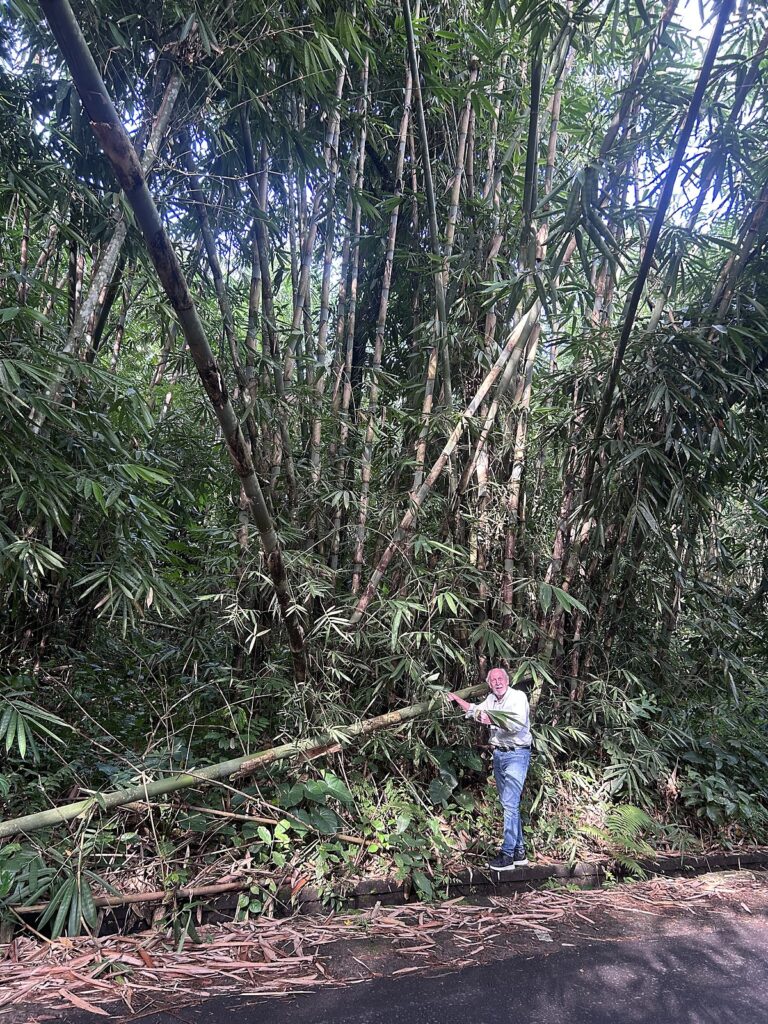
Bamboo is everywhere in Bali. Growing in vast forests. Effectively used in landscaping for resorts. Preserved in traditional villages as a tourist attraction. Incorporated in the design of luxury resorts.

bamboo reigns bali green school ulaman luxury villas bamboo forest 1200x1600 (1)
A Balinese bamboo grove towers overhead, the raw material behind the island’s most ambitious buildings. (Photo Credit: Ken Hickson)

But still the most distinctive use of bamboo as a building material is not for tourists, but for international students. It’s the Green School which opened in 2008.

bamboo reigns bali green school ulaman luxury villas green school building 1600x1200
Bali’s most recognised bamboo building, the Green School, established in 2008. (Photo Credit: Ken Hickson)

I was determined to see for myself this time what progress had been made since we first visited the school in 2009, as guests of the founders, John and Cynthia Hardy.

Inspired by Al Gore’s ‘Inconvenient Truth’ in 2006 and compelled to take up his call to action, they started with the School’s bamboo bridge, spanning 22 meters across the Ayung River. Completed in November 2006, it created a beautiful, strong symbol of the transition from the realm of idea to reality.

Green School opened in September 2008 with 90 students and a tailor-made campus that emerged from the jungle and rice fields.

When we visited in May 2026, we see for ourselves how it has expanded in more ways than one. More bigger bamboo buildings to accommodate 514 students and an inspiring example of education for sustainability.

bamboo reigns bali green school ulaman luxury villas reception 1200x1600 (1)
A bamboo reception welcomes visitors to Bali’s Green School. (Photo Credit: Ken Hickson)

The young well-informed guide Rana, who look us on a tour of the property, was excited to report on Green School’s latest mission to help learners and educators of all ages uncover new ways of thinking, designing and bringing to life the products, processes, and places that are needed for a collective shift to regenerative futures.

He told us the Green School has started on the world’s first ever K-12 Biomimicry for Regenerative Design (BiRD) Lab to promote systems thinking, find inspiration in Nature to design local solutions to global challenges, and inspire the world with artefacts and stories of learning.

But BiRD is more than a lab, it is an approach to learning and doing that will nurture regenerative futures through the cultivation of bio-empathy, reciprocity, and long-term thinking.

Designed by the famous bamboo architecture firm IBUKU (led by Elora Hardy), in collaboration with MAIN Studio, the structure is built entirely of locally sourced Balinese bamboo.

You can read more about Bali’s Green School BiRD Lab here.

bamboo reigns bali green school ulaman luxury villas sports hall 1600x1200 (1)
The Green School’s vaulted bamboo sports hall, where guide Rana led the tour. (Photo Credit: Ken Hickson)

Meantime, the very same founders of the Green School, have ventured into the tourism sector with their very own Bambu Indah Eco Resort Ubud, which also makes the most of Bali’s ready availability of bamboo.

We didn’t have the time to visit Ubud this time, but did make it to see another fine example of Bali bamboo resort architecture: Uluman Eco Luxury Bali.

After two decades of visiting Bali and falling in love with its people, lush landscapes, and rich culture, Dino Magnatta decided to build his retirement ‘dream’ home to escape the cold Canadian winters.

He envisioned a unique jungle ‘tree house style’ bamboo villa, combining luxury with comfort, nestled amidst rivers, jungle, and rice fields, like the famous Ubud area once was. Once he found the right piece of land, he went ahead to build what has become a unique luxury resort in the heart of Bali.

We were taken on an exclusive tour with Dodi to see these very impressive bamboo structures of Ula Man for photographs and couldn’t resist staying for lunch at what has become an attraction in itself: the E.A.R.T.H. poolside restaurant.

bamboo reigns bali green school ulaman luxury villas earth restaurant 1600x1200
Ulaman’s E.A.R.T.H. poolside restaurant and bar at dusk, a bamboo attraction in its own right. (Photo Credit: Ken Hickson)

From our introduction and photographs you can get some idea of the scope and design of Ulaman Bali, but you can see and read a lot more on the website.

We have always been impressed by the emphasis on eco-design and green landscaping in Bali resorts, epitomised by the work of the late and great Australian architect Made Wijaya, most notably with his work at Four Seasons Bali Jimbaran Bay, which we had the pleasure of staying once around 1990 and later in 1996.

His Bali resort landscaping has been the inspiration for many others and we feel sure it influenced the look and feel of two other resorts we enjoyed staying at recently: Peppers Seminyak, along with the 12 year old Mayo Resort in North Bali.

bamboo reigns bali green school ulaman luxury villas peppers seminyak 1600x1200 (1)
Bamboo and timber feature through the grounds and poolside dining at Peppers Seminyak. (Photo Credit: Ken Hickson)

Bamboo and other timbers and trees featured prominently inside and outside of our luxury villa at Peppers Seminyak.

GM Todd Williams told us he is taking the 19-year-old resort through a makeover, but he assured us it will be as green as ever and even more sustainable in every way.

You can expect more from me in future reports on Bali tourist resort architecture, including the sustainability measures being undertaken at Peppers Seminyak and how Mayo Resort maximises its coastal location in North Bali to source local ingredients for its excellent Bora Bora Bar and Bistro.

The post Bamboo Reigns in Bali from the Green School to Ulaman’s Luxury Villas appeared first on Wood Central.
  •  

Wood for the Trees Turns Material Matters Into a Walk-In Hardwood Forest

3 June 2026 at 11:14

A century ago, the hardwood forests of the eastern United States were little more than stumps and ashes, and next week the American Hardwood Export Council will rebuild a piece of that comeback inside a Copenhagen exhibition hall. Wood for the Trees, the immersive walk-through it has staged for 3daysofdesign, retraces a hardwood’s path from standing tree to finished product entirely in donated US timber.

Step inside and the room becomes an abstract arboreal setting, with materials raised on rotating trunks, seating hewn into the shape of fallen logs, and graphics suspended overhead like the boughs of a forest canopy. Audio-visual displays, environmental data and narrative panels thread between the objects, turning the documentary that inspired the show into a space the visitor walks through rather than watches.

The journey moves through five stages — growth, stewardship, selection, resilience and timber — each opening a door onto the realities of responsible forest management. The early rooms trace how trees regenerate and even clone themselves across generations, the day-to-day and century-spanning labour of tending a forest, and the careful judgement of which trees to fell and which to leave standing.

And later, the focus turns to resilience and how a forest shrugs off climate shifts, pests and disease, before the final stage follows the grain to the point where the forest meets the human world. Drawn from AHEC’s recent documentary Forested Future, which followed the communities whose livelihoods rest on forests, the show widens a Copenhagen platform the council has used in recent years for designer collaborations and sculptural one-offs.

Watch the trailer for Forested Future, AHEC’s documentary on the Appalachian forest communities whose stewardship inspired Wood for the Trees. (Video: AHEC)

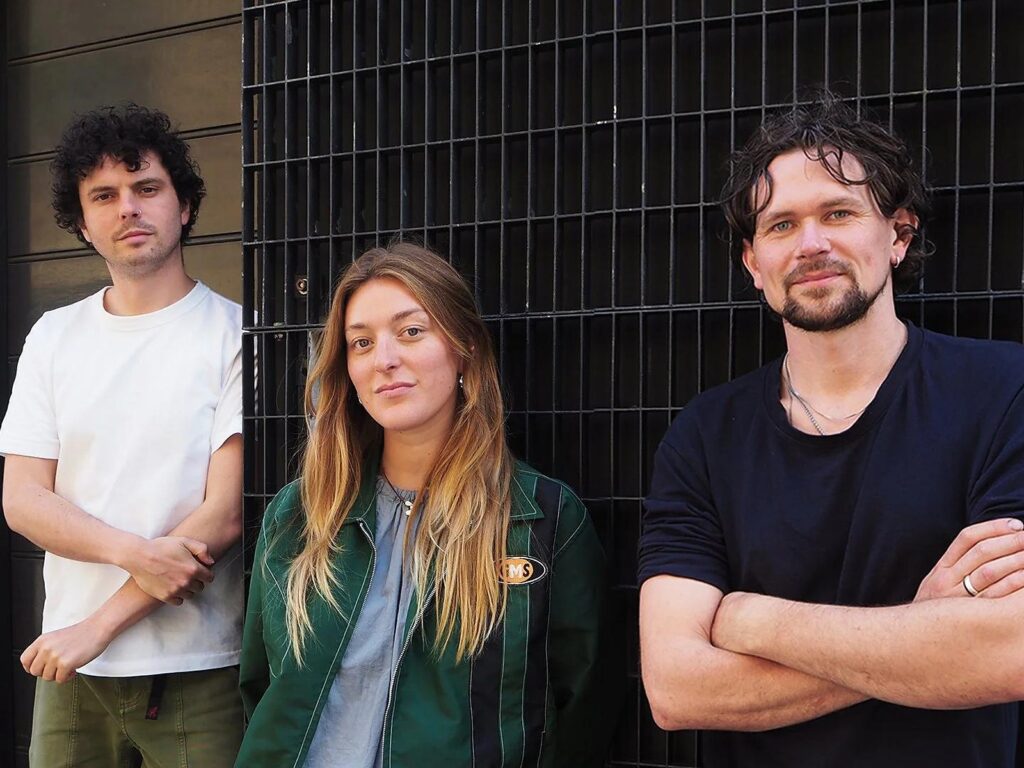
Mitre & Mondays, the London studio of Josef Shanley-Jackson, Freya Bolton and Finn Thomson, builds objects and spaces around reuse, repair and regenerative materials. Benchmark, the Berkshire furniture-maker founded by Terence Conran and Sean Sutcliffe in 1984, built the show from those donated boards, drawing on four decades of working with natural, non-toxic timber.

Mitre & Mondays designers Josef Shanley-Jackson, Freya Bolton and Finn Thomson at Benchmark's workshop
The Mitre & Mondays trio behind the exhibition, from left, Josef Shanley-Jackson, Freya Bolton and Finn Thomson, at Benchmark’s workshop. (Photo Credit: Mitre & Mondays, Supplied to Wood Central by AHEC)

Behind the spectacle sits a recovery the council returns to often, with the eastern United States hardwood forests rebounding from those stumps and ashes to more than 40 million acres today. They are now growing at twice the rate they are harvested, a ratio AHEC uses to argue that a diversified timber market gives landowners a reason to keep forests standing rather than clear them.

Every plank in the installation was donated by the family-owned sawmills Bingaman & Son Lumber, MacDonald & Owen, Northland Forest Products and Rossi Lumber. Four species carry the room, with American red oak, yellow birch, hard maple and cherry, each chosen to show the range a diversified market can draw on.

The post Wood for the Trees Turns Material Matters Into a Walk-In Hardwood Forest appeared first on Wood Central.

  •  

Mass Timber ‘Bunkhouse’ Proves Recovery Need Not Repeat the Past

3 June 2026 at 09:13

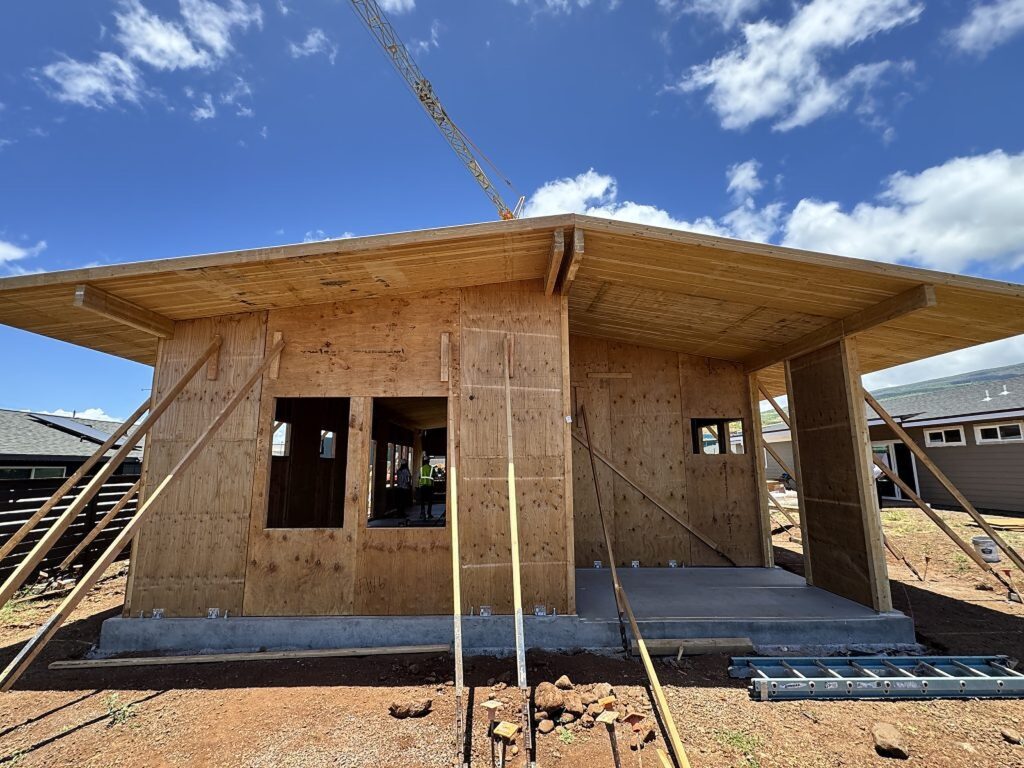
A vacant Lahaina lot that once held a home destroyed in the August 2023 Maui wildfires has become the site of the first mass timber dwelling in Habitat for Humanity’s global history. That is according to Hawaiʻi Off Grid Architecture + Engineering, the Maui firm whose volunteer bunkhouse is now rising as a flat-pack system built for rapid disaster rebuilding.

Designed by HIOG principal David Sellers, who also sits on Habitat for Humanity Maui’s board of directors, the Bunkhouse uses veneer-laminated timber walls and glue-laminated timber roof panels dimensioned around a four-foot module. That module allows termite treatment before installation, efficient shipping across the Pacific and rapid assembly once the panels reach the site.

Front elevation of the Lahaina bunkhouse showing veneer laminated timber walls and craned roof panels
The bunkhouse’s veneer laminated timber walls and craned roof panels rise on the cleared Lahaina lot. (Photo Credit: Hawaiʻi Off Grid)

Sellers, who led the design with support from WoodWorks, said two decades of underbuilding had left the islands unable to rebuild Lahaina at the speed residents deserve, and the bunkhouse answers that with a system that can be prefabricated and deployed after future disasters. “Recovery doesn’t have to mean rebuilding the same way,” he said.

The flat-pack logic is the point for HIOG, which conceived the dwelling as a proof of concept for prefabricated mass timber as a route to affordable, resilient housing at a lower cost and faster pace. Maui’s largest architecture and engineering firm, HIOG, commits 30 per cent of its work to community projects and partnered on disaster relief after the 2023 fires.

Three project leaders wearing lei and hard hats at the Lahaina mass timber bunkhouse blessing
Project leaders mark the start of construction at the Lahaina mass timber bunkhouse blessing. (Photo Credit: Hawaiʻi Off Grid)

According to Jennifer Cove, president and chief executive of WoodWorks, the partnership advances education, workforce development and design work for new mass timber housing prototypes whilst honouring local architectural character. “This project demonstrates how mass timber can strengthen post-disaster rebuilding,” she said.

Meanwhile, Matt Bachman, the executive director of Habitat for Humanity Maui, said the bunkhouse will expand the charity’s volunteer capacity in Lahaina, where each additional worker moves another family closer to a permanent home. “Volunteers have always been at the heart of Habitat for Humanity’s work,” Bachman said.

HIOG expects the Bunkhouse to be completed within four months, with August 2026 the target — three years after the August 2023 fires razed the lot and much of historic Lahaina.

The post Mass Timber ‘Bunkhouse’ Proves Recovery Need Not Repeat the Past appeared first on Wood Central.

  •  

Seoul to Build Korea’s First Hybrid Timber Arena on the Han River

1 June 2026 at 14:49

The Seoul Metropolitan Government will build Korea’s first large-scale hybrid timber international arena on the Han River waterfront, a 199.9 billion won ($145 million) venue near Gwangnaru Station designed for elite combat sports and year-round public use. That is according to the city government, which on Monday named the winning entry in an international design competition for the Gwangjang-dong Multipurpose Sports Complex.

A joint entry by Gawa Architects & Associates, Iséak Architects and DD Architects won the commission ahead of 27 rival submissions, with a circular arena built around a hybrid timber frame. Such a structure remains a rarity among large-scale public buildings in Korea, where mass timber has been slow to move into civic infrastructure.

The judging panel praised the winning design for balancing public accessibility with professional arena functionality, citing its separation of athlete and spectator circulation and its fit with the surrounding district. The panel reached that view despite complex underground conditions on the site, which lies above a subway line and waste treatment infrastructure.

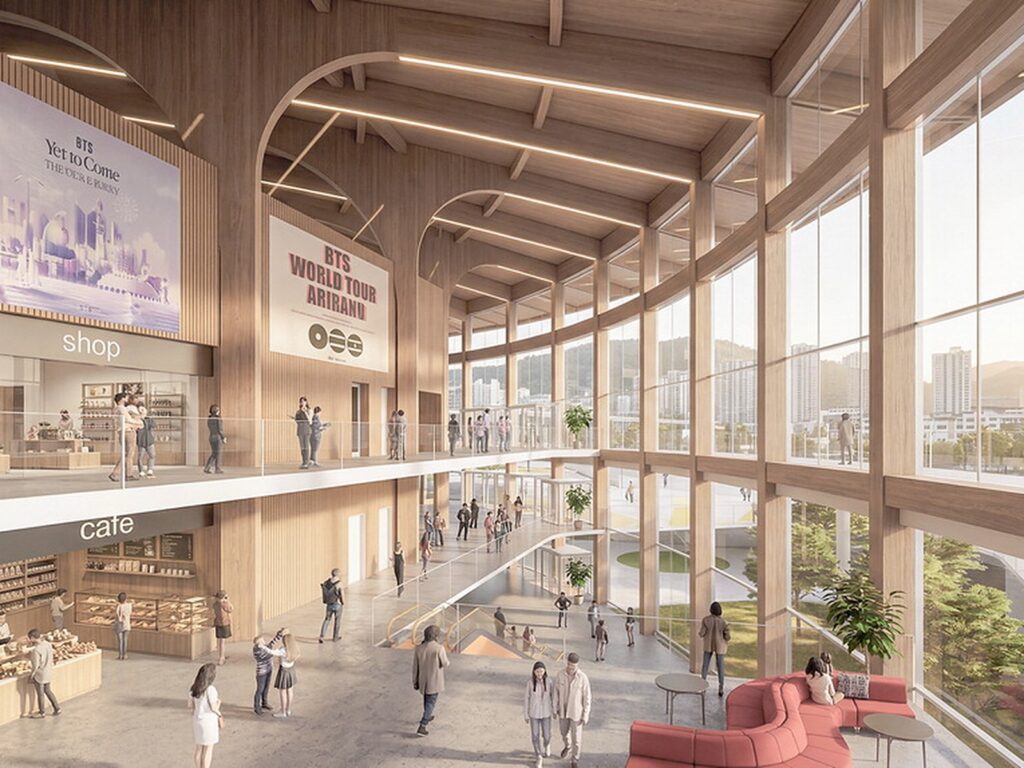
Interior render of the timber arena concourse, with exposed timber beams, a glazed wall, retail and café units, and event signage on an upper level.
Inside the arena, the design pairs an exposed timber frame with a public concourse of shops and cafés, doubling as a cultural venue on non-competition days. (Render courtesy of the Seoul Metropolitan Government)

Designated for urban sports facilities in 1978, the 50,916-square-metre site languished for decades before administrative clearances and central investment reviews were secured in 2025. The master plan will connect the arena with existing local hubs, including the Gwangjin-gu Citizens’ Sports Center, the Seoul Gwangjin Youth Center and the YES24 Live Hall.

Engineered to meet rigorous international regulatory standards, the venue will host premium training camps and global tournaments in combat sports such as taekwondo, judo and wrestling. On non-competition days, it will open to amateur sport, cultural events and public concerts.

Aerial render of the Gwangjang-dong sports complex showing a circular timber-roofed arena beside landscaped parkland running toward the Han River.
The master plan threads continuous green space between the arena and the Han River, integrating the venue with the Gwangjin-gu Citizens’ Sports Center and YES24 Live Hall. (Render courtesy of the Seoul Metropolitan Government)

Continuous green space will run between the arena and the river at ground level, whilst a public car park below will absorb parking demand around Gwangnaru Station. The design leans on the site’s position as a gateway to Seoul along the Han River, aiming to read as a new urban landmark.

The complex is intended to serve as an open public space where residents’ daily lives coexist with international sport, rather than as a conventional sports venue. That is the stated aim of Kim Yong-hak, the city’s director general for future space planning, who said Seoul would keep delivering public architecture through open, professional design competitions.

The city will finalise the contract with the winning consortium this month, ahead of an 18-month detailed design phase. Construction is scheduled to break ground in April 2028, with the arena due to open in August 2031.

The post Seoul to Build Korea’s First Hybrid Timber Arena on the Han River appeared first on Wood Central.

  •  

Billionaire Developer Floats 25-Story Plyscraper Over West Palm Beach

28 May 2026 at 15:53

Billionaire developer Jeff Greene has put forward a 25-story, 399-apartment tower for a downtown West Palm Beach block that, if built in the prefabricated timber described by its design team, would stand as the tallest wood-framed building in Florida. That is according to the South Florida Business Journal, which first detailed the proposal for 120 South Dixie Highway under the state’s Live Local Act.

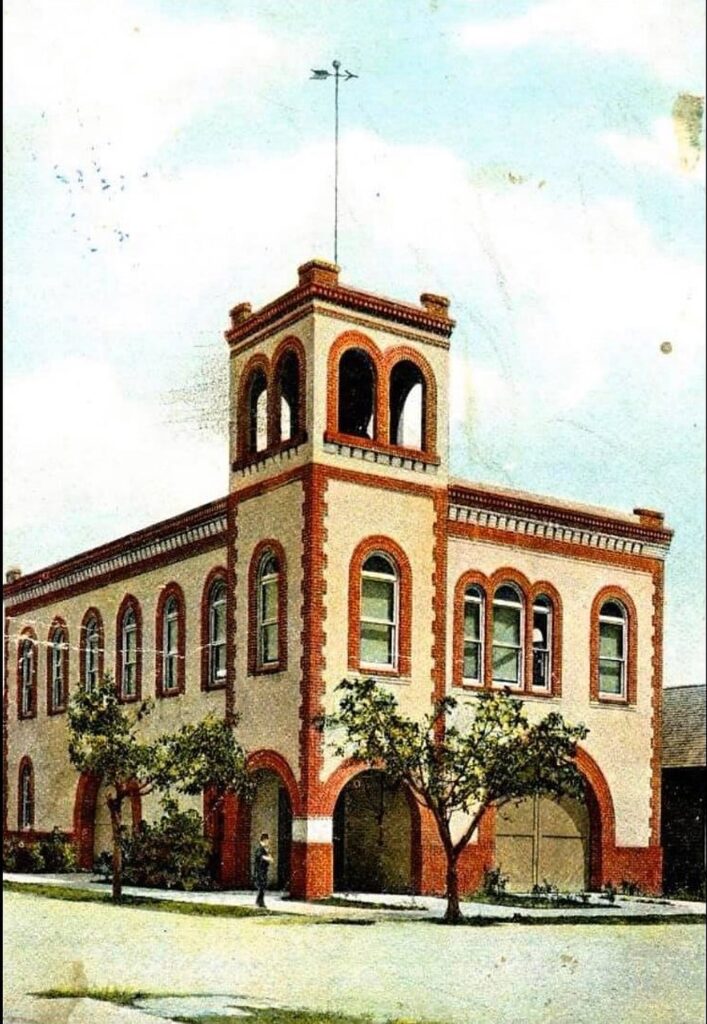
The tower is the work of Carlo Ratti Associati, the Turin and New York practice whose founder curated the 2025 Venice Architecture Biennale, with a tapering faceted facade rising above a brick podium. Its design would fold a turn-of-the-century firehouse on the site into the building’s frontage, keeping the masonry landmark within a modern high-rise.

Colourised vintage postcard of a two-storey brick-and-stucco firehouse with an arched bell tower and weathervane in early-1900s West Palm Beach.
The high-rise would incorporate part of this turn-of-the-century firehouse into its facade. (Image from Facebook)

Carlo Ratti Associati and development partner Nexus Systems intend to build the tower from prefabricated timber modules, a method the team says would speed construction and keep costs down. The developers argue that off-site timber fabrication and the material’s lower embodied carbon would deliver a faster, cleaner build than a conventional concrete frame.

Frontal render of the proposed West Palm Beach timber tower, its faceted facade narrowing to a sculptural peak above a brick base.
Three-quarter render of the proposed West Palm Beach timber tower showing its stepped, tapering timber facade and street-level podium.
Carlo Ratti Associati’s design tapers to a faceted timber peak above a brick podium. (Image: Carlo Ratti Associati)

The Live Local Act lets qualifying projects bypass some local zoning limits and pursue administrative approval in return for long-term workforce housing. About 160 of the 399 apartments, roughly 40 per cent, would be reserved for households earning at or below 120 per cent of the area median income, which Palm Beach County sets at $104,000.

Plans describe studios through three-bedroom units of 505 to 1,320 square feet, with workforce homes set on floors two to four and six to 11 and market-rate apartments above. The scheme also carries about 7,550 square feet of retail and 236 parking spaces, alongside shared amenities including a pool and gym on the fifth floor.

The West Palm Beach Plans and Plats Review Committee reviewed the proposal on 14 May and returned it for changes the developer must make before construction can begin. That early municipal scrutiny sits at the front of a Live Local approval path that can otherwise move administratively once a filing meets the statutory checklist.

Tall-wood towers have won global support for faster assembly and lower carbon, yet they continue to raise engineering, fire-safety and insurance questions, particularly in hurricane-exposed markets such as South Florida. Whether a 25-story timber building can meet Florida’s wind codes and insurers’ requirements remains the central technical test for the design.

The 25-story Ascent tower in Milwaukee, completed in 2022 as the world’s tallest mass-timber building at the time, is routinely cited as proof that high-rise timber is achievable. Its example also shows how approval processes and insurance standards shift sharply from one jurisdiction to the next.

Greene is pressing ahead with the twin-tower One West Palm development downtown and holds extensive land across the city, a portfolio that has repeatedly drawn him into disputes with West Palm Beach over height and zoning. The new timber proposal arrives as those tensions continue, with the developer and the city already at odds over a separate Currie Park scheme.

For now the proposal rests with the West Palm Beach Plans and Plats Review Committee, which will decide whether a 25-story timber tower holding 160 affordable apartments clears the changes it has demanded before construction.

The post Billionaire Developer Floats 25-Story Plyscraper Over West Palm Beach appeared first on Wood Central.

  •  

Timber Cathedral Crowns the World’s First Wild Koala Breeding Centre

27 May 2026 at 12:37

A timber “cathedral” of NSW hardwood columns, rising into a tiered canopy above rows of log benches, is the signature space of the world’s first wild koala breeding centre. Guulabaa, or Place of Koala in the Gathang language of the Biripi people, was built almost entirely from local hardwood and raised in a working state forest as a direct answer to the Black Summer bushfires.

The 25-hectare site breeds koalas for release into the wild, as part of a recovery programme led by Koala Conservation Australia. Its elevated timber decks link a cafe and gallery run by the Bunyah Local Aboriginal Land Council to the rest of the visitor experience.

Its design has drawn international recognition, from the 2025 Urban Land Institute Asia Pacific Awards for Excellence in Hong Kong to a shortlisting in last year’s World Architecture Festival. Guulabaa broke ground in Cowarra State Forest on the NSW Mid North Coast in early 2023, with funding from the Australian and NSW Governments, and reached completion in December 2024.

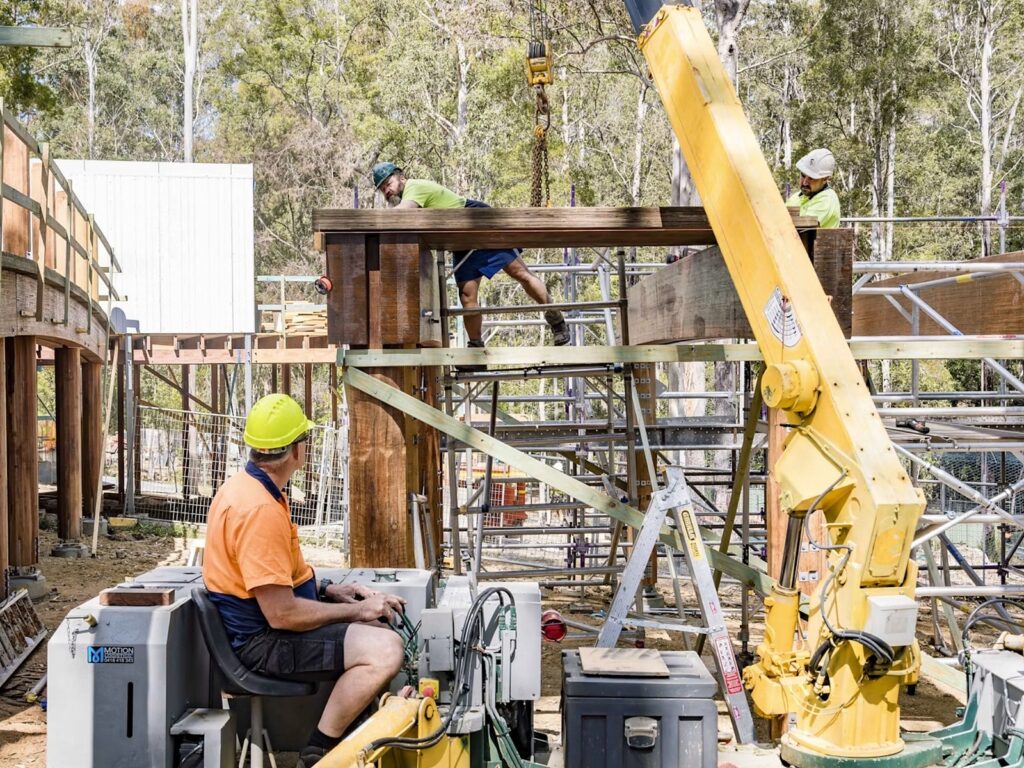
Construction workers and a crane operator placing a large timber deck onto hardwood poles at the Guulabaa site.
Crews position a mass timber deck during construction of the Guulabaa hub, prefabricated off-site and craned into the working forest. (Photo Credit: Supplied by Forestry Corporation of NSW to the Timber Design Awards as part of the submission)

The hub is a 90 per cent timber structure, with four main decks of mass timber supported on a braced pole system, and traditional framing retained for the stairs, gallery and roofs. Bridge-ply LVL decking spans pairs of large LVL and Stringybark beams, while unseasoned hardwood poles, bolted to concrete foundations with steel brackets, carry the decks clear of the ground.

Each deck was prefabricated off-site under a Design for Manufacturing and Assembly process, then craned into position to limit disturbance to the working forest around it. Even the steel bracing between the poles was set, the award’s entry notes, “to minimise climbing hazards” and keep the ground beneath the decks clear.

Workers guiding a large laminated veneer lumber panel lifted by crane during construction at Guulabaa.
A prefabricated LVL panel is craned into place at Guulabaa, with stacked bridge-ply decking waiting on the forest floor. (Photo Credit: Supplied by Forestry Corporation of NSW to the Timber Design Awards as part of the submission)

The timber came from eight local hardwood businesses — Ironwood, Coffs Harbour Hardwoods, Hurford Hardwood, Pentarch Forestry, Machins Sawmilling, Hayden Timbers, Weathertex and Big River Group — a local supply chain that, the entry says, “helped revitalise the regional industry.” Weathertex also supplied the cladding, described in the entry as a carbon-positive board made from sawmill waste.

Central to the design was fire-resistant Tallowwood, a native hardwood that, the awards entry argues, proved viable where “sustainable native timber construction was previously considered impossible”. Traditional First Nations cool-burning practices were written into the site’s fire management, drawing on Indigenous knowledge held by the Bunyah Local Aboriginal Land Council.

Elevated timber deck of the finished Guulabaa hub raised on hardwood poles among tall eucalypt trees.
The completed Guulabaa hub steps through the canopy on unseasoned hardwood poles, a 90 per cent timber structure. (Photo Credit: Supplied by Forestry Corporation of NSW to the Timber Design Awards as part of the submission)

The cathedral also serves as the site for cultural awareness training, integrating First Nations culture into the visitor experience. Its awards entry argues that Guulabaa has set “a new precedent for safe, climate-adaptive architecture in bushfire-prone regions”.

Designed by global architecture firm Gensler, with structural engineering by TTW and construction by F & SJ Maione, the hub was shaped in collaboration with Forestry Corporation NSW and the Bunyah Local Aboriginal Land Council. “Guulabaa challenged us to rethink what regenerative architecture should be,” said Ken McBryde, then Design Director at Gensler Australia.

Speaking to the media last year, McBryde said the project was less about a bold architectural statement than about designing with care and respect for Country, crediting the result to long-term thinking shared across the project team and First Nations knowledge holders. It was TTW that entered Guulabaa in the Public Building category of last year’s Australian Timber Design Awards, and projects of its kind help explain a change in this year’s programme.

For the first time, architects, engineers and builders are encouraged to identify the source of their timber, tracing it to the forest region and, in many cases, the sawmill. That is according to awards organiser Kylan Low, who said more than 4,000 Australian projects have entered the awards since 2000. The programme is run by the Timber Development Association and supported by Forest and Wood Products Australia and WoodSolutions.

Headshot of Kylan Low, organiser of the Australian Timber Design Awards, smiling in a dark suit and tie.
Kylan Low, organiser of the Australian Timber Design Awards. (Photo Credit: Supplied)

Early-bird entries for the 27th awards close at 7 pm this Friday, 29 May, with the final submission deadline set for July 3.

“For the first time in its 27-year history, the Australian Timber Design Awards is tracking timber back to its forest region of origin, and in many cases, the sawmill,” Low said. “It’s a milestone for the programme and a powerful statement about the transparency and traceability our industry can offer.”

The post Timber Cathedral Crowns the World’s First Wild Koala Breeding Centre appeared first on Wood Central.

  •  

Firefighters Turn to Timber for Award-Winning Hawke’s Bay Station

27 May 2026 at 08:52

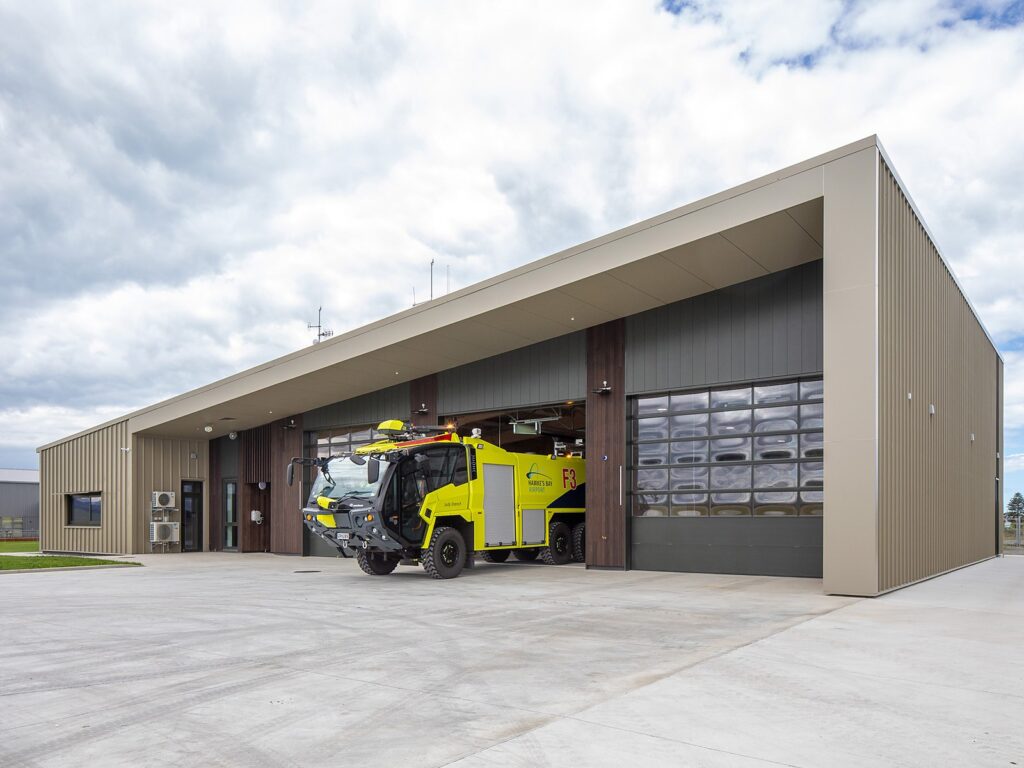
Hawke’s Bay Airport’s new fire station has won the Public Architecture category at the 2026 Gisborne and Hawke’s Bay Regional Architecture Awards. That is notable for a 550-square-metre building whose structure is glulam and cross-laminated timber rather than steel — a combustible material, in the one building type meant to fight fire. The award was announced earlier this month in Napier, where RTA Studio won three honours across the evening. The Havelock North practice took the Public Architecture category for the airport station alongside its Hawke’s Bay Museum Research and Archives Centre in Hastings.

A fire station is no ordinary building to attempt in timber. New Zealand’s Building Code classifies fire, rescue and police stations as Importance Level 4, the category for facilities that must keep operating once disaster strikes. Mass timber is combustible, and leaving it exposed increases the fuel load in the rooms it lines, so the station’s timber surfaces were tested against fire-safety criteria before that rating was confirmed.

The win is not the first for a timber fire station in the region. Australia’s first fully mass-timber fire station, the Maryborough Fire and Rescue Station in Queensland, took the global Built by Nature prize for public infrastructure last October, judged the world’s best example of timber use in its category ahead of 400 entries. Designed by Brisbane architect Kim Baber, the two-storey Maryborough complex used about 500 cubic metres of certified mass timber and was independently assessed to have saved roughly 1,742 tonnes of carbon against a conventional build.

A walk through the sustainability thinking behind Hawke’s Bay Airport’s fire station, from its mass timber structure to rooftop solar and rainwater harvesting. (Video: Hawkes Bay Airport).

The brief was written for resilience. Cyclone Gabrielle tore through Hawke’s Bay in February 2023, cut power and water to the airport and left its operations team running a critical transport hub on whiteboards and landlines. RTA Studio designed the replacement to keep working through the next such event, which shaped its structure, power supply, and water storage.

Low-carbon concrete was specified for the foundations, floor slabs, and external works, helping to reduce the building’s embodied emissions, which the airport wanted aligned with its decarbonisation targets. Hawke’s Bay Airport, on land the 1931 earthquake raised from the Ahuriri Lagoon, has held the Airport Carbon Accreditation scheme’s highest tier, Level 4+ ‘Transition’, since 2023 — a standing no other New Zealand airport has matched.

RTA Studio said the project follows “a more-with-less philosophy.” A long plan runs beneath a monopitch roof that rises over a triple-bay garage, then steps down at the far end to an office, kitchen, gym and open-plan workspace beside a separate control room. Sited airside at the south-eastern end of the runway, the garage at last lets the airport keep every fire appliance under cover, where the 1960s kitset shed it replaces could not.

West elevation of Hawke's Bay Airport fire station clad in green-gold corrugated steel with a fire tanker outside the triple-bay garage
The west elevation of the RTA Studio-designed station, wrapped in green-gold corrugate that echoes the district’s tawny farmland, with the airport tanker Judy Drench at the triple-bay garage. (Photo Credit: Patrick Reynolds)

RTA Studio wrapped the stripped-back rectangular form in green-gold corrugate, a colour chosen to echo the tawny farmland of the district and the nearby Poraiti hills. Vertical slot windows on the rear elevation draw light into the workshop, picked out in bands of Colorsteel in a darker green.

Inside, the lower 2.2 metres of the prefabricated CLT walls have been left visible, under a light whitewash that keeps the timber grain on show. The finish eases vehicle decontamination in the parking bay and carries through as a decorative datum line into the administrative wing.

Roof-mounted solar panels, angled to avoid sunstrike for passing aircraft, generate electricity for the station’s daily operation. Rainwater is harvested from the sloping roof and stored in tanks holding 50,000 litres, drawn on for routine truck washing and, in an emergency, for firefighting. Wood Central understands the airport is weighing a far larger solar array across the wider site.

Hawke’s Bay Airport Chief Executive Nick Flack said at a public open day on 20 May that the station, in service since February, had been built almost entirely by Hawke’s Bay firms, from RTA Studio to lead contractor TW Construction. “All our partners are locals, the build crew’s local,” Flack said.

Napier Mayor Richard McGrath toured the station’s NZ$1.6 million tanker, Judy Drench, at the open day and said the facility had made the region safer and more resilient. “We don’t muck around with lives,” McGrath said, calling the station a sound investment.

Fighting fires is the rarest part of the job, Airport Fire Station Officer Brian Bassett said, with most shifts given over to keeping wildlife clear of a runway ringed by an estuary. Crews use stockwhips, gas guns and fireworks to move birds, deer and the occasional seal off the tarmac, and now cut the surrounding grass to 250 millimetres to keep magpies and plovers away.

Flack said the station has been designed to serve the airport for the next 50 to 60 years — the working life RTA Studio set out to reach in glulam and cross-laminated timber rather than steel.

The post Firefighters Turn to Timber for Award-Winning Hawke’s Bay Station appeared first on Wood Central.

  •  

Engineered Wood Products Find Their Sweet Spot With Mid-Rise Housing

27 May 2026 at 07:29

Architects and developers can now test hybrid mass timber systems within minutes rather than weeks of consultant coordination, a shift its backers say is critical to moving engineered wood into mainstream mid-rise housing. That is according to Ricardo Brites, director of engineering and VDC at Mercer Mass Timber, one of North America’s largest mass timber producers, who has built his career on making timber buildings cheap enough to compete with concrete and steel.

BuildSpec, a free digital platform developed by Mercer with ZGF Architects and Fast + Epp, generates real-time structural and carbon-impact data for mid-rise housing projects. Brites told the Vancouver Sun it lets teams compare hybrid systems at the earliest massing stage, work that until now took weeks of consultant coordination to complete.

The barrier BuildSpec aims to remove, Brites says, is timing: project teams rarely have enough information to weigh a timber system before a design has already hardened around conventional concrete and steel. By the time cost estimates and engineering assessments are in hand, many projects are locked into assumptions that leave little room for an engineered wood alternative.

For Brites, the structural case for mass timber is settled, and the open question is now price, the measure he says will decide whether engineered wood becomes a mainstream housing material.

What drives me is cost competitiveness, he said.

Engineered products such as cross-laminated timber, or CLT, are made by layering wood panels into components strong enough for multi-storey buildings, increasingly built alongside steel or concrete, where each material performs best.

Brites is candid that the strongest projects rarely rely on timber alone, with each material used for what it does best rather than treated as an all-or-nothing structural choice. That thinking has pushed Mercer toward hybrid systems, which draw on timber’s speed and warmth while leaning on the proven economics of steel and concrete.

Beyond the calm of exposed-wood interiors, Brites points to prefabrication as engineered timber’s decisive advantage, with structural components manufactured off-site through precise digital modelling and delivered ready for installation. That moves problem-solving away from the building site, resolving co-ordination issues digitally before fabrication begins and cutting both construction timelines and costly on-site surprises.

The City of Vancouver estimates that mass timber can cut a building’s embodied carbon by 25 to 45 per cent compared to conventional concrete and steel, one of the metrics BuildSpec is built to surface while a project is still on the drawing board. That carbon performance has become central to the material’s appeal in jurisdictions tightening emissions rules for new construction.

Canada, and British Columbia in particular, has become one of North America’s most active mass timber markets, a result Brites attributes to acute housing pressure and supportive policy, backed by expanding manufacturing capacity. Demonstration projects such as the University of British Columbia’s Brock Commons Tallwood House helped establish early confidence in tall timber construction, whilst newer policies are encouraging more standardised mid-rise development.

Brites sees North America moving through a stage Europe passed years earlier, having worked in the United Kingdom on projects for Lendlease, Mace and Berkeley Homes as mass timber shifted there from a niche product toward a near-commodity. The current phase, he says, is a transition from early demonstration projects toward broader market adoption.

Brites argues the housing shortage will not be solved by better-designed individual buildings, but by repeatable delivery systems that produce good housing predictably and at a workable cost, a benchmark for the construction sector now expected to help deliver the 430,000 to 480,000 new homes a year that the Canada Mortgage and Housing Corporation says the country needs by 2035.

The post Engineered Wood Products Find Their Sweet Spot With Mid-Rise Housing appeared first on Wood Central.

  •  

Windmill Backs Mass Timber for All Projects up to 18 Storeys

25 May 2026 at 09:54

One of Canada’s best-known affordable-housing developers will design almost every new building up to 18 storeys, using mass timber, betting its forward pipeline on engineered wood and off-site manufacturing. That is according to Windmill Developments’ new chief executive, Jeremy Reeds, who told Connect CRE Canada that cross-laminated timber and prefabricated systems will account for a large share of the company’s future portfolio.

Reeds, who Windmill appointed as chief executive in April, said any project up to 18 storeys is now being designed with mass timber in mind, with cross-laminated timber set to feature across much of the affordable-housing specialist’s pipeline. The shift extends a prefabricated building approach that the company has developed with British Columbia’s Intelligent City.

Working with Intelligent City, Windmill has built prefabricated floor and exterior wall systems that integrate structural, electrical and HVAC components off-site before the modules reach the construction site. Reeds said the method can sharply shorten construction timelines whilst cutting embodied carbon, improving operational efficiency and trimming costs tied to scheduling and delivery.

The clearest example to date is in Toronto, where Windmill’s nine-storey, 60-unit rental building at 230 Royal York is scheduled to begin occupancy in August. Reeds pointed to the project as a marker of the company’s growing reliance on engineered timber. Another marker is taking shape in Ottawa, where Windmill is redeveloping a former Korean church site into a roughly 200,000-square-foot project with 296 rental units, about 25 per cent of which are designated affordable housing. The development will retain portions of the church facade and fold them into the new podium structure.

Reeds said the church redevelopment reflects a longstanding Windmill approach of partnering with churches and non-profit organisations to draw value from ageing properties whilst keeping community uses intact.

A second Ottawa-area project, Parkway House, is a partnership with a non-profit supporting adults with disabilities, with the first phase carrying 266 units that local non-profit Nesting Ground will own and operate. The two developments point to a delivery model Windmill wants to take national.

Reeds, who joined Windmill in 2019 as finance director and has since served as partner, chief financial officer and chief operating officer, was promoted to president in 2024 under the company’s succession plan. He succeeded founder Jonathan Westeinde as chief executive in April, with Westeinde moving to the role of executive chair.

Reeds said his longer-term goal is to build on Windmill’s two-decade record in sustainable development and widen its national operations, with the developer “looking very closely at other key markets” beyond Ontario over the next five to 10 years.

Mass timber will carry much of that expansion, with Windmill planning to specify engineered wood and cross-laminated timber on developments well beyond its Ontario base. Reeds said the company measures its progress less by what it delivers alone than by how far it can shift the wider sector.

The post Windmill Backs Mass Timber for All Projects up to 18 Storeys appeared first on Wood Central.
  •  

Mass Timber Delivers Oran Park’s New School in Just Nine Months

24 May 2026 at 03:29

A public school in south-west Sydney has been delivered in less than nine months, its classrooms, commons and envelope built almost entirely from exposed laminated veneer lumber that doubles as both structure and finished surface. That is according to the project’s entry in the 25th Australian Timber Design Awards, lodged by head contractor Lipman in the Public Building category, which sets out how Oran Park Public School uses engineered timber and high pre-manufactured value to meet School Infrastructure NSW’s push for faster school delivery.

Oran Park Public School classroom with an exposed laminated veneer lumber ceiling cassette and operable glazed doors open to an adjoining teaching space
A lower-level classroom at Oran Park Public School: its exposed NelsonPine LVL ceiling cassette serves as a structural element, finished lining, and fire protection for the level above. (Photo Credit: Mike Chorley, provided to Wood Central by the Australian Timber Design Awards)

Exposed LVL runs through the primary columns and beams, the closed floor cassettes and the closed ceiling cassettes, accounting for around 70 per cent of the structure. The floor cassettes were built from a NelsonPine LVL panel that serves as finished ceiling lining, a structural element, and fire protection for the level above.

Meanwhile, Roof cassettes, comprised of NelsonPine LVL billets, serve as the structure and finished ceiling in a single component, with MeySPAN LVL and MeyJOIST engineered I-joists completing the modules. Timber Building Systems fabricated and installed the timber scope, working with NelsonPine to machine LVL columns to exact dimensions for a visually seamless match with the ceilings.

Two-storey exterior of Building O at Oran Park Public School at dusk, showing exposed LVL soffits to the upper walkway and a pre-cast concrete external stair
The exterior of Building O at Oran Park Public School at dusk, with exposed LVL soffits lining the upper walkway and pre-cast concrete stairs and circulation kept clear of the timber structure. (Photo Credit: Mike Chorley, provided to Wood Central by the Australian Timber Design Awards)

The building achieves a 5 Star Green Star as-built rating, with exposed timber soffits delivered in a Class 9B building of Type B construction under the National Construction Code. The awards entry states that the exposed LVL solution “featured prominently in the sustainability strategy” for the school, supported by heat-exchange energy recovery systems serving every teaching space.

Bennett and Trimble led the architecture, with Bligh Tanner as the structural and facade engineer, and Lipman as the early contractor involvement partner and head contractor. Lipman’s submission states engineered timber was specified for its alignment with “modern methods of construction, accelerated delivery and low-carbon buildings.”

Multi-purpose space at Oran Park Public School with sliding operable walls open to an LVL-framed learning commons and an exposed plywood ceiling
Oran Park Public School learning area with an exposed laminated veneer lumber ceiling, yellow accent wall and built-in joinery
Aerial view of Oran Park Public School showing two low-rise engineered timber buildings surrounded by housing in south-west Sydney
Inside Oran Park Public School — a multi-purpose space opening through operable walls to the LVL-framed learning commons, a general learning area beneath the exposed timber ceiling and an aerial of the school’s two engineered timber buildings in south-west Sydney. (Photo Credit: Mike Chorley, provided to Wood Central by the Australian Timber Design Awards)

Oran Park Public School was entered in the Public Building category of the 25th Australian Timber Design Awards, the 2024 edition of a program that recognised 15 projects. The awards have run for 27 consecutive years, a roll call that takes in World Buildings of the Year, Olympic venues, embassies near the White House and, in 2025, Archer Office’s reuse of a condemned 1892 boot factory in Bondi Junction.

Two-storey exterior of Building O at Oran Park Public School at dusk, showing exposed LVL soffits to the upper walkway and a pre-cast concrete external stair
oran park public school homebase acoustic detail 1600x1200
Classroom at Oran Park Public School with a full-height window wall, exposed LVL ceiling and rows of student tables and chairs
Building O at Oran Park Public School is lit at dusk, a homebase entry marked by a red acoustic panel and patterned glazing, and a classroom drawing daylight through a full-height window wall beneath its exposed LVL ceiling. (Photo Credit: Mike Chorley, provided to Wood Central by the Australian Timber Design Awards)

Entries for the 27th Australian Timber Design Awards are now open, with organiser Kylan Low revealing that the program is the industry’s way of championing its best work, with every winning project carrying a supply chain story that runs from the forest through sawmills and engineers to builders. “Behind every winning project is a supply chain story that begins in the forest,” Low said.

Please note: Early-bird entries for this year’s awards close at 7 pm, Friday, the 29th of May 2026. For more information, visit the Australian Timber Design Awards dedicated website.

The post Mass Timber Delivers Oran Park’s New School in Just Nine Months appeared first on Wood Central.

  •  

Timber ‘Pringle’ Rises as North America’s Longest Bending Gridshell

22 May 2026 at 23:43

A saddle-shaped timber canopy nicknamed “the Pringle” has been craned into position at a film studio campus outside Atlanta, Georgia, forming North America’s longest bending-active timber gridshell. That is according to StructureCraft, the Vancouver-based timber engineer and design-builder behind the superstructure, which set the doubly curved grid in place earlier this week, ahead of a grand opening early next month in time for the FIFA World Cup.

Wood Central understands the 370-square-metre Assembly Studios Bandshell rests on two precast concrete plinths at the edge of a new public greenspace, its elastically bent timber laths arching up from a near-flat lattice into a doubly curved span of close to 25 metres. Stainless-steel shingles will clad the finished shell, shaped to catch the Georgia sun from almost any angle.

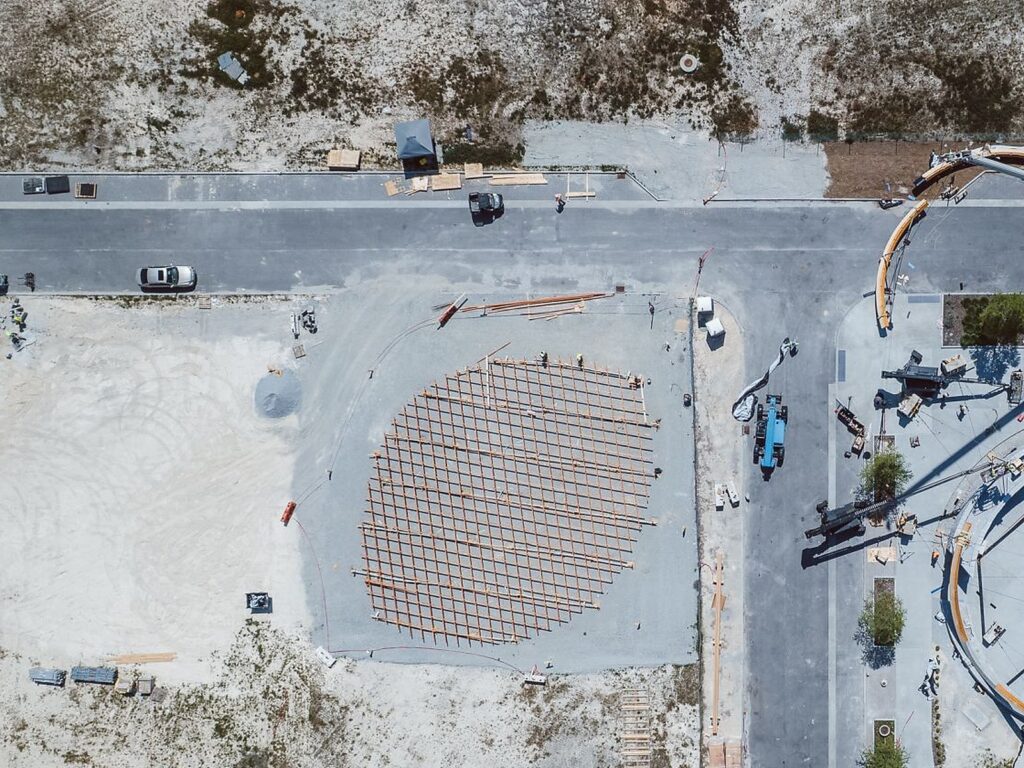
Aerial view of the circular timber gridshell laid out as a near-flat lattice on its construction pad at Assembly Atlanta, Georgia.
An aerial view shows the timber gridshell in its near-flat lattice state, the circular grid of laths later elastically bent into a doubly curved canopy spanning close to 25 metres. The structure rises beside a new public greenspace at the Assembly Studios campus in Doraville, Georgia. (Photo credit: StructureCraft)

Bending-active gridshells of this kind trace back to the experimental lath roofs of the 1970s, before the structural type fell out of use worldwide, held back by the engineering nerve and the fused design-and-build approach it demands. StructureCraft head of engineering Lucas Epp said no comparable timber gridshell had been attempted at this scale anywhere in North America.

“It’s going to be an eye-catcher for sure,” Epp said.

The $10 million budget covers site works, civil engineering, landscaping, and building services, with the bandshell opening the long-delayed second phase of Assembly Atlanta, the 49-hectare Grey Media production campus in Doraville. Apple TV’s forthcoming remake of Cape Fear is among the productions recently shot at the studios.

Curved glulam timber arches rise on cables over the concrete amphitheatre stage at the Assembly Studios Bandshell, Georgia.
Curved glulam arches are tensioned into position over the amphitheatre stage at the Assembly Studios Bandshell, the second timber element of a venue anchored by the saddle-shaped gridshell canopy. StructureCraft fabricated the arches offsite to the same millimetre tolerances before crews craned each rib into the ring. (Photo credit: StructureCraft)

Fabrication ran entirely offsite, with the timber members shaped in Canada and trucked to Georgia before Bailey Construction hoisted the completed shell onto its supports and fixed it at six points. Gipson Company president Jay Gipson said the curved geometry forced every surrounding platform, wall and stage element to be built to a tolerance of around five millimetres.

“These woods have turns, they have twists,” Gipson said.

Crews were scheduled to fix the plywood diaphragm in the week after the grid was set, followed by the roofing and secondary components that finish the canopy.

The canopy is not the only timber structure on the site, with a ring of curved glulam arches rising over the bandshell’s concrete amphitheatre stage, each rib craned in and tensioned against the others to hold the sweeping form. Smith Dalia Architects, the Atlanta practice behind the bandshell, drew the arches and the saddle shell as a single composition, a timber set piece for a park built to host open-air screenings and full-scale concerts.

The post Timber ‘Pringle’ Rises as North America’s Longest Bending Gridshell appeared first on Wood Central.
  •  

Mass Timber Could Gain New Ground as Architects Turn From Glass

22 May 2026 at 05:20

A decade-long appetite for shimmering glass towers is giving way to heavier and more tactile materials, with architectural practices now reaching for brick, concrete, stone and rammed earth in buildings designed to stand for a century. That is according to property publication Domain, which cited climate urgency and fatigue with glass curtain walling as the forces opening the way for a more durable architecture, one in which engineered timber and hybrid construction could emerge as ways to deliver the qualities long associated with masonry.

One project already testing that thinking is SJB’s Surry Hills Village, which pairs an exposed mass timber frame with a mottled brick exterior, a contemporary reading of the warehouse character of the inner-Sydney precinct. Emily Wombwell, a director at SJB, said the commercial building had been conceived as a robust yet flexible structure in which timber carries the internal expression whilst brick holds it to its surroundings.

“Brick is everywhere in that part of the city,” Wombwell said.

The retreat from glass is partly a reckoning with craft, according to Peter Miglis, a director at Woods Bagot, who argues that prefabricated curtain wall systems have produced skylines of sheer, anonymous glass at the expense of material depth. Where a single trade can assemble a glass facade, he said, a building loses the layering of skill and intent that gives it character.

“Now there’s a yearning for solid buildings that age with grace,” Miglis said.

PROPERTY group Toga has unveiled the winning design for the revitalisation of the #SurryHills Shopping Village and at the same time, lodged the development application for the site. #cre #commercialrealestate #commercialproperty https://t.co/zts3bdMSWl pic.twitter.com/in8jgmVti1

— Australian Property Journal (@AusPropJournal) October 10, 2018

Heavier materials also carry a performance argument, because masonry and concrete hold significant thermal mass — the capacity to absorb, store, and slowly release heat through the day.

Patrick Nolan of Kennedy Nolan said thermal comfort in masonry buildings could be achieved with far less energy than in fully glazed or lightweight structures, provided the design accounted for orientation, shading and ventilation. The environmental case is more complicated, however, because concrete carries a high embodied carbon cost that the sector has yet to resolve through fly ash and alternatives to Portland cement.

Mass timber is where Nolan looks for a way through, suggesting that if timber or hybrid construction could match masonry’s structural and cultural offerings, the result would be genuine newness in the architectural cycle.

Whether engineered timber takes on that role more widely remains an open question, though projects such as Surry Hills Village show that timber and masonry already share structural and expressive work rather than compete for it. Nolan said demand for heavy buildings appeared to be long-lasting and that a change in architecture was both inevitable and welcome.

“It would be difficult to justify returning to fully glazed facades,” he said.

The post Mass Timber Could Gain New Ground as Architects Turn From Glass appeared first on Wood Central.
  •  

Bruce Springsteen’s Mass Timber Museum Opens Where Born to Run Began

21 May 2026 at 13:18

US music icon Bruce Springsteen is just days away from the opening of a new museum dedicated to his life and legacy, the Bruce Springsteen Center for American Music at Monmouth University, on 13 June. The 2,750-square-metre building, first revealed in 2023, stands a short walk from the New Jersey shore where Springsteen wrote Born to Run.

Designed by New York practice CookFox Architects, the mass timber structure — its ceiling and support columns left exposed — houses Springsteen’s archives, exhibition galleries and a 240-seat theatre. The weathering steel and timber building has been conceived as a destination for exhibition, education, performance and research, anchored by a glue-laminated and cross-laminated European spruce frame.

A weathering steel rain screen wraps the rectangular volume in a nod to New Jersey’s dockyards and factories, whilst the structural frame uses harvested European spruce in both glue-laminated and cross-laminated timber sustainably. CookFox left all of the wood unstained to express its natural character, setting it against resin-infused paper millwork, a surface also used by guitar makers for fretboards.

A walkthrough of the Bruce Springsteen Center for American Music, with founding executive director Robert Santelli on the project’s origins and the musician’s response to the proposal. (Video: Bruce Springsteen Center for American Music)

Robert Santelli, the centre’s founding executive director, said the building places Springsteen within the wider story of American music rather than treating him in isolation. Recalling the moment he first put the proposal to the musician, Santelli said Springsteen told him he would prefer to be seen as a chapter in that ongoing story.

“A chapter in the ongoing story of American music,” Springsteen said.

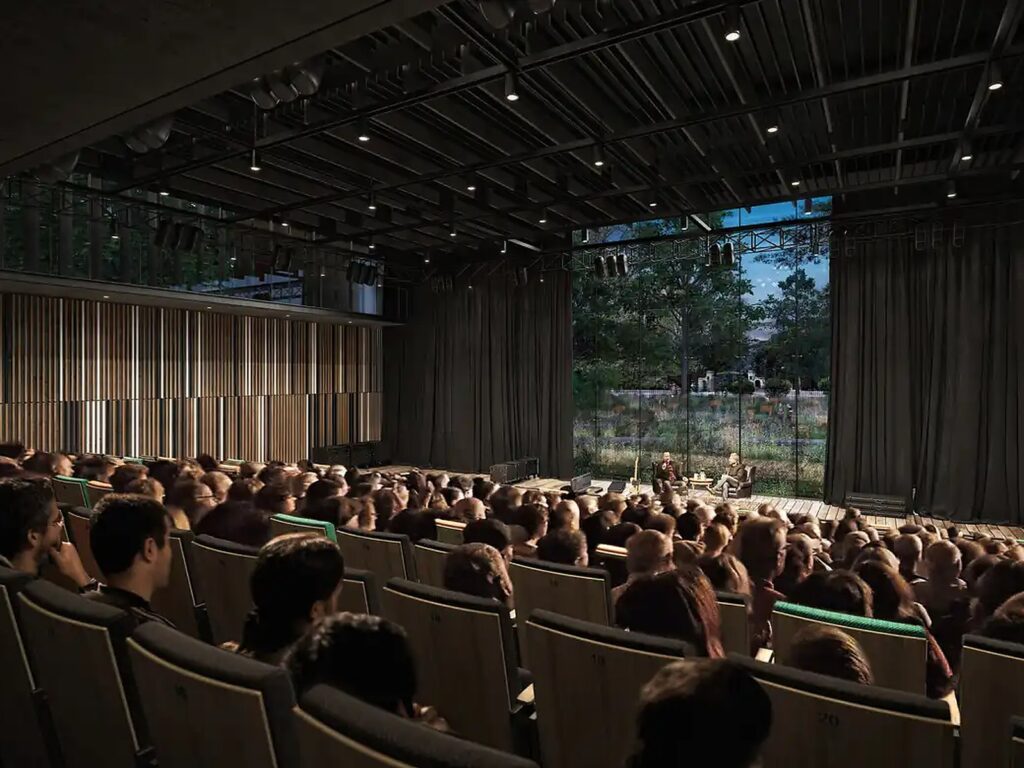
Inside the 240-seat theatre, thin vertical timber slats give the room human scale and conceal acoustic panels tuned to absorb and reflect sound, whilst the end-grain wood block flooring of the kind once laid in factories reveals the growth rings of the trees it was milled from. A full window-wall behind the stage draws daylight into the space and connects the building to the surrounding campus.

Render of the 240-seat theatre at the Bruce Springsteen Center for American Music with an audience and a glazed wall behind the stage
An audience fills the 240-seat theatre, where a glazed wall behind the stage opens the timber-lined room to the campus landscape. (Render: CookFox Architects)

The archives will preserve Springsteen’s papers and notes alongside recorded music, programmes, posters, ticket stubs and stage-worn garments across five separate climate and humidity-controlled environments. Exhibition designers C&G Partners have laid out eight galleries of rare artefacts, iconic photography, a hands-on rehearsal studio and an immersive concert experience, including a documentary on Springsteen’s place in American music directed by Thom Zimny.

Render of a gallery interior at the Bruce Springsteen Center for American Music with an exposed mass timber ceiling and visitors viewing exhibits
Exposed glue-laminated beams and columns frame a gallery where C&G Partners has laid out rotating exhibitions on American music. (Render: CookFox Architects)

Rick Cook, founding partner of CookFox, said the design grew from a personal connection to Springsteen’s work that ran through every decision on form, proportion and materiality. The practice drew directly on the musician’s creative instincts when shaping the visitor experience and the high-performing theatre, Cook said.

“As a team, we were inspired by Bruce Springsteen’s honesty, bravery and authenticity,” Cook said.

Targeting LEED v4 Gold certification, the all-electric, net-zero-ready building offsets more than 75 per cent of its energy use through Monmouth University’s campus-wide solar array, with Torcon as the project contractor and DeSimone Consulting Engineers as the structural engineer and facade consultant. The Bruce Springsteen Center for American Music opens to the public on 13 June, its archives holding more than 35,000 items tracing the musician’s life and the broader story of American music.

The post Bruce Springsteen’s Mass Timber Museum Opens Where Born to Run Began appeared first on Wood Central.

  •  

Carpenter’s Home Revives Lost Trade Under 26-Metre Glulam Roof

18 May 2026 at 14:14

China’s rural mass timber push has produced a 26-metre clear-span glulam workshop in Haotang Village, with 12 curved glued-laminated timber beams spanning an open production hall, returned to local carpenter Zhang on the same patch of ground his original village shed once occupied. The 405-square-metre Carpenter’s Home, completed by Shanghai-based studio Primary Architects under the village’s Eight Traditional Crafts Revival Program, replaces an aging woodworking shed at the rural settlement’s entrance with a digitally fabricated hybrid glulam-and-steel hall designed for woodworking, school workshops and community tea gatherings beneath a single sweeping roof in Pingqiao District.

The 12 curved glulam beams step down gradually from east to west across the workshop floor, with each member running to steel connection nodes in a hybrid system carrying the full 26-metre span without an intermediate column. The double-curved geometry was digitally modelled and parametrically controlled before being prefabricated off-site and assembled through a modular construction process at the village edge, with curved skylights cutting the timber shell in narrow ribbons that follow the curvature of the glulam.

Interior of Carpenter's Home showing twelve curved glulam beams above tiered timber seating and the upper-level tea room in Haotang Village, China.
Twelve curved glulam beams descend from east to west above the open learning hall at Carpenter’s Home, with tiered timber seating tracing the curvature of the roof and the upper-level tea room visible at the rear of Primary Architects’ Haotang Village workshop. (Photo Credit: DONG Image | @rudy_dong96)

Chief architects Xiang Huang and Songyan Mao approached the roof as an extension of the surrounding mountain, with the curving roofline tracking what the practice calls a dialogue of “disconnected form yet connected spirit” with the distant hills. Skylight openings were sized through sunlight simulations so the workshop operates primarily on natural light through the day, with operable polycarbonate facade panels carrying ventilation across the building envelope and the filtered light spreading evenly across the timber surfaces of the open-plan learning hall.

The operable polycarbonate facade panels at Primary Architects' Carpenter's Home in Haotang Village provide ventilation and daylight to the 405-square-metre glulam workshop, with a mature tree threading through the facade line.
The operable polycarbonate facade panels open across the curved envelope of Carpenter’s Home, carrying ventilation and daylight into the 405-square-metre Haotang Village workshop with a mature tree threading through the facade line. (Photo Credit: DONG Image | @rudy_dong96)

The open-plan hall accommodates research workshops and educational activities for up to two school classes at once, with flexible woodworking tables supporting traditional mortise-and-tenon teaching alongside contemporary timber experiments. Displays of hand planes, ink markers and timber sections line the walls, placing vernacular tools alongside engineered wood technologies as the workshop reopens the trade Zhang had practised at the original village shed.

Local carpenter Zhang at the workbench inside Primary Architects' 405-square-metre Carpenter's Home glulam workshop in Haotang Village under the Eight Traditional Crafts Revival Program.
Local carpenter Zhang has returned to his bench inside Primary Architects’ Carpenter’s Home, with the new 405-square-metre glulam hall replacing the original village woodworking shed under the Eight Traditional Crafts Revival Program. (Photo Credit: DONG Image | @rudy_dong96)

The ground floor preserves a dedicated woodworking production area at one end of the hall, with the other section opening toward villagers and visitors through exhibitions, workshops and educational programmes. Upstairs, a tea room serves as a public gathering space and a waiting lounge for parents during school activities, with labour, teaching, hospitality and community interaction deliberately overlapping under one roof.

The upper-level tea room at Carpenter's Home opens to the forested bamboo edge of Haotang Village through curved glazed walls beneath the exposed glulam roof structure.
The upper-level tea room at Carpenter’s Home opens to the forested bamboo edge of Haotang Village through the curved glazed wall, operating as a public gathering space and waiting lounge beneath the exposed glulam roof structure. (Photo Credit: DONG Image | @rudy_dong96)

It comes as Wood Central reported on Canadian glulam gaining ground in China, with more than 20 Chinese glulam producers now operating across the country and Hem-Fir and Yellow Cedar laminations entering small-batch production in 2025. “The pathway is real, and the next step is repeatability,” Lance Tao, Export Development Program Manager for Canada Wood Group, said of Chinese glulam adoption, with the Haotang Village project sitting on the demand end of the same supply chain now scaling across Chinese civic and educational construction.

The Pingqiao District workshop joins a widening Chinese mass timber portfolio anchored by the Jiangsu Provincial Rehabilitation Hospital — China’s first large-scale wood-concrete composite building, delivered under a glulam certification programme established between the Canadian Wood Group’s Chinese office and the China Academy of Building Research. The Haotang Village hall sits on the smaller civic end of the same supply pipeline, with the 26-metre clear span and double-curved roof geometry showing how Chinese glulam manufacturing is feeding programmes well beyond the hospital and high-rise tier.

The 405-square-metre workshop was delivered for client Xinyang Pingqiao District Juxing Agricultural Investment and Development Co., Ltd. by Shanxi Junchen Construction Co., Ltd., with wood structure detailed design by Bowen Li — and carpenter Zhang now back at his bench on the same patch of ground his original village shed once occupied at the entrance of Haotang Village.

The post Carpenter’s Home Revives Lost Trade Under 26-Metre Glulam Roof appeared first on Wood Central.
  •  

1776 Drones to Light Up Teddy Roosevelt Library’s Grand Opening

18 May 2026 at 04:01

State, federal and community leaders have set out final preparations for the 4 July grand opening of the Theodore Roosevelt Presidential Library, the first US presidential library built with mass timber, with a 1,776-drone show, free national park entry and a five-day Medora A250 festival now confirmed for the holiday weekend. That is according to North Dakota Governor Kelly Armstrong, who gathered the briefing in Medora and reaffirmed his 7 April executive order mobilising state agencies for America 250 events, including the library opening.

Casting the briefing as central to the state’s biggest tourism moment in a generation, Armstrong positioned the opening as the anchor event for the ND250 programme running across North Dakota through July. “We want residents and guests to enjoy this celebration safely and confidently,” Armstrong said.

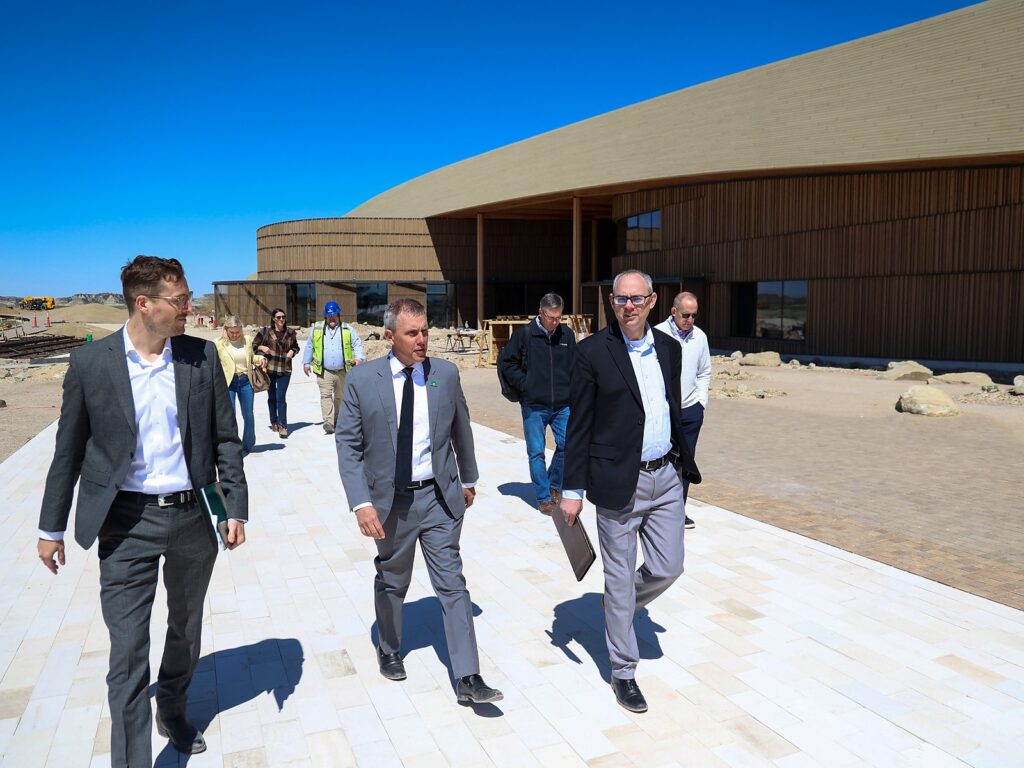
Armstrong and Lauf walked the project site with the library and Medora Foundation teams ahead of the briefing, with crews still threading interior fit-out across the 96,000-square-foot building less than two months out from the 4 July grand opening. The walk-through took the delegation along the new entrance paving, through the auditorium build-out and across the main exhibition floor before the press conference convened on the wooden deck overlooking the Badlands butte.

Robbie Lauf and Governor Kelly Armstrong walk along the new paver entrance to the Theodore Roosevelt Presidential Library with the curved mass timber roof and timber-slat facade visible behind them.
Robbie Lauf (left) and Governor Kelly Armstrong walk the new paver entrance to the Theodore Roosevelt Presidential Library on 6 May 2026, less than two months out from the 4 July grand opening. (Photo Credit: North Dakota Office of the Governor)

Theodore Roosevelt Presidential Library Executive Director Robbie Lauf set out opening-day plans, with the 1,776-drone show keyed to the founding year staged alongside an immersive exhibition programme inside the 96,000-square-foot mass timber building. The drone show will be a first for a US presidential library opening, with the choreography sized to the 1776 reference Lauf has built into the broader weekend programme.

Tour delegation walking through the Theodore Roosevelt Presidential Library's main exhibition hall with exposed glulam columns and cross-laminated timber ceiling above ongoing construction equipment.
Exposed glulam columns and a cross-laminated timber ceiling carry the Snøhetta-designed curved roof above the library’s main exhibition hall during the 6 May 2026 walk-through. (Photo Credit: North Dakota Office of the Governor)

Theodore Roosevelt National Park Superintendent Rachel Daniels announced the reopening of the South Unit Scenic Loop Road, with free park entry granted across the 3-5 July weekend to align with the library opening and ND250 holiday programme. Theodore Roosevelt Medora Foundation CEO Clarence Sitter outlined Medora’s A250 Week, a 2-5 July festival of free programming tied to the holiday weekend, with Tourism and Marketing Director Sara Otte Coleman briefing the same gathering on visitation trends and the broader economic contribution of the state’s travel sector.

The Theodore Roosevelt Presidential Library's 300-seat auditorium under construction with scaffolding and stacked timber panels on the floor.
Scaffolding and finishing materials still on the floor of the library’s 300-seat auditorium on 6 May 2026 as crews push toward the 4 July grand opening. (Photo Credit: North Dakota Office of the Governor)

The Medora gathering has been called the largest in the North Dakota Badlands since Theodore Roosevelt National Memorial Park was dedicated in 1949, with Wood Central reporting in March that approximately 40,000 people are expected across the $450 million project’s five-day opening programme. Wood Central understands state law enforcement has been folded into the policing plan for a town of 160 permanent residents, with three resident officers stretched well beyond normal capacity by the holiday weekend influx.

Aerial construction photo of the Theodore Roosevelt Presidential Library in Medora, North Dakota, with cross-laminated timber roof panels and steel columns visible across the 93-acre Badlands site.
An aerial view of the Theodore Roosevelt Presidential Library under construction (May 2025) on its Badlands butte in Medora, North Dakota, showing the curved mass timber roof structure taking shape above the 96,000 sq ft build. (Photo credit: Chad Ziemendorf / Theodore Roosevelt Presidential Library Foundation)

It comes as construction crews have driven the 93,000-square-foot mass timber structure across its final fit-out phase, with Mercer Mass Timber’s roughly 1,800 cubic metres of cross-laminated timber and glulam cubic metres of cross-laminated timber and glulam delivering a total carbon benefit of 3,031 metric tonnes of carbon dioxide equivalent, the same as powering 320 homes for a year.

 The Theodore Roosevelt Presidential Library exterior showing the curved mass timber roof and timber-slat drum auditorium on its Badlands butte site.
The Theodore Roosevelt Presidential Library’s curved mass timber roof and timber-clad drum auditorium on its Badlands butte site, 6 May 2026. (Photo Credit: North Dakota Office of the Governor)

Wood Central understands that every living US president will attend the dedication ceremony on 4 July before doors open to the 40,000 visitors anticipated across the five-day programme, with North Dakota’s tourism agencies operating under Armstrong’s 7 April executive order through to the opening weekend.

The post 1776 Drones to Light Up Teddy Roosevelt Library’s Grand Opening appeared first on Wood Central.

  •  

Copenhagen Just Floated a Timber Public Space Over Its ‘Paper Island’

17 May 2026 at 10:24

Copenhagen’s last working shipyard has built its first public building, with Krohns Bådbyggeri applying the same timber slipway techniques once used to launch Royal Danish Navy ships to a 230-square-metre floating Douglas fir community space designed by Arcgency and MAST at the artificial island of Christiansholm.

That is according to Mads Møller, founder of Copenhagen studio Arcgency, who revealed that the project was designed to belong to the water. Bedding 1 is the first of three floating timber buildings planned for the canal-side development locally known as Papirøen, or Paper Island, with two further structures, a network of piers and a floating garden to follow under Cobe’s masterplan.

Anchored in the Arsenalgraven canal where the Royal Danish Naval Shipyard once stood, Bedding 1’s angular Douglas fir frame echoes the timber slipways once used to launch new ships from the site. Wood Central understands that Krohns Bådbyggeri remains the last active shipyard in central Copenhagen, carrying the construction work for Bedding 1 using techniques drawn from the same Danish shipbuilding tradition.

Close exterior detail of the angular Douglas fir slipway-style frame wrapping the long sides of Bedding 1, with the cabin-like volume pulled back behind the supports and clad in horizontal Douglas fir planks.
Angular Douglas fir supports flanking Bedding 1’s long sides, referencing the slipway scaffolding once used to ease new ships into the Arsenalgraven canal. (Photo Credit: Edith Sahlberg Gruvander)

“Bedding 1 was conceived as something that belongs to the water,” Møller said.

Organised across two storeys totalling 230 square metres, the upper deck is level with the quayside and houses a single flexible community space designed to host events and gatherings. A metal staircase from the quay descends to the lower level, where two apartments provide accommodation for guests of the island’s residents and open onto a covered timber terrace with mooring for boats and kayaks.

Bedding 1, the new floating timber community space and guesthouse designed by Arcgency and MAST, moored beside Cobe's Paper Island masterplan in the Arsenalgraven canal in central Copenhagen with its angular Douglas fir slipway frame visible on the river side.
Bedding 1 moored beside the Paper Island redevelopment in the Arsenalgraven canal, Copenhagen — the angular Douglas fir frame on the long sides directly references the timber slipways once used to launch ships from the Royal Danish Naval Shipyard, parts of which formerly occupied the site. (Photo Credit: Edith Sahlberg Gruvander)

Framing the long sides of the structure, angular Douglas fir supports recall the slipway scaffolding historically used to ease ships into the water, with the cabin-like building pulled back behind them and clad in horizontal Douglas fir planks for privacy. White walls and pale timber carpentry fill the interior, with large windows framing views of the surrounding canal and the Paper Island development beyond.

The upper-level community space inside Bedding 1, with white walls, pale Douglas fir floor and pitched ceiling framed by large windows looking onto the Arsenalgraven canal and the Paper Island redevelopment beyond.
Bedding 1’s upper deck holds a single flexible community space designed for events and gatherings, with windows framing views to Christiansholm and the wider Paper Island development. (Photo Credit: Edith Sahlberg Gruvander)

Cobe developed the masterplan for the Paper Island redevelopment, with Bedding 1 anchoring a wider canal-side scheme that will eventually include two further floating buildings, a network of piers and a floating garden. The Christiansholm work follows a wider Copenhagen push into timber neighbourhoods, with the Danish capital advancing all-timber housing and public space schemes as part of a citywide low-carbon construction agenda.

Interior view of the covered timber walkway running alongside Bedding 1's lower level, with Douglas fir cladding, exposed structural supports and bulkhead lighting in the foreground and the gabion-stone shoreline of Christiansholm visible at the far end.
A covered Douglas fir walkway runs the length of Bedding 1’s lower level, where two guest apartments open onto a terrace with mooring for boats and kayaks. (Photo Credit: Edith Sahlberg Gruvander)

It comes as MAST’s floating residential masterplan for a disused Rotterdam dock advances through the Dutch planning system, with the Danish studio targeting 100 cross-laminated timber homes in the Spoorweghaven basin, which would become Europe’s largest floating housing district. The Copenhagen and Rotterdam projects mark a growing northern European turn toward timber as the material of choice for canal-side civic and residential architecture.

The post Copenhagen Just Floated a Timber Public Space Over Its ‘Paper Island’ appeared first on Wood Central.

  •  

Adding more security.

By: dbhost
15 May 2026 at 14:58
As some MAY remember, years ago, the house next to me got rented out to some not so great renters, and I became very security focused after things started walking away...

Well fast forward to this past month and my oldest brother gifted me his now orphaned Wyze Pan Cam V3s. He went with a camera setup that doesn't have a subscription even though the Wyze subscription is relatively inexpenisve...

So between the gifted Wyze Cam Pan v3 that has auto tracking / pan / tilt, I also set up my Wyze Cam V3 that had been previously watching my fence line in the side of the house, now replaced with a Wyze Cam Battery with solar panel (had problems sourcing power for the cams without solar...).

Mind you I live in a decent neighborhood, but that's the problem. Thieves etc... from out of the area tend to stalk neighborhoods like mine since the PD that recognizes them is 2 towns away.

I hate th contribute to a surveillance state, but I can limit the monitoring range to the edge of my property. So since I am the one monitoring IN and ON my property, we should be good to go.

I have a couple of Ring devices left. A Ring Spotlight Cam wired, a Ring Doorbell cam, and a Ring Floodlight cam. I am trying to get off of Ring as the lag between event and notification is huge, like 30 seconds... WIth the Wyze it is almost instantaneous...

I have the Wyze floodlight cam to replace the ring that is basically the motion activated floodlight fixture typically seen in backyards and driveways but with a camera.

So to protect the shop itself I have the following coverage.

1 cam in the rear of the shop pointing toward the roll up doors
1 cam in the front of the shop pointing to the man door from the house.
1 cam outside down the driveway between the roll up doors.
Door contact sensors at each door
85db siren
Security keypad.

It stinks when the behavior of others makes you have to take security steps like this...
  •  

After 39 Years in a Tent — Curved Timber Roof Now Tops Hudson Valley Shakespeare

15 May 2026 at 05:56

An open-air mass timber theatre carrying 475 seats under a curved glulam grid shell has been completed in Garrison, New York for Hudson Valley Shakespeare, with Studio Gang’s Samuel H. Scripps Theater Center targeting LEED Platinum as a first for a purpose-built US theatre.

The 14,850 square foot (1,380 square metre) venue establishes Hudson Valley Shakespeare’s first permanent home, replacing 39 years of seasonal productions inside a tent at the nearby Boscobel House and Gardens after construction began on the new site in October 2024. Bringing actors, audiences and back-of-house together under one roof for the first time, the building also extends the company’s performance season beyond what the seasonal tent could accommodate.

The timber-framed grid shell, a single sweeping canopy supported on prefabricated A-frame timber columns, was engineered by Thornton Tomasetti with mass timber design assistance from Quebec-based fabricator Art Massif and built by construction manager Consigli, which has delivered more than 20 cross-laminated timber and glulam projects across the Northeast US. The concentric glulam geometry shelters the auditorium without enclosing it, with the proscenium arch beneath framing direct views across the Hudson River towards Storm King Mountain, Snake Hill and Breakneck Ridge.

Prefabricated glulam A-frame columns supporting curved mass timber grid shell roof at Samuel H. Scripps Theater Center.
Prefabricated A-frame timber columns carry the curved glulam grid shell over the auditorium, with the catwalks, rigging and lighting infrastructure suspended from the underside. (Photo Credit: Jason O’Rear)

Targeting LEED Platinum, the Samuel H. Scripps Theater Center will be the first purpose-built theatre in the United States to achieve the rating, with mass timber and material strategies cutting Global Warming Potential by 24 per cent and passive design and active systems reducing overall energy use by 50 per cent against the standard baseline. Rainwater reuse and efficient fixtures cut water consumption by 78 per cent, with rooftop photovoltaic panels supplying roughly 10 per cent of the building’s energy load.

Studio Gang sustainability diagram showing 24% GWP reduction, 50% energy reduction, 78% water reduction, 10% PV supply.
Studio Gang’s environmental strategy delivers measurable reductions in global warming potential, energy use, and water consumption, with mass timber, photovoltaic panels, and rainwater reuse anchoring the LEED Platinum target. (Image: Studio Gang)

The wood structure replaced what the design team had originally explored as a tensile fabric tent, with Studio Gang rejecting that path on embodied-carbon grounds before iterating towards the timber frame that now defines the building. “We thought it could be a sort of tent,” Gang told Architectural Record.

Founded in 1987 and previously known as the Hudson Valley Shakespeare Festival, the theatre company relocated to the 98-acre Garrison site in 2022 on land conveyed by philanthropist and conservationist Christopher Davis. Support pavilions clad in yakisugi, a charred Japanese cedar, house the rehearsal studios, dressing rooms, offices and concessions that the company has never previously had under a permanent roof.

The landscape transition has been led by Nelson Byrd Woltz, whose Senior Principal, Thomas Woltz, has overseen the rewilding of the former golf course into native meadow and wetland habitat across nearly 14 acres of new planting and 250 native or adaptive trees. “Our design celebrates the natural beauty of this extraordinary site,” Woltz said.

Aerial view of Samuel H. Scripps Theater Center on rewilded 98-acre Garrison site with Hudson Highlands behind.
The Samuel H. Scripps Theater Center sits on the rewilded 98-acre Garrison site, with Studio Gang’s curved mass timber roof rising above the yakisugi-clad support pavilions and the Hudson Highlands visible across the river. (Photo Credit: Jason O’Rear)

The opening season at the Samuel H. Scripps Theater Center runs from June to September 2026 with a production of King Lear, with Hudson Valley Shakespeare publicly committed to carbon neutrality by 2040 across the full 98-acre campus.

The post After 39 Years in a Tent — Curved Timber Roof Now Tops Hudson Valley Shakespeare appeared first on Wood Central.

  •  

Top Architects Make the Case for ‘Forever Furniture’ at Cult Melbourne

14 May 2026 at 09:16

Six of Australia’s most awarded architectural practices have used American red oak, cherry and maple to design heirloom-quality furniture as a direct challenge to disposable design culture, with the resulting works unveiled today at Cult Design’s Abbotsford showroom for the opening of Melbourne Design Week. KEEP: Forever Objects Designed by Six Australian Architects runs at Cult until 8 June 2026, following the show’s 2025 Sydney launch.

The exhibition has been curated by former Vogue Living Australia editor-in-chief David Clark, and is presented by the American Hardwood Export Council (AHEC) in partnership with Melbourne furniture retailer Cult Design and Evostyle. Clark has commissioned new works from Edition Office, Kennedy Nolan, Lineburg Wang, Neil Durbach, Richards Stanisich with Meg Ashforth, and Virginia Kerridge — with each practice asked to translate its spatial thinking into the intimate scale of furniture, working only with red oak, cherry or maple.

The Melbourne run is the second Australian staging of KEEP after the show’s 2025 Sydney debut, and the latest move in a design-sector campaign AHEC has run across more than 50 international markets over three decades. The trade body represents thousands of American producers — from family-run sawmills to major flooring manufacturers — and has promoted more than 20 commercially available hardwood species to designers, architects and furniture makers worldwide.

Wide installation view of the KEEP exhibition at Cult Design Melbourne showing sculptural American hardwood seating, a woven chair, side table and a glowing maple totem lamp by six Australian architects.
KEEP pieces range from sculptural seating and tables to lighting and experimental objects — each translating an architect’s spatial thinking into the intimate scale of furniture. (Photo Credit: Graham Alderton, supplied by AHEC)

The resulting KEEP pieces range from sculptural seating and tables to lighting and experimental objects. Each work has been positioned as a direct challenge to throwaway furniture culture, asking what makes an object worth keeping.

“Historically, and in other places, it is more commonplace for architects to design furniture, for their own projects or for companies by commission,” Clark said. “In the nascent Australian furniture industry, it is less so.”

He said the exhibition is designed to test what Australia’s most accomplished practitioners might produce outside their usual spatial brief. “I thought it would be interesting to see what prominent and successful architects might design outside their usual focus, and perhaps, in the process and conversation, what they might bring to the texture and layers of the Australian design ecosystem,” Clark said.

Among the line-up is Brisbane practice Lineburg Wang, established by Michael Lineburg and Lynn Wang in 2018. The studio took out the AIA Queensland Architecture Medallion in 2023 and the Eleanor Cullis-Hill Award at the AIA National Awards in 2024 — placing it among the youngest practices in the show.

Monolithic blonde American hardwood bench and a tall maple totem lamp on display at the KEEP exhibition, Cult Design Melbourne, with natural daylight casting patterned shadows across the gallery floor.
Each architect commissioned for KEEP has worked exclusively in American red oak, cherry or maple — translating spatial thinking into the intimate scale of furniture. (Photo Credit: Graham Alderton, supplied by AHEC)

The three timber species at the heart of KEEP — red oak, cherry and maple — were selected for their performance, expressive qualities and environmental credentials. According to U.S. Forest Service Forest Inventory and Analysis data published by AHEC, American red oak grows at 60.6 million cubic metres a year against a harvest of 31.9 million, lifting net standing volume by 28.7 million cubic metres annually.

Cherry adds 5.4 million cubic metres of net volume each year, and soft maple adds 20.4 million. Each of the three species featured in the show is part of a forest resource where annual growth significantly exceeds harvest — the sustainability framing that has anchored AHEC’s design-sector messaging in Australia and globally for more than a decade.

“KEEP is a reminder that the things we choose to live with can carry meaning and memory,” said Rod Wiles, Regional Director of the American Hardwood Export Council. “These works are made to endure, not just in use, but in the stories they can hold.”

Installed at Cult Design’s Abbotsford showroom at 16–28 Duke Street, KEEP invites Melbourne Design Week audiences to slow down and consider the value of the objects they choose to live with. The Design Week programme runs from today until 23 May, with the exhibition continuing for a further two weeks at Cult until 8 June 2026.

The show’s central premise — that an object’s worth lies in how long it can be kept — finds a thematic echo in the descriptor that Melbourne practice Kennedy Nolan uses for its own architectural work: creating enduring settings for life. For more on the exhibition and the species featured, visit americanhardwood.org or follow @ahec_anz.

The post Top Architects Make the Case for ‘Forever Furniture’ at Cult Melbourne appeared first on Wood Central.
  •  

22-Storey Mass Timber Pod Hotel Targets Vancouver’s Howe Street

14 May 2026 at 02:44

A new 22-storey mass timber pod hotel could rise opposite Vancouver’s Law Courts, with local developer 1517856 B.C. Ltd. and Unison Architecture Ltd. filing a rezoning application for the 408-unit project at 948 Howe Street. That is according to the rezoning submission lodged with the City of Vancouver, which describes the proposal as a “high density lodging concept” combining “nano pods” and “nano rooms” on a 7.6-metre by 36.6-metre downtown site.

The development team is targeting budget-conscious urban travellers — specifically the 18- to 34-year-old demographic — who favour central location, digital connectivity and social experiences over conventional room size, although the submission stops short of disclosing potential room rates. Concrete, steel and mass timber make up the structural mix across the narrow Howe Street lot, with Unison Architecture targeting a late 2028 or early 2029 opening window.

Each nano pod provides a private sleeping capsule of roughly 3 square metres, fitted with a standard door, integrated lighting and ventilation, a secure lock, a reclining bed, and under-bed luggage storage. Pod guests share washroom and shower facilities on each floor, whilst the fully enclosed nano rooms stretch to roughly 10 square metres of climate-controlled space, with sound isolation, secure storage and digital amenities.

22-storey mass timber pod hotel rendering for 948 Howe Street Vancouver by Unison Architecture, with 408 nano pod and nano room units across a narrow downtown lot.
Whistler and Richmond pod hotel interiors — the British Columbia precedents Unison Architecture has drawn on for the 408-unit Howe Street proposal, with the format already established across parts of Asia, Europe and the United States. (Photo Credit: Unison Architecture)

A sky reception area offering elevated city views sits alongside a sky bar open to the public, and guests will enter from Howe Street to complete app-based self-check-in and check-out. The design omits guest parking entirely, instead leaning on the Granville Entertainment District’s existing transit connections.

Royce Chwin, president and chief executive officer of Destination Vancouver, has written a letter of support for the application and urged faster approvals for additional pod hotels in the downtown core. “It aligns with broader goals to add new hotel capacity,” Chwin wrote, with the submission describing the development team’s intent as transforming an underutilised orphaned site through the nano-pod and nano-room format.

The application follows a May 2024 Vancouver City Council motion, moved by councillors Sarah Kirby-Yung and Lisa Dominato, encouraging the development of pod hotels as a response to the city’s hotel shortage. Council subsequently adopted a hotel policy in 2025 targeting approximately 10,000 new hotel rooms in Vancouver by 2050, with the broader goal of supporting the city’s tourism economy alongside its film, technology and life sciences sectors.

Whistler and Richmond already operate pod hotel concepts in British Columbia, drawing on a typology that has grown rapidly across Asia, Europe and parts of the United States. Destination Vancouver estimated in 2022 that the city needs an additional 10,000 hotel rooms between 2023 and 2050, and the development team argues the nano-pod and nano-room format addresses that gap on otherwise underutilised sites.

The public period on the 948 Howe Street rezoning application closes Tuesday, 19 May. A late 2028 or early 2029 opening hinges on Council approval of the 22-storey hybrid concrete, steel and mass timber pod tower.

The post 22-Storey Mass Timber Pod Hotel Targets Vancouver’s Howe Street appeared first on Wood Central.

  •  
❌