WoodCentral Forums

Est. 1998 — 27 years of woodworking knowledge

Friday Puzzler -- Divided Triangle

Posts

Friday Puzzler -- Divided Triangle

#1

Friday Puzzler -- Divided Triangle

Alex Y

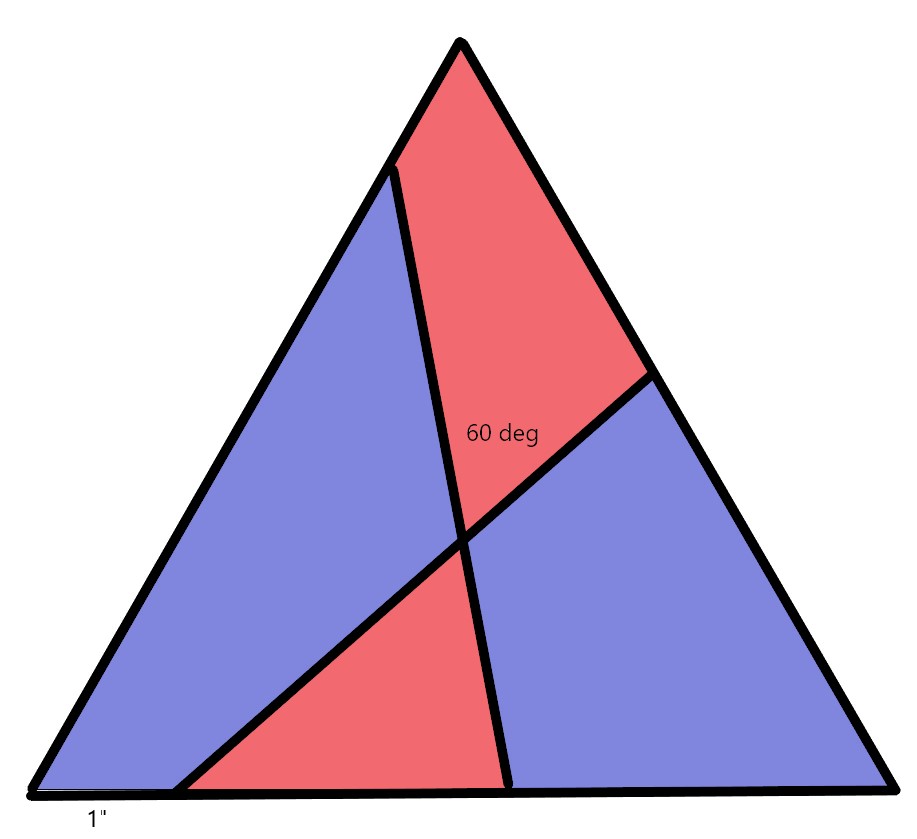
The equilateral triangle below is 6" on each side. A line is drawn from a point 1" away from one of the vertices through the center of the triangle. A second line is drawn through the center, at an angle of 60 degrees from the first line. The drawing below depicts that triangle, with no trickery. What is the ratio of the blue area to the red area?


Re: Friday Puzzler -- Divided Triangle

#2

Re: Friday Puzzler -- Divided Triangle

Larry Barrett

2:1. And I think I can prove it, but have not done so yet.

Re: Friday Puzzler -- Divided Triangle

#3

Correct!

Alex Y

A guess? I didn't ask for a proof, but go for it! :-)

Re: Friday Puzzler -- Divided Triangle

#4

Re: Correct!

Larry Barrett

Not quite a proof, but some thoughts.

The internal angles of an equilateral triangle are 60 degrees. So when the instructions say that the second line forms an angle of 60 degrees with the first line it made me think that perhaps the first line did not need to be 1" from the end,maybe could be anyplace, as long as the second line was at the 60 degree angle.

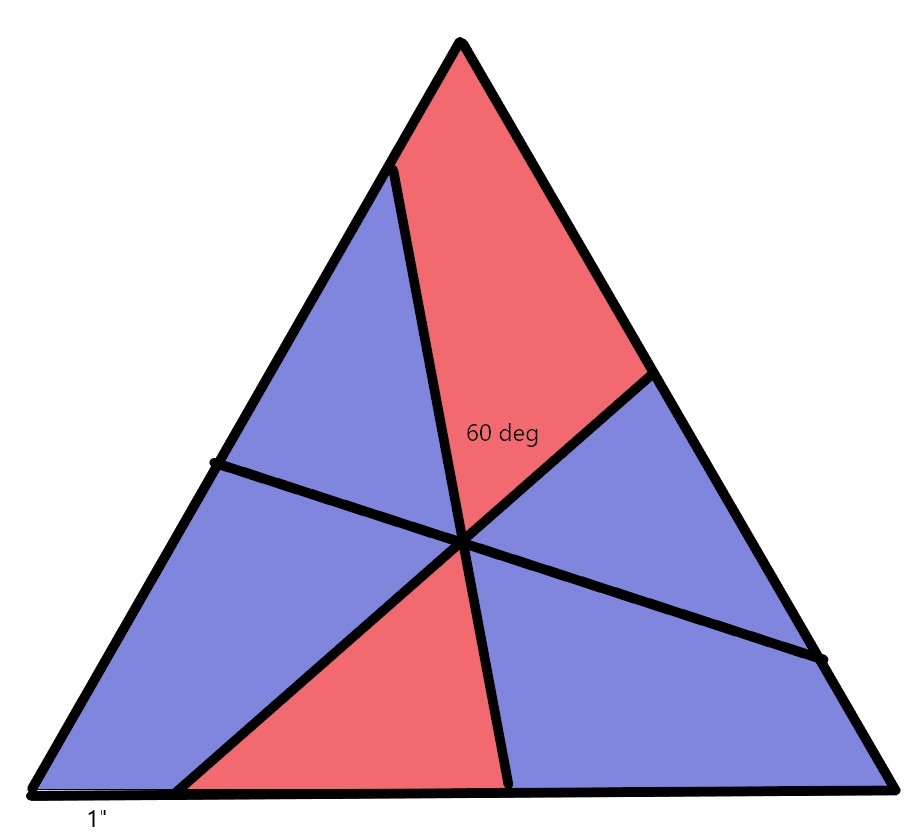
So now construct the same equilateral triangle (label the angles X, Y, Z) and draw the first line from X through the center to the opposite side. This line bisects angle X and forms an altitude for the triangle. The second line now is drawn from Y through the center and forms an angle 60 degrees to line 1 where they intersect at the center (and this line bisects Y) . Now draw a third line from Z through the center. These three lines divide the triangle into 6 identical internal triangles and it is easy to see that two of these internal triangles now correspond to area B in the original problem, and the remaining 4 internal triangles correspond to area A and the ratio of A to B is 2:1.

Now overlay this with the original lines and you can see that overlapping areas look like they are congruent. Not a real proof, but a visual start.

I suspect that in the original problem, line 1 can start at any point and as long as line 2 forms the 60 degree angle with line 1 at the center, the ratio of areas will be 2:1.
Re: Friday Puzzler -- Divided Triangle

#5

Re: Correct!

Alex Y

I suspect that in the original problem, line 1 can start at any point and as long as line 2 forms the 60 degree angle with line 1 at the center, the ratio of areas will be 2:1.


Correct, and your proof works for the case of lines starting at vertices. You can apply similar logic to the example given.

Besides the 1" being irrelevant, it is helpful to look at the angle between lines as 120 degrees rather than 60 degrees. The second line is a 120 degree rotation of the first line about the center. Do that another time to put in a third line, and you will have 3 identical triangles, two blue and one red; and 3 identical quadrilaterals, two blue and one red. qed


👍 This page answered my questions

Your vote helps other woodworkers quickly find the answers and techniques that actually work in the shop.