Friday Puzzler -- Paper Cuts
Alex Y
Not the painful kind :-)
Make two cuts in the shape below resulting in three pieces that can be reassembled into a square (with no gaps or overlaps).
Credit Alex Bellos at The Guardian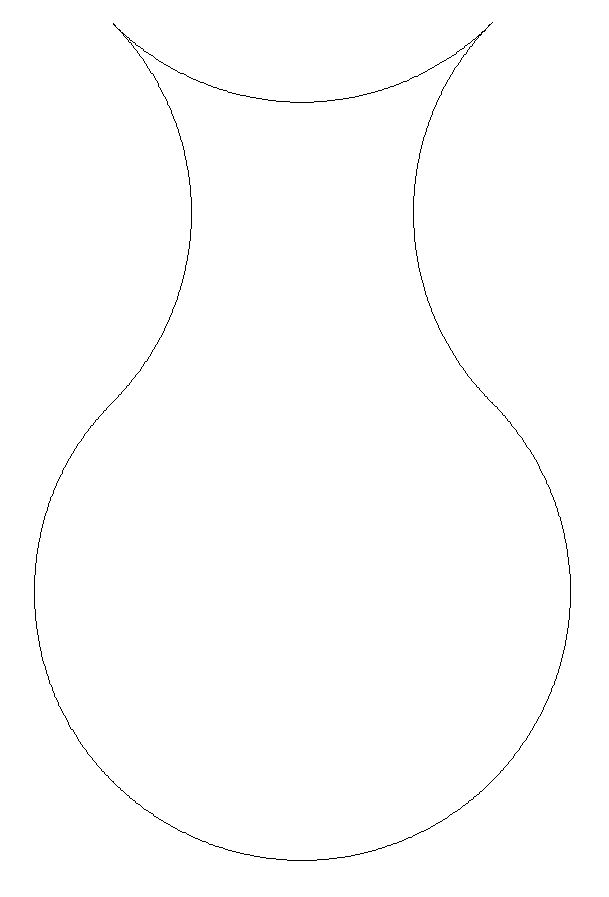
Knowledge You Can Build On — Est. 1998
Friday Puzzler -- Paper Cuts
Alex Y
Not the painful kind :-)
Make two cuts in the shape below resulting in three pieces that can be reassembled into a square (with no gaps or overlaps).
Credit Alex Bellos at The Guardian
Re: Friday Puzzler -- Paper Cuts
Henry Higginbotham
Tangent to tangent, x2?
Re: Friday Puzzler -- Paper Cuts
johnv
vertical bisect, then horizontal cord near bottom
Re: Like so:
Henry Higginbotham
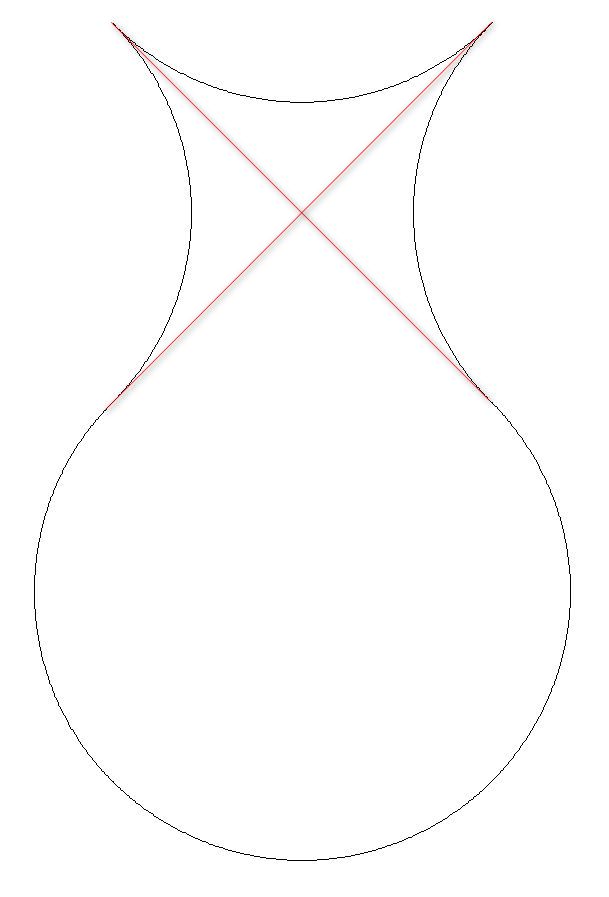
Re: Friday Puzzler -- Paper Cuts
Alex Y
Not sure I quite picture that, John, but it sounds like you will have the same issue as Henry -- four pieces after your cuts.
Very good, BUT...
Alex Y
The challenge was to make two cuts resulting in three pieces. Your first cut results in two pieces, then you cut each of those pieces -- three cuts resulting in four pieces.
Re: Friday Puzzler -- Paper Cuts
Sam Force Make a horizontal cut across the top width of the "ball" that matches the width of the "ears" then make a vertical cut at the exact center of the top section. That should give you 3 pieces, the top 2 pieces when rotated down should produce a square
Hopefully this makes sense, I have limited experience with drawing
Re: Very good, BUT...
johnv
I should have read more closely. i missed the three piece requirement.
Re: Friday Puzzler -- Paper Cuts
Alex Y
Sam, I drew the cuts as I understood your direction, and the result was a "nearly rectangle" with a long top side, two shorter vertical sides, and a wavy line at the bottom.
But maybe I misunderstood what you described.
Re: Friday Puzzler -- Paper Cuts
Sam Force
It made sense in my jumbled mind 
 , in my post when I open it is a tiny pdf symbol, if you click on it, it opens for me. It's a VERY ROUGH drawing
Re: Friday Puzzler -- Paper Cuts
Alex Y
That's what I thought you were doing, but note that the top of the original drawing is a curve, not the straight line you show. And when you rotate down those pieces, they won't reach the bottom of the circle.
Time for a hint?
Alex Y
One of Sam's cuts is correct.
And confirming what you probably assumed from the drawing: all curves in the drawing are the same radius.
Re: Time for a hint?
Henry Higginbotham
From my first attempt I was pretty sure the sides had to have a dimension of 2R, and thus one cut had to be across the lower arc and through its center. Another then had to be the same length.
I couldn't see how to make anything work with one of Sam's cuts. Then it hit me: maybe Alex meant one of my cuts. From there the next one seemed obvious, but I had to actually make a cut-out to see if it worked. Not a perfect scissors job, but it looks workable.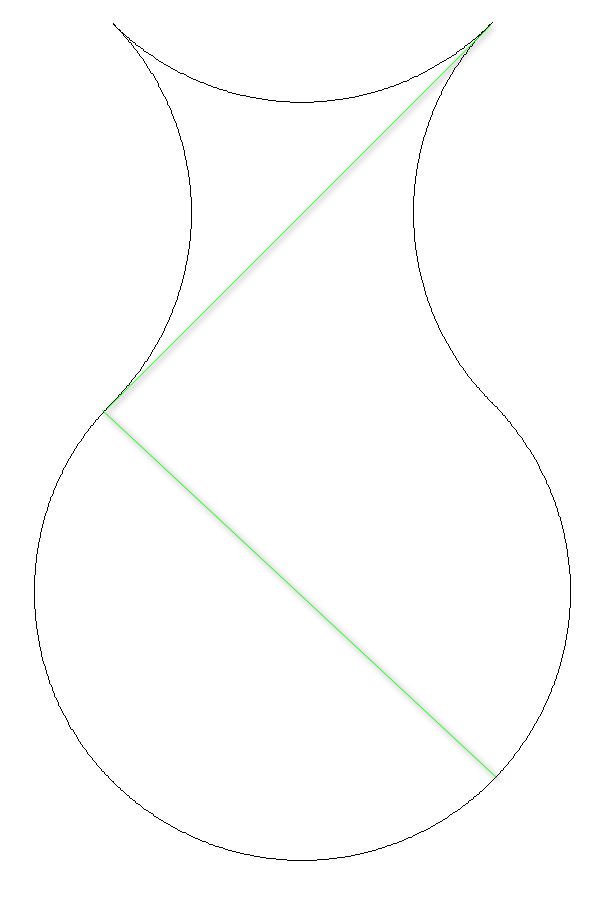
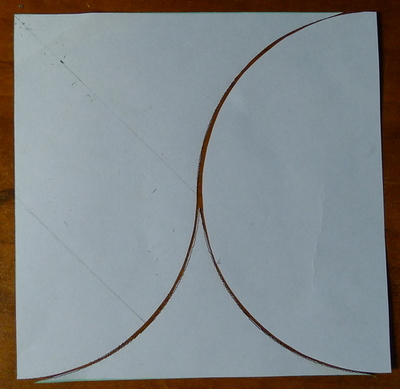
Correct!!
Alex Y
And my apologies to all for the faulty hint. I was not looking at the solution, and forgot what line cut to make the semi-circle.
Re: Time for a hint?
Larry Barrett
Nice going Henry. I tried starting with a square to see if I could create any part of the original shape. Obviously it could be done, but I failed.
Re: Time for a hint?
Alex Y
I didn't get it either. In retrospect, I wonder if the observation that the bottom of the "vase" is 3/4 of a circle, and the top is composed of three concave quarter circles. would have helped. They obviously have to match with each other in the interior of the square. But I never saw that before giving up, so don't know if that might have led me to the answer.
Re: How I got there
Henry Higginbotham
Sort of by chance, actually. I had hit the Reply button to Alex's hint with the intention of sharing my observations* and admitting defeat.
To help myself explain things better, I opened the image I'd posted earlier on the other monitor, and noticed for the first time that another 2R line could be drawn at right angle from the lower end of one of my earlier nonconforming cuts. Two lines of the correct length joined at the ends and at right angle would be a good start to a square.
Even so, the tilted view somehow made it hard for me to visualize completing a square, so I printed it out and assembled it as in the picture. So I was thaaaaat close to giving up. 
--------------
*As I pointed out earlier, my first erroneous attempt did show that the sides of the square were equal to 2R, or the diameter of a completed circle, so there had to be two cuts 2R long. And to yield a square, the cuts had to be 90° to each other.
Re: How I got there
Alex Y
Nicely reasoned. I always like to hear HOW people get an insight to solve a problem!


