WoodCentral Forums

Est. 1998 — 27 years of woodworking knowledge

Friday Puzzler -- Four Dots

Posts

Friday Puzzler -- Four Dots

#1

Friday Puzzler -- Four Dots

AlexY

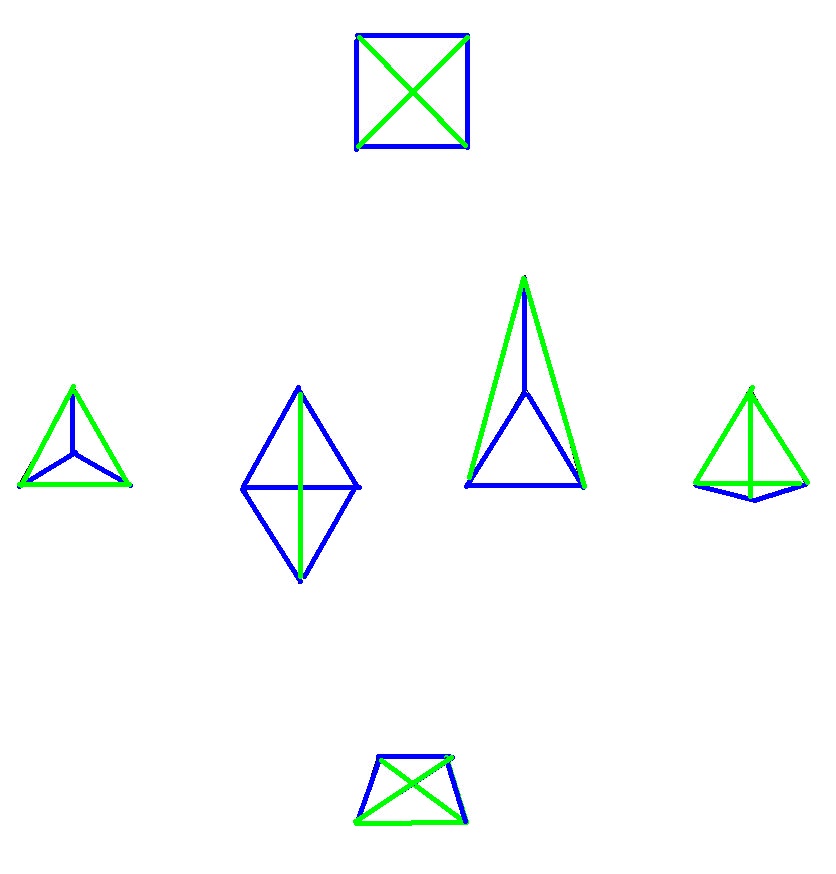
In how many ways can you arrange four dots on a page (four points in a plane) so that there are only two distances between pairs of dots.

For example, if the four dots were the arranged in a square, the distance between any two dots is either the length of the sides of the square or the length of the diagonals.

If you find it too easy (I certainly didn't!), prove that you have found all such patterns.

Re: Friday Puzzler -- Four Dots

#2

Re: Friday Puzzler -- Four Dots

Ed in Leaside

I see equilateral triangle with a dot in its center as fitting the parameter.

Re: Friday Puzzler -- Four Dots

#3

That's one


Re: Friday Puzzler -- Four Dots

#4

Re: Friday Puzzler -- Four Dots

Sam Force

I see a smiley face, but with a nose and no eyes :\

Re: Friday Puzzler -- Four Dots

#5

Re: Friday Puzzler -- Four Dots

Larry Barrett

How about a rhombus, with 4 sides and one diagonal all equal.

Re: Friday Puzzler -- Four Dots

#6

That's another

Alex Y

It was the second (and last) one I was able to come up with.

Can you find more or prove these three (the square, Ed's, and yours) are the only ones?

Re: Friday Puzzler -- Four Dots

#7

Explain?

Alex Y

You may well be onto an answer, Sam, but I can't picture it from this description. Can you elaborate or maybe post a picture of a drawing?

Re: Friday Puzzler -- Four Dots

#8

Re: That's another

Larry Barrett

How about three dots in a row, equally spaced, and a fourth dot directly above the center dot and same distance from the center dot. It will be a different, but same, distance from the other two. Think isosceles triangle.

Re: Friday Puzzler -- Four Dots

#9

Re: That's another

Larry Barrett

Replying to myself, that last idea will not work.

Re: Friday Puzzler -- Four Dots

#10

Re: Friday Puzzler -- Four Dots - Proof?

Larry Barrett

Problem: How many ways can 4 dots be placed on a sheet of paper so that there are at most two different distances between pairs of dots.

Place two dots on a sheet of paper with a distance x between them.

Now place a third dot on the paper. This dot must be the same distance, x, from at least one of the first two dots. If not, the three dots would have three different distances between each pair, violating the premise.

Case 1: the third dot is the same distance x from each of the first two. In this case you have formed an equilateral triangle. The fourth dot could be place at the centroid of the triangle, with a distance y between it and each of the other three dots; or it could be placed outside the triangle the same distance x from two of the three dots but distance z to the fourth dot. This forms a rhombus. If it was outside the triangle but distance x from just one of the first three dots, then there would be three separate distances between pairs.

Case 2:The third dot is a distance x from just one of the first two, but is a distance y from the other dot. The third dot could be on the extended line between dots 1 and 2 (case2a), or it could be at an angle 90 degrees from one dot, say dot 1 (case 2b), or it could be at an angle less than 90 degrees to dot 1(case 2c).

For case 2a, I do not believe there is any way to place the fourth dot that will not violate the premise of no more than two distinct distances between pairs of dots.

For case 2b, the third dot is placed at 90 degrees and at a distance x from dot 1 and at a distance y to dot 2. Then the fourth dot would have to be at 90 degrees to both dot 3 and dot 2, and at a distance x to both dot 3 and dot 2, and at a distance y to dot 1, forming a square.

For case 2c, the third dot is place at a distance x from dot 1 and at an angle less than (or greater than) 90 degrees. It will then have a distance y to dot 2. The fourth dot must then be placed so that it has a distance x to dots 2, 3, and 4, forming a rhombus as in case 1.

So it seems to me that there are only 3 solutions to this problem, the ones identified in other replies.

Re: Friday Puzzler -- Four Dots

#11

Not quite proven

Alex Y

Good systematic approach, but you dismissed some possibilities too quickly.

In case 1, there are two more solutions.

In case 2c, there is one more solution.

Re: Friday Puzzler -- Four Dots

#12

Re: Not quite proven

Larry Barrett

Case 1 - 3 dots forming an equilateral triangle with sides x. Label the corners A, B, C. Draw an altitude from side AB to corner C. Extend this altitude and place the fourth dot on the extended line so that it is a distance x from C. It will then be a different distance (can be calculated, but I am lazy) from both A and B.

Re: Friday Puzzler -- Four Dots

#13

And Another


Re: Friday Puzzler -- Four Dots

#14

Re: Not quite proven

Larry Barrett

And building on the last solution for the equilateral triangle, on the same extended altitude from the AB baseline through C, this time extended above C, place the fourth dot on this baseline a distance x from C. It will have a different, but same, distance to both A and B.

Re: Friday Puzzler -- Four Dots

#15

That's the last equilateral triangle one

Alex Y

Assuming from "this time above C", you meant that the prior one was below AB

Re: Friday Puzzler -- Four Dots

#16

Re: Not quite proven

Larry Barrett

For case 2C, the starting point is with dots A and B with distance x between them. Then dot C is placed at an angle, less than or greater than 90 degrees, to B the same distance x to B, but at a distance y to A.

One alternative for the fourth dot D is to place it to form a rhombus, with the distance from D to C, B, and A equal to x.

The only other alternative that I can think of is to place D so that it is a distance y to C and A, forming an equilateral triangle with B located at the center, with distance x to A, C, and D.

Re: Friday Puzzler -- Four Dots

#17

Four Dots -- Solutions *LINK*

Alex Y

Here are the six possibilities, with the long distances in each solution in green and the short in blue.

If you are interested in the proof that these are the only solutions, check out


this blog post

👍 This page answered my questions

Your vote helps other woodworkers quickly find the answers and techniques that actually work in the shop.