Friday Puzzler -- Long Division
Alex Y
A [pretty hard] puzzle from a grade school kid.
The image below shows a long division problem with only two of the digits filled in. Fill in all the boxes. 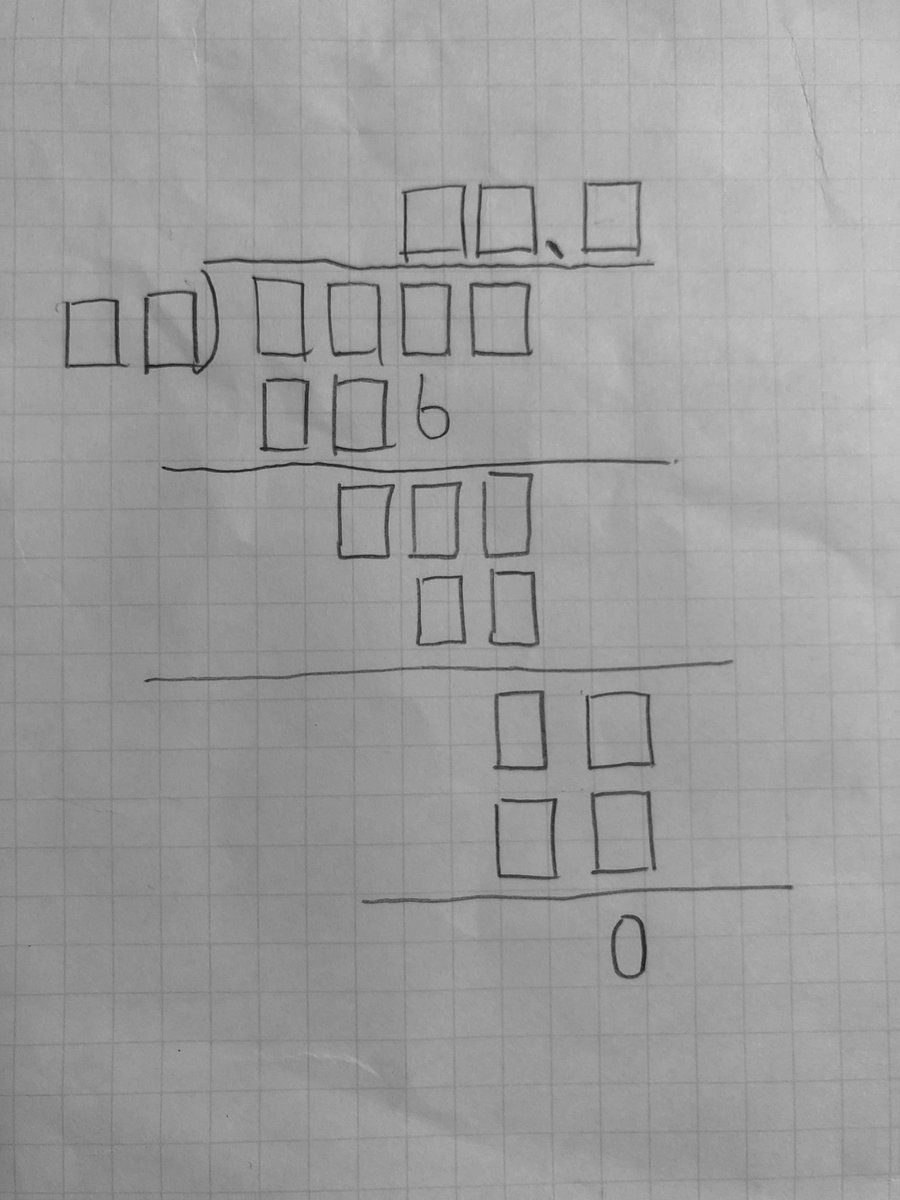
To make it easier to report your answer, use this: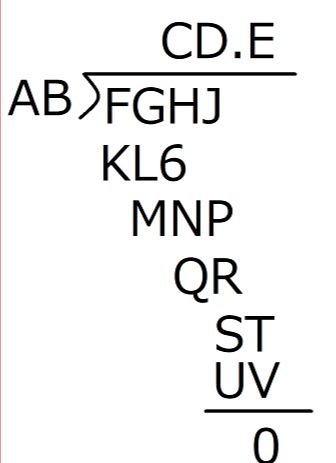
Knowledge You Can Build On — Est. 1998
Friday Puzzler -- Long Division
Alex Y
A [pretty hard] puzzle from a grade school kid.
The image below shows a long division problem with only two of the digits filled in. Fill in all the boxes.
To make it easier to report your answer, use this:
Re: Friday Puzzler -- Long Division
Larry Barrett
M must be 1 and N must be 0 and Q must be 9, since MNP - QR = S. So MNP must be 10x and QR must be 9x, something like 103 and 97. Also, T must be 0 and since ST-UV = 0, E*AB must = UV.
Re: Friday Puzzler -- Long Division
Alex Y
On the right track, Larry!
Re: Friday Puzzler -- Long Division
Larry Barrett
Continuing, observe since T=0, ST is of the form S0 and since ST-UV=0, V must also =0 and UV is also of the form U0. Also, by observation, P must equal J.
Now, since C*AB = KL6, we can see that C*B must = 6 or a product that ends in 6.
The possibilities for the ordered pair (B,C) are (1,6), (2,3), (2,8), (3,2), (4,4), (4,9), (6,1), (6,6), (7,8), (8,2), (8,7), (9,4). Note that neither B nor C can be 5 or 0.
Since C*AB = KL6, a three digit number, C can not be 1, which eliminates the pair (6,1). A start on winnowing down the pairs, but not much of a start.
But also observe that E*AB = UV = U0. So U0 is a multiple of 10, which means that the factors of E*AB must be (x,2,5). If E=x, then AB must be 2*5= 10. But B can not be 0, so E must be 2 or 5. If E=2, then AB =x*5, which will be a number that ends in 5. But from above, B can not be 5. So E must be 5 and AB is of the form x*2, which will be an even number. And, since 5*AB = U0 (a two digit number), A must be 1 since 5*(anything greater than 1) will result in a three digit number.
So from the list of (B,C) above we can eliminate pairs where B is an odd number, leaving (2,3), (2,8), (4,4), (4,9), (6,6), (8,2), and (8,7).
So at this point, the possibilities for the ordered pair (AB,C) are (12,3), (12,8), (14,4), (14,9), (16,6), (18,2), and (18,7).
Since we also know that C*AB is a three digit number (KL6), the possibilities for AB and C come down to 14 and 9 or 18 and 7. If AB and C are 14 and 9, then KL6 would be 14*9=126. If AB and C are 18 and 7, then KL6 would be 18*7=126.
Since we know that M is 1 and N is 0 we can conclude that FGH must be 136 (126 +10) = 136.
Now we have to look at D*AB, where AB is either 14 or 18, and we also know that D*AB = QR and that MNP - QR is a single digit, S. And from above, we know that MNP is of the form 10P and Q must be 9 and QR must be of the form 9R where R is greater than P so that 10P - 9R = S (a single digit).
If AB is 18, then if D is 4, D*18 = 72, if D is 5, D*18 = 90, and if D is 6, D*18 = 108. Since So D can only be 5 in order for Q to be 9, but if R is 0, no matter what P is, 10P - 90 will be greater than a single digit.
So it looks like AB must be 14 (and C must be 9). Now we want to find D such that D*14 is 9R. If D is 6, D*14 = 84. If D is 7, D*14 is 98. This looks good. Now we need to find P such that 10P - 98 = S. And recalling that E*14 must be a multiple of 10. We know that E = 5, and 5*14 = 70. So S must be 7, which means that P is 5 since 105 - 98 = 7.
I think this solves the problem. AB is 14, CD is 97, E is 5, FGHJ is 1365, KL6 is 126, MNP is 105, QR is 98, ST is 70, UV is 70.
Correct!
Alex Y
I like your initial recognition of the fact that MNP and QR had to be 10x and 9y. I didn't recognize that until near the end.
Continuing, observe since T=0, ST is of the form S0 and since ST-UV=0, V must also =0 and UV is also of the form U0.
The only possibilities for V=0 are:
E=0 (NO, since there would be no reason to look for an answer beyond CD)
B=0 (NO, since C*AB ends in 6)
E is even and B is 5 (NO, since C*AB ends in 6)
B is even and E = 5 YES
The only possibilities for 5*AB to be a two digit number are for AB to be 12, 14, 16, or 18.
Going to our next known, KL6, we see that the only possibilities for a single digit * 12, 14, 16, or 18 to be a three digit number ending in 6 are 9*14 or 7*18, both of which equal 126, so we have KL = 12.
Only at this point did I see your observation about MNP and QR, and I didn't fully see it yet, just that I realized that QR had to be >90 for the remainder after this step to be a single digit.
The largest 2-digit multiples of 14 and 18 are 7*14 = 98 and 5*18=90. That gives us AB = 14, D = 7, and going back to the previous step we know that C=9. QED


