WoodCentral Forums

Est. 1998 — 27 years of woodworking knowledge

Friday Puzzler (cont'd) -- Chess Board 2 of 3

Posts

Friday Puzzler (cont'd) -- Chess Board 2 of 3

#1

Friday Puzzler (cont'd) -- Chess Board 2 of 3

Alex Y

Larry correctly pointed out that all the squares on a diagonal in a chess board are the same color, so removing two diagonally opposite corners would leave two fewer squares of one color than the other -- impossible to tile with dominoes that cover one of each color.

The next puzzle is what happens if you eliminate one square of each color. Some examples are trivial, e.g. if you remove a1 and b1. But are there examples of one white and one black square, that if removed will result in a board that cannot be tiled with 31 dominoes?

If so, provide an example.

If not, prove that it can be tiled no matter which black square and while square are eliminated.
Re: Friday Puzzler (cont'd) -- Chess Board 2 of 3

#2

Re:  Chess Board 2 of 3 partial solution

Alex Y

There is no "aha!" solution to this one. In fact, it is always possible to tile the chessboard with one black and one white square missing.

The proof involves finding a strategy for tiling the board that is easily adjustable when one white and one black square are removed. There are probably lots of such strategies. I'll leave this until the end of the week and then show the strategy I have seen (not found myself) for this.

Re: Friday Puzzler (cont'd) -- Chess Board 2 of 3

#3

Re:  Chess Board 2 of 3 Solution

Alex Y

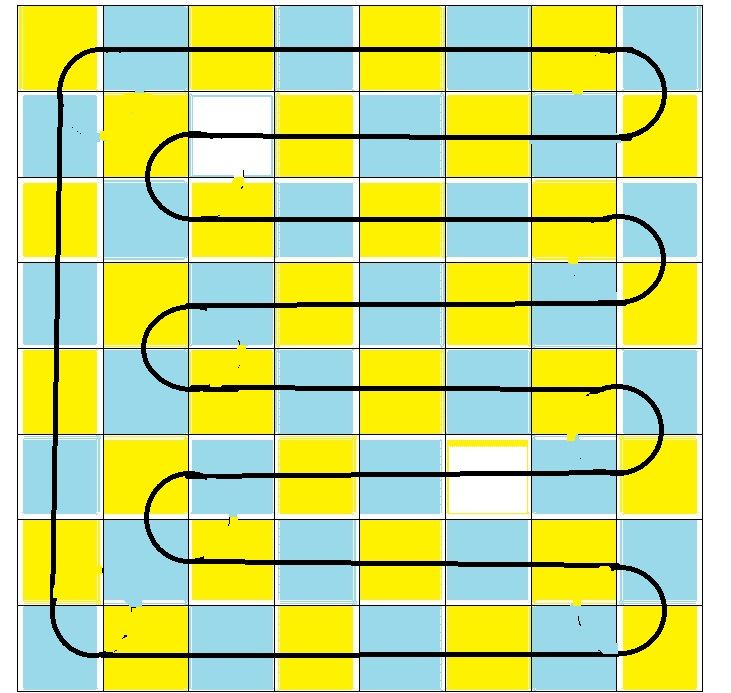
Here is just one of probably very many possible strategies for tiling a chessboard that can be easily modified if a white and black (or blue and yellow in this rendering) square is eliminated.

Note that the path shown below is a complete circuit, ending up wherever you start. And it doesn't matter whether you start blue-yellow or yellow-blue, or which direction.

I've picked one blue and one yellow square to eliminate, but which ones clearly doesn't matter. If you start to the right of the missing blue square, you will put down dominoes on yellow-blue pairs along this path ending with the yellow-blue that is next to the missing yellow square. Going the other direction from the missing blue square, you tile the rest of the board, ending up next to the missing yellow square.


👍 This page answered my questions

Your vote helps other woodworkers quickly find the answers and techniques that actually work in the shop.