WoodCentral Forums

Est. 1998 β€” 27 years of woodworking knowledge

Friday Puzzler -- three angles

Posts

Friday Puzzler -- three angles

#1

Friday Puzzler -- three angles

Alex Y

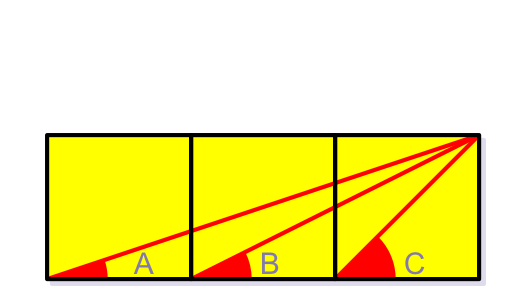
This one is mathematical in nature, but requires nearly no knowledge of math. Prove that

Angle A + Angle B = Angle C

in the drawing of three squares below, using very basic geometry -- no trig needed or allowed.


Re: Friday Puzzler -- three angles

#2

Re: Friday Puzzler -- three angles

Larry Barrett

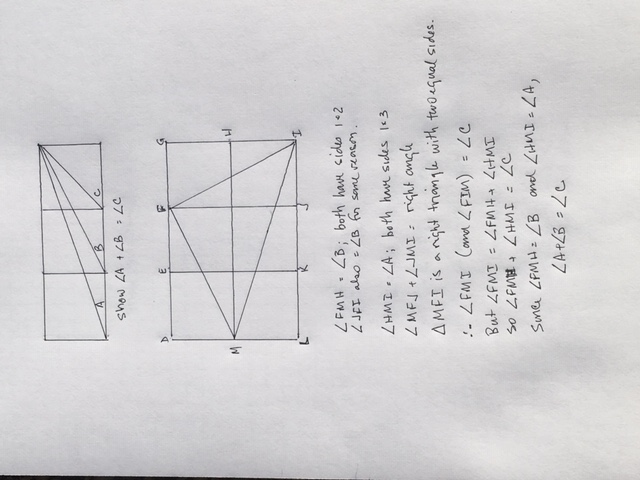
Wish I could remember how to rotate a photo.


Re: Friday Puzzler -- three angles

#3

Re: Friday Puzzler -- three angles

Alex Y

I follow and agree with the first three lines. But I don't see why angleMFJ + angleJMI is a right angle, and can't follow the argguent that follows.

While I don't follow it all, it looks like it has the right elements, so figure out is right. Just need a little help…

Re: Friday Puzzler -- three angles

#4

Re: Friday Puzzler -- three angles

Larry Barrett

Label the interior intersection on line FJ as N.

Triangles NMF, MDF, JFI, and FGI are all congruent.

Angles DFM, FMN, FIG, and JFI are all equal.

Angle DFN is a right angle since the grid consists of perpendicular lines.

Angle DFN = angle DFM + angle MFN. Since angle DFM = angle JFI,

angle MFI is also a right angle.

Triangle MFI is a right triangle and sides MF and FI are equal and angles FMI and FIM are also equal.

Triangle MFI is similar to the triangle in the original drawing that included angle C,

so angle FMI equals angle C.

Angle FMI equals angle FMN + angle HMI.

Since angle FMN equals angle B and angle HMI = angle A,

angle A + angle B = angle C.
Re: Friday Puzzler -- three angles

#5

Excellent!

Alex Y

Sorry it has taken so long to reply. On vacation and this is the first time I have had a confluence of time, pencil, and paper required for me to follow your proof.

Re: Friday Puzzler -- three angles

#6

Another proof/demonstration

Alex Y

Draw two more squares as in the drawing below.

Note that angle A plus the new angle D equals angle C, since they both equal the angle (45*) between a side and a diagonal of one of the original squares.

A+D=C

D is equal to B, since they both are angles between the long side and diagonal of a 1x2 rectangle.

Substitute B for D in the previous equation,

A+B=C

qed

πŸ‘ This page answered my questions

Your vote helps other woodworkers quickly find the answers and techniques that actually work in the shop.